
A safety system can look complete on paper and still fall short during a busy shift. A QHSE consultant GCC teams can work with helps close that gap by connecting applicable requirements to controls people can understand and use. Across the UAE and wider GCC, requirements vary by jurisdiction and sector, and operational teams need arrangements that work alongside day-to-day demands.
Clear procedures and reliable compliance matter, but practical safety depends on more than documentation. Controls need to match the work, reflect real risks, and make sense to the people carrying it out. This article explains how QHSE consulting can turn relevant requirements into workable improvements, what to look for in an advisory engagement, and how to choose a proportionate next step for your organisation.
Shebin Abraham, IDIP NEBOSH, CertIOSH, MIIRSM, is an ADOSH-SF Senior OHS Practitioner with 21 years of OHS experience serving clients across the UAE and GCC. His work includes freelance HSE and OHS consulting, ADOSH-SF and Trakhees guidance, safety training, professional mentorship, and ADNOC HSE prequalification support. The focus is practical: strengthen workplace arrangements while keeping people at the centre of decisions.
Key Takeaways
- A QHSE consultant connects relevant requirements with practical controls, while operational teams retain day-to-day ownership.
- A focused engagement can cover assessment, documentation, implementation, training, and follow-up, shaped around your operations and resources.
- For a QHSE consultant GCC engagement to strengthen safety, procedures need to reflect actual tasks and risks, not sit apart from daily work.
- A proportionate action plan begins with understanding operations, workforce exposure, current arrangements, and applicable requirements.
- Shebin Abraham, IDIP NEBOSH, CertIOSH, MIIRSM, is an ADOSH-SF Senior OHS Practitioner with 21 years of OHS experience across the UAE and GCC.
What Does a QHSE Consultant in the GCC Actually Do?
QHSE consulting offers practical guidance to help an organisation manage relevant quality, health, safety, and environmental responsibilities. The term builds on Environment, Health, and Safety (EHS), with quality included as an additional management focus. A QHSE consultant GCC organisations work with can help interpret applicable requirements and translate them into processes that fit the work being done.
The consultant’s role is advisory. It does not transfer management accountability. Leaders remain responsible for decisions and oversight, while supervisors and workers retain their operational roles. A consultant can assess current arrangements, recommend improvements, and support implementation. The organisation must put controls into practice and maintain them.
Requirements are not identical across the GCC. What applies depends on factors such as jurisdiction, sector, activity, and the relevant authority. Advice should therefore reflect the organisation’s operations and applicable requirements, rather than rely on a generic template.
How QHSE consulting connects requirements with daily work
Useful advice links policies, risk controls, worker communication, and supervision. For example, when a maintenance task involves several steps and handovers, an adviser can review how hazards are assessed, whether instructions reflect the actual sequence, and how supervisors communicate changes. Recommendations should account for operational constraints and worker needs. That makes controls easier to apply in practice. The adviser supports the team, but does not take over its responsibilities.
When organizations may benefit from specialist QHSE support
Specialist input can help when an organisation is developing its management system, reviewing compliance arrangements, changing work methods, or addressing gaps in internal capability. It can also provide focused expertise alongside existing HSE personnel when their time is limited or a particular issue needs closer attention.
A QHSE consultant helps turn applicable requirements into practical workplace controls that teams can understand, apply, and review. That means looking beyond whether a procedure exists. Consider whether it reflects the task, reaches the people doing the work, and is supported by supervision.
Shebin Abraham, IDIP NEBOSH, CertIOSH, MIIRSM, is an ADOSH-SF Senior OHS Practitioner with 21 years of OHS experience serving clients across the UAE and GCC. His advisory work helps teams connect relevant requirements with practical implementation.
What Can a GCC QHSE Consultant Support During an Engagement?
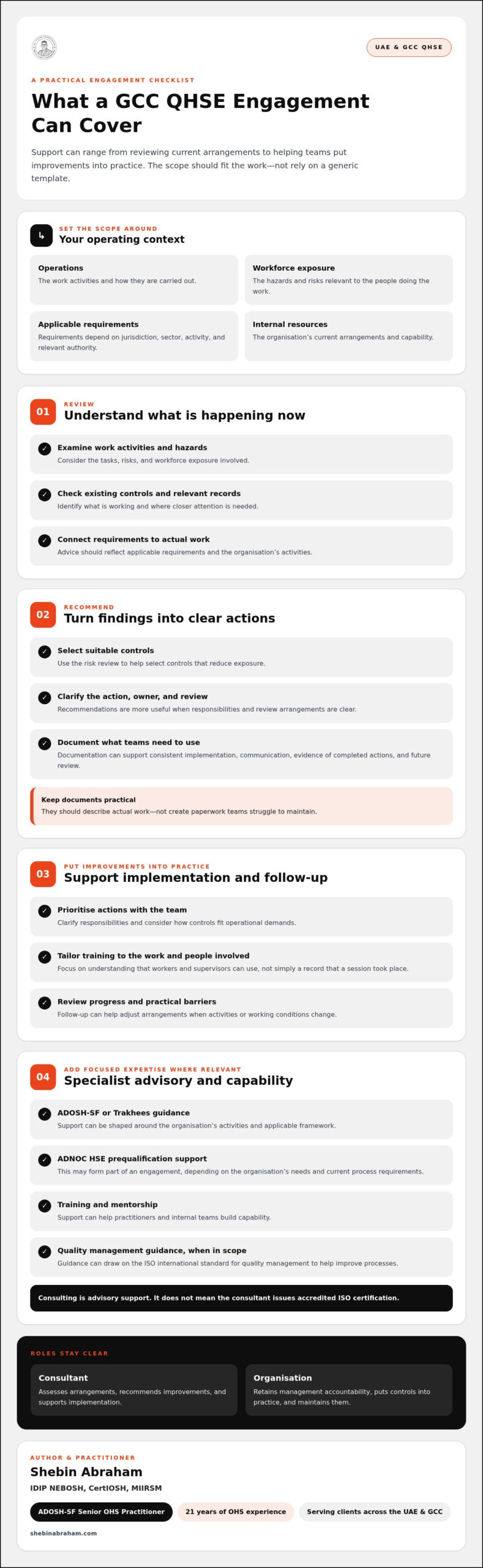
The scope should fit the organisation’s operations, workforce exposure, applicable requirements, and internal resources. A QHSE consultant GCC engagement may address a defined issue or provide broader support, from reviewing current arrangements to helping teams put improvements into practice.
From risk review to practical QHSE controls
An assessment can examine work activities, hazards, existing controls, and relevant records to identify what is working and where attention is needed. Risk assessment is a decision-making process for identifying hazards, evaluating risks, and selecting suitable controls to reduce exposure.
Recommendations are most useful when they specify the action, who will own it, and how it will be reviewed. Documentation can support consistent implementation, clear communication, evidence of completed actions, and future review. It should describe actual work, not create paperwork that teams struggle to maintain. Where quality management is in scope, guidance can also draw on the ISO international standard for quality management to help improve processes.
Implementation, training, and follow-up
Advice needs to move beyond findings. An adviser can work with the team to prioritise actions, clarify responsibilities, and consider how controls fit operational demands. Follow-up provides an opportunity to review progress, address practical barriers, and adjust arrangements when activities or working conditions change.
Training can be tailored to the work and the people involved. Mentorship can also support practitioners and internal teams as they build capability. The goal is understanding that workers and supervisors can use, not simply a record that a session took place.
Specialist advisory and a proportionate scope
Where relevant, support may include advisory work related to ADOSH-SF or Trakhees requirements, shaped around the organisation’s activities and applicable framework. ADNOC HSE prequalification support can also form part of an engagement. The scope should reflect the organisation’s needs and current process requirements, rather than assume that every organisation follows identical steps.
Consulting can help an organisation strengthen its management arrangements, but it does not mean the consultant issues accredited ISO certification. The consultant advises and supports; implementation and ongoing ownership remain with the organisation.
Shebin Abraham, IDIP NEBOSH, CertIOSH, MIIRSM, is an ADOSH-SF Senior OHS Practitioner with 21 years of OHS experience serving clients across the UAE and GCC. Explore QHSE consulting support for freelance HSE and OHS advisory.
Will a QHSE Consultant Create Paperwork or Improve Workplace Safety?
Documentation alone does not control workplace risk. A procedure supports safer work only if it reflects the task, reaches the people doing it, and can be followed in real operating conditions. Judge the value of a QHSE consultant GCC organisations engage by how well the advice connects documented requirements with implementation, not by the number of forms or procedures produced.
Consider two approaches to a routine materials-handling task. A disconnected document sits in a folder and may not reflect how the work is organised. A useful procedure identifies the activity, relevant controls, and responsible roles. Supervisors explain it in terms workers can use, and workers have a practical way to raise concerns when a control is unclear or difficult to follow.
What makes a QHSE procedure useful to the people doing the work?
A useful procedure gives clear guidance for a defined activity without becoming difficult to follow. It connects the task to practical controls and clear responsibilities. Supervisors and workers can help test whether instructions make sense in the workplace, how controls are communicated, and whether barriers exist, such as unclear steps or a mismatch with the work sequence.
Review procedures when work methods, risks, or applicable requirements change. This helps keep guidance relevant and prevents an old version from becoming detached from current practice. Good records support the review by showing what was agreed and when arrangements were reconsidered.
How to recognize practical advisory value
Check whether agreed actions have an owner, whether completion is followed up, and whether controls are reviewed. Ask whether workers can explain the requirements relevant to their tasks and show how they apply them. The volume of documentation alone says little about whether controls are understood or used.
- Action: Is there a clear next step?
- Ownership: Is responsibility assigned?
- Follow-up: Is completion reviewed?
- Use: Can workers understand and apply the control?
A documented requirement describes what should happen; an implemented risk control is understood and used during the work. This distinction supports a meaningful safety culture, consistent with the United Nations’ emphasis on promoting and creating a safety and health culture. It does not promise a particular outcome, but it gives teams a practical basis for reviewing how arrangements work.
Shebin Abraham, IDIP NEBOSH, CertIOSH, MIIRSM, is an ADOSH-SF Senior OHS Practitioner with 21 years of OHS experience. His advisory approach focuses on workable controls, clear communication, and the people affected by everyday decisions.
How to Turn QHSE Advice into a Practical GCC Action Plan
Good advice needs a clear route into daily operations. A practical plan starts by defining the need, understanding the work and people affected, identifying applicable requirements, and agreeing how actions will be implemented and reviewed. For organisations working across the GCC, consider requirements within each relevant jurisdiction and sector instead of treating the region as one regulatory framework.
Define the scope around operations and applicable requirements
Start with the activities being carried out, the workforce groups involved, contractor interfaces, and the QHSE arrangements already in place. This gives the review a grounded scope and helps distinguish existing strengths from genuine gaps. Identify relevant national and sector requirements using current authoritative sources, taking account of the organisation’s activities and the authorities that apply to them.
Next, agree on priorities. Consider the level of risk, relevance to the work, feasibility of putting a control in place, and who in the organisation can own it. A useful plan is not a list of every possible improvement. It gives teams a manageable sequence and explains why each action matters. The broader OHS Services in the UAE pillar can also provide foundational context for organisations building their understanding of OHS support.
Assign actions, build capability, and review progress
Turn findings into actions with an owner, priority, and review point. For example, if a procedure does not reflect a work activity, revise it with input from the people doing the task, brief relevant teams, and review how the updated control is being used. Keep each action proportionate to the issue and available resources.
When a capability gap affects implementation, targeted safety training or mentorship can help supervisors, workers, or internal practitioners apply the agreed arrangements. A QHSE consultant GCC organisations engage can support this process while the organisation retains ownership of decisions and ongoing implementation.
Review progress with the people responsible for the work. Check whether actions were completed, whether controls are understood and usable, and whether changing conditions call for adjustments. Follow-up is a learning cycle, not a promise of a particular compliance or safety outcome. It helps teams identify what is working, address barriers, and keep attention on protecting people.
Shebin Abraham, IDIP NEBOSH, CertIOSH, MIIRSM, is an ADOSH-SF Senior OHS Practitioner with 21 years of OHS experience serving clients across the UAE and GCC. Discuss practical QHSE advisory for your organisation.
Work with an Experienced QHSE Consultant Across the GCC
Effective QHSE support depends on understanding relevant requirements and the realities of the work. Shebin Abraham, IDIP NEBOSH, CertIOSH, MIIRSM, is an ADOSH-SF Senior OHS Practitioner with 21 years of occupational health and safety experience. He works with clients across the UAE and GCC, providing collaborative advisory shaped around each organisation’s operations and priorities.
Experienced advisory grounded in practical operations
As an independent adviser, Shebin works alongside client teams to understand current arrangements, discuss operational concerns, and support practical improvements. His experience includes ADOSH-SF and Trakhees OHS advisory, focused on requirements relevant to the organisation and its activities. These frameworks apply in their relevant contexts, not universally across every GCC jurisdiction.
Support also includes safety training and mentorship for workplace teams and practitioners. This connects written arrangements with how people communicate, supervise, and carry out work. The aim is considered advice that internal teams can apply and maintain, while management and operational responsibilities remain with the organisation.
For organisations seeking a QHSE consultant GCC businesses can work with directly, this collaborative approach brings specialist perspective alongside existing capabilities. Advice can focus on the issue at hand, whether that means reviewing an arrangement, strengthening team understanding, or aligning work with applicable requirements.
Start with a focused conversation about your priorities
A useful first discussion begins with a clear picture of your operations: what work is being carried out, where your teams see the main challenges, and what you want to improve. Describe the QHSE arrangements already in place and any relevant requirements your organisation needs to address.
The advisory scope can then reflect your operational context, internal resources, and priorities. A focused conversation helps establish whether you need specific guidance, training or mentorship, or broader OHS support. It keeps the next step proportionate instead of assuming that every organisation needs the same approach.
If you are considering QHSE support, share the priorities your team is working through. Shebin can discuss how practical advisory may help your organisation strengthen its approach to QHSE across the UAE and GCC.
Make Your Next QHSE Improvement Practical
Strong QHSE performance depends on connecting relevant requirements to controls people can understand and use. A consultant can help assess operational needs, focus documentation on implementation, and shape a proportionate action plan. Leaders and teams remain central to putting that advice into practice and reviewing progress.
Choosing a QHSE consultant GCC organisations can work with means looking for practical, context-aware guidance that supports workplace safety and operational consistency. Shebin Abraham, IDIP NEBOSH, CertIOSH, MIIRSM, is an ADOSH-SF Senior OHS Practitioner with 21 years of occupational health and safety experience. His background includes ADOSH-SF and Trakhees OHS advisory, safety training, and professional mentorship for teams and practitioners.
Start with the priorities that matter to your organisation, whether you are reviewing current arrangements, addressing a capability gap, or seeking clearer alignment with applicable requirements. Discuss your QHSE priorities with Shebin Abraham and explore a practical next step for your operations. Steady, people-centred improvements can help build stronger everyday working practices.
Frequently Asked Questions
What does a QHSE consultant do in the GCC?
A QHSE consultant GCC businesses engage can assess workplace arrangements and translate relevant quality, health, safety, and environmental requirements into practical guidance. Support may include reviewing activities, identifying gaps, developing or improving procedures, advising on controls, and helping teams implement actions. The scope depends on the organisation’s operations, risks, internal resources, and applicable requirements. Management and operational teams retain responsibility for decisions and day-to-day implementation.
Why hire a QHSE consultant instead of relying only on internal staff?
A consultant can add focused expertise and capacity alongside internal staff, especially when teams are stretched, reviewing a system, or addressing a specific capability gap. This support does not replace internal knowledge or accountability. Shebin Abraham, IDIP NEBOSH, CertIOSH, MIIRSM, an ADOSH-SF Senior OHS Practitioner with 21 years of OHS experience, works collaboratively with client teams to support practical improvements, training, and professional mentorship.
Do QHSE requirements apply uniformly across all GCC countries?
No. Applicable requirements can vary by country, sector, activity, and relevant authority. A framework that applies to a particular organisation or activity in the UAE should not automatically be treated as a requirement throughout the GCC. Start by identifying where and how the organisation operates, then establish relevant requirements using current authoritative sources. This helps ensure advice reflects the actual context rather than a one-size-fits-all interpretation.
Can a QHSE consultant help with ADOSH-SF or Trakhees requirements?
Yes. Shebin Abraham provides advisory support related to ADOSH-SF and Trakhees OHS requirements, with the scope tailored to the organisation and relevant framework. This can include guidance on documentation, assessments, and implementation arrangements. These frameworks apply in their relevant contexts, so advice should relate to the organisation’s activities and requirements rather than present them as a single standard for every GCC jurisdiction.
How can a QHSE consultant help without creating unnecessary paperwork?
A consultant can focus documentation on what teams need to guide work, communicate controls, record agreed actions, and review arrangements. For example, a procedure should reflect the task and clarify practical responsibilities, not simply add another form. Teams can assess its value by checking whether workers understand and use the controls, actions have owners, and follow-up identifies barriers or needed updates.
What should an organization prepare before engaging a QHSE consultant?
Begin with a clear description of your operations, the activities and workforce groups involved, and the QHSE concerns you want to address. Gather relevant procedures, assessments, records, and information about current arrangements, if available. Also identify applicable jurisdictions or sector requirements and the internal people who should contribute. This context helps shape a proportionate scope around your priorities and resources.
Can a QHSE consultant support both training and management-system improvements?
Yes. Advisory support can combine management-system review or improvement with targeted safety training and mentorship, depending on the organisation’s needs. Training can help teams understand relevant controls, while system work can connect procedures, responsibilities, and review arrangements. Shebin Abraham provides safety training and professional mentorship alongside OHS consulting. The organisation remains responsible for implementing and maintaining its arrangements.