

What if a carefully calculated LTIFR still gives your team the wrong impression of safety performance? If you’re working out how to calculate lost time injury frequency rate, the formula matters, but so do the injury definitions and hours-worked records behind it. Across UAE and GCC workplaces, consistent reporting boundaries make the result more useful for operational decisions.
It’s understandable to focus first on the multiplier. A common formula uses 1,000,000, while other reporting bases use a different multiplier. But even the right formula can produce a misleading rate if lost-time injuries are classified inconsistently or exposure hours are incomplete. LTIFR is a lagging measure of frequency, not a complete picture of risk or injury severity.
This practical guide explains the formula, shows how to calculate the rate from documented inputs, and outlines how to interpret it alongside other OHS evidence. It also covers how to set clear reporting boundaries and check that hours worked match the same period and workforce scope as the injury records. The article is authored by Shebin Abraham, IDIP NEBOSH, CertIOSH, MIIRSM, ADOSH-SF Senior OHS Practitioner, with 21 years of OHS experience.
Key Takeaways
- Learn how to calculate lost time injury frequency rate using documented injury counts, hours worked, and the multiplier set by your reporting basis.
- Define which cases qualify as lost-time injuries and apply that definition consistently across reporting periods and work groups.
- Compare LTIFR trends only when the population, time period, and reporting methods are aligned.
- Use changes in the rate to guide questions, reviews, and follow-up actions, not as proof of what caused an incident or as a complete safety verdict.
- Written by Shebin Abraham, IDIP NEBOSH, CertIOSH, MIIRSM, ADOSH-SF Senior OHS Practitioner, drawing on 21 years of OHS experience.
What Is Lost Time Injury Frequency Rate, and What Does It Measure?
Lost Time Injury Frequency Rate (LTIFR) relates qualifying lost-time injuries to the hours worked during a defined reporting period. It helps an organisation assess how often these cases occur relative to recorded work exposure, rather than relying on the injury count alone. Before calculating or comparing the rate, define the case criteria and reporting basis.
Organisations use LTIFR to review performance over time, identify changes that merit attention, and support OHS discussions across projects or work groups. It is one measure, not a complete assessment of workplace safety. A low or falling rate cannot, by itself, establish that hazards are controlled or people are protected from harm.
Keep event categories distinct. Count a lost-time injury only when it meets the organisation’s adopted criteria. A near miss, hazard observation, or other incident may still be important for prevention, but it is not automatically a lost-time injury. Good recordkeeping preserves these distinctions instead of treating every safety report as the same type of case.
For a foundational overview of the measure and its calculation, see What is LTIFR? This guide focuses on consistent classification and careful use of the rate in UAE and GCC OHS reporting.
What counts as a lost time injury?
Don’t assume one definition applies to every organisation or reporting arrangement. Set out the criteria your organisation has adopted, including the reporting boundary and how cases are classified, then apply them consistently. Absence from work is central to many definitions, but the precise threshold and treatment of a case depend on the applicable reporting basis.
Classification is not a judgement about blame, and it does not describe the full severity of an injury. Record each case against the agreed criteria, while retaining investigation findings and other incident information for a broader review. Consistent classification is essential to calculating LTIFR from reliable inputs.
What LTIFR can and cannot tell you
LTIFR connects qualifying recorded cases with recorded exposure hours, so it can support like-for-like trend monitoring when definitions and boundaries remain stable. It does not show, on its own, which hazards workers encountered, how severe injuries were, or whether controls were effective. Changes in hours, workforce scope, or reporting practice can also affect the result.
LTIFR is a frequency indicator that relates qualifying lost-time injuries to hours worked, not a complete safety score. Use it as one signal in a wider OHS review, alongside incident details, hazard reports, control checks, and investigation findings. This broader view keeps attention on both recorded outcomes and workplace conditions.
How to Calculate LTIFR: Formula, Inputs, and a Worked Example
To calculate LTIFR, you need a qualifying lost-time injury count, total hours worked for the same reporting period and boundary, and the multiplier required by your adopted reporting basis. Keep these inputs aligned. A correct calculation using mismatched periods or workforce groups can still produce a rate that’s difficult to interpret.
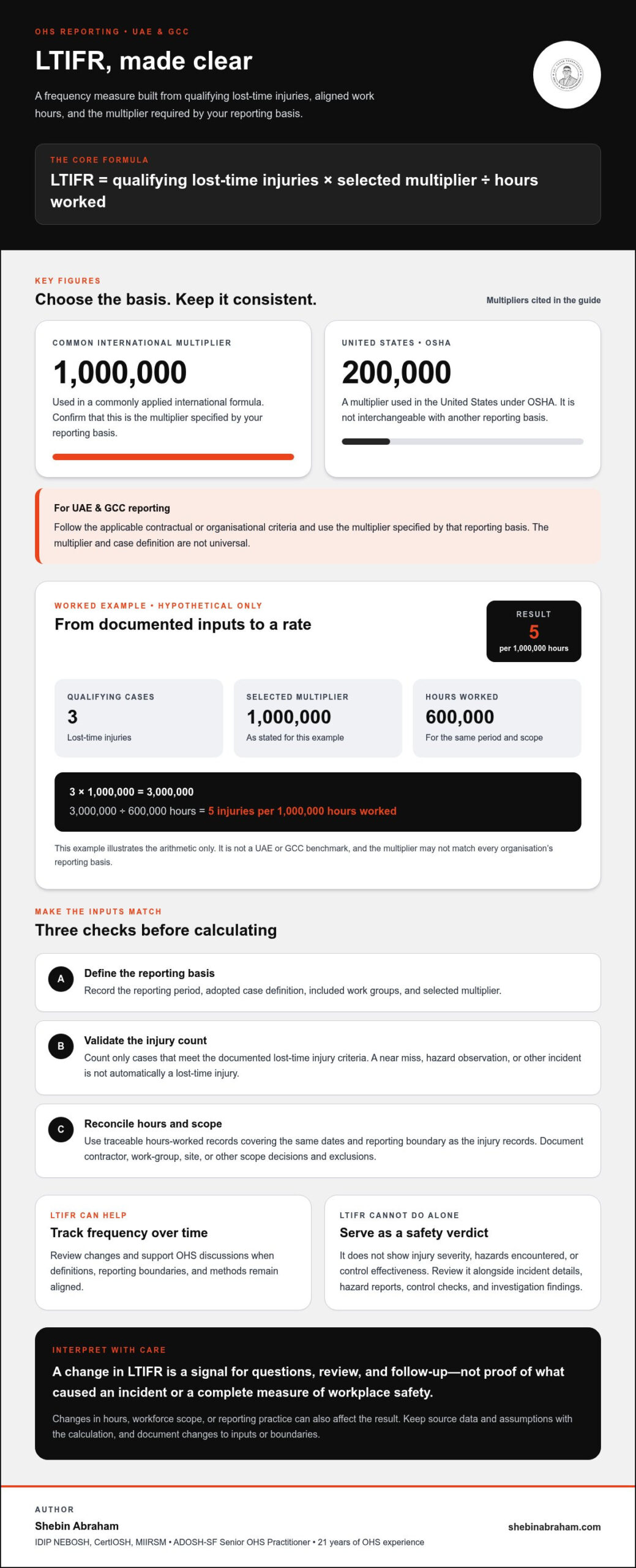
LTIFR = qualifying lost-time injuries × selected multiplier ÷ hours worked. The formula is straightforward, but neither the multiplier nor the case definition is universal. A multiplier of 1,000,000 is commonly used internationally, while 200,000 is used in the United States under OSHA. For UAE and GCC reporting, follow the applicable contractual or organisational criteria and use the multiplier specified by that reporting basis.
Gather the injury count and exposure hours
Start by fixing the reporting period, such as a defined quarter or year. Count only cases that meet the documented lost-time injury criteria for that period. Then collect traceable hours-worked records covering the same dates and reporting scope. Decide and record whether the calculation includes contractors, particular work groups, or multiple sites, and document any exclusions. Apply those boundaries consistently in later periods.
Apply the formula without changing its basis
Work through the calculation in order so the result is easy to reproduce and review:
- Confirm the basis: Record the reporting period, case definition, included work groups, and selected multiplier.
- Validate the inputs: Check the qualifying injury count against case records and reconcile exposure hours to the same period and scope.
- Multiply the injury count: Multiply the qualifying cases by the selected multiplier.
- Divide by hours worked: Divide that product by total exposure hours, then record the result with its reporting basis.
Worked example, hypothetical only: Assume a reporting period has 3 qualifying lost-time injuries, 600,000 hours worked, and an adopted multiplier of 1,000,000. First, calculate 3 × 1,000,000 = 3,000,000. Then divide 3,000,000 by 600,000 hours. The result is an LTIFR of 5 injuries per 1,000,000 hours worked, using the stated multiplier. This example illustrates the arithmetic only. It is not a UAE or GCC benchmark, and the multiplier may not match every organisation’s reporting basis.
Keep the calculation record with its source data and assumptions. If the injury count, hours, or reporting boundary changes, document why rather than silently altering the basis between periods. Organisations standardising OHS records and reporting processes can use OHS consulting support to align calculation practices with operational needs.
How to Interpret LTIFR Without Treating It as a Safety Verdict
Read LTIFR in context. The reporting period, hours worked, case definition, workforce scope, and completeness of records all shape the result. A rate can change because injury frequency changed, but it can also shift when hours, reporting coverage, or classification practices change. Before drawing a conclusion, check the inputs and boundaries behind the number.
A low rate, or even a zero rate, doesn’t prove that workplace risks are controlled. It may mean there were no qualifying cases during the period, but it doesn’t establish whether hazards were present, controls were effective, or all relevant events were reported. Treat the figure as a prompt for review, not reassurance on its own.
Compare like with like
Trend comparisons are most meaningful when the reporting period, injury criteria, multiplier, workforce scope, and method for counting hours remain aligned. If coverage expands to include additional contractors or work groups, a change in the rate may reflect that broader scope as well as changes in recorded injuries. Note scope changes alongside the result. Don’t assume a rate is acceptable simply because it appears low or resembles a figure from another organisation.
| Comparison | How to read it |
|---|---|
| Same organisation, consistent basis | Useful for examining change over time, while still checking incidents and reporting completeness. |
| Different populations or methods | Use caution. Differences in definitions, workforce coverage, hours, or multipliers can make the rates incomparable. |
For example, comparing two reporting periods is less reliable if the later period includes a work group omitted from the earlier one. Document the scope change before interpreting the trend. LTIFR supports comparison only when the underlying calculation basis is consistent.
Read the rate alongside other OHS evidence
LTIFR measures frequency, not injury severity. It won’t show whether a case resulted in a minor or serious outcome, nor identify the hazard or control failure involved. Review the incident details and investigation findings to understand what happened and what may need attention.
Consider the rate alongside hazard reports, corrective action status, relevant exposure information, and findings from workplace reviews. Lagging indicators describe events that have already occurred; leading indicators can help teams examine preventive activity and whether controls are being checked. Each answers a different question, so use them together rather than treating one as a substitute for another.
LTIFR is one indicator of recorded injury frequency, not proof that overall workplace safety is good or poor. For UAE and GCC organisations, sound interpretation depends on clear records and careful attention to the people, work activities, and controls behind the figure.
A Repeatable LTIFR Reporting Process for UAE and GCC Workplaces
A reliable LTIFR process starts before anyone enters a number into the formula. Agree on the reporting boundary, case criteria, and data sources first. For organisations working across UAE and GCC sites or projects, a documented method helps teams use the same approach each period and explain differences that affect the result.
Keep internal reporting conventions separate from external requirements. ADOSH-SF, client, or contractor-specific criteria may apply to a particular reporting arrangement. Use the relevant current documentation to confirm which definition and multiplier apply; don’t assume one organisation’s convention is suitable for another.
Set reporting scope and definitions before counting
Record the start and end of the period, the workforce covered, the adopted definition of a qualifying injury, and the selected multiplier. Name the source records for injury cases and hours worked. If a work group or site is excluded, document the reason and apply that boundary consistently. If the scope changes later, record what changed so readers can interpret the trend fairly.
- Set the period: Identify the dates covered and use the same period for case records and exposure hours.
- Define the population: Note the sites, projects, employees, contractors, or work groups included, based on the chosen reporting basis.
- Write down the criteria: Document the qualifying injury definition and multiplier, including the source of any applicable client or contractor criteria.
- Identify exclusions: Record exclusions and any changes in coverage rather than quietly changing the calculation boundary.
This gives the team a clear, consistent basis for calculating LTIFR and reviewing results across reporting periods.
Validate records and retain the calculation trail
Before calculating, reconcile injury records with investigation outcomes and the agreed case criteria. Check that hours-worked totals come from traceable records and match the reporting period and workforce boundary. Resolve or document differences between sources instead of choosing whichever figure produces a preferred rate.
- Confirm each counted case meets the documented criteria, and retain its supporting record.
- Check that hours relate to the same population and period as the injury count.
- Record the inputs, multiplier, calculation, date prepared, and reviewer.
- Log methodology changes so future comparisons remain transparent.
Retain enough evidence for another authorised reviewer to reproduce the result and understand the decisions behind it. Shebin Abraham provides OHS consulting for UAE and GCC organisations refining their reporting approach, helping connect records, calculations, and operational review. Explore OHS consulting support for a more consistent reporting process.
Use LTIFR Results to Strengthen OHS Improvement
A changed LTIFR is a reason to ask better questions, not a conclusion about what caused the change. Before deciding on action, examine the work activities, incident circumstances, controls, reporting coverage, and investigation findings behind the figure. The rate can direct attention, but the people and conditions involved should guide the response.
First check whether the reporting basis stayed consistent. Did exposure hours or workforce scope change? Were injury cases classified using the same criteria, and was reporting practice consistent? If those inputs are stable, review the cases themselves. Look for relevant patterns in tasks, equipment, work conditions, or controls without assuming that a trend alone establishes cause.
Move from a number to a useful review
Use the rate as one prompt in your established OHS review process. Check investigation findings and control performance, then decide whether the evidence supports a proportionate review or corrective action. Assign actions through existing arrangements, identify who will follow them up, and check whether they were completed and effective. Record the reasoning, including when the evidence does not support a specific change.
A practical review can distinguish three possibilities: the underlying risk picture may have changed, the way cases or hours are recorded may have changed, or both may have shifted. For example, expanded reporting coverage could affect the rate even if work conditions did not change. Trace calculation inputs to their records, then compare them with operational evidence before drawing conclusions.
Use learning from individual cases as well as the aggregate result. A rate may remain unchanged while an incident reveals a control weakness worth addressing. Equally, a change in the rate does not prove that a particular control failed. Keep investigations, corrective actions, and follow-up focused on evidence and preventing harm.
Connect calculation practice with experienced OHS guidance
Consistent definitions and reliable records give leaders a sounder basis for OHS oversight. Shebin Abraham provides OHS consulting and ADOSH-SF guidance for organisations in the UAE and GCC, supporting a practical connection between reporting discipline and workplace improvement. Check applicable ADOSH-SF, client, or contractor reporting criteria against the relevant current documentation before using them.
Use the calculation as part of a wider cycle: review the evidence, agree proportionate actions, share relevant learning, and revisit whether actions were completed. This keeps attention on improving work conditions rather than pursuing a particular rate. The aim is not simply a better-looking figure, but a careful response that supports people and strengthens controls.
To connect consistent LTIFR reporting with practical OHS oversight, explore OHS consulting and safety guidance.
Make Each Reporting Cycle a Chance to Learn
Let each reporting cycle strengthen how your organisation listens to workers and responds to risk. Bring OHS and operational teams together to discuss what the records reveal, what remains unclear, and which improvements deserve attention. Keep the conversation focused on evidence and practical follow-through, not on achieving a particular rate.
For organisations across the UAE and GCC, dependable reporting supports clearer oversight when teams work across sites, projects, or reporting arrangements. If you’re refining how to calculate lost time injury frequency rate, make the process part of a wider commitment to learning, consistent records, and thoughtful action. This discipline helps keep the purpose where it belongs: supporting safer work and protecting people.
Shebin Abraham, IDIP NEBOSH, CertIOSH, MIIRSM, ADOSH-SF Senior OHS Practitioner, brings 21 years of OHS experience to his advisory work. Explore OHS consulting and practical safety guidance to strengthen your reporting and OHS approach.
Small, well-founded improvements can build confidence in your OHS process. Keep learning, keep reviewing, and keep people at the centre of every decision.
Frequently Asked Questions
Is LTIFR the same as total recordable injury frequency rate?
No. LTIFR focuses on qualifying lost-time injuries, while a total recordable injury frequency rate (often called TRIR) includes a broader set of recordable cases under the organisation’s adopted criteria. Because the case categories differ, the two rates aren’t interchangeable. If both appear in a report, label each clearly and state the definitions and calculation basis so readers don’t mistake a change in one measure for a change in the other.
Can a near miss be counted as a lost time injury?
No. A near miss describes an event that could have caused harm but did not result in an injury at the time. Record it through the organisation’s near-miss process so it can support prevention and learning. If a person later reports an injury linked to the event, assess that injury under the organisation’s adopted case criteria and document the classification. Don’t count the near-miss report itself as an injury.
How often should an organisation calculate LTIFR?
There isn’t one frequency that suits every organisation. Set a reporting rhythm that supports timely internal review and meets applicable contractual or reporting criteria. For example, a team might review the rate on a regular internal cycle and also prepare it for a defined reporting period. Keep the period consistent when comparing results, and avoid drawing strong conclusions from a short period with limited exposure hours or few cases.
What does an LTIFR of zero mean?
A zero rate means no qualifying lost-time injuries were recorded for the defined period and reporting scope, assuming the data and classification are complete. It doesn’t establish that no hazards or near misses occurred, or that every control worked as intended. Check that hours and case records cover the intended workforce, and continue reviewing hazard reports, control checks, and worker feedback. A zero result is a record of reported cases, not a guarantee.
What should an organisation do if hours-worked records are incomplete?
Don’t present a result based on incomplete hours as though it were exact. First identify the missing work groups, dates, or source records, then reconcile available timesheets, payroll data, or other established records where appropriate. If the organisation uses an estimation method, document its basis and apply it consistently only where the adopted reporting criteria allow it. Clearly qualify the result or delay final reporting until the exposure figure is adequately supported.
Can LTIFR alone show whether safety performance is improving?
No. A falling rate may be encouraging, but it doesn’t show by itself whether controls improved or risks reduced. Compare the trend with completed corrective actions, inspection findings, hazard reports, and investigation learning. Also check for changes in workforce coverage or reporting practice that could affect the figures. A credible assessment combines outcome data with evidence of preventive activity and what workers experience in the workplace.