

What if the clearest sign of audit readiness isn’t a polished folder, but a procedure workers can explain and follow on site? If you’re asking how to prepare for an ADOSH audit, start by connecting the requirements in your OHS system with the way work is actually carried out. Common questions include which records matter, whether they reflect current practice, and whether managers and workers can explain their responsibilities.
A clear preparation sequence helps you assign owners, check documents against workplace practice, and organise evidence so it can be traced and understood. This guide explains how to manage those steps and respond to findings with practical follow-up, rather than treating the audit as a paperwork exercise.
Written for organisations operating in the UAE and GCC, this guide draws on the experience of Shebin Abraham, IDIP NEBOSH, CertIOSH, MIIRSM, an ADOSH-SF Senior OHS Practitioner with 21 years of OHS experience. Use the steps ahead to prepare your team and show how its safety arrangements work in practice.
Key Takeaways
- Start by confirming the audit scope and the current ADOSH-SF requirements that apply to your organisation.
- Use a clear preparation sequence to assign owners, map evidence, check workplace practice, and track actions.
- Learn how to prepare for an ADOSH audit by linking each applicable requirement to its controls, records, and observed work.
- Practise retrieving evidence and explaining work without scripting answers. Encourage accurate responses grounded in actual practice.
- Use ADOSH-SF consulting to strengthen readiness and action planning, not as a promise of a particular audit outcome.
How to Prepare for an ADOSH Audit: Know Its Purpose and Scope
Uncertainty about what an auditor may examine can make preparation feel like a race to collect documents. Start with the scope: understand what is being assessed, which requirements apply, and what evidence can show that OHS arrangements work in practice. Knowing how to prepare for an ADOSH audit means establishing these boundaries rather than assuming every audit follows the same checklist.
An audit examines whether an organisation’s OHS management arrangements are suitably established and working, using the criteria set for that audit. A routine site inspection usually focuses on conditions or activities observed at a particular time. The two may inform each other, but their purposes and criteria aren’t automatically the same. Broader Occupational Safety and Health (OSH) principles provide useful context. The applicable, current ADOSH-SF requirements and communicated audit criteria should guide preparation.
Audit readiness is traceable evidence connecting applicable requirements and controls with records and work as actually performed. A document may show that a process has been written down. Readiness also means being able to relate that process to the people, activities, and workplace conditions it is intended to support.
Clarify the audit scope before gathering evidence
First, establish the boundaries. Identify the organisation, activities, locations, and time period included in the stated scope. Then record the audit objectives, criteria, schedule, and requested information as communicated to the entity. This gives managers a shared reference and helps avoid spending time on material outside the review while overlooking evidence directly related to it.
Separate confirmed requirements from assumptions. Check the applicable ADOSH-SF source and version against current authoritative material before mapping evidence. Keep the audit communication that identifies particular criteria with your preparation records. A familiar template, an older internal checklist, or another organisation’s audit experience doesn’t prove that the same criteria apply to your audit. If the scope or wording is unclear, resolve it through the appropriate audit communication channel rather than guessing.
Set a calm, accountable preparation mindset
Preparation should help the organisation understand its performance and identify improvements, not coach people to conceal gaps. If a record is missing or practice differs from a procedure, document the issue honestly, assess its significance, and assign someone to address it. This measured approach supports learning and keeps the focus on protecting people, not simply presenting a polished file.
Give one coordinator responsibility for the schedule, information requests, and evidence register. Managers who own the systems under review should confirm that records are current and explain how arrangements are implemented. Workers should be able to describe their actual tasks and relevant controls in their own words.
This practical, evidence-led approach reflects the perspective of Shebin Abraham, an ADOSH-SF Senior OHS Practitioner with IDIP NEBOSH, CertIOSH, and MIIRSM credentials and 21 years of OHS experience. His OHS and ADOSH-SF consulting helps organisations connect documented arrangements with workplace practice, while responsibility for the organisation’s own systems remains with its leaders and teams.
Build an ADOSH Audit Preparation Plan with Clear Owners and Dates
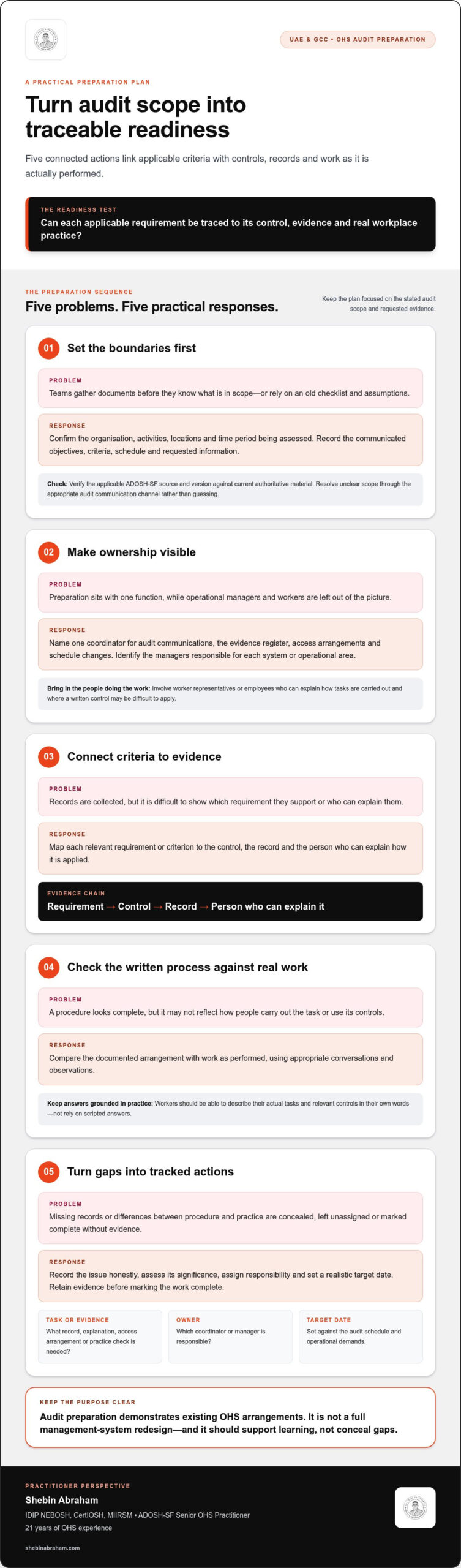
A preparation plan turns the audit scope into coordinated work. Keep it focused: this is a time-bound plan for demonstrating existing OHS arrangements, not a full management-system redesign. Developing or implementing a wider system is a separate project, such as an OHS management system implementation guide. For audit preparation, concentrate on the stated scope, the evidence requested, and whether arrangements are reflected in everyday work.
Use an ordered sequence so teams know what depends on what:
- Confirm the scope. Translate the communicated audit objectives and criteria into the activities, records, and work areas that need attention.
- Appoint owners. Name a coordinator and identify the managers responsible for each system or operational area under review.
- Map the evidence. Connect each relevant requirement or criterion to the control, record, and person who can explain its application.
- Check practice. Compare the documented arrangement with work as performed, using appropriate conversations and observations.
- Track actions. Record gaps, assign responsibility, set a realistic target date, and retain evidence before marking work complete.
Assign owners to the audit preparation work
The coordinator should manage audit communications, the evidence register, access arrangements, and schedule changes. Operational managers should confirm what happens in their areas and supply relevant records, rather than leaving all preparation to the OHS function. Involve worker representatives or employees who can explain how tasks are carried out. Their input may reveal where a written control is clear on paper but difficult to apply in practice.
Make ownership visible. A simple tracker can include fields such as:
- Task or evidence: The record, explanation, access arrangement, or practice check needed.
- Owner: The coordinator or manager responsible for completing or supplying it.
- Target date: A date set against the communicated audit schedule and operational demands.
- Status and follow-up: The current position, any obstacle, and the next action.
Sequence checks without disrupting normal operations
Begin early enough to locate requested information, confirm access, and resolve practical issues, such as records held in different systems. Use the audit schedule as your planning reference. Don’t present internal target dates as prescribed ADOSH-SF deadlines or mandatory formats. Arrange short conversations and site observations around operational needs so the review captures normal work without unnecessary disruption.
Keep unresolved items visible. If an action is incomplete, record the obstacle, accountable owner, next step, and revised target date. Close it only when there’s evidence that the action has been completed, not simply because the audit date is approaching. This sequence provides a practical way to prepare for an ADOSH audit while keeping attention on genuine progress, not just a tidy tracker.
For teams coordinating scope, evidence, and follow-up, ADOSH-SF consulting support can help strengthen preparation while the organisation’s people retain ownership of its systems.
Make ADOSH Audit Evidence Traceable to Controls and Real Work
As the preparation plan progresses, organise evidence so an auditor can follow its logic. Start with an applicable audit requirement or criterion, identify the control intended to address it, locate the relevant record, and connect that record to what people do at work. This chain helps show not just that a document exists, but how the arrangement is put into practice.
A record can show that an activity was documented, but evidence linked to actual work helps demonstrate how a control operates. A training record, for example, may show that training was recorded. It doesn’t by itself establish how a worker applies the relevant procedure during a task. This distinction is central to preparing for an ADOSH audit with meaningful evidence, not simply a large volume of documents.
Organize records around audit criteria, not file volume
Group relevant policies, procedures, assessments, training records, and monitoring evidence according to the confirmed audit scope and criteria. An evidence index can identify the topic, linked control, record location, responsible person, and current status. Keep it focused on helping someone retrieve and understand the evidence, rather than creating another large file that’s difficult to maintain.
Check each item for currency, attribution, accessibility, and consistency with related records. If a procedure has been revised, for instance, confirm that the evidence relates to the version currently in use. Flag gaps or conflicting information honestly and record who will investigate or resolve each issue. Don’t quietly replace, backdate, or alter records to make them appear consistent.
Illustrative evidence map: These examples show how to structure a traceable link. They aren’t a complete list of audit criteria or a statement that every item applies to every organisation.
| Topic | Illustrative evidence | Owner | Status |
|---|---|---|---|
| Risk control | Relevant assessment and a record showing control review | Area manager | Located, practice check pending |
| Training | Training record and worker explanation of task controls | Line manager | Under review |
| Incident follow-up | Incident record and documented action progress | Assigned manager | Open, follow-up needed |
Connect paperwork with workplace conditions
Check whether the evidence tells a coherent story. Compare the documented control with observations of the relevant work and supporting records. Ask employees how they carry out the task during normal operations, which controls they use, and where they refer if conditions change. Their answers can help clarify whether a procedure is understood and workable without asking them to repeat scripted wording.
If what you observe differs from the document, record the difference for review. A procedure may not reflect a change in work, or a control may be applied differently than expected. Capture the facts, identify who will assess the issue, and preserve the original evidence. The aim is an accurate picture that supports practical improvement and shows how the organisation’s OHS arrangements function in real conditions.
Rehearse the ADOSH Audit Day and Prepare for Findings
A brief internal rehearsal can expose practical snags before the audit, such as a record that’s difficult to retrieve, an unavailable contact, or uncertainty about who should explain a control. Keep the exercise focused on access, communication, and evidence retrieval. It isn’t a mock performance for appearance’s sake, and it shouldn’t train staff to give scripted answers. The aim is to help people participate calmly and describe work as it really happens.
Help managers and workers participate confidently
Brief relevant managers, workers, and representatives on the audit purpose, schedule, likely interactions, and the route for handling questions or requests. Explain who will coordinate information and where participants can direct an auditor if they’re unsure who owns a topic. Make necessary records and responsible contacts accessible, while planning access around normal work arrangements.
Invite participants to explain their responsibilities and experience in plain language. Encourage accurate, truthful answers rather than memorised wording or unsupported assurances. If someone doesn’t know an answer, they can say so and identify who can verify it, or explain how they would locate the information. A clear, honest response is more useful than a guess. This is a practical part of preparing for an ADOSH audit without making the workplace feel staged.
During the rehearsal, test a few realistic tasks: locate a requested record, identify the manager responsible for an activity, and walk through how a worker would explain a relevant procedure during normal work. Note where access, terminology, or responsibilities are unclear. Address these issues through the appropriate owner, without interrupting operational work simply to make the rehearsal look complete.
Respond constructively when the audit identifies gaps
When the audit identifies a concern, first make sure the organisation understands what has been recorded. Capture the finding in the auditor’s terms and clarify the evidence or context if something is factually unclear. Keep the discussion respectful and specific. Don’t dismiss a finding based on an assumption, and don’t agree to a description that the available facts don’t support.
Then give the issue a clear path to resolution:
- Assign an accountable owner to investigate the circumstances and determine what needs attention.
- Agree proportionate corrective action that addresses the issue and, where appropriate, its contributing cause.
- Record the action, target date, and evidence needed to show that the work has been completed.
- Check completion and effectiveness using relevant evidence, rather than closing the item solely because a task was reported as done.
Keep follow-up visible to the people responsible, and escalate delays or barriers through the organisation’s normal management arrangements. Findings can guide improvement when actions are owned, evidence-based, and followed through.
ADOSH-SF preparation support focuses on strengthening the link between documented arrangements and work in practice.
Use ADOSH-SF Consulting to Strengthen Audit Readiness
External advisory can give a team a clear view of its preparation without taking ownership away from the organisation. For UAE and GCC businesses, practical ADOSH-SF consulting can help review the audit scope, organise evidence, assess readiness, and plan proportionate actions. The aim is to strengthen the organisation’s own OHS arrangements, not to promise a particular audit outcome.
Support is most useful when it addresses a defined challenge. If records are difficult to navigate, advisory can help organise documentation around applicable criteria and clarify how records relate to controls and workplace practice. If leaders are unsure where readiness gaps remain, a compliance assessment can review evidence and highlight areas for attention. Where arrangements need further development, implementation guidance can help translate applicable requirements into workable processes for managers and employees.
Match advisory support to the preparation challenge
Start with the question the organisation needs answered. Is the difficulty understanding the scope, finding consistent evidence, judging readiness, or making a documented arrangement workable in daily operations? Defining the need helps keep support focused on preparation rather than expanding it into an unplanned redesign of the whole OHS management system.
Shebin Abraham provides freelance OHS and ADOSH-SF consulting, including documentation support, compliance assessments, and guidance on implementing applicable standards. He is an ADOSH-SF Senior OHS Practitioner with IDIP NEBOSH, CertIOSH, and MIIRSM credentials and 21 years of OHS experience. His practical perspective helps teams examine whether records and stated controls align with work as performed, while managers retain responsibility for their systems and decisions.
A focused ADOSH-SF compliance assessment can help an organisation understand its readiness and identify issues for follow-up. Treat it as a review that supports improvement, not as a substitute for the organisation’s own oversight or a guarantee of a particular audit result.
Continue improvement after the audit
Use audit findings to strengthen controls and organisational learning after the review is complete. Consider whether an action addresses only the observed issue or whether the underlying arrangement also needs attention. Track responsibilities and evidence of completion through the organisation’s established processes, then use what the team learns to improve relevant procedures, communication, or monitoring. This keeps audit preparation connected to ongoing protection and operational discipline.
For a wider perspective on selecting advisory support, explore the guide to an occupational health and safety consultant UAE. The right scope of support depends on the organisation’s needs, existing arrangements, and applicable criteria. Focus on practical advice that helps your people understand and strengthen the systems they use.
Tailored OHS or ADOSH-SF consulting can help clarify scope, improve evidence organisation, assess readiness, and plan accountable follow-up.
Turn Audit Preparation into Lasting OHS Progress
Use the audit as a point of direction, not a finish line. Keep improvement connected to everyday decisions: make ownership clear, give teams the support to apply controls, and revisit actions when work or conditions change. This helps make preparation part of a dependable OHS culture rather than a temporary push before an audit.
Knowing how to prepare for an ADOSH audit is valuable, but the lasting benefit comes from using what the process reveals. A well-managed review can help leaders see where arrangements are working, where teams need clearer support, and what deserves attention next. Progress doesn’t require every issue to be solved at once. It does require honest evidence, accountable follow-through, and care for the people affected by the work.
If you’re ready to strengthen your organisation’s preparation, discuss practical ADOSH-SF audit preparation support with Shebin Abraham. Take the next step with clarity and build readiness that supports safer work beyond audit day.
Frequently Asked Questions
Is an ADOSH audit the same as an OHS inspection?
No. An ADOSH audit reviews an organisation’s OHS arrangements against the criteria set for that audit, while an inspection typically checks particular workplace conditions or activities. For example, an inspection might identify an issue with a work area, while an audit may examine how the organisation’s arrangements address and monitor that kind of issue. Inspection findings can inform an audit, but the two activities have different purposes and shouldn’t be treated as interchangeable.
How long does it take to prepare for an ADOSH audit?
There’s no single preparation period that suits every organisation. The time needed depends on the audit scope, how accessible and current relevant records are, and whether teams need to resolve gaps or clarify responsibilities. To plan how to prepare for an ADOSH audit, work back from the communicated audit schedule and allow time for evidence review, operational input, and follow-up. Avoid setting an arbitrary deadline that leaves unresolved issues hidden.
Who should take part in ADOSH audit preparation?
Preparation should involve people who understand both the OHS arrangements and the work they govern. An OHS lead or assigned coordinator can organise the process, while managers contribute information about their areas. Include employees or worker representatives who can explain how tasks are carried out. For example, the person maintaining a training record may locate it, while the relevant supervisor and worker can explain how that training relates to a task.
Does passing an ADOSH audit certify an organization?
No. An audit outcome is not the same as certification. An audit assesses performance against its applicable scope and criteria; it doesn’t, by itself, issue an accredited ISO certificate or certify an organisation generally. Keep the audit result and any related records in their proper context. If the organisation is pursuing a separate certification, that process has its own requirements and should not be confused with ADOSH-SF audit readiness or outcome.
What should an organization do if an ADOSH audit identifies a gap?
First, understand the finding and the evidence behind it. If a factual detail needs clarification, raise it through the appropriate audit communication channel and keep a clear record of the discussion. Then assess the issue, decide what corrective action is appropriate, and assign someone to manage it. For example, a gap involving unclear responsibilities may call for clarifying the relevant role and checking that affected staff understand the change.
Can a small organization prepare for an ADOSH audit without an internal HSE team?
Yes. A small organisation can assign a suitable manager or coordinator to organise the work and involve people who oversee the relevant activities. It can also use OHS or ADOSH-SF consulting support to review readiness, documentation, or applicable arrangements. External advice can help identify areas for attention, but the organisation’s leaders and workers still need to understand and maintain the systems that apply to their work.