
Could one experienced HSE practitioner be a better fit than a consultancy firm? A larger team may seem like the safer choice, but the right support depends on the work, not the provider’s size. If you’re weighing whether to hire freelance HSE consultant instead of consultancy firm support, compare the expertise, continuity and accountability your operation needs.
It’s reasonable to want confidence that your HSE requirements will be covered and that support will remain dependable. In the UAE and GCC, the approach should also fit your operating context, whether you need focused advice, ongoing support or help with a defined project. A freelance engagement can work well when its scope and responsibilities are clear; a firm may suit work that calls for broader team capacity.
This article compares both models across expertise, continuity, accountability and project fit. It draws on the experience of Shebin Abraham, an ADOSH-SF Senior OHS Practitioner with 21 years of OHS experience and credentials including IDIP NEBOSH, CertIOSH and MIIRSM. Use the comparisons and practical questions below to match HSE support to your needs while keeping people and operations in view.
Key Takeaways
- Choose an HSE delivery model by matching the work’s scope, risk profile and required expertise, rather than assuming a larger provider is automatically a better fit.
- Compare communication, continuity, coordination and agreed deliverables to understand how each option will support your operation.
- Before you hire freelance HSE consultant instead of consultancy firm support, decide whether you need focused project input or ongoing advice.
- HSE consulting can support compliance, but it doesn’t transfer an organisation’s responsibility for managing workplace safety.
- Shebin Abraham is an ADOSH-SF Senior OHS Practitioner with 21 years of OHS experience and credentials IDIP NEBOSH, CertIOSH and MIIRSM.
Freelance HSE Consultant or Consultancy Firm: Why the Model Matters
Choosing between an independent practitioner and a consultancy firm is a decision about how expertise is delivered, not a shortcut for judging its quality. An adviser in either model should understand the work, communicate clearly and provide support that matches the agreed scope. The key question is whether the arrangement gives your operation the knowledge, access and accountability the task requires.
The right HSE consulting model matches the work’s risk and scope with the expertise, involvement and accountability your organisation needs. A focused assessment or documentation review may call for a different arrangement from a broad, multi-discipline programme. Your internal HSE capability matters too: a team seeking specialist guidance may need a different level of adviser involvement from a team looking for ongoing collaboration.
HSE work is ultimately about protecting people and managing workplace risks. The broader purpose of Occupational Safety and Health helps frame why an engagement matters, but the delivery model should reflect the actual work. Requirements and operating contexts can differ, including where ADOSH-SF or Trakhees requirements apply. Define the support you need before choosing an arrangement.
What does hiring a freelance HSE consultant involve?
With a freelance HSE consultant, your organisation works directly with an independent practitioner. The person discussing the work can also carry out the agreed assessment, review documentation, advise on safety systems or provide targeted guidance. Clarify the expected outputs, boundaries, access to relevant information and communication arrangements from the outset.
For example, a business might need a review of one part of its safety documentation rather than a wider consulting programme. Defining the task helps both sides understand what will be delivered and how findings will be discussed. Direct access can support close collaboration, but it doesn’t remove the need to agree responsibilities and involve the organisation’s decision-makers.
What does a consultancy firm engagement involve?
A consultancy firm provides an organisation-based relationship. Depending on the agreed scope and the firm’s structure, work may be assigned to one adviser or involve a team. Make sure the engagement’s communication channels and coordination arrangements fit the work. A larger organisation may offer access to broader resources, but its size alone doesn’t show that the assigned expertise fits the task.
If you’re deciding whether to hire freelance HSE consultant instead of consultancy firm support, start with four questions: What work must be done? What risks or specialist knowledge are involved? What can your internal team manage? How closely should the adviser work with that team? Clear answers help you choose a delivery arrangement and establish accountability.
Compare Expertise, Access, Continuity, and Scope
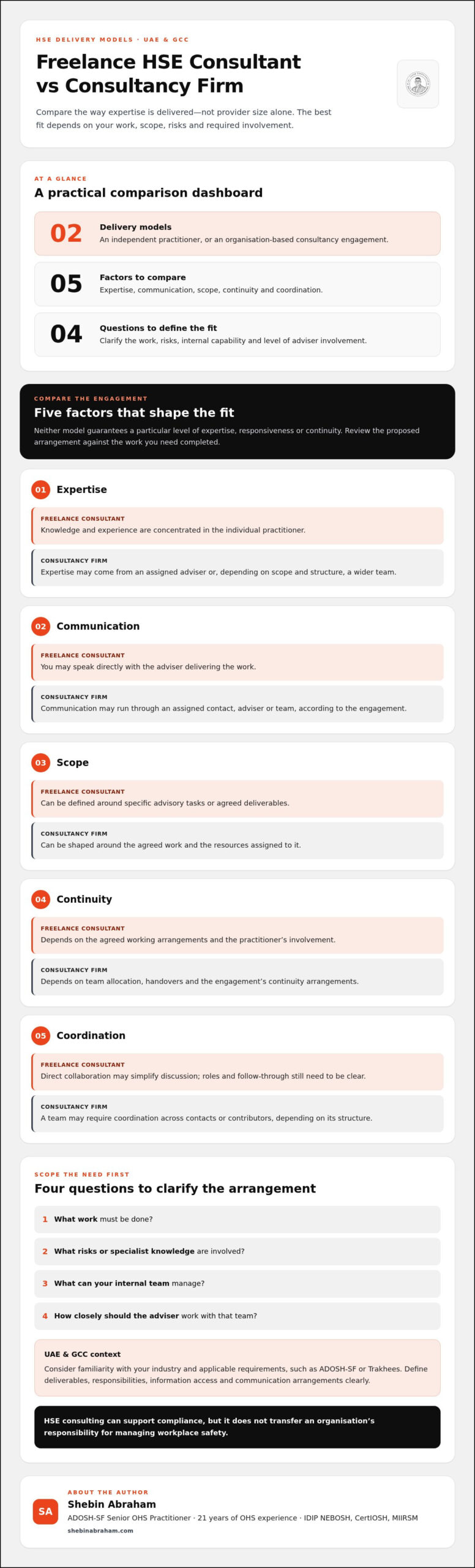
Neither an individual consultant nor a consultancy firm guarantees a particular level of expertise, communication or continuity. Compare the proposed arrangement with the work you need completed. In the UAE and GCC, familiarity with your industry and relevant requirements, such as ADOSH-SF or Trakhees where applicable, may matter more than provider headcount.
| Factor | Freelance consultant | Consultancy firm |
|---|---|---|
| Expertise | Knowledge and experience are concentrated in the individual practitioner. | Expertise may come from an assigned adviser or, depending on the scope and firm structure, a wider team. |
| Communication | You may discuss the work directly with the adviser delivering it. | Communication may involve an assigned contact, adviser or team, according to the engagement. |
| Scope | Can be defined around specific advisory tasks or agreed deliverables. | Can be shaped around the agreed work and resources assigned to it. |
| Continuity | Depends on the agreed working arrangements and the practitioner’s involvement. | Depends on team allocation, handovers and the engagement’s continuity arrangements. |
| Coordination | Direct collaboration may simplify discussion, while your team still needs clear roles and follow-through. | A team may require coordination across contacts or contributors, depending on its structure. |
An individual consultant gives you a direct point of contact; a firm-based engagement may coordinate the work through an assigned adviser or team. Neither structure is automatically more responsive or reliable. Agree how questions, updates and decisions will be handled before work begins.
How does direct access affect the working relationship?
Speaking with the practitioner doing the work can help you share operational context without relaying it through several people. For example, a discussion about an assessment can cover the relevant process, work conditions and existing controls, helping the adviser understand what the review needs to address. In a firm-based arrangement, an assigned contact or team can also support clear communication when responsibilities and information handovers are understood.
How should businesses compare expertise and continuity?
Look beyond job titles or company size. Match the adviser’s relevant experience to your hazards, sector, regulatory context and expected outputs. Then agree practical continuity details: who attends discussions, how findings are shared, how often progress is reviewed and how handovers will work if more than one person contributes. These are engagement details to establish, not qualities to assume from either model.
If you’re deciding whether to hire freelance HSE consultant instead of consultancy firm support, compare the people and working arrangements with the actual requirements. A defined review may call for focused expertise; broader work may need coordinated contributions. Choose the option that gives your team access to the right knowledge and a clear path from advice to action. Shebin Abraham provides a direct advisory option through his freelance HSE and OHS consulting for UAE and GCC operations.
Can a Freelance HSE Consultant Handle Your Risk and Compliance Needs?
Yes, an independent consultant can be a practical fit when the required scope matches their expertise and the working arrangements are clear. The same test applies to a consultancy firm. Provider size alone doesn’t establish whether the right experience, involvement or capacity is in place. Before deciding whether to hire freelance HSE consultant instead of consultancy firm support, define the hazards and issues to address, the outputs you need and how the adviser will work with your team.
In the UAE and GCC, applicable requirements depend on the operation and relevant framework. An engagement involving ADOSH-SF or Trakhees considerations should be shaped around the requirements relevant to the organisation, rather than treated as a one-size-fits-all exercise. Advisory support can help a team assess its arrangements, strengthen documentation or plan improvements, but it doesn’t transfer the organisation’s responsibility for its own decisions and actions.
When is an independent consultant a practical fit?
A focused engagement may suit a defined assessment, documentation support, specialist advice or targeted improvement work. Direct collaboration can help an internal team share operational context and work through findings with the adviser. For instance, a safety system review can focus on agreed documents, observations and recommendations, while the organisation retains responsibility for deciding and implementing next steps.
Where relevant, the scope can address ADOSH-SF or Trakhees requirements. Make the boundaries clear: what will be reviewed, what deliverables are expected, who will provide information and how recommendations will be discussed. This helps keep the support useful and proportionate to the need.
When might a firm-based engagement suit the scope?
A consultancy firm may suit work that calls for coordinated input across different disciplines or a broader programme of support. The engagement should identify the expertise involved, how contributors will coordinate and who will communicate findings. A firm structure may help organise wider input, but it doesn’t guarantee that every relevant risk will be addressed or that compliance will result.
Whichever arrangement you choose, distinguish advisory work from other functions. HSE consulting is not the same as issuing accredited certification, delivering emergency medical response or supplying safety equipment. Define the service and its limits so advice or documentation support is not mistaken for another function.
Use these questions to test whether the arrangement fits:
- Does the adviser’s experience align with the operation’s hazards and relevant framework?
- Are the scope, deliverables and communication arrangements clear?
- Does the work call for one specialist or coordinated contributions across disciplines?
- How will recommendations be reviewed, assigned and followed through internally?
Shebin Abraham, an ADOSH-SF Senior OHS Practitioner with 21 years of OHS experience and credentials IDIP NEBOSH, CertIOSH and MIIRSM, provides freelance HSE and OHS consulting across the UAE and GCC. His work includes specialist advice related to ADOSH-SF and Trakhees requirements. Match the required expertise and accountability to the work, then agree how the organisation and adviser will work together.
A Practical Framework for Comparing HSE Consulting Options
A sound choice starts with the work, not the provider’s size. Use a simple sequence to turn a broad HSE concern into an engagement you can assess: define the need, map the scope, compare relevant expertise, agree deliverables and set communication arrangements. This also helps you decide whether you need one-off input or an ongoing advisory relationship.
How do you define the right HSE consulting scope?
Start with the operational issue. Identify the activities involved, who or what may be affected, and the practical outcome you want. Are you seeking an assessment of current arrangements, help with a safety system, documentation support or training? Separate immediate priorities from longer-term improvement aims so the engagement can address the need without blurring its boundaries.
Then map the context. Note the relevant operations, existing internal capability and any applicable framework. ADOSH-SF or Trakhees requirements may shape the expertise and deliverables where they apply to your organisation. Explain what the adviser should consider rather than assuming every operation has the same compliance needs.
What should a clear engagement establish?
Put responsibilities and expectations into plain language. Define what information the organisation will provide, what work the adviser will complete, what deliverables will be produced and who will review findings. Agree how often communication will take place and when progress or recommendations will be discussed. These details support accountability whether you hire freelance HSE consultant instead of consultancy firm support or engage a firm-based team.
Check that each deliverable connects to your operating context. A written review should state what it covers and how its findings relate to the agreed scope. For ongoing advice, clarify how new issues will be raised and prioritised. For a one-off assignment, agree how the work will be closed out and handed back to the internal team. Keep responsibility for organisational decisions clear.
- Define the need: State the operational issue and the outcome you want.
- Map the scope: Identify activities, applicable context and the support required.
- Compare expertise: Match relevant experience to the hazards and deliverables.
- Agree the work: Record responsibilities, outputs, communication and review points.
- Review the fit: Decide whether the need is one-off or ongoing, then adjust the arrangement if the scope changes.
If you’re weighing an independent engagement against a larger organisation, the guide Freelance HSE Consultant UAE: A Practical Hiring Guide offers a related perspective. For a comparison with an employed role, see Freelance Safety Consultant vs Full-Time HSE Officer. Use these distinctions to identify the support arrangement that fits your need.
For UAE and GCC operations, Shebin Abraham provides freelance HSE consulting support tailored to a defined scope, from focused advice to ongoing collaboration. A clear description of the operational issue and desired outcome gives the engagement a practical starting point.
Work Directly With an Experienced Freelance HSE Consultant
Practical HSE support should reflect the work on the ground, the organisation’s priorities and the applicable context. Working directly with an independent practitioner gives your team a clear advisory relationship focused on an agreed scope, whether you need help with a defined task or ongoing guidance.
Shebin Abraham is an individual freelance HSE and OHS consultant serving clients across the UAE and GCC. He is an ADOSH-SF Senior OHS Practitioner with 21 years of OHS experience and credentials IDIP NEBOSH, CertIOSH and MIIRSM. His experience supports practical, collaborative advice shaped around workplace needs and relevant requirements.
What can tailored freelance HSE support address?
Support can be tailored to workplace safety systems, assessments, HSE documentation and improvement priorities. Where relevant to an organisation’s requirements, specialist advice can address ADOSH-SF or Trakhees matters. Training and professional mentorship can also form part of an engagement when they fit its agreed purpose.
A tailored scope connects the work to the organisation’s actual needs. An assessment can inform a discussion about existing arrangements; documentation support can help organise and strengthen HSE records; and advice can help internal teams consider practical improvements. The focus is not simply on producing paperwork. It is on supporting informed decisions that contribute to safer, more consistent operations.
Collaboration works best when everyone understands the expectations. The organisation can outline its operating context, existing arrangements and intended outcome, while the consultant’s work is shaped around agreed priorities. The organisation remains involved in decisions and follow-through, keeping the advice connected to operational realities.
How can a business take the next step?
Start with a clear description of your operation and the challenge you want to address. Identify the activities involved, the support you are seeking and what a useful outcome would look like. A practical discussion can help define the scope, clarify the advisory role and establish a collaborative way of working.
If you’re considering whether to hire freelance HSE consultant instead of consultancy firm support, focus on the expertise and involvement your operation needs. A direct engagement may suit a defined advisory requirement or a tailored working relationship. The right choice depends on the scope and how the work will be delivered.
To discuss your HSE consulting needs with Shebin Abraham, share your operation, current challenge and intended outcome. This gives the conversation a clear focus on your priorities and a practical way to work together.
Make Your Next HSE Decision Practical
Your next step doesn’t need to be a long-term commitment or a broad programme. Start by identifying the decision your team needs to make, the operational issue behind it and the support that would help move the work forward. A focused conversation can turn that need into a clear scope, with responsibilities and expected outcomes understood from the outset.
If you’re considering whether to hire freelance HSE consultant instead of consultancy firm support, ground the choice in what your operation needs now and how that need may develop. The right arrangement should help your people act with greater clarity while keeping safety and operational responsibility in view.
Use the comparisons in this article to define the expertise, scope and working arrangements your organisation needs. The FAQ below answers common questions about making that choice.
Frequently Asked Questions
Is a freelance HSE consultant suitable for a UAE business?
Yes, a freelance HSE consultant can suit a UAE business whose needs align with the practitioner’s experience and the agreed work. For example, a company with an internal safety team might use external input to review a particular procedure or assessment, while its team manages routine follow-through. Consider the operation’s activities, internal resources and relevant compliance context. The arrangement should support your actual work, not simply reflect a preference for an individual or a firm.
Can one freelance HSE consultant support ongoing compliance work?
Yes, an independent consultant may provide ongoing advisory support when the scope and working arrangements are established. A business might agree on regular reviews of selected safety documentation, advice on emerging operational questions or guidance as improvement actions progress. Set expectations for communication, records and review points so the support stays connected to changing needs. Keep internal responsibility for decisions and implementation clear, and revisit the scope if the operation or priorities change.
What is the difference between a freelance HSE consultant and a consultancy firm?
A freelance HSE consultant works independently, while a consultancy firm delivers its services through an organisation. With an independent practitioner, you may communicate directly with the person providing the advice. A firm may assign a point of contact or involve multiple contributors, depending on its structure and the work. Neither arrangement automatically ensures a better outcome. Compare who will perform the work, how information will reach them and how recommendations will be communicated.
How do I decide whether to hire a freelance HSE consultant or a firm?
Start with the task you need completed, the hazards and activities involved, and the output your team can use. Then assess the relevant experience of the people who would deliver the work, not only the provider’s profile. If you plan to hire freelance HSE consultant instead of consultancy firm support, consider whether one practitioner can meet the defined scope or whether the work requires coordinated input. Include familiarity with relevant UAE or GCC frameworks where applicable.
Can a freelance HSE consultant help with ADOSH-SF or Trakhees requirements?
Yes, specialist freelance advice can help organisations address relevant ADOSH-SF or Trakhees requirements. Depending on the agreed scope, this may include compliance assessments, documentation support or implementation guidance. For example, an organisation can identify the framework relevant to its activities and define the specific records or processes it needs reviewed. The consultant provides professional advice within that scope; the organisation remains responsible for its own decisions and workplace arrangements.
Does hiring an HSE consultant transfer the employer’s safety responsibilities?
No, engaging an HSE consultant does not transfer the organisation’s responsibilities for workplace health and safety. The consultant can provide advice, assessments or documentation support, but the organisation’s leaders and relevant teams remain involved in decisions and follow-through. For example, if an assessment identifies an improvement, the organisation must determine how to address it within its operations. Define the advisory role clearly and maintain internal oversight of actions and outcomes.
To discuss a practical HSE support scope with Shebin Abraham, share your operation and the challenge you want to address.