

An inspection-ready site isn’t built by filing procedures away; it shows in how work is actually done. Effective Trakhees EHS inspection preparation brings your records, people, and daily site practices into alignment. If you’re unsure which evidence to organize, concerned that written procedures don’t reflect routine work, or short on preparation time, a clear plan helps you address readiness while keeping operations in view.
This guide explains how to prepare your team, organize relevant records, and review site operations before an inspection. You’ll also learn how to identify gaps early and how specialist Trakhees OHS consulting can help connect documentation, site conditions, and follow-up actions. The aim is straightforward: make safety arrangements visible in everyday work, not just in documentation.
This guidance is informed by Shebin Abraham, an ADOSH-SF Senior OHS Practitioner with 21 years of OHS experience. Shebin holds IDIP NEBOSH, CertIOSH, and MIIRSM credentials, and provides Trakhees OHS compliance and inspection-preparation advisory for businesses in the UAE and GCC.
Key Takeaways
- Shape Trakhees EHS inspection preparation around the requirements relevant to your business, activities, and approvals.
- Organize current, accessible records so they reflect the arrangements and work taking place on site.
- Prepare workers and supervisors to explain their roles and describe how documented controls work in practice.
- Use specialist Trakhees OHS consulting to connect records, site conditions, and follow-up actions.
- Assign a coordinator to support the inspection, provide requested information through your process, and keep responses factual.
What Trakhees EHS inspection preparation involves for UAE businesses
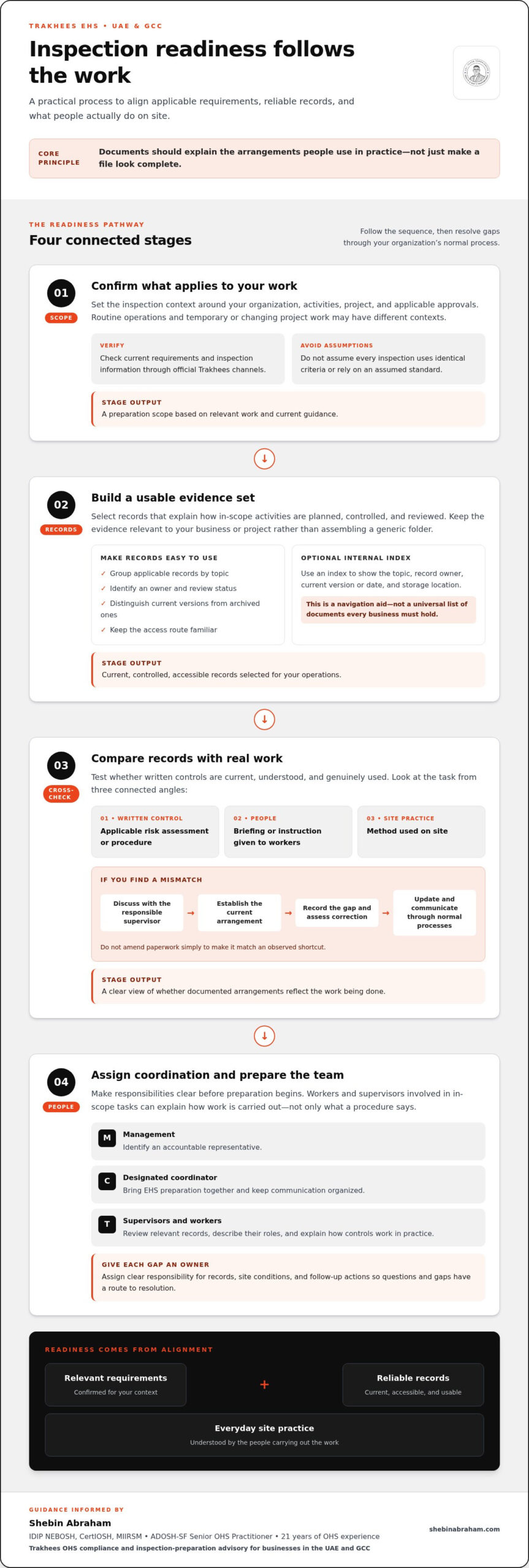
Effective Trakhees EHS inspection preparation brings three things into alignment: the requirements that apply to your organization, the controls described in your records, and the work people actually carry out on site. Readiness isn’t established by collecting documents alone. Evidence should help explain how relevant health and safety arrangements operate in practice.
Inspection scope can vary with the organization, its activities, the project, and the approvals that apply. A business undertaking routine operations may have a different context from a project team carrying out temporary or changing work. Don’t assume every inspection follows an identical set of criteria. Confirm current requirements and inspection information through official Trakhees channels, then focus your preparation on the information relevant to your context.
Use this guide as a practical way to assess readiness, not as a complete statement of Trakhees compliance requirements or a replacement for permit application and submission instructions. Keep those processes distinct: inspection preparation focuses on whether applicable arrangements are understood, available, and reflected in site practice. Where a requirement is unclear, rely on current official guidance rather than an assumed standard.
Who should coordinate inspection readiness?
Set clear responsibility before preparation begins. Management should identify an accountable representative, while a designated coordinator brings the EHS preparation together and keeps communication organized. Involve supervisors and workers whose tasks could fall within the inspection scope; they can explain how work is carried out beyond what a procedure says. Assign owners for records, site conditions, and follow-up actions so each question or gap has a clear route to resolution.
Why paperwork alone does not establish readiness
Written arrangements matter when they describe the work people perform, not an idealized version of it. For example, if a procedure describes how a task is planned and supervised, compare that description with how supervisors brief and oversee the task in practice. The details will differ by workplace. The aim is to establish whether applicable arrangements are current, understood, and genuinely used, rather than assume one document or control is required everywhere.
A useful review connects the evidence to what can be observed. If records describe a process that has changed, or workers follow a different routine, address the mismatch before an inspection. Discuss it with the people responsible, establish what the current arrangement should be, and make appropriate updates through the organization’s normal process. This keeps preparation focused on reliable information and safer, more consistent work, rather than making a file appear complete.
Organize Trakhees EHS records around real work and current requirements
A useful evidence set is shaped by the business or project, not by a generic folder of safety paperwork. Start by identifying the activities in scope and the current Trakhees requirements that apply to them. Then gather relevant records that explain how those activities are planned, controlled, and reviewed. Inspection and submission document requirements can change, so verify them through current official Trakhees guidance rather than relying on an old template or another organization’s files.
During Trakhees EHS inspection preparation, make records easy to trust and use. They should be current, controlled, accessible to the people who need them, and consistent with the work being done. A document that is difficult to locate, has unclear approval status, or describes a superseded arrangement can create confusion even when site practice is sound.
Make safety documentation usable during an inspection
Group applicable records by topic, assign an owner, and show their review status. Use a clear naming convention or index so a supervisor can distinguish the current version from an archived one. Keep the access route familiar to the people coordinating the inspection. This makes relevant evidence easier to retrieve through your normal document-control process without interrupting work to search unrelated folders.
A simple index might identify the topic, record owner, current version or date, and storage location. Treat it as an internal navigation aid, not a list of documents every business must hold. Select evidence based on applicable guidance and your operations. Before the inspection, ask the relevant supervisor to locate and explain the records, so the process doesn’t depend on one person’s memory.
Connect records with training and operational controls
Training evidence is most useful when it relates to the person’s assigned role and current activities. Compare what the record says with the work the person is expected to perform, then consider whether the relevant briefing or instruction is reflected in daily practice. The purpose is to check fit and clarity, not to assume that a particular training record is universally required.
Make the connections visible. For a task, review the applicable risk assessment or procedure alongside the briefing given to workers and the method used on site. If they differ, ask the responsible supervisor whether the activity or its controls have changed. Record the gap, assess what needs correction, and follow the organization’s process for updating arrangements and communicating changes. Don’t amend paperwork simply to make it match an observed shortcut.
When evidence is extensive or the relationship between written controls and site practice is difficult to assess, a specialist review can help bring the picture together. Trakhees OHS consulting support from Shebin Abraham helps organize relevant records and identify inconsistencies for follow-up. Keep the focus on accurate, useful evidence that supports safe work, not on building a file that looks complete but fails to reflect operations.
Prepare site operations, workers, and supervisors for inspection questions
Records can describe intended controls, but a walkthrough shows how work is being carried out. Plan the review around activities and risks relevant to the inspection scope, rather than treating every area as equally relevant. Consider where work is active, where conditions are changing, and which tasks supervisors and workers may be asked to explain.
Use a focused operational walkthrough
Walk the relevant work areas with a supervisor who understands the activity. Observe how tasks are organized and whether the controls described in applicable procedures and briefings are evident in practice. Access, housekeeping, equipment use, and safeguards may be relevant, depending on the work. Keep the review proportionate to the activity; don’t treat any single observation as a universal Trakhees requirement.
Make observations specific enough to act on. Record the location or task, what was observed, and who is responsible for assessing the issue. If you identify an immediate risk, escalate it through the organization’s established process rather than leaving it for a later inspection discussion. For other gaps, agree on an owner and follow-up action, then track whether the response addresses the underlying condition.
Keep the walkthrough genuine. Don’t move hazards out of view, pause normal controls to create a staged impression, or conceal an unsafe condition. A realistic review gives management a chance to address concerns and helps ensure that what workers explain matches what is happening around them.
Help workers and supervisors communicate clearly
Before the inspection, explain its purpose, the areas or activities in scope, and who will coordinate questions. This helps people know where to direct requests without making them feel they need to perform or memorize answers. A briefing should support clear communication, not rehearse a script.
Invite workers to describe their actual tasks in their own words. They should be able to explain the hazards they encounter and the controls they use as part of the job. If someone is unsure, don’t prompt them with an answer to repeat. Note whether further instruction or clarification may be needed, and address it through normal supervisory channels.
Supervisors can help by answering accurately, referring to relevant arrangements when needed, and being clear about what they know. If a question falls outside their knowledge, they should avoid guessing and involve the appropriate person. Honest answers support a more useful inspection conversation than rehearsed statements that don’t reflect site practice.
Use Trakhees EHS inspection preparation to strengthen safe, everyday work, not just presentation on inspection day. Review observations with the people responsible, prioritize concerns through established processes, and confirm that agreed actions are completed. This practical approach connects what is documented with what workers experience on site.
Decide where Trakhees EHS consulting can strengthen inspection readiness
Internal coordination may be enough when responsibilities are clear, records are consistent, and supervisors can explain how documented arrangements apply to current work. Specialist support is useful when teams are unsure how to interpret applicable requirements, evidence is fragmented, or operational changes have left procedures and practice out of step. Choose the scope of support based on your organization’s capacity and inspection context, not on an assumption that every business needs the same input.
Signs that specialist preparation support may help
Look for practical signals: no one is sure who owns a record, different teams rely on different versions, or an earlier finding remains unresolved without a clear action owner. These issues make it harder to understand readiness and prioritize attention. An independent perspective can bring uncertainties into view before the inspection, while decisions and corrective actions remain with the organization’s management.
The type of review matters. A document-only review can examine whether records are organized, current, and consistent with each other. It may not show whether the controls described are understood or used on site. A broader review can connect records with operational arrangements, speak with relevant supervisors, and consider observed work practices and follow-up actions. The right scope depends on what your team needs to clarify.
Neither approach guarantees an inspection outcome, and consulting doesn’t transfer management accountability. Treat external advice as a way to strengthen understanding and support sound decisions. Your team remains responsible for assessing identified issues, deciding appropriate actions, and ensuring agreed improvements are carried through.
What tailored Trakhees OHS consulting can address
Trakhees OHS consulting helps an organization interpret relevant compliance requirements and prepare for an inspection in its specific business or project context. Shebin Abraham shapes the advisory work around the questions the team needs to resolve, rather than assuming a standard package of records or controls applies everywhere. Check any requirement or inspection instruction against current official Trakhees guidance.
Practical advisory support connects three parts of readiness: applicable requirements, the organization’s documented arrangements, and what is happening in operations. A review can clarify where evidence needs attention, whether site practice reflects written controls, and how to assign identified improvement actions. This joined-up perspective is useful when preparation is spread across management, EHS, and operational teams.
Shebin Abraham brings 21 years of OHS experience and specialized Trakhees compliance and inspection-preparation advisory. His guidance considers each organization’s circumstances, including both documentation and the realities of work. Businesses seeking broader workplace safety advisory can also explore UAE OHS consulting and freelance HSE support.
If responsibilities, evidence, or follow-up actions remain unclear, Trakhees OHS consulting can help your team focus its review on the issues that matter to its inspection context.
Manage the Trakhees EHS inspection and turn findings into action
A clear inspection-day process helps your team respond calmly and keep attention on safe operations. Before the inspection, designate a coordinator who can communicate with relevant supervisors and record owners and knows how to locate information likely to be requested. Include a plan for capturing observations and moving them into your normal follow-up process as part of Trakhees EHS inspection preparation.
Keep inspection-day coordination calm and reliable
The coordinator can guide communication, but shouldn’t become the only person who understands the work or holds the records. Make sure relevant supervisors know how to reach them, and workers know who is coordinating questions. Provide accurate information through the organization’s agreed process. If a detail needs checking, say so and identify who can verify it rather than guessing.
Keep normal work practices in place. Don’t stage a demonstration or change conditions to create an impression that differs from everyday operations. A calm, factual explanation of how a task is usually carried out is more useful than rehearsed answers. If a question raises a concern, record it and route it to the person responsible for assessing the issue.
Follow through on inspection findings
Capture findings accurately, using clear descriptions rather than assumptions about causes or requirements. Confirm what action is expected through applicable channels, then assign an owner and an appropriate priority. Set a follow-up date through your organization’s process, and retain evidence of completed actions where that process requires it.
Some observations may call for prompt attention, while others may need review before an action is agreed. Keep the distinction clear. If the issue relates to a work practice, involve the supervisor and relevant workers in understanding what happened and what improvement is practical. If documentation needs attention, identify the responsible owner and make changes through established document-control arrangements. This gives each finding a route from observation to resolution.
After actions are assigned, check their progress rather than treating the inspection record as the endpoint. Confirm that the agreed response has been completed and addresses the finding. If circumstances change or an action cannot be completed as planned, document the status and agree on the next step through the appropriate internal channel. Consistent follow-up supports learning and helps management see whether improvements are holding in day-to-day operations.
For UAE and GCC businesses that need practical, project-specific preparation support, Shebin Abraham provides Trakhees OHS consulting informed by 21 years of OHS experience. Shebin holds IDIP NEBOSH, CertIOSH, and MIIRSM credentials and is an ADOSH-SF Senior OHS Practitioner. Discuss tailored Trakhees EHS preparation support with Shebin Abraham to help connect inspection findings with clear, workable follow-up.
Make readiness part of everyday operations
Use the period after an inspection to strengthen how your organization learns from its own work. A recurring review of changing activities, responsibilities, and improvement actions can help keep arrangements relevant between inspections, rather than turning preparation into a last-minute exercise. Keep current Trakhees guidance central, and tailor your approach to the scope that applies to your business or project.
Where your team needs experienced, project-specific advice, Shebin Abraham provides specialized Trakhees OHS compliance and inspection advisory. He is an ADOSH-SF Senior OHS Practitioner with IDIP NEBOSH, CertIOSH, and MIIRSM credentials, and 21 years of OHS experience.
Discuss your Trakhees EHS inspection preparation with Shebin Abraham and take a considered next step toward making safe, well-managed work part of daily practice. With clear ownership and practical guidance, your team can move forward with confidence.
Frequently Asked Questions
What should a company prepare before a Trakhees EHS inspection?
Confirm the inspection context, identify who will coordinate responses, and make relevant information easy to retrieve. Trakhees EHS inspection preparation should also include a review of recent operational changes, such as a new task, revised work area, or change in supervision. These changes can affect how existing arrangements apply. Check current official Trakhees information for applicable requirements, since inspection expectations shouldn’t be assumed to be identical for every organization.
Which documents may be relevant to a Trakhees EHS inspection?
Relevant documents depend on the organization’s activities and inspection scope. They may include applicable risk assessments, work procedures, training or briefing records, and records showing how identified issues were addressed. Treat these as examples, not a universal document list. Before presenting a record, check that it relates to the work being discussed and that its status is clear. Verify specific documentation requests through current official Trakhees guidance or inspection communication.
How can workers prepare for questions during a Trakhees inspection?
Workers can prepare by understanding the purpose of the inspection and being ready to describe their normal tasks honestly. A supervisor might invite a worker to explain how a routine task is carried out, what could create risk, and which controls they use. Encourage questions if instructions are unclear. Workers shouldn’t memorize scripted responses or guess at answers. Clear, natural explanations give a more accurate picture of how work is performed.
Can a business use its existing OHS procedures for Trakhees inspection preparation?
Yes, existing OHS procedures can be a useful starting point if they suit the organization’s activities and applicable requirements. Review them for changes in work methods, responsibilities, or operating conditions. For example, a procedure written for an earlier task arrangement may no longer describe current practice. Confirm that the procedure remains relevant and that the people expected to follow it understand it. Check applicable Trakhees guidance for any specific requirements.
What should a company do if it identifies gaps before a Trakhees EHS inspection?
Record each gap clearly, notify the responsible supervisor or manager, and assess what action is appropriate through the organization’s established process. Separate urgent concerns from issues that need further review, and assign an owner to each action. If a procedure and current work differ, establish which arrangement is appropriate before changing records. Keep a record of decisions and progress so the team can explain the status accurately if asked.
When should a business consider Trakhees EHS consulting?
Consider specialist support if your team is uncertain about applicable requirements, has conflicting records, or needs an independent view of how documented arrangements relate to site practice. Consulting can also help when preparation responsibilities are spread across teams or findings lack clear follow-up. Shebin Abraham provides tailored advisory input, while management remains responsible for organizational decisions and actions. The review should reflect the business or project context, not assume a standard approach fits all.
Does Trakhees inspection preparation differ between project types?
Yes, preparation can differ because activities, risks, project conditions, and applicable approvals may vary. A site carrying out one type of work may need to consider different operational arrangements from a business performing another activity. Start by defining the inspection context, then identify which current requirements and records relate to it. Don’t rely on another project’s preparation materials as a complete guide; verify relevant expectations through official Trakhees channels.
How can an organization follow up on Trakhees inspection findings?
Translate each finding into a clear action, identify who owns it, and agree how progress will be tracked through the organization’s process. Clarify the finding before deciding on a response, especially if its wording or implications are unclear. Retain appropriate evidence when an action is completed, and review whether it addressed the issue in practice. If a finding requires clarification, use the applicable communication channel rather than relying on assumptions.