

What makes Trakhees construction safety requirements useful on site is not simply knowing the rules. It is connecting each applicable requirement to the work being planned and the controls people will use. Project teams may understand the importance of safety but still be unsure which official requirements apply or how to turn regulatory wording into practical arrangements.
Construction activities change across project phases, so safety planning needs to keep pace. This article explains how to identify relevant Trakhees requirements, relate them to project activities and review site arrangements as work progresses. It also covers how specialist guidance can help teams interpret requirements and apply them to real project conditions.
Written by Shebin Abraham, IDIP NEBOSH, CertIOSH, MIIRSM, an ADOSH-SF Senior OHS Practitioner with 21 years of OHS experience, this guide offers a practical perspective on Trakhees compliance for UAE and GCC construction work. You’ll find ways to distinguish official requirements from implementation advice and connect safety planning to changing site needs.
Key Takeaways
- Use current official Trakhees material to identify which construction safety requirements apply to the project.
- Translate verified requirements into controls that address the hazards and activities taking place on site.
- Review safety arrangements at each project phase and when work conditions change.
- Assign practical ownership for implementing and reviewing controls so compliance is part of day-to-day work.
- Trakhees OHS advisory can help teams interpret requirements and apply them to project conditions.
What do Trakhees construction safety requirements cover?
In this article, Trakhees construction safety requirements refers to construction safety provisions in the official Trakhees construction safety document identified as Regulation CS-4.0. Use the current official document to confirm its scope, revision and applicable provisions before relying on a specific requirement for a project.
A general explanation can help teams understand construction safety principles, but it cannot determine what Trakhees requires for a particular project. For a wider introduction, see Construction Safety Principles. Treat that background as supplementary information, not a replacement for the official regulation or project-specific interpretation.
How PCFC, Trakhees, and Regulation CS-4.0 fit together
PCFC is the wider regulatory organisation, and Trakhees is its regulatory arm for designated areas and activities. In this context, Regulation CS-4.0 is the identified official document to consult on construction safety. Refer to its current text when determining the scope, applicability or detail of a particular provision.
Training and registration information serves a different purpose. A course catalogue can describe learning or registration schemes, but it does not replace regulatory wording or establish that a particular course is required for a project role. Use the regulation to confirm construction-specific provisions and treat learning resources as supporting material.
How to establish which requirements apply to a project
Start with the project scope and the official sources that govern it. Confirm that you are using the current document, identify its stated applicability and compare relevant provisions with the work planned. A useful first step is to list the main activities and phases, then note which provisions appear relevant and where interpretation is needed.
Keep confirmed regulatory provisions separate from implementation guidance. A team might discuss an activity during planning meetings to communicate safety expectations. Unless the official text establishes that discussion as a requirement, describe it as a project-level practice, not a Trakhees mandate.
When scope or wording is unclear, record the question and obtain qualified, project-specific OHS interpretation before turning an assumption into a site instruction. This creates a clearer basis for decisions and helps safety arrangements reflect both the verified source and the work people will perform.
Shebin Abraham, IDIP NEBOSH, CertIOSH, MIIRSM, is an ADOSH-SF Senior OHS Practitioner with 21 years of OHS experience. His Trakhees OHS advisory work helps teams interpret applicable requirements in the context of their construction projects.
Which construction safety control areas should project teams examine?
Begin with the current official text of Regulation CS-4.0 and any relevant Trakhees guidance. Treat the subjects in this section as areas to review, not as a confirmed list of regulatory requirements. Include a control in a summary of Trakhees requirements only when an applicable official source supports it. This prevents general safety examples from being presented as rules for every project.
For each provision you verify, make its practical meaning clear by connecting three points: the hazard or exposure it addresses, the control stated in the official source, and the way that control relates to the project’s work. Keep the regulatory description close to the source. Then explain site-level application separately, so readers can distinguish a provision from an implementation suggestion.
Connect hazards to verified site controls
Build the connection from the actual scope of work. Identify the activity being planned, consider its hazards, and compare them with the relevant CS-4.0 provision and applicable official guidance. If a provision applies, explain what it calls for without extending it into a broader duty that the source does not establish.
Site arrangements will depend on project conditions. Planning discussions, work instructions or site briefings may help put a verified control into practice. Present those measures as implementation guidance unless the official text specifically makes them a requirement. This keeps advice useful without suggesting that one arrangement applies to every construction activity.
Account for competence, communication, and supervision
Training, registration and role requirements need the same source discipline. Trakhees’ course catalogue lists offerings such as Manager Safety Awareness and the Safety Advisor and Safety Supervisor Registration Schemes. These listings describe courses or schemes. On their own, they do not establish that a particular project role must hold a particular registration. Confirm any such requirement in the current official material.
Clear communication is a practical part of implementation. Teams can explain relevant controls in language workers understand, coordinate work between people sharing an area and pass on updates when plans change. These steps support understanding and coordination. Describe them as good practice unless a current official provision confirms a specific obligation.
As a source-attribution rule, call a control a Trakhees requirement only when the current official CS-4.0 text or applicable official guidance supports that claim. Otherwise, label it as general safety practice or implementation guidance. This distinction makes Trakhees construction safety requirements easier to interpret without blurring regulatory text and practical advice.
Where teams need help relating verified provisions to site conditions, Trakhees OHS advisory support can help translate regulatory wording into practical implementation guidance.
Trakhees Safety and Construction Project Phases
Verified safety requirements need to stay connected to the work as a project moves from planning to execution and review. Regulation CS-4.0 and applicable official guidance provide the basis for confirming regulatory provisions. The phase-by-phase examples below are implementation guidance, not a statement that Trakhees mandates these particular steps.
| Project phase | Implementation guidance |
|---|---|
| Planning | Compare the proposed scope and work sequence with current official requirements. Note relevant provisions and identify questions that need interpretation. |
| Before site activities begin | Turn verified provisions into practical arrangements suited to the planned activities and site conditions. Brief the people involved on controls that affect their work. |
| Active work | Observe whether planned arrangements remain suitable as tasks progress and work areas or interfaces change. Communicate relevant updates to affected teams. |
| Review and change | Revisit hazards, controls and applicable provisions when the scope, sequence or conditions change. Adjust implementation guidance where needed. |
Before site activities begin
Use the planning stage to understand the work, its sequence and the site conditions that may affect it. Compare that picture with current official Trakhees material. For each relevant provision, decide how the team will put it into practice. Resolve questions about scope or interpretation before treating an assumption as a requirement.
Planning discussions can also clarify how activities interact. For example, teams can consider whether the sequence or shared work areas create interfaces that need coordination. This is a practical planning approach, not a claim about a specific CS-4.0 clause. Keep permit-submission details separate from this project lifecycle discussion.
During active work and when conditions change
Work rarely stays exactly as first planned. A task may move, its sequence may change or another activity may affect the same area. As part of implementation, consider whether changed conditions affect the hazards, the relevance of a verified requirement or the way a control is being applied. Communicate material updates to the people whose work is affected.
Review and communication help keep controls relevant and understood, but they do not replace compliance with applicable official requirements. A written plan alone cannot show whether arrangements still fit conditions on the ground. Pay attention to how work is actually carried out and revisit relevant controls when circumstances shift.
This staged approach helps teams apply Trakhees construction safety requirements consistently without confusing project-level practices with regulatory provisions. The aim is to keep verified requirements, changing work and the people carrying it out aligned.
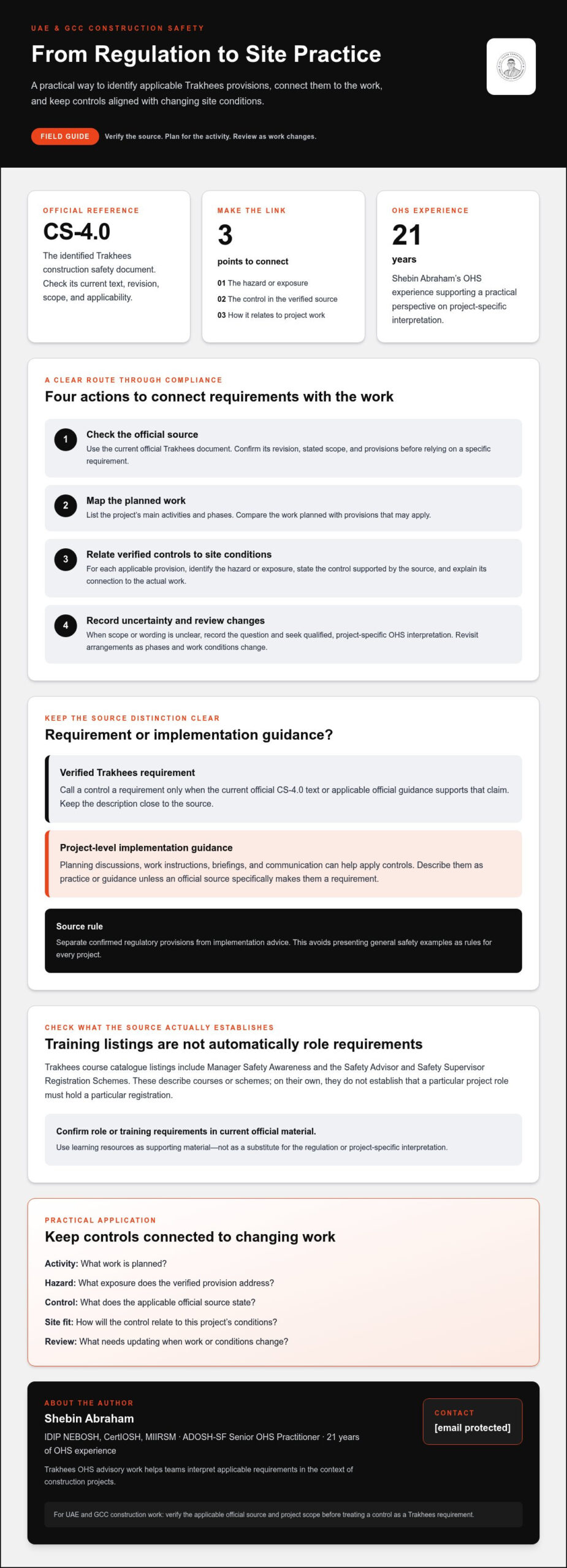
How can teams turn Trakhees requirements into consistent site practice?
Consistency comes from making each verified requirement understandable, assigning practical ownership and checking whether the agreed approach still fits the work. First establish what applies using current official Trakhees material. Then build project arrangements around confirmed provisions rather than assumptions. The sequence below is an implementation aid, not a separate compliance checklist.
- Clarify the requirement. Identify the applicable official provision and the project activities it relates to. Keep the source wording distinct from explanations added for the team.
- Connect it to project arrangements. Decide which existing process or work activity will put the requirement into practice. Assign a suitable person or function to coordinate that process, based on the project’s organisation.
- Communicate what people need to do. Explain relevant controls before work begins and reinforce them during the work where needed. Use task-specific language so workers understand how the arrangements relate to their activities.
- Review and respond. Use observations, feedback and changes in work conditions to identify arrangements that need attention. Address gaps through established project processes and revisit the relevant requirement when circumstances change.
Translate verified requirements into responsibilities and communication
Practical ownership does not mean assigning a legally mandated role without evidence. It means identifying who will coordinate a project process, communicate relevant controls or raise an issue through agreed channels. Formal role descriptions should reflect applicable official requirements and the project’s actual arrangements.
Supervisors and other relevant team members can help make controls clear by relating them to the day’s work, explaining changes that affect a task and giving workers a way to raise concerns. These are implementation practices. Present them as specific Trakhees duties only when the current official source supports that description.
Review implementation and improve controls
Ongoing review helps teams notice when a control no longer fits the conditions or when workers need clearer communication. Record and address gaps through appropriate project processes, then consider whether the applicable requirement or its implementation needs review. An internal review helps manage site arrangements. It is not a formal Trakhees inspection or approval, and it does not replace either.
Keep submission-specific matters separate from day-to-day implementation. The dedicated article on Trakhees safety permit documentation can provide focused guidance on that topic, while this section explains how teams maintain practical controls after identifying applicable requirements.
Shebin Abraham’s 21 years of OHS experience inform his practical approach to interpreting requirements and supporting implementation. Project decisions should still be grounded in current official guidance. For tailored help applying verified requirements to site processes, explore Trakhees OHS consulting support.
When can Trakhees OHS consulting support a construction project?
Specialist support can help when a team is unsure how a verified Trakhees provision relates to its scope of work, needs to review existing safety arrangements or wants to turn regulatory wording into practical site processes. The aim is to improve understanding and implementation, not to replace official guidance or the project team’s operational decisions.
For construction work in the UAE and GCC, interpretation needs to account for both the official context and the project’s activities, conditions and existing arrangements. Advisory support can help teams examine that connection and distinguish general safety practice from a confirmed Trakhees obligation.
What practical advisory support can address
Shebin Abraham provides Trakhees OHS advisory, compliance assessments, construction safety guidance and documentation support. This work can help teams review applicable safety protocols, assess how existing arrangements align with verified requirements and identify where implementation needs clearer coordination.
For example, a team may have a documented control but need to understand how it fits the work sequence or how to communicate it to the people carrying out the task. Advisory guidance can make that connection clearer and more practical. Regulatory claims remain anchored to current official sources, while project-specific recommendations are presented as guidance rather than official requirements.
Consulting can support interpretation and implementation, but it cannot guarantee regulatory approval, an inspection outcome or compliance. Current official material remains the basis for determining what Trakhees requires. For broader OHS advisory considerations, readers may also refer to a UAE occupational health and safety consultant guide.
A clear next step for project teams
Start by setting out the project context and the question that needs resolving. Include the construction scope, the activity or arrangement under review, and the point where the team needs help connecting official requirements to site practice. A clear question helps focus the discussion on relevant interpretation and practical implementation.
Shebin Abraham, IDIP NEBOSH, CertIOSH, MIIRSM, is an ADOSH-SF Senior OHS Practitioner with 21 years of OHS experience. His experience informs his advisory work, while current official Trakhees material remains the reference for regulatory requirements.
If your team needs help interpreting Trakhees requirements or strengthening how they are applied on site, discuss the project context and the safety question you’re working through.
Build confidence into the next project decision
Make the next step practical: choose an upcoming activity or change in scope, then identify the official guidance that applies and consider how the relevant controls will work for the people doing the job. A focused review can surface questions early, before assumptions become embedded in site arrangements. Keep confirmed Trakhees construction safety requirements distinct from project-level implementation guidance.
If interpreting a provision or applying it to construction activities is challenging, specialist advice can bring the regulatory context and operational realities into the same discussion. Shebin Abraham provides Trakhees OHS advisory, compliance assessment and implementation support, drawing on 21 years of OHS experience.
Discuss Trakhees OHS support for your project and outline the project context and safety question you’d like to address. A focused conversation can help your team strengthen practical safety arrangements and keep attention on the wellbeing of everyone involved.
Frequently Asked Questions
What is Regulation CS-4.0 in Trakhees construction safety?
Regulation CS-4.0 is the identifier given to the official Trakhees construction safety document. Use its current text to confirm construction-specific provisions rather than relying on a summary or training catalogue. To determine whether a provision relates to planned work, compare its wording with the project scope and obtain qualified interpretation if the application remains unclear.
Do Trakhees construction safety requirements apply to every project?
Applicability depends on the project and the scope established by current official material. Do not assume that a rule for one type of work automatically applies to another. For example, when planning a change to an existing site, establish whether the work falls within the relevant document’s scope before treating a provision as applicable. Use project-specific OHS interpretation to resolve scope questions.
Where can I find the current Trakhees construction safety regulations?
Use the official PCFC or Trakhees rules and regulations material, including the construction safety document identified as Regulation CS-4.0. Confirm the document’s current status and applicability before using it to guide a project decision. If you are reviewing a saved or previously circulated copy, compare it with the official material rather than assuming it reflects the current version.
Does Trakhees require construction safety training for site personnel?
Confirm training requirements in current official Trakhees material that applies to the project and personnel. A course listing alone does not establish that every site worker must complete a specific course. The Trakhees catalogue includes offerings such as Manager Safety Awareness and Safety Advisor or Safety Supervisor Registration Schemes. Treat these as catalogue information, then verify any claimed project-specific requirement against an official source.
What is the difference between Trakhees safety requirements and general OHS practices?
Trakhees requirements are provisions supported by applicable official Trakhees material. General OHS practices are measures teams use to manage workplace risks, but they should not be labelled as Trakhees rules unless an official source supports that description. For example, a project may choose a particular way to brief workers about a task. Describe that as an implementation approach unless the relevant regulation requires it.
Can project safety requirements change when construction activities or site conditions change?
Establish applicable provisions from current official sources, then consider how a change in work affects their application and the project’s controls. If a planned task changes or another activity affects the work area, review the relevant hazards and arrangements, and communicate updates to those involved. This is sound management practice, but it does not replace regulatory interpretation or any applicable formal process.
Who can help interpret Trakhees OHS requirements for a construction project?
A qualified OHS adviser can help teams interpret applicable material and relate it to project conditions. Shebin Abraham provides Trakhees OHS advisory, compliance assessment and implementation support. He holds IDIP NEBOSH, CertIOSH and MIIRSM credentials, is an ADOSH-SF Senior OHS Practitioner and has 21 years of OHS experience. His guidance supports practical understanding, while current official Trakhees sources remain the basis for regulatory requirements.