

What if the biggest inspection gap isn’t missing paperwork, but a difference between what your procedures say and what workers do on site? Preparing for how to pass Trakhees safety inspection means bringing those two sides into alignment, not simply arranging files before the inspector arrives.
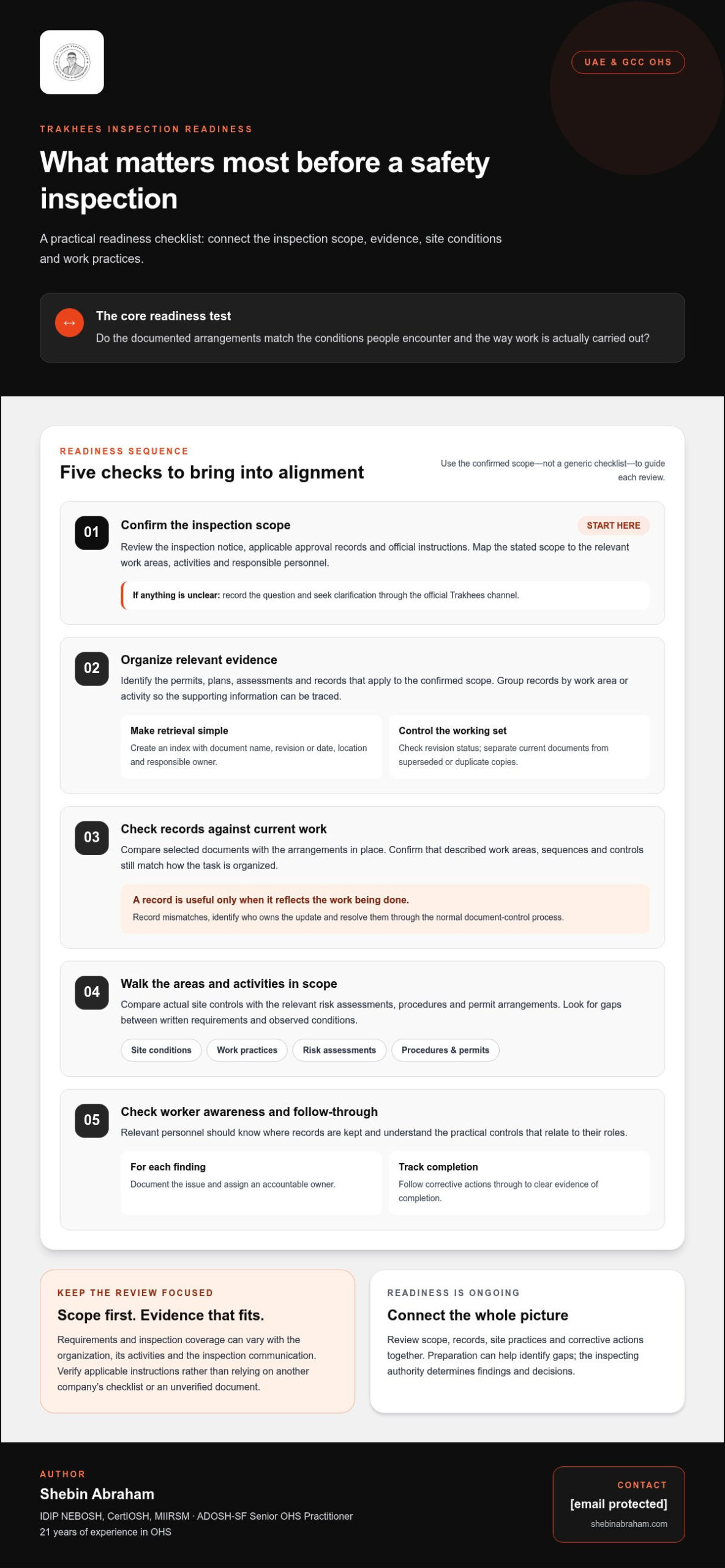
Inspection readiness depends on your project scope and applicable Trakhees requirements. A useful review connects the records you hold with the conditions people encounter during work, so your team can identify gaps before the inspection.
This guide gives you a practical way to review documents, site conditions, and worker awareness, then assign and track corrective actions. It also explains how to make preparation an ongoing part of safety management rather than a last-minute task.
Shebin Abraham, IDIP NEBOSH, CertIOSH, MIIRSM, is an ADOSH-SF Senior OHS Practitioner with 21 years of OHS experience. His Trakhees OHS consulting helps organizations connect applicable requirements with evidence, site conditions, and the way work is carried out.
Key Takeaways
- To understand how to pass Trakhees safety inspection, prepare around the confirmed scope rather than assuming every inspection covers the same items.
- Organize relevant records so they’re current, easy to trace, and consistent with site arrangements.
- Walk through the areas and activities in scope, comparing actual controls with the relevant risk assessments, procedures, and permit arrangements.
- For each finding, document the issue, assign an accountable owner, and track corrective actions with clear evidence of completion.
- Make readiness repeatable by reviewing inspection scope, records, site practices, and follow-up actions together.
How to Pass a Trakhees Safety Inspection by Preparing for the Actual Scope
To understand how to pass Trakhees safety inspection, start by establishing what the inspection is intended to review. Readiness isn’t a universal stack of documents or a last-minute site tidy-up. It means aligning the requirements that apply to your organization and activities with your documented arrangements and the work an inspector can observe.
Inspection readiness is the consistent alignment of applicable requirements, reliable evidence, safe site conditions, and the way people carry out their work. A procedure alone can’t show whether a control is used in practice. A well-managed work area can also be difficult to assess if the supporting records are missing or unclear.
The scope can vary according to your organization, its activities, and the inspection communication. Don’t assume that another company’s checklist or a general document list defines what your inspection will cover. Use the information that applies to your own operations to guide your preparation.
Start by confirming what this Trakhees inspection covers
Review the inspection notice, applicable approval records, and official instructions available to your organization. Map the stated scope to the work areas, activities, and responsible personnel it covers. If the communication identifies a particular work area, for example, make sure the people overseeing and performing work there understand which records and arrangements relate to it.
Write down any unclear points and seek clarification through the official Trakhees channel. This helps your team focus on relevant requirements without guessing or overlooking activities. Keep a record of the scope information used to guide your review.
Use the wider compliance framework without duplicating it
This section focuses on inspection readiness, not a full account of every Trakhees OHS requirement. For broader context on the framework, consult the Trakhees OHS compliance practical guide. For a general introduction to the discipline and its role in protecting workers, see Occupational safety and health.
Use that wider understanding to frame your review, then return to the specific inspection scope. Preparation can help you identify and address gaps, but it can’t guarantee a passing outcome. The inspecting authority determines inspection findings and decisions.
Trakhees Inspection Preparation Checklist: Organize Evidence Before the Visit
Once you’ve established what the inspection covers, organize evidence so the relevant record can be found and understood without delay. Don’t rely on a generic document list. Use the inspection communication and applicable official instructions to identify which permits, plans, assessments, and records relate to your organization’s activities.
A clear evidence folder is more than a collection of files. It should let a reviewer follow the connection between an activity, its documented controls, and the people responsible for carrying them out. This makes preparation for how to pass Trakhees safety inspection focused on traceable, useful information rather than paperwork for its own sake.
Organize the records relevant to your inspection
Group applicable records by work area or activity, then create an index showing each document’s name, current revision or date, location, and responsible owner. Someone reviewing a specific activity should be able to locate its permit arrangements and supporting assessment without searching through unrelated files. The records you need depend on the confirmed inspection scope.
- Use official instructions: Identify which permits, plans, assessments, and other records apply to the inspection.
- Make retrieval simple: Arrange records by the work area or activity they support, and keep a clear index.
- Control the working set: Check revision status and separate current documents from superseded or duplicate copies that could cause confusion.
- Name an owner: Assign someone to maintain each record and help relevant personnel locate it.
For submission-focused guidance, use the Trakhees safety permit documentation guide alongside the requirements that apply to your inspection. It can help you review permit documentation, while your inspection folder should still reflect the specific scope and current instructions.
Check whether records reflect current work
Before the visit, compare selected records with the arrangements in place. If a document describes a particular work area, sequence, or control, check that it still matches how the task is organized. A current-looking file isn’t useful if it describes arrangements that have changed. Record any mismatch, identify who owns the update, and resolve it through your normal document-control process.
Check accessibility with the people who use the records. Relevant personnel should know where documents are kept and be able to explain how they guide or support their work. They don’t need to recite a document word for word, but they should understand the practical controls relevant to their role. This check can reveal gaps between written arrangements and day-to-day practice.
If your team has a Trakhees PDF labelled 2022, don’t assume its title proves it is current or applies to your inspection. Verify the latest applicable requirements through official Trakhees instructions before relying on it, and make sure any document or checklist matches your inspection scope.
For help aligning permit records with site arrangements, Trakhees OHS preparation support can provide practical guidance tailored to the work and inspection scope.
On-Site Trakhees Safety Inspection Checklist: Review Conditions and Work Practices
Records describe intended controls, while a site walk-through helps you check whether those arrangements are reflected in the work. Keep the review within the confirmed inspection scope and observe normal operations, rather than preparing only areas that look presentable. The aim is to identify practical gaps early and decide what action is needed.
For construction-specific context, the Trakhees construction safety requirements guide can help frame issues relevant to construction activities. Apply any guidance alongside the official instructions and requirements for your own scope.
Walk the site against the work actually taking place
Plan a route through the work areas and activities identified for review. At each point, compare what you see with the relevant risk assessment, procedure, and permit arrangements. Check whether the controls described in those records are present and being used as intended. If a task or condition changes during the walk-through, note the difference instead of assuming the original paperwork still reflects the work.
Where relevant to the scope, review access and housekeeping, equipment condition, and controls around active tasks. Check that the protective measures identified for the work are available and in use. Don’t treat a visual check as a technical test or assume that a control is suitable simply because it is present. Compare observations with applicable documented arrangements and follow up on inconsistencies.
Record each gap in a way that helps the responsible team act. Capture the location, activity, observed condition, responsible person or role, and a practical next action. “Work area” is too broad to guide follow-up, for example. Identify the specific area and task, then state what needs attention. Keep notes factual and distinguish an observation from an assumption about its cause.
Check worker understanding through normal engagement
Speak with workers as part of the walk-through. Invite them to describe the hazards they encounter during their task and the controls they use. Ask how they raise a concern and who supervises or supports the work. Let people answer in their own words. Coaching rehearsed responses can hide gaps, while ordinary conversation and observed practice give a more useful picture of understanding.
Worker awareness isn’t a memory test. Listen for whether an explanation fits the actual task and matches the controls in the relevant documents. If the answer and observed practice differ, explore the reason respectfully. The issue may point to unclear instructions, changed work arrangements, or a control that isn’t being followed as intended. Record what you observed and address it through the appropriate process.
Observed practice must match documented controls because safety depends on what people can apply during real work, not only on what a procedure says.
To connect site observations with tailored Trakhees OHS preparation, explore practical OHS support focused on your inspection scope.
How to Address Trakhees Inspection Findings and Demonstrate Follow-Through
A finding needs more than a quick fix and a note that it’s complete. Treat each observation communicated by the inspecting authority as a traceable action: understand what was found, control any immediate concern, identify why it occurred, and verify that the corrective measure works in practice. This gives your team a clear record of its response and supports safer work.
Follow the process and timelines stated in the inspection communication. Don’t assume that every inspection uses the same response format, submission route, or deadline. If a direction is unclear, seek clarification through the official channel rather than relying on a general assumption.
Turn each finding into a traceable corrective action
Record the finding accurately, using the authority’s wording where appropriate. Link it to the affected activity and location, then note the risk, any interim control, and the role accountable for follow-up. Keep the finding distinct from your interpretation of its cause. This helps the people responsible act while preserving a clear account of what was communicated.
Before deciding on a longer-term correction, consider what contributed to the issue. If a control wasn’t followed, for example, explore whether instructions were unclear, arrangements had changed, or responsibilities weren’t understood. A surface-level correction may not resolve the underlying cause. Set a practical completion plan with an action owner, any interim measures, a target date consistent with the authority’s instructions, and evidence to verify completion.
- Describe the finding: Capture its wording, affected activity, location, and relevant risk.
- Control immediate concerns: Record any interim measure taken while longer-term action is planned.
- Assign accountability: Name the responsible role and set a practical completion plan.
- Verify effectiveness: Schedule a follow-up review and retain evidence of implementation.
Prepare a clear response and close-out record
Use the response format and submission route specified in the official communication. Keep the response concise and factual: state the action taken, when it was completed, and what evidence supports that claim. Evidence might include a revised record, an inspection note, or other relevant documentation, provided it directly relates to the finding. Don’t claim closure while an action is still underway. Describe its status accurately and explain the next step.
Close-out should test more than whether a task was marked complete. Revisit the affected activity where appropriate, compare the corrective measure with the original concern, and confirm it is being applied as intended. If it hasn’t resolved the issue, revise the action and continue tracking it rather than closing the record prematurely.
Effective close-out is documented corrective action verified in practice, not simply a response marked complete. A reliable process also clarifies who is accountable and what remains open, reducing the chance that findings disappear into email threads or untracked notes.
For practical help connecting Trakhees inspection findings with corrective-action evidence and site implementation, get support with Trakhees OHS inspection preparation.
Plan Your Trakhees Inspection Readiness with Practical OHS Support
Inspection preparation is strongest when it becomes a repeatable working process, not a rush before a visit. Confirm the scope, review relevant evidence, inspect work in practice, and track any actions that follow. This cycle keeps documents connected to site conditions and gives people a clear role in maintaining safety between inspections.
Knowing how to pass Trakhees safety inspection starts with preparation that fits your organization’s actual activities. A checklist can structure the review, but it can’t guarantee an inspection outcome. The inspecting authority makes its own decisions. Focus on understanding applicable requirements, identifying gaps honestly, and addressing them in a way that supports safer work.
Choose preparation support that fits the inspection scope
OHS support can help teams connect official requirements with records and site implementation. Shebin Abraham provides Trakhees OHS consulting and practical, tailored inspection preparation for operations across the UAE and GCC. This can include reviewing applicable requirements and available evidence against your activities, then identifying where documented arrangements and work practices may not align.
A structured site review can bring potential gaps into view before the inspection. The review should follow the relevant scope, observe work as it is carried out, and capture issues clearly enough for the responsible team to act. When a gap is identified, the team can consider what needs immediate attention, determine a corrective action, assign an owner, and agree how progress will be followed up.
This approach is collaborative. Site personnel contribute practical knowledge of the work, while OHS guidance helps connect that experience with applicable requirements and supporting evidence. The result is a preparation process that supports understanding and action, rather than relying only on a folder of records or a last-minute walk-through.
Make the next step straightforward
Before starting a preparation review, bring together the inspection communication, relevant approvals or records, and a clear picture of the activities and areas in scope. Note your priorities, such as reviewing documentation, checking site arrangements, or organizing follow-up for known gaps. This gives the discussion a practical starting point and keeps it focused on your operation’s needs.
Keep the objective clear: build a more reliable connection between Trakhees requirements, evidence, and the way work is done. If you need tailored help preparing for an inspection, discuss Trakhees inspection preparation with Shebin Abraham. The work can focus on your inspection scope and preparation priorities, without promising a particular regulatory outcome.
Build Readiness Into Everyday Work
The strongest preparation doesn’t end when an inspection is over. Use what your team learns to strengthen routine supervision, keep working documents aligned with site conditions, and make follow-up part of normal operations. This helps people recognize when arrangements have changed and raise concerns before small gaps become harder to manage.
Knowing how to pass Trakhees safety inspection isn’t about rehearsing for a single visit. It’s about building a workplace where applicable requirements, practical controls, and worker understanding remain connected over time. Inspection outcomes remain with the authority, but an ongoing approach gives your organization a clearer basis for maintaining readiness.
For tailored Trakhees OHS advisory, inspection preparation, and permit-documentation support, work with Shebin Abraham on your inspection preparation. Start with a clear view of your scope and priorities, and build a more consistent approach to safer work.
Frequently Asked Questions
Is a Trakhees safety inspection checklist the same for every organization?
No. A single checklist shouldn’t be assumed to fit every organization. A practical answer to how to pass Trakhees safety inspection begins with the inspection communication, applicable requirements, and the activities your organization carries out. A checklist prepared for one operation may omit relevant evidence for another. Verify the current scope through official Trakhees channels, then use a checklist as a working aid, not a substitute for the requirements.
Can an organization pass a Trakhees safety inspection with pending corrective actions?
The inspecting authority determines the outcome, so pending actions don’t guarantee a pass or a particular result. Address immediate risks, record each action transparently, and assign a responsible owner. Keep implementation evidence available, such as a relevant updated record or follow-up observation. Distinguish clearly between work in progress and a resolved finding, and follow the close-out instructions and timelines in the communication you receive.
How much notice does Trakhees give before a safety inspection?
Don’t assume a notice period without current, applicable official information. Follow the inspection communication your organization receives, and maintain readiness rather than relying on advance warning. Keep responsibilities clear and relevant records accessible as part of normal operations, so preparation doesn’t depend on a particular lead time. If timing or instructions are unclear, seek guidance through the relevant official Trakhees channel.
What happens if key site personnel are unavailable during an inspection?
Plan suitable coverage by identifying responsible personnel and representatives who understand the work within their roles. Keep relevant records accessible, and make sure designated staff can explain the controls they oversee. This is a readiness measure, not a claim about formal attendance rules. Follow any instructions in the inspection communication. If an assigned person is unavailable, use your organization’s established arrangements and avoid assuming what the authority will accept.
Is the Trakhees required-documents PDF from 2022 still valid for inspections in 2026?
The filename alone can’t show whether the PDF is current or relevant to your inspection. Before relying on it, compare it with the latest applicable documents and instructions available through official Trakhees sources. Document needs can depend on the inspection scope, so don’t treat an older PDF as a definitive checklist for every organization. Keep a note of the source and version you used when preparing your records.
Can a company pass a Trakhees inspection without a dedicated HSE officer?
Don’t assume a staffing rule without checking the requirements that apply to your organization. Confirm role expectations in the relevant governing instructions, and ensure competent people can explain and implement the controls within their responsibilities. Teams should know who maintains key records and who oversees relevant work. External OHS support can assist with preparation, but responsibility for the organization’s arrangements remains with the organization.
Does passing one Trakhees safety inspection guarantee future compliance?
No. An inspection outcome doesn’t guarantee future compliance. Work activities, site conditions, and applicable requirements may change after an inspection, so maintain controls and keep relevant records aligned with current operations. Treat preparation as part of ongoing OHS management, not a one-time exercise. If work changes, review whether existing arrangements still reflect it and address gaps through your normal follow-up process.