

The most familiar ISO consultant isn’t automatically the right fit. When comparing Dave QMS ISO 45001 consulting alternatives, weigh relevant experience, qualifications, references, standards expertise, fees and the practical value of the support. ISO identifies ISO 45001:2018 as an international standard for occupational health and safety management systems.
Choosing a consultant can feel difficult when proposals use similar language, but the differences matter: the right adviser should understand your operations and help your team make safety management practical. This guide explains what to compare, from industry experience and credentials to project scope, communication and value, with a focus on UAE and GCC needs.
Shebin Abraham is the author, an ADOSH-SF Senior OHS Practitioner with IDIP NEBOSH, CertIOSH and MIIRSM credentials. He brings 21 years of experience in occupational health and safety.
Key Takeaways
- Prioritize consultants whose occupational health and safety experience matches your industry, operational risks and project scope.
- Compare relevant training and standards knowledge, then assess whether the consultant can explain a clear, practical approach to implementation.
- Use references from comparable projects to understand how a consultant works with teams and supports real-world implementation.
- Assess fees against the defined scope, deliverables and ongoing support so you can compare value, not just the headline price.
- For UAE and GCC workplace needs, consider whether focused OHS or ADOSH-SF and Trakhees consulting aligns with your requirements.
Consultant experience with ISO 45001 and occupational health and safety standards
Compare consultants by how they apply occupational health and safety requirements to real work, not by proposal language alone. For UAE organizations, relevant experience means connecting the management system with operational hazards, workforce practices and certification readiness.
ISO 45001 Management Systems
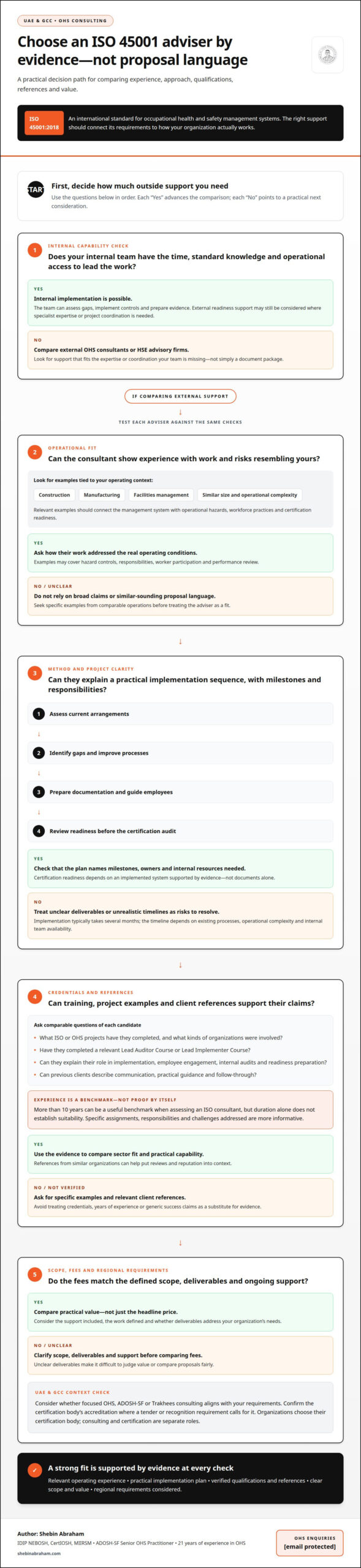
According to the International Organization for Standardization (ISO), ISO 45001:2018 is an international standard for occupational health and safety management systems. Ask how a consultant has applied its requirements in operations resembling yours, such as construction, manufacturing or facilities management. Look for examples linking hazard controls, responsibilities, worker participation and performance review, rather than a document package detached from daily work.
ISO 45001 applies to organizations of any size, nature or type of operation. That breadth makes context important: a consultant should understand the difference between office-based risks and site-based work, then shape system processes around the organization’s actual activities. Ask how the consultant identifies gaps and translates them into practical actions, owners and evidence.
Implementation and Certification Readiness
Implementation support should follow a clear sequence: assess current arrangements, identify gaps, improve processes, prepare documentation, guide employees and review readiness. A useful project plan sets out milestones and responsibilities, so managers can see when decisions or internal resources are needed. Certification readiness depends on an implemented system supported by evidence, not documents alone.
What are the steps and timeline to implement ISO 45001 with a consultant? Start with a gap assessment, then address process design, documentation, training and internal review before the certification audit. Implementation typically takes several months, with the timeline shaped by existing processes, operational complexity and the time available from the internal team.
Businesses considering Dave QMS ISO 45001 consulting alternatives can compare independent OHS consultants, HSE advisory firms and internal implementation with external readiness support. Which UAE consultants specialize in ISO 45001 implementation and certification readiness? Look for consultants whose work specifically covers occupational health and safety management systems, implementation planning and audit preparation; assess their industry fit and examples of comparable scope.
Does ISO 45001 certification in the UAE require an accredited certification body? Organizations choose their certification body, while accreditation may matter where a tender or recognition requirement calls for it. Confirm that the selected body’s accreditation fits the intended use of the certificate; consulting and certification are separate roles.
Can UAE companies implement ISO 45001 without a consultant? Yes. An internal team can lead the work if it has the time, standard knowledge and operational access to assess gaps, implement controls and prepare evidence. External guidance can help where specialist expertise or project coordination is needed.
What risks should businesses consider when selecting an ISO 45001 consulting provider? Watch for generic templates, unclear deliverables, unrealistic timelines, weak industry understanding and blurred consulting or certification roles. Protect operational information through suitable confidentiality arrangements, and ensure the project plan leaves your organization free to select its certification body.
Consultant experience, qualifications and industry background
Look beyond a consultant’s title. Assess relevant project experience, formal training and familiarity with your sector, then compare them with the work your organization needs. Useful examples show how the adviser handles real operating conditions, from employee participation to audit preparation, rather than relying on generic claims about health and safety.
How do UAE ISO 45001 consulting firms compare by services, experience and client reviews? Compare their implementation and audit-readiness support, relevant industry work, qualifications and feedback from previous clients. Reviews can reveal communication and project-management patterns, while references from similar organizations help put those impressions into context.
Experience is most useful when it matches your organization’s size and operating model. A consultant familiar with a large, multi-site operation may handle responsibilities and communication differently from one supporting a small, single-site business. Look for examples from your sector, such as coordinating contractors on construction sites or addressing shift-based work in manufacturing.
Use the same questions to assess each candidate:
- How many ISO or occupational health and safety projects have they completed, and what kinds of organizations were involved?
- Have they completed a Lead Auditor Course or Lead Implementer Course relevant to their work?
- Can they explain their role in implementation, employee engagement, internal audits and readiness preparation?
- What experience do they have with organizations of similar size, operational complexity and sector?
- Can previous clients describe the consultant’s communication, practical guidance and follow-through?
More than 10 years of experience is a useful benchmark when assessing an ISO consultant, but duration alone doesn’t establish suitability. Ask for specific examples of completed assignments, the consultant’s responsibilities and the challenges addressed. A clear account of how an adviser handled a difficult operational issue is more informative than an unqualified claim of success.
Check qualifications in context. A course certificate shows training; project examples show how that knowledge was applied. Ask who will deliver the work, especially if a firm proposes a wider team. The person leading discussions should explain audit findings clearly and connect recommendations to your organization’s actual processes.
Finally, compare references and public reviews for recurring themes, not isolated praise. Look for comments about responsiveness, practical advice and whether agreed work was completed. For UAE organizations seeking occupational health and safety guidance, a focused conversation about UAE OHS consulting support can help clarify the operational context and the expertise required.
Ask about the consultant’s relevant project experience, implementation approach, time in the field and industries served. These details help distinguish relevant experience from broad claims. Check whether the consultant has completed Lead Auditor or Lead Implementer training, and consider how that training relates to the responsibilities they will take on.
Checking references and reputation
References can show how a consultant works during implementation, not just how a proposal reads. Ask for previous clients with a similar project scope, sector and operating conditions. A reference from a single-site office may offer limited insight if your organization manages contractors, multiple locations or high-risk work. Match each example to the challenges your team needs to address.
With permission, speak directly with a reference and ask about the consultant’s role. Find out how they handled gaps, engaged employees and turned assessment findings into actions. Ask whether documentation reflected actual processes or remained separate from daily work. These details reveal the quality of the working relationship and the practical value of the advice.
Use the same focused questions for every reference:
- What was the project scope, and which implementation tasks did the consultant personally lead?
- How did the consultant communicate with managers, employees and operational teams?
- Were recommendations clear enough for staff to apply during routine work?
- How were audit findings or delayed actions handled?
- Would the organization work with the consultant again, and why?
Ask for examples, not general praise. A reference might explain how a consultant helped a maintenance team clarify inspection responsibilities or improve its tracking of corrective actions. Compare the account with the proposed method and deliverables. If the stated approach differs from the reference’s experience, ask why before weighing the proposal.
Check whether the reference’s system and sector provide a fair comparison. An organization with ISO 9001 experience, for example, may be able to discuss document control and audit coordination, but that alone doesn’t demonstrate occupational health and safety expertise. Ask specifically about the consultant’s work on health and safety processes, worker engagement and implementation in comparable operations.
Professional affiliations can provide context. The International Register of Certificated Auditors and the American Society for Quality are examples of organizations associated with professional communities. Treat membership as one signal, not a substitute for relevant project evidence. Confirm that the named consultant, not just the firm, has the experience and qualifications presented.
Protect sensitive information during reference checks. Share only the project context needed for a useful discussion, and use an appropriate non-disclosure agreement before sharing proprietary documents. A careful process lets you learn from previous projects while respecting client confidentiality and maintaining trust.
When checking additional references, ask whether the client’s industry was similar to yours and which parts of that experience are relevant. If the fit is limited, treat the reference as context rather than a direct comparison. Focus on what the consultant did and how it relates to the needs you are evaluating.
Use reference feedback to identify points that need clarification with the consultant. A reference should inform your judgment, not make it for you. Consider whether the client’s experience provides a meaningful basis for assessing the consultant’s suitability for your project.
Consultancy fees and value
Compare consultancy proposals by scope and outcomes, not just the headline fee. In the UAE, work may range from a focused gap assessment to broader implementation support, internal audit preparation and certification readiness. For a fair comparison, give each consultant the same project brief, including sites, activities, existing processes and the support your team needs.
Cost depends on the project scope, operational complexity, locations, existing documentation and level of consultant involvement. A business with established procedures may need a targeted review, while an organization building its management system may need broader guidance. These differences affect workload and deliverables, so compare proposals against the same scope.
Ask each consultant to set out the work in clear stages. A proposal might separate initial assessment, process improvement, employee guidance, internal audit support and certification audit readiness. Each stage should identify its outputs and your organization’s responsibilities. For example, specify whether the consultant will review existing risk controls and help turn findings into updated procedures and assigned actions.
Use a comparison table or written scorecard to assess value across proposals:
- Scope: which departments, sites and operational activities are covered?
- Deliverables: what assessment records, procedures or action plans will be produced?
- Internal effort: what time and subject-matter input must managers and employees provide?
- Support boundaries: does the engagement include internal audit guidance and readiness review?
- Change control: how are additional tasks handled if the agreed scope changes?
Check each proposal’s assumptions. A lower-priced proposal may cover document review but exclude site engagement, employee training or follow-up on corrective actions. A higher-priced proposal may include more direct support, but that matters only if those tasks fit your needs. Ask what each deliverable helps your team achieve and how it supports day-to-day health and safety.
Separate consulting from certification. A consultant can guide implementation and help prepare your organization, while a certification body conducts the certification audit. Your organization should choose the certification body. Avoid treating software purchases or unrelated services as essential unless they address a defined operational need.
Assess value by the capability your team gains. After the engagement, can employees maintain documentation, conduct an internal audit and track improvement actions? A practical proposal clarifies responsibilities and helps your team operate the system. Compare these lasting outcomes alongside scope, support and fees.
ISO standard expertise
Standard expertise means applying relevant requirements to your organization, not simply naming standards in a proposal. Ask how the consultant conducts a gap analysis, interprets applicable clauses and turns findings into practical actions. The approach should reflect your industry, existing systems and intended certification scope.
For occupational health and safety, confirm the consultant works with ISO 45001:2018, the standard version identified for certification. The International Organization for Standardization (ISO) describes it as an international standard for occupational health and safety management systems. Ask how the consultant connects its requirements to your operations, rather than relying on generic templates.
Ask the consultant to explain the Plan, Do, Check, Act method in practical terms. Planning can identify workplace hazards and objectives; doing puts agreed controls into operation; checking reviews performance; and acting supports improvement. Request an example of how this cycle informs decisions, responsibilities and evidence in your sector.
Check related standards only where they fit your organization’s needs. ISO 9001 addresses quality management, while ISO 14001 concerns environmental management and ISO 50001 energy management. A consultant familiar with integrated systems can explain how shared processes, such as document control or internal audits, may align without confusing distinct requirements.
Ask about legacy system knowledge, too. OHSAS 18001 is the predecessor to ISO 45001, so migration experience can help an organization understand which existing arrangements need review. The consultant should explain how they assess older procedures, identify gaps against the current standard and prioritize changes, rather than treating every existing document as obsolete.
Use these prompts to assess technical depth:
- Which ISO requirements shape your proposed gap analysis and why?
- How do you conduct an assessment across different sites or industries?
- What evidence would demonstrate that a process is implemented, not merely documented?
- How do you explain findings to managers and employees responsible for controls?
- How will you distinguish ISO requirements from your organization’s chosen methods?
Strong expertise includes clear boundaries. ISO 45001:2018 does not prescribe a particular management system design or specific occupational health and safety performance requirements. A capable consultant helps the organization develop arrangements suited to its context, then evaluates whether those arrangements meet the standard and support its own objectives.
Ask for a sample explanation of a finding, with confidential details removed. It should identify the relevant requirement, the evidence reviewed and a practical improvement path. To discuss a standards-focused ISO 45001 gap analysis, bring your current system scope and the operational questions you need resolved.
Shebin Abraham: OHS Services
Shebin Abraham provides OHS Services to organizations seeking practical occupational health and safety support in the UAE and GCC. His consulting can support teams addressing workplace risks, improving safety processes or meeting applicable operational requirements.
Shebin Abraham is an ADOSH-SF Senior OHS Practitioner with IDIP NEBOSH, CertIOSH and MIIRSM credentials, and 21 years of OHS experience. For organizations needing freelance support, his offerings include a Freelance HSE Service, Freelance ADOSH-SF OHS consulting and Trakhees OHS consulting. The right starting point depends on your operational context and the specific standards or requirements your team is addressing.
For a conversation about your OHS needs, contact Shebin Abraham or visit shebinabraham.com.
Set your next OHS priority
Before speaking with a consultant, define the operational change your management system should support. Is the priority clearer ownership of workplace controls, stronger employee participation or a more consistent approach across work areas? Naming the issue makes discussions more focused than a broad conversation about certification alone.
As you compare alternatives to Dave QMS for ISO 45001 consulting, consider how each adviser will work with your team after identifying improvement needs. A constructive partnership should make responsibilities understandable and help people apply agreed processes during everyday work. That is where management-system discipline can support both organizational stability and the well-being of employees.
Shebin Abraham’s OHS Services can support organizations seeking practical HSE and occupational health and safety guidance. Start a conversation about your priorities and the support your team needs: contact Shebin Abraham about ISO 45001.
Take the next step with a clear priority, keeping workplace health and safety at the heart of the work.
Frequently Asked Questions
How do I choose an ISO consultant?
Choose an ISO consultant whose working method fits your team and the change you need to make. Describe a real operational challenge, such as inconsistent contractor induction across sites, and ask how the consultant would address it. Compare the clarity of each response, who would lead the work, how staff would be involved and how progress would be discussed. A good fit makes responsibilities clear while keeping decisions with your organization.
What should businesses look for when choosing an ISO 45001 consultant in the UAE?
Look for an adviser who can connect ISO 45001 work with your organization’s UAE operating context and relevant workplace requirements. Ask how they would adapt their approach for your activities, workforce and existing processes, rather than applying one template to every company. Discuss how managers and employees will contribute, how operational changes will be communicated, and how the system can remain usable after implementation. Those details help you judge whether the support fits your day-to-day needs.
Which UAE consultants specialize in ISO 45001 implementation and certification readiness?
Look for consultants who support occupational health and safety management systems, implementation planning and audit preparation. Assess their fit with your industry and their experience on comparable projects.