

Neither TÜV Nord nor a freelance consultant is automatically the right choice for every Trakhees inspection. The TUV Nord vs freelance consultant decision depends on the assignment: whether it requires an independent inspection, witnessing, or a review of applicable criteria, standards, codes, and specifications. TÜV Nord is part of a global network specializing in inspection, testing, and certification; a freelance consultant can provide focused OHS compliance support.
It’s reasonable to want confidence that the work meets relevant requirements without adding unnecessary complexity. This comparison explains how the options differ, what to consider when defining the inspection scope, and how to choose an approach suited to your project. It also shows how a consultant’s review and advisory support can complement an independent inspection.
The article is authored by Shebin Abraham, IDIP NEBOSH, CertIOSH, MIIRSM, an ADOSH-SF Senior OHS Practitioner with 21 years of experience in occupational health and safety.
Key Takeaways
- Choose between a third-party inspection body and a freelance consultant based on the work required: independent inspection, witnessing, criteria review, or OHS advisory support.
- Approval and acceptance depend on the relevant Trakhees service and the scope of the assignment, so distinguish inspection authority from consultancy support.
- A consultant can support compliance reviews and preparation, but that role is different from conducting or signing off an inspection where formal authorization is required.
- Inspection fees depend on the scope, technical requirements, site conditions, and deliverables. Compare proposals against the same defined work.
- Use the decision guide to match your project’s required deliverable with the appropriate type of inspection or consulting support.
Does Trakhees require an approved third-party inspection body or consultant?
The requirement depends on the specific Trakhees process and deliverable. Don’t treat “inspection,” “witnessing,” and “consultancy” as interchangeable roles. A third-party inspection body may perform an independent inspection, while a consultant can review applicable criteria or advise on occupational health and safety compliance. A provider’s name alone doesn’t determine which role the assignment requires.
Start with the required outcome. Does the project need an inspection report, a witness record, a technical review, or advice on meeting OHS requirements? These deliverables serve different purposes. For example, a project-document review can identify gaps against specified criteria, but it is not the same as an independent site inspection. Similarly, witnessing a defined activity records what was observed; it does not, by itself, determine whether the witness can issue formal approval.
For a Trakhees-related task, define the scope using the applicable criteria, standards, codes, and specifications. Identify the relevant process and required output before appointing a provider. This distinction matters because a consultant’s technical input can support readiness, while a formal inspection may require an inspection body accepted for that specific purpose. Don’t assume one appointment covers both functions.
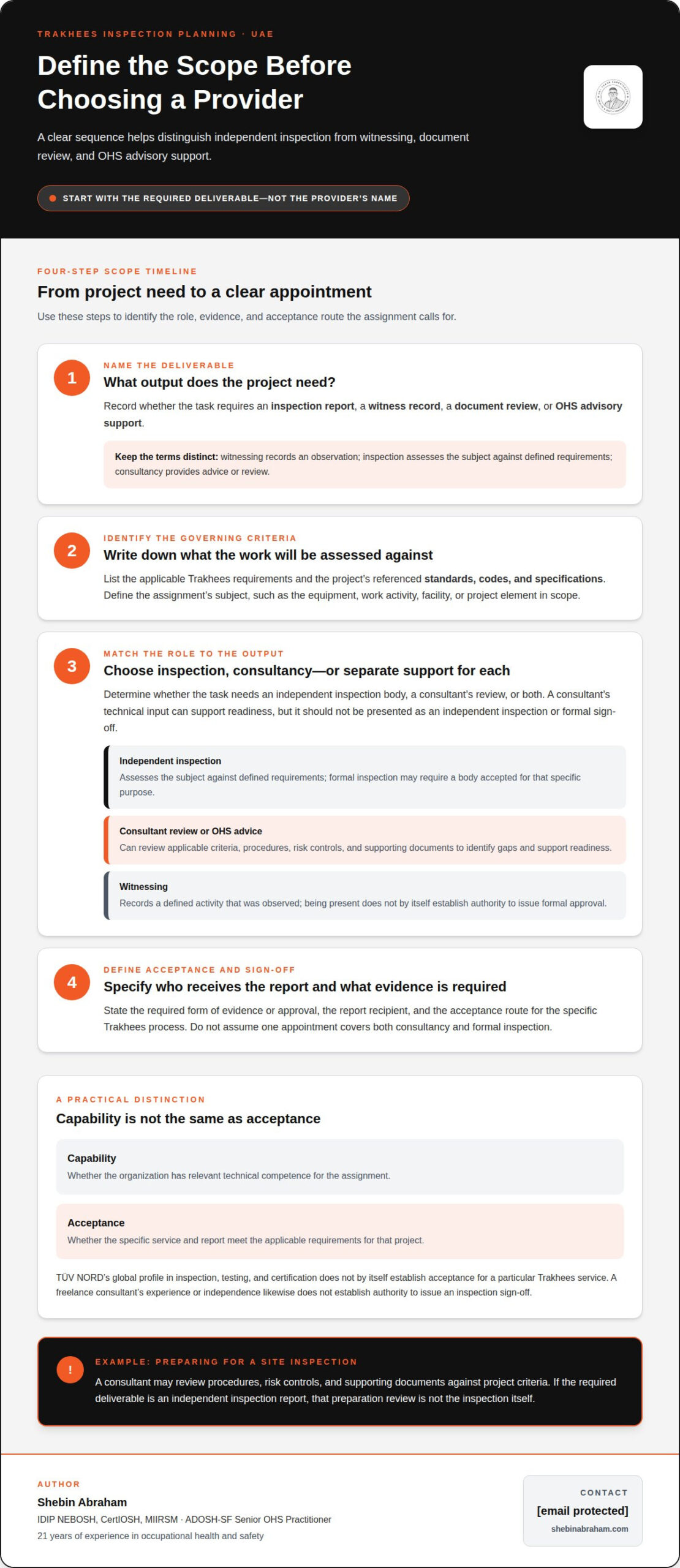
Use this sequence to clarify the role:
- Name the deliverable. Record whether the task requires inspection, witnessing, document review, or OHS advisory support.
- Identify the governing criteria. List the applicable Trakhees requirements and the project’s referenced standards, codes, or specifications.
- Match the role to the output. Determine whether the work requires an independent inspection body, a consultant’s review, or separate support for each.
- Define acceptance and sign-off. State who receives the report and what form of evidence or approval the process requires.
Consider a contractor preparing for a site inspection. A consultant can review procedures, risk controls, and supporting documents against the project criteria. If the required deliverable is an independent inspection report, that preparatory review should not be presented as the inspection itself. Clear role descriptions help everyone understand who observed the work, who assessed it, and who issued the final document.
A witness assignment should likewise state which activity is to be observed and what record is expected. Being present at a test or work activity does not automatically make someone an approved inspector. The distinction is practical: witnessing records an observation, inspection assesses the subject against defined requirements, and consultancy provides advice or review. The scope should specify which function applies.
TÜV NORD is part of a global network that also includes TÜV Rheinland and TÜV SÜD, specializing in inspection, testing, and certification. That profile alone does not establish whether a specific service is accepted for a particular Trakhees process. A freelance consultant’s independence or experience likewise does not establish authority to issue an inspection sign-off. Match the appointment to the required deliverable and acceptance route.
The direct answer depends on the scope: determine whether the Trakhees assignment requires an independent third-party inspection body or consultant support. If formal inspection or sign-off is required, distinguish that authority from advisory work. If the task involves readiness, criteria review, or OHS guidance, consultancy may meet that need, but it should not be described as inspection approval.
The required inspection or approval depends on the specific Trakhees process and deliverable. Identify whether the task calls for independent inspection, witnessing, document review, or OHS advice. Then confirm the provider’s role and the evidence or sign-off required for that scope.
Is TÜV NORD approved by Trakhees for the relevant inspection services?
TÜV NORD’s international presence does not, by itself, establish approval for a specific Trakhees inspection service. The relevant question is whether the entity performing the work is accepted for the exact service and deliverable required. Approval for one activity should not be assumed to cover another inspection, witnessing assignment, or technical review.
TÜV NORD is part of a global network that also includes TÜV Rheinland and TÜV SÜD, organizations specializing in inspection, testing, and certification. This profile may indicate broad technical capability, but it cannot replace evidence that the particular service is accepted within the applicable Trakhees process. The service name, performing entity, and required output all matter.
Separate capability from acceptance. Capability is whether the organization has the relevant technical competence for the assignment. Acceptance is whether its specific service and report meet the project’s applicable requirements. A recognized name may address the first question, but the name alone does not answer the second.
To assess the fit, define the assignment before comparing providers:
- Identify the exact service. Specify whether the task is inspection, witnessing, testing, or review of documents.
- Describe the subject. State which equipment, work activity, facility, or project element is in scope.
- Set the required output. Define whether the project needs a report, witness record, findings register, or other deliverable.
- Connect the criteria. Record the applicable Trakhees requirements and project standards, codes, or specifications.
- Match the provider to the scope. Make sure the named entity and service correspond to the intended work and output.
For example, a project may need a witness to observe a defined test and document the result. Another assignment may require an inspection against technical criteria. A third may need safety documents reviewed before site activity begins. These are distinct scopes, even if one organization can provide several types of technical work.
Read any proposal or appointment record carefully. “Inspection services” is broad and does not tell the project team which activity is covered. A useful scope identifies the subject, inspection method or review task, criteria, boundaries, and deliverable. If the document only names TÜV NORD without describing the service, it leaves the key comparison unanswered.
Also distinguish the organization’s role from the individual performing the work. A company’s general service capability does not automatically establish the competence or authorization relevant to every assignment. The scope should identify who carries out the activity and who issues the resulting record. This is especially important when a project requires an independent inspection or formal sign-off.
The practical answer is service-specific: TÜV NORD’s global network status alone does not demonstrate approval for the particular Trakhees service. Assess the named entity, activity, criteria, and deliverable together. This avoids treating brand recognition as a substitute for acceptance and prevents consultancy or witnessing from being mistaken for inspection sign-off.
A focused Trakhees inspection scope review can help clarify the work required and distinguish compliance advice from independent inspection.
Define the exact service, subject, criteria, and required output, then confirm that the entity performing the work is accepted for that specific Trakhees service. A provider’s name or general technical capability alone does not establish acceptance.
Can a freelance consultant legally conduct or sign off Trakhees inspections?
Distinguish a freelance consultant’s role from their authority. A consultant can provide OHS advice, review project documents, or witness a defined activity when engaged to do so. Those tasks do not automatically authorize the consultant to issue a formal inspection sign-off. For a Trakhees assignment, the required deliverable and acceptance route determine who must conduct and sign the inspection.
Freelance status alone answers neither question. It does not prove someone is authorized to sign an inspection record, nor does it mean they cannot provide useful technical support. Treat competence, appointment, and approval as separate matters. A consultant’s experience can support a review, but cannot replace any specific authorization required for the formal inspection process.
Start by separating three activities. An OHS consultant can assess documents against stated project criteria and identify gaps. A witness can record observations during a specified activity. An inspector assesses the defined subject against applicable requirements and produces the required inspection record. One assignment can involve multiple activities, but its documents should clearly identify each role.
For example, a project may need risk assessments reviewed before work begins, followed by an independent equipment inspection. The review can identify missing controls or supporting records. It does not become the equipment inspection simply because the same consultant reviewed the file. The appointment should name the person or entity responsible for the inspection and the signatory responsible for its report.
Clarify the arrangement through these practical steps:
- Describe the task. State whether the assignment is advisory review, witnessing, inspection, or a combination.
- Identify the criteria. Name the applicable Trakhees requirements and project standards, codes, or specifications.
- Define the record. Specify the report, witness record, review comments, or other required output.
- Assign responsibility. Identify who performs the work, who reviews findings, and who signs the formal record.
- Keep the roles distinct. Label consultancy comments as advice, and inspection findings as inspection results.
Clear roles help prevent a common documentation problem: a report describes observations but appears to claim formal approval. The title, scope, findings, and signature block should match the work performed. If a consultant reviewed documents only, the record should describe a document review. If an independent inspection is required, the inspection record should identify the responsible provider and signatory.
For witnessing, define the observed activity and the limits of the witness’s record. A note that a test was observed does not necessarily establish that the item passed every applicable criterion. The record should distinguish what happened, what evidence was reviewed, and any assessment against specified requirements. This clarity supports sound project decisions and helps protect everyone relying on the record.
The practical answer depends on the assignment’s formal requirements: freelance consultancy can support Trakhees-related OHS review and preparation, but freelance status alone does not confer inspection sign-off authority. A consultant should sign only for work and authority assigned to that role. Before work starts, make the inspection appointment, criteria, deliverable, and signatory responsibilities explicit.
How much does TÜV NORD charge for Trakhees inspections in Dubai
The price of Trakhees inspection work depends on the scope and is provided after a quote request. The inspection method, technical subject, site conditions, and reporting requirements all affect cost. One figure would not represent every assignment, because a document review and a site inspection involve different work.
Start by defining the deliverable. A quote for witnessing a particular activity may cover different tasks from one for inspecting equipment against project criteria. The provider also needs to understand the work location, access arrangements, relevant standards or specifications, and expected report. A clear scope helps TÜV NORD price the actual work rather than a loosely defined request.
For a useful comparison, give each provider the same scope. Include the subject, applicable criteria, inspection boundaries, expected site activity, and reporting requirements. If one proposal covers only an inspection visit while another includes document review and a detailed report, their totals do not represent equivalent services. Compare the work included before comparing the quoted amounts.
Cost factors commonly include:
- Inspection scope: The number and complexity of items or activities influence the work required.
- Technical criteria: The standards, codes, specifications, and acceptance points shape the assessment.
- Site requirements: Location, access, coordination, and the inspection environment affect planning.
- Reporting: A concise observation record differs from a report requiring structured findings and supporting evidence.
- Additional tasks: Separate witnessing, document review, or follow-up work may change the agreed scope.
Consider two projects. One requests a document review against a stated specification. Another needs an inspector to attend a site activity, examine defined items, and issue a report. The second assignment has different attendance and reporting requirements. A meaningful comparison accounts for those differences rather than treating both requests as the same inspection.
Read the quotation for inclusions and exclusions. Confirm that the named inspection activity, location, criteria, and deliverable match the project request. Note whether document review, site attendance, witnessing, or follow-up findings are included. If the proposal uses a broad label such as “inspection services,” request a clearer description through the quote process before comparing costs.
When comparing TÜV NORD with a freelance consultant, compare like with like. A consultant’s fee for OHS advice or readiness review should not be compared with a third-party inspection quote as though both deliver the same outcome. Treat consultancy, witnessing, and independent inspection as distinct cost items. This makes the decision clearer and reduces the risk of paying for work that does not meet the intended need.
Request a quote in UAE dirhams and provide the inspection scope, technical criteria, site details, and report requirements together. Then compare the proposed deliverable with the price. For the TUV Nord vs freelance consultant for Trakhees inspection decision, the useful comparison is not simply the lowest amount. It is whether the quoted work matches the required role and output.
TÜV NORD’s charge depends on the scope, technical criteria, site requirements, and requested reporting. Submit a clearly defined scope through the quote process, then compare proposals based on the work each includes.
Shebin Abraham: OHS Freelancer Trakhees Consulting
Shebin Abraham’s OHS Freelancer Trakhees Consulting supports businesses with practical OHS guidance for Trakhees-related compliance work. Turn to this support when you need help reviewing applicable criteria, organizing OHS documentation, or clarifying readiness before an inspection. The service focuses on consultancy and compliance support, separate from formal inspection or sign-off authority assigned to an inspection body.
For needs beyond a Trakhees-specific review, OHS Services and Freelance HSE Service provide broader workplace health and safety support. Shebin Abraham also offers Freelance ADOSH-SF OHS consulting for organizations addressing those standards. Choose support based on your project scope and the deliverable you need.
Contact Shebin Abraham to discuss your Trakhees OHS consulting needs.
Set the Scope Before You Commit
Before making an appointment, turn the project need into a clear written scope. State the intended outcome, the work involved, the criteria to apply, and the record your team needs. This gives the decision a practical basis and keeps advisory support distinct from formal inspection work.
Choosing between TÜV NORD and a freelance consultant for Trakhees inspection work should follow the scope, not brand familiarity alone. The right fit depends on the required role, deliverable, and acceptance route for your assignment. Those details determine the choice.
If you need help defining the OHS consulting scope or preparing for Trakhees-related compliance work, speak with Shebin Abraham. A focused discussion can clarify which support fits your project and what to do next.
Contact Shebin Abraham to discuss your inspection, and move forward with a clearer scope and greater confidence in your decision.