

Outsourcing your HSE function in the UAE gives your business flexible access to professional safety support without building every part of the function in-house. It can help address changing workloads, project demands and operational risks.
Safety still depends on people understanding the work and receiving appropriate oversight. The challenge is choosing a practical level of support that fits your organisation, rather than overloading internal resources or paying for a structure that does not match current needs.
This article explains how outsourced HSE support works, what shapes its scope and how to align coverage with your risks and budget. It also compares ongoing and project-based assistance and explains what a professional can contribute.
The guidance reflects the experience of Shebin Abraham, an OHS consultant with 21 years of experience in OHS, holding IDIP NEBOSH, CertIOSH and MIIRSM credentials, and serving as an ADOSH-SF Senior OHS Practitioner. His work across the UAE and GCC informs a practical, people-centred approach to workplace health and safety.
Key Takeaways
- Assess whether ongoing or project-based HSE support better fits your current operations and workload.
- Shape coverage around the work being done, the risks involved and the support your teams need.
- Look beyond technical skills when considering qualified safety professionals; practical fit matters too.
- Set clear expectations for the scope of support, responsibilities and communication.
- Understand how an outsourced HSE function can support safety management while giving your business flexibility.
Why outsource your Health and Safety needs?
An outsourced HSE arrangement brings focused occupational safety and compliance support into your operations. The professional works to an agreed scope, reviewing work risks, clarifying responsibilities and reporting progress on actions.
HSE Roles and Consultancy Services
HSE roles can include workplace risk review, safety procedure development, incident follow-up, and operational guidance. Occupational safety support focuses on how tasks are planned and performed, while compliance work connects those practices with applicable requirements. Consultancy services may also review management systems; the International Organization for Standardization (ISO) identifies ISO 14001 as a standard to which a company’s environmental management system may be aligned.
When selecting a consultant, assess the work they will cover, their relevant sector experience and how they will coordinate with managers and employees. For example, a consultant supporting a site with changing activities needs a clear route to raise hazards and track corrective actions.
Regulatory Compliance Support
UAE regulatory compliance support starts with identifying the requirements that apply to your organisation’s activities and operating location. A consultant can map them to procedures, records, assigned responsibilities and practical controls, making it easier to check whether the written system reflects everyday work.
Regulatory audits can then assess whether documented processes match workplace practice. A useful audit records findings, responsible owners, agreed actions and follow-up status. Its scope should reflect the relevant UAE authority and sector, since one checklist will not suit every operation.
Implementation works best as a defined sequence. First, the consultant reviews your activities, existing documents and safety arrangements. Next, both sides agree priorities, responsibilities, reporting routes and a support schedule. The consultant then delivers the agreed services, such as reviewing procedures or advising on risk controls. This keeps the work connected to operations, not just document production.
Performance reporting should show meaningful progress, not simply completed visits. A report can summarise open actions, recurring hazards, incident trends, audit findings and decisions requiring management attention. Repeated concerns around a task, for example, may indicate a need for clearer controls or targeted workforce guidance. Reports should identify evidence, owners and next steps so managers can act and monitor follow-through.
Audits also help clarify where a management system needs attention. ISO 14001 alignment, for instance, relates to environmental management, while occupational safety reviews focus on workplace health and safety arrangements. These are distinct areas, even when an organisation coordinates them within broader governance. The provider should define the audit scope and explain how findings connect to operational responsibilities.
Before work begins, agree what information the consultant needs, how often they will report and who will receive findings. Set a route for urgent operational concerns and a process for escalating overdue actions. Clear communication gives managers a usable view of performance and keeps safety oversight connected to changing conditions.
Long-term or project-based HSE outsourcing in the UAE
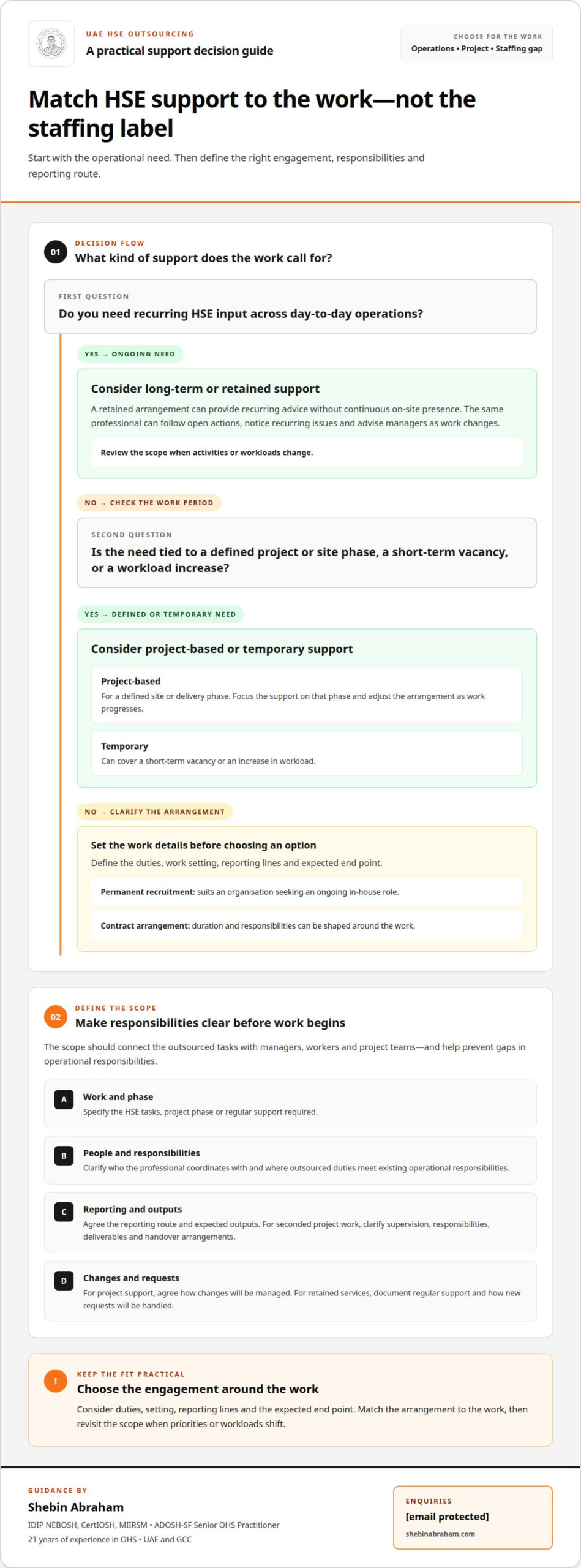
Outsourcing the HSE function means assigning agreed safety tasks to an external professional or team. To outsource an HSE function in the UAE, first define whether you need support for ongoing operations, a specific project or a temporary staffing gap.
Staffing and Engagement Options
Temporary support can cover a short-term vacancy or workload increase, while project-based support serves a defined site or delivery phase. Permanent recruitment suits organisations seeking an ongoing in-house role. Contract arrangements offer another option, with duration and responsibilities shaped around the work.
Consider the duties, work setting, reporting lines and expected end point before deciding on an arrangement. A project-based HSE professional may focus on site coordination, while retained support can provide recurring advice without continuous on-site presence. Match the engagement to the work rather than choosing a staffing label first.
Scope of HSE Outsourcing
The scope defines which HSE tasks the consultant handles and how they connect with managers, workers and project teams. It may include professional support, reviews, advice or coordination within a defined project. Clear boundaries help prevent gaps between outsourced tasks and existing operational responsibilities.
For project-based support, define the work phase, reporting route, expected outputs and how changes will be managed. For retained services, document regular support and how new requests will be handled. These details help both sides respond effectively as priorities shift.
Long-term support can suit businesses that need recurring HSE input across day-to-day operations. A retained arrangement builds continuity: the same professional can follow open actions, identify recurring issues and advise managers as work changes. Review the scope when activities or workloads change.
Project-based HSE support serves a different purpose. A construction or industrial project may need focused safety input during a particular phase, with the arrangement adjusted as work progresses. Seconded project work places a professional within the project’s working structure for the agreed assignment. The contract should clarify supervision, responsibilities, deliverables and handover arrangements.
Successful outsourcing also depends on selecting the right vendor, managing the relationship, and structuring the contract properly, according to Supply Chain Resource Cooperative. Set out who approves changes, how concerns are escalated, and how performance discussions happen. These steps keep hiring decisions connected to operational needs.
Before work begins, map the required duties against the project schedule or ongoing workload. This helps determine whether temporary, retained, contract or permanent support fits best. A temporary vacancy, for example, calls for different coverage from a project that needs consistent HSE presence through several work stages.
When you outsource an HSE function in the UAE, align the engagement terms with the scope, reporting needs, and expected work. Project-based HSE support can be considered alongside those requirements.
Flexibility, efficiency and risk reduction
Outsourced HSE support can adapt to changing workloads while keeping workplace risks under review. A safety professional can focus on hazard identification, controls and follow-up where operational conditions require attention.
For liability planning, treat outsourcing as the allocation of defined tasks, not an automatic transfer of every responsibility. The agreement should record who performs each activity, who approves decisions and how unresolved risks are escalated.
A safety officer’s practical role can include applying workplace procedures, assessing risks and supporting regulatory compliance. For example, a site review may identify an unsafe access route. The officer can document the hazard, recommend controls and track whether the responsible manager completes the action.
This flexibility can make HSE coverage more efficient as workloads change. During a busy project phase, support can focus on site activities and coordination. As work shifts, attention can move to inspections, action tracking or procedure reviews. Set the scope according to actual exposure and work demands, not habit.
Risk assessment starts with the task, its hazards and the people who may be affected. The professional considers existing controls, identifies gaps and recommends proportionate measures. If several teams share a work area, for example, the assessment can examine access, movement and coordination between them.
Follow-through matters. A risk register can link each finding to a control, responsible owner and review status. The HSE professional can report overdue actions and recurring observations to managers. This gives the organisation a clear basis for prioritising work instead of treating every finding as equally urgent.
Safety audits provide a structured check of whether planned controls are working as intended. An audit can compare procedures with observed workplace practices, then record evidence, gaps and corrective actions. A larger audit programme is not automatically more effective; its scope should reflect the activities and risks being reviewed.
To use outsourced support effectively, agree how often site observations will take place, what reports will contain and who will receive them. A report could separate newly identified hazards from actions still awaiting closure. This helps managers spot emerging concerns while keeping existing commitments visible.
Clear communication also helps prevent gaps between the external professional and internal teams. Name an operational contact, establish a route for reporting immediate hazards and agree how recommendations will be reviewed. The consultant can coordinate assessments and follow-up while managers retain visibility of workplace decisions.
Review the arrangement when operations change, such as when a project introduces new tasks or work areas. Update the assessment, communicate revised controls and record who owns each action. This keeps risk mitigation aligned with current conditions and gives routine performance reviews a clear basis.
Outsourcing qualified safety professionals
Outsourced HSE support works best when a professional’s skills match your organisation’s work. In the UAE, assess relevant experience, practical judgement and familiarity with the compliance requirements for your industry.
Experience and Qualifications
Review candidates’ qualifications alongside their work history and the responsibilities they would assume. A skilled professional should be able to explain how they have handled comparable risks, communicated findings and followed actions through. Ask for specific examples, such as coordinating safety reviews across teams, rather than relying on a job title alone.
Screen candidates for technical skills, attitude and aptitude, not credentials alone. A professional may understand procedures yet struggle to engage workers or explain controls clearly. Discussing a realistic site scenario can reveal how they identify hazards, communicate priorities and respond when a planned control is difficult to apply.
Outsourcing the HSE Officer Role
UAE companies can arrange outsourced HSE support, but whether it can replace a designated in-house post depends on applicable requirements and site conditions. Define the role, work setting and expected coverage first. Then assess whether an external professional can meet those needs and coordinate effectively with managers and employees.
A suitable training partner understands your organisation’s needs and industry compliance requirements. Ask how training will be tailored to job functions and workplace interactions. A useful proposal links each learning activity to a clear purpose, such as helping a team recognise hazards connected with its assigned tasks.
Quality assurance begins before an assignment starts. Match the role description to the professional’s experience, then agree how work and performance will be reviewed. Decide who receives updates, how concerns are raised and how recommendations are followed up. These steps make the contribution visible to operational managers.
A professional supporting a site with several work groups, for example, needs more than general safety knowledge. They must communicate across teams, understand the work sequence and raise practical concerns with the right manager. A tailored selection process tests these capabilities against the actual assignment.
Training also requires a clear view of employees’ responsibilities. A partner should connect content to the tasks people perform and how departments interact. If a worker’s duties change, the organisation can review whether further instruction is appropriate. This makes training more relevant than delivering identical material to every role.
During selection, compare the proposed professional’s experience with the scope, reporting structure and expected interactions. Discuss how they would document observations and communicate an unresolved concern. These examples show whether they can turn technical knowledge into useful guidance for decision-makers.
After appointment, review performance against agreed responsibilities and evidence from the work. Consider whether reports are clear, actions are tracked and advice reflects operational conditions. If the assignment changes, revisit the role profile and support needs to keep the professional’s skills aligned with organisational priorities.
Tailoring support to service needs, risks and budget
Start by defining the work, the people exposed to risk and the decisions outsourced support should inform. A clear scope helps align professional coverage with operational needs and available budget.
Costs and Service Comparisons
Outsourcing and in-house hiring have different cost structures. An in-house role involves recruitment, onboarding and ongoing employment management; outsourced support is shaped by the agreed scope and coverage. Compare what each option includes, such as site presence, advice, reporting and follow-up. The price depends on the case and is provided after a quote request. Key factors include service scope, coverage pattern and operational risk.
A business needing defined project support, for example, may not need the same arrangement as one requiring recurring HSE input. Compare the work delivered, not just the role title. Consider how the professional handles changing priorities, communicates findings and tracks actions. This makes budget discussions more useful than comparing a salary figure with a service proposal.
Provider Selection and Contracting
Choose a provider whose relevant experience and proposed approach match your industry, risks and operating requirements. Define responsibilities, deliverables, reporting, escalation routes and how scope changes are agreed in the contract. These terms make the arrangement clear to managers and the external professional.
Use onboarding to familiarise the professional with site procedures, key contacts and current priorities. Set out who supplies operational information, who receives reports and how actions are assigned. An observation raised during a site visit, for example, needs a clear route to the manager responsible for addressing it.
Build the service scope around the work itself. Identify which locations, activities and teams need support, then distinguish recurring duties from occasional requests. A tailored arrangement might combine scheduled reviews with additional input during a higher-risk work phase. Clear boundaries help avoid duplication of existing responsibilities.
Employee needs also shape the service. Establish who needs HSE training, when it is needed and what it should achieve. Someone starting a new task may need different guidance from a supervisor coordinating several teams. Connecting training to job functions makes support more relevant to daily work.
Budget decisions should reflect risk and required coverage, not simply the lowest proposed fee. Consider how often professional input is needed, which activities require attention and how quickly managers need findings addressed. A proposal should connect these factors to specific deliverables so the organisation understands what the service includes.
During contract reviews, assess whether reporting, follow-up and coverage still match operations. A new project phase or changes to employee responsibilities may call for an adjusted scope. Record agreed changes, assigned owners and review dates to keep the arrangement clear as requirements evolve.
Discuss a support scope shaped around your operational needs through a tailored HSE support discussion.
Shebin Abraham
Shebin Abraham helps UAE businesses shape outsourced HSE support around operational risks, compliance needs and required coverage. His OHS Services and Freelance HSE Service suit organisations seeking ongoing guidance or focused professional input. He also provides freelance ADOSH-SF OHS consulting and Trakhees OHS consulting.
Shebin Abraham is an ADOSH-SF Senior OHS Practitioner with IDIP NEBOSH, CertIOSH, and MIIRSM credentials, and 21 years of experience in OHS. This practical background supports a considered approach to workplace safety and regulatory requirements across the UAE and GCC.
To assess outsourced HSE support for your organisation, contact Shebin Abraham to discuss your needs.
Set a clear direction for your HSE support
Before outsourcing your HSE function in the UAE, decide which operational concern needs attention first. You may need stronger day-to-day oversight, professional support or guidance on a specific compliance requirement. A defined priority gives the discussion a practical starting point and helps shape a scope around your working environment.
Shebin Abraham provides OHS Services and Freelance HSE Service, as well as Freelance ADOSH-SF OHS consulting for organisations seeking support aligned with that framework. Discuss your activities, current arrangements and the responsibilities you want external support to address. This keeps the next step grounded in your needs, rather than a generic service model.
Bring your priorities into a focused discussion and consider what support would help your teams work safely and consistently. Contact Shebin Abraham about HSE support to explore a suitable direction for your organisation.
Frequently Asked Questions
How can Contracting Out or Outsourcing your HSE Support Solve your Business Challenges?
Outsourcing can give a business access to HSE expertise when internal capacity or specialist knowledge is limited. A growing operation, for example, may need focused support for a new project without making it a permanent internal role. A clearly scoped arrangement gives managers a defined route for advice and follow-up, while professional HSE input supports their operational decisions.
Which UAE laws and regulations apply to outsourced HSE services?
Applicable requirements depend on an organisation’s activities, location and regulatory framework. ADOSH-SF and Trakhees OHS are examples of frameworks covered by specialist consulting. A professional can help identify relevant requirements and connect them with workplace procedures and records. Do not assume one framework applies to every UAE operation: the business’s activities and the authority overseeing them shape the compliance context.
How much does it cost to outsource HSE services in the UAE?
There is no single fee for every outsourced HSE arrangement. The price depends on the case and is provided after a quote request. Scope, engagement type, professional coverage and expected deliverables shape the proposal. For a useful comparison, consider the full arrangement, including onboarding and the management time needed to coordinate support, rather than focusing only on the headline service fee.
What HSE services do UAE consultants and providers typically offer?
HSE providers may offer occupational health and safety consulting, freelance HSE support and advice on specific compliance frameworks. Shebin Abraham’s relevant services include OHS Services, Freelance HSE Service, Freelance ADOSH-SF OHS consulting, Trakhees OHS consulting and ADNOC HSE Prequalification Support. The right scope depends on the work and compliance needs. An organisation preparing for an ADNOC prequalification process, for example, may seek focused HSE prequalification support.