

A project’s safety oversight should fit its work pattern, not simply its headcount. Part-time safety officer services in the UAE provide project-based support for site inspections, safety coordination, and incident reporting. They can help teams maintain practical oversight as staffing needs change across project stages.
It’s understandable to want experienced safety support without adding a full-time role when project needs don’t call for one. This article explains how part-time support can contribute to UAE regulatory compliance, staffing, inspections, and incident reporting, and what to consider when arranging it.
Shebin Abraham, IDIP NEBOSH, CertIOSH, MIIRSM, is an ADOSH-SF Senior OHS Practitioner with 21 years of experience in occupational health and safety. His practical perspective informs the guidance that follows.
Key Takeaways
- Align safety officer coverage with the project’s workload and changing phases to support consistent oversight.
- Short-term professional support can help assess workplace hazards, respond to emergencies, and maintain project operations.
- Make site inspections and incident reporting part of a clear process for recording issues and following up on them.
- Assess qualifications alongside education, certification, and relevant experience; the NEBOSH International General Certificate is widely considered an entry-level qualification for HSE roles.
- Understand that engagement costs depend on the project scope, schedule, industry, and the professional’s experience.
Regulatory compliance
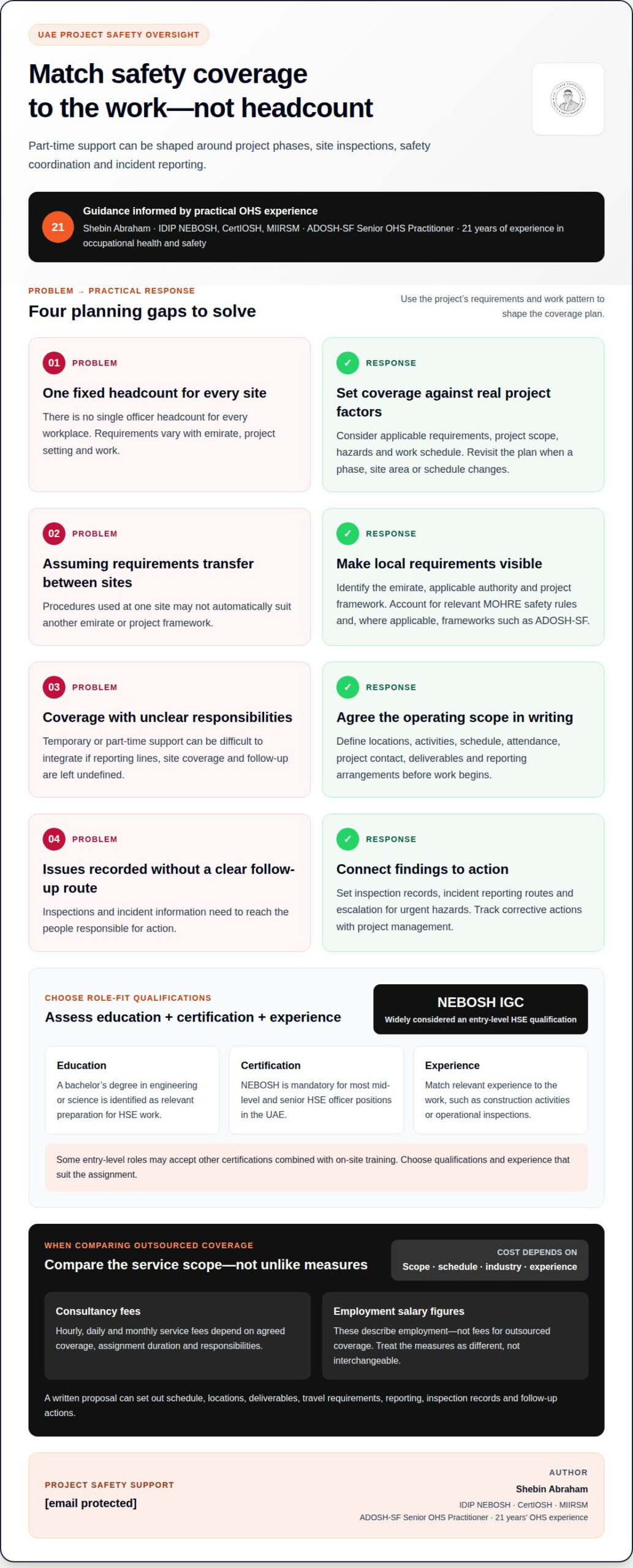
Safety requirements can differ across UAE emirates and project settings. There is no single officer headcount for every workplace. Determine staffing by considering applicable requirements, project scope, hazards, and work schedule.
Emirate-Specific Requirements
Begin by identifying the emirate, applicable authority, and project framework. MOHRE requires companies to follow safety rules, so workplace planning should account for relevant requirements. Some projects may also need to align with a specific framework, such as ADOSH-SF. Don’t assume procedures used at one site automatically suit another project or emirate.
Next, map the project’s activities to its compliance needs. A construction project with changing work areas may need regular reviews of site controls, while an established workplace may focus on maintaining existing procedures. Record applicable requirements, responsible roles, inspection arrangements, and reporting routes together. This gives managers and the safety officer a shared reference as site conditions change.
For projects operating across emirates, make the compliance plan clear about each site’s applicable requirements. A company-wide procedure can support consistent practice, while local and project-specific requirements still need consideration. Show this distinction in working documents, such as inspection records and corrective-action logs. Teams can then identify which procedure applies without treating all UAE sites as identical.
Qualifications and Certifications
Choose a safety officer whose qualifications suit the role and project. UAE HSE roles commonly consider education, certification, and experience together. The NEBOSH International General Certificate is widely considered a minimum entry-level qualification. A bachelor’s degree in engineering or science is also identified as relevant preparation for HSE work.
Role seniority matters. NEBOSH is mandatory for most mid-level and senior HSE officer positions in the UAE. Some entry-level roles may accept other certifications combined with on-site training. Match the officer’s background to the work, such as construction activities or operational inspections. Relevant experience helps the officer apply procedures in context, rather than relying on documents alone.
Agree on the coverage scope before work begins. Set out which locations and activities the officer will oversee, how inspections will be recorded, and how findings will reach project management. Define how urgent hazards and routine corrective actions are escalated. These arrangements integrate part-time coverage into daily operations and clarify the support the project needs.
Review staffing whenever project conditions change. A new work phase, additional site area, or revised schedule can alter inspection demands and coordination needs. Revisit the coverage plan against applicable requirements and current activities, then adjust responsibilities where needed. This keeps compliance oversight connected to the work taking place, rather than relying on a fixed headcount or outdated plan.
Short-term Safety Officer Supply Across the UAE
UAE businesses can arrange short-term coverage through freelance HSE professionals and occupational health and safety consultants. Match the engagement to project activities, site schedule, and reporting needs, then agree on responsibilities before work starts. This gives temporary support a defined role within the project’s existing management arrangements.
Hourly, Daily, and Monthly Rates
UAE salary figures describe employment, not fees for outsourced coverage.
Hourly and daily service fees depend on the agreed scope and coverage pattern. A scheduled inspection differs from recurring site presence and follow-up. Monthly arrangements also depend on assignment duration and responsibilities. Treat employment salaries and consultancy fees as different measures, not interchangeable rates.
Ask for a written scope showing the schedule, locations, expected deliverables, and travel requirements. The proposal should explain whether reporting, inspection records, and follow-up actions are included. These details make comparisons useful without treating an employment salary benchmark as a service price.
Part-Time and Outsourced Providers
Freelance HSE professionals and OHS consultants are relevant options for UAE projects seeking part-time or outsourced support. This approach can suit fluctuating workloads, defined project stages, or changing oversight needs during operations.
Temporary safety officers can assess workplace hazards, respond to emergencies, and help maintain project operations. A project entering a busier phase, for example, may need closer oversight than during quieter periods. Define the assignment’s purpose and reporting line so support fits the site’s actual needs.
Outsourcing still requires coordination with project management. Establish who receives inspection findings, how urgent concerns are raised, and how open actions are tracked. Clear communication integrates temporary support with site teams and connects observations to operational decisions.
Hiring and Verifying a Safety Officer
Before engagement, describe the project’s activities, work schedule, and expected coverage. Ask the professional to outline relevant experience, qualifications, attendance, and reporting arrangements. Match these details to the assignment, such as inspections across an active site or support during a defined work phase.
Agree on practical details in writing: scope, start and end points, access arrangements, project contact, and deliverables. Set a process for recording hazards and communicating incident information. These steps give the professional and project team a shared operating framework from the outset.
During the assignment, review whether planned coverage matches site activity. Adjust the schedule if work locations or priorities change. Keep communication direct, record agreed changes, and assign follow-up for outstanding observations. For project-specific freelance HSE support, explore freelance HSE services.
Site inspections and incident reporting
A part-time safety officer can make site visits purposeful by linking each inspection to current work. Before arriving, the officer reviews the work schedule, active areas, recent observations, and open corrective actions. For example, if a project has moved to a new work zone, the inspection can focus on access routes, housekeeping, and controls around that activity.
During a walk-through, the officer observes work as it is actually performed, speaks with relevant supervisors, and records findings clearly. Each observation should identify the location, condition, potential consequence, and action needed. “Clear obstruction near the loading area” is more useful than “poor housekeeping” because the team can locate and address the specific issue.
An inspection plan should reflect the project’s changing activities rather than rely on a fixed checklist alone. The officer can review access and egress, work-at-height arrangements, equipment condition, material storage, and site housekeeping where relevant. Findings should distinguish immediate concerns from routine improvements, helping managers prioritise action.
- Record the observation: Include the site area, activity, and condition observed.
- Assign follow-up: Identify the responsible role and agreed corrective action.
- Track progress: Keep open items visible until their status is reviewed.
Incident reporting needs a similarly clear path. After an incident or near miss, the safety officer records available details, including when and where it occurred, the activity involved, and people or equipment affected. The report should separate observed facts from later analysis. For example, note that a material shifted during handling before drawing conclusions about why it happened.
Next, the officer helps organise follow-up with the relevant site team. This may include gathering accounts, reviewing the work sequence, identifying contributing conditions, and documenting corrective actions. A near miss involving a blocked walkway, for instance, can prompt a review of storage arrangements and communication between work groups. The purpose is to understand events and reduce repeat exposure, not assign blame prematurely.
Part-time coverage makes handover especially important. At each visit, the officer can review unresolved inspection findings and incident actions with the designated project contact. A concise written update should state what was observed, what remains open, and who owns the next step. If work locations or priorities change between visits, the project team can share that information before the next inspection.
Agree on the reporting route before the assignment begins. Specify who receives routine inspection records, who handles urgent site concerns, and how incident information reaches project management. Consistent records help teams compare recurring observations and see whether corrective actions have been completed. They also preserve continuity when different supervisors manage separate areas or project phases.
What qualifications and certifications must a safety officer have in the UAE?
There isn’t one qualification that applies to every HSE role. Employers commonly consider education, certification, and experience together, then match the officer’s background to the position and work environment. The NEBOSH International General Certificate is widely considered a minimum entry-level qualification for HSE roles.
Education and Certification
A bachelor’s degree in engineering or science is identified as a qualification for HSE officer roles. It can provide relevant technical grounding, while safety certifications show focused occupational health and safety study. The NEBOSH International General Certificate is widely considered an entry-level qualification, but it should be considered alongside the role’s duties and the candidate’s practical background.
Certification expectations can vary by seniority. NEBOSH is mandatory for most mid-level and senior HSE officer positions in the UAE. Some entry-level roles may accept other certifications combined with on-site training. These distinctions matter when staffing a project: an entry-level qualification pathway may not suit a role requiring independent oversight of complex activities.
Experience and Role Fit
Experience is another key part of the assessment. Entry-level HSE roles often accept candidates with 0-2 years of experience and training. Mid- to senior-level roles typically require 3-7 years of relevant experience. The appropriate background depends on the work involved, such as construction, logistics, or oil and gas operations.
For a project assignment, compare the candidate’s experience with its actual activities. A professional who has supported site inspections, incident reporting, or contractor coordination may be better aligned with those duties than someone whose experience is limited to a different environment. Consider the scope and level of responsibility, not just the job title.
Assessing a Candidate for Project Work
Use a consistent review process before agreeing to the assignment. Start with the role description, then assess education, relevant certifications, and work history against its responsibilities. For example, if the officer will oversee inspections during changing project phases, look for experience demonstrating practical site oversight and clear reporting.
- Education: Consider whether the candidate’s studies relate to the role, including engineering or science education.
- Certification: Match the qualification to the role’s seniority and requirements.
- Experience: Assess the candidate’s relevant experience against the project’s responsibilities.
- Practical fit: Discuss how the candidate has handled responsibilities similar to the project’s duties.
A certificate alone doesn’t show how someone applies safety principles on site. Discuss a relevant work example, such as how the candidate documented an inspection finding or communicated a concern to supervisors. This helps clarify their approach without assuming every project requires the same expertise. Align the selection with the assigned duties, work setting, and expected level of oversight.
Experience: Assess whether the candidate’s previous work aligns with the project’s activities and level of responsibility, rather than relying on a title alone. Most UAE companies require a combination of education, certification, and experience for HSE officer roles. Consider these elements together when determining whether a candidate suits the assignment, and check that the evidence provided relates to the duties the officer will perform.
What are typical hourly, daily, and monthly rates for UAE safety officers?
UAE salary benchmarks describe employment, not the fee for outsourced safety officer coverage. Treat these figures as salary context, not hourly, daily, or monthly service prices.
Hourly, daily, and monthly fees depend on the assignment’s scope and schedule. The fee depends on the specific engagement, with factors including coverage frequency, site locations, project activities, reporting duties, and the professional’s experience. A short inspection visit and recurring project oversight involve different work, so a single rate would not describe both assignments accurately.
For hourly coverage, define the specific tasks and time commitment included. A project may need an officer for a planned inspection, a site briefing, or a review of open findings. Clarify whether preparation and written reporting are included. An hourly figure has little meaning unless the work and deliverables attached to it are also clear.
Daily coverage can suit a defined site activity or a temporary increase in workload. For example, a project might arrange attendance around a particular phase, with responsibilities agreed in advance. The scope should say which areas the officer covers, which teams they coordinate with, and what records they provide. These details make the daily engagement measurable without assuming every site day carries identical responsibilities.
A monthly arrangement can support recurring oversight when inspections, coordination, and follow-up continue across project stages. Set out the attendance pattern, locations, reporting expectations, and process for changing coverage if operations shift. If work expands into another area, the additional scope may affect the proposal. Clear boundaries help project managers plan continuity and understand what the monthly engagement covers.
Compare proposals by scope, not price alone. Check whether each includes the same attendance pattern, site coverage, documentation, and follow-up responsibilities. Experience also matters: UAE salary benchmarks distinguish entry-level and senior roles, but they do not set freelance service fees. Match the professional’s background to the project’s activities and the level of oversight required.
- Hourly: Specify tasks, time, and reporting deliverables.
- Daily: Define site areas, activities, and attendance purpose.
- Monthly: Agree recurring coverage, reporting, and scope-change arrangements.
For a project-specific estimate, request a safety services quote with the assignment scope, schedule, and site locations.
Search interest is another form of context: 1600+ people search monthly for safety officer jobs in the UAE. That figure may help frame the role’s visibility, but it is not a service-rate benchmark and does not define the coverage a project needs. For a quote, keep the discussion tied to the work requested, the attendance arrangement, the locations included, and the reporting or follow-up expected. Ask providers to describe these elements clearly and identify any limits on the agreed scope. This makes proposals easier to assess against operational requirements, while keeping employment interest separate from the cost of outsourced support.
Shebin Abraham: OHS Services
Shebin Abraham provides OHS Services and freelance HSE support for projects needing practical safety oversight. Turn to him when you need help aligning inspections, incident reporting, or workplace safety arrangements with project requirements. His consulting also includes Freelance ADOSH-SF OHS consulting and OHS Freelancer Trakhees Consulting.
Shebin Abraham is an IDIP NEBOSH, CertIOSH, MIIRSM professional and ADOSH-SF Senior OHS Practitioner with 21 years of experience in OHS. He brings a grounded perspective to project teams seeking experienced support with occupational health and safety compliance.
Share your project scope, location, schedule, and main OHS needs to start a focused discussion. Contact Shebin Abraham to discuss the support that fits your project.
Set Your Project Up for Consistent Safety Oversight
Choosing part-time safety officer services in the UAE is an opportunity to shape oversight around how your project actually operates. Make the next step a clear conversation about the work ahead: which locations need coverage, how project activities are scheduled, and what reporting will help your team act on findings.
A defined scope gives the discussion a practical starting point. Consider the support your project needs during its current phase and how responsibilities may shift as work progresses. From there, you can discuss an arrangement that aligns professional oversight with your operational priorities.
Shebin Abraham offers OHS Services, Freelance HSE Service, and Freelance ADOSH-SF OHS consulting. To discuss staffing support for your project, contact Shebin Abraham about staffing.
Thoughtful planning helps your team make safety oversight part of the work, not an afterthought. Take the next step with clarity and confidence.
Frequently Asked Questions
What do part-time safety officer services in the UAE include?
Part-time coverage can include practical OHS consulting tailored to the project’s agreed scope. Beyond site oversight, support may involve developing or improving workplace safety procedures and management systems. For example, a project team may need help organising procedures so supervisors can use them consistently in daily operations. Define responsibilities and deliverables clearly so the engagement supports the organisation’s safety arrangements rather than duplicating existing roles.
Which UAE regulations apply to part-time safety officers and workplace HSE services?
The applicable framework depends on the emirate, sector, and project requirements. Relevant frameworks and authorities include UAE Federal Labour Law, MOHRE, ADOSH-SF, TRAKHEES, and Abu Dhabi EAD. Not every framework applies to every workplace. For example, ADOSH-SF consulting supports work aligned with Abu Dhabi’s occupational safety and health framework, while TRAKHEES consulting addresses its OHS requirements. Establish the project’s applicable framework when defining the assignment.