

A lower recurring cost may not provide the support your operation needs. Comparing HSE software vs a consultant retainer means weighing different kinds of value: software supports repeatable inspections, recordkeeping and reporting, while a retainer provides agreed advisory support. The right fit depends on whether your main need is structured administration, specialist guidance, or both.
It’s understandable to focus first on the monthly commitment. A useful comparison also considers scope, availability, reporting, performance measures and access to specialist advice. This article explains how those factors affect ongoing costs and what each option can and cannot cover for UAE and GCC operations.
The discussion is informed by Shebin Abraham, IDIP NEBOSH, CertIOSH, MIIRSM, an ADOSH-SF Senior OHS Practitioner with 21 years of experience in occupational health and safety. You’ll see where software can support consistent processes, when consultant input matters, and how to think about the two options as distinct forms of HSE support.
Key Takeaways
- Compare the full scope of support, not just recurring fees: software and a consultant retainer address different operational needs.
- Define retainer scope, responsibilities, availability and reporting expectations in writing to make the arrangement clear.
- Use agreed performance measures to review delivered value and whether advisory support still fits changing HSE needs.
- Consider whether your priority is consistent record-keeping and reporting or access to specialist judgement on complex issues.
- Assess how software and human expertise could complement each other when your operation needs both structured processes and practical advice.
What Is a Consulting Retainer?
A consulting retainer is a fee for a consultant’s services over an agreed period. In HSE, it can cover specified work, access to advice, or both. Monthly and quarterly arrangements are common. A pay-for-work retainer covers defined tasks, while a pay-for-access retainer reserves access to expertise. Comparing HSE software vs a consultant retainer starts with this distinction: one organizes processes, while the other provides agreed work or professional access.
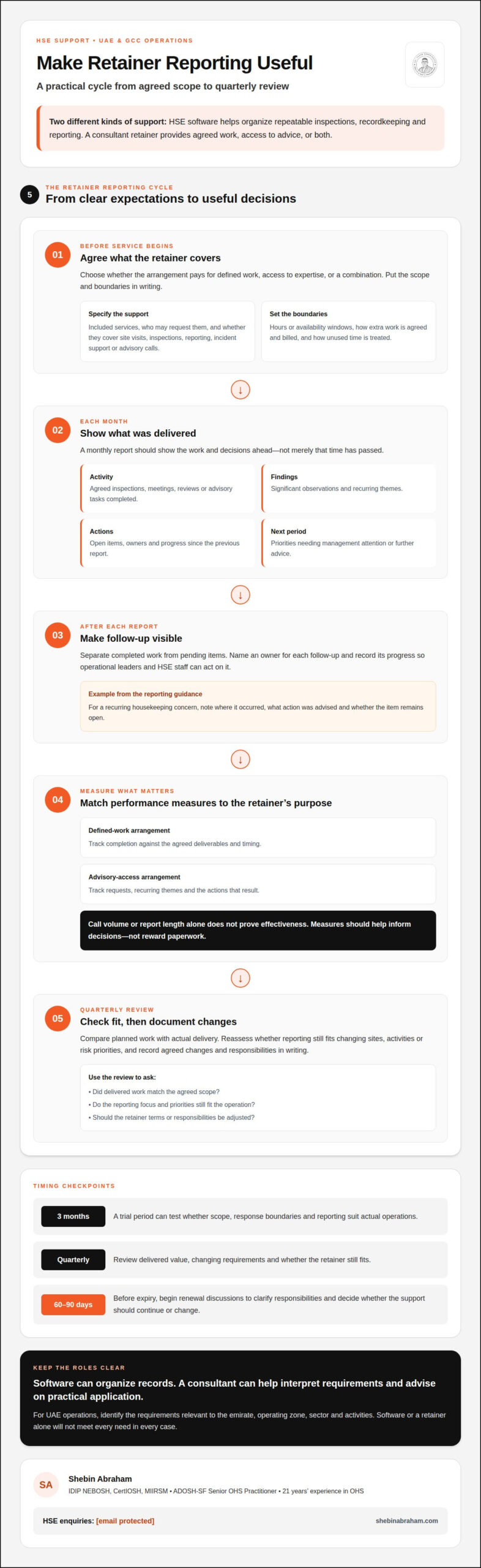
Define the scope before the contract begins. Specify which services are included, who can request them, and whether support covers site visits, inspections, reporting, incident support, or advisory calls. Set limits on hours or availability windows, and describe how extra work is agreed and billed. For example, an hours-based arrangement might use 10 hours in one month and 3 hours the next. The contract should explain how unused time is treated.
Set out both sides’ responsibilities. Identify the consultant’s deliverables and the business’s role in providing access, records and operational contacts. Record the financial terms, payment timing, confidentiality requirements and protection of confidential information after termination. State whether the consultant is an independent contractor rather than an employee. That describes the intended relationship, but does not by itself settle every legal question about how the arrangement operates.
Termination terms help both parties understand how the relationship can end. Consulting retainer contracts commonly use a 30-day notice period, while some require 60 or 90 days. A 12-month commitment without an exit option can leave a business paying for support that no longer fits. Include a clear termination path, notice method, final payment process, and treatment of unfinished work. Written proposals and change-control language can also prevent scope creep.
For UAE businesses, identify the requirements relevant to the operation’s emirate, operating zone, sector and activities before deciding what support is needed. Software can organize records; a consultant can help interpret requirements and advise on their practical application. The right balance depends on the work and the expectations that apply. Software or a retainer alone will not meet every need in every case.
There is no single UAE price for HSE software. Costs depend on user numbers, sites, selected functions, configuration and support arrangements. Compare the recurring subscription with any setup or service components, and assess what each cost covers. A retainer’s fee also depends on the agreed access, hours and deliverables. Comparing HSE software vs a consultant retainer fairly means weighing equivalent needs, not treating different packages as interchangeable.
Trial periods and scheduled reviews make an arrangement easier to assess. A three-month trial can test whether the agreed scope, response boundaries, and reporting suit actual operations. Review delivered work and changing needs quarterly, then adjust the contract through written agreement. Begin renewal discussions 60-90 days before expiry. This gives both parties time to clarify responsibilities, revise scope, and decide whether continued access or defined work better serves the business.
Retainer reporting and performance metrics
A monthly report should show what the retainer delivered, not just that time has passed. A useful format links advisory work to operational activity, such as inspections completed, actions raised and recurring concerns discussed. Separate completed work from pending items, and name the owner of each follow-up. This makes the contribution visible to managers and gives the next review a practical starting point.
Agree on the reporting structure before the service period begins. A consultant’s report might cover work completed, key observations, recommendations, outstanding decisions and planned priorities. For example, a recurring housekeeping concern should show where it occurred, what action was advised and whether it remains open. Keep the language clear enough for operational leaders to act on, with enough detail for HSE staff to track trends.
- Activity: Record agreed inspections, meetings, reviews, or advisory tasks completed.
- Findings: Summarize significant observations and recurring themes.
- Actions: Identify open items, owners, and progress since the previous report.
- Next period: Note priorities that need management attention or further advice.
Use quarterly reviews to test whether reporting reflects changing needs. Consulting firms can review delivered value, client requirements, and whether retainer terms need adjustment. Compare planned work with actual delivery, then discuss shifts in sites, activities, or risk priorities. A quarter-by-quarter view can reveal that the original reporting focus no longer matches the operation. Record agreed changes and responsibilities so the next monthly report follows the revised direction.
Performance measures should match the retainer’s purpose. For defined work, track completion against agreed deliverables and timing. For access to advisory support, track requests, themes and resulting actions instead. Don’t treat call volume or report length as proof of effectiveness. A concise recommendation that resolves a recurring issue may matter more than a long activity log. Measures should inform decisions, not reward paperwork.
Termination rights also affect reporting. The contract should state which records and final summaries are due when the arrangement ends, who receives them and how open actions are handed over. Set out the notice process and how work already underway will be handled. A closing report can list completed deliverables, unresolved issues and decisions requiring internal ownership. This supports continuity without implying that the consultant remains responsible after the contract ends.
Software analytics and consultant reporting serve different purposes. Configured software may organize inspection records or display open actions across locations; its usefulness depends on the information entered and the reports available. A consultant can interpret patterns, explain operational implications, and recommend priorities. Where UAE operations need more structured OHS reporting and advisory review, specialist HSE guidance can help connect recorded information with practical decisions.
Comparing ongoing advisory access with defined consulting work
Retainer models differ in what they reserve: completed work, access to advice, or both. That distinction affects availability, audit preparation and how support can respond to changing operational demands.
Pay-for-Work and Pay-for-Access Models
A pay-for-work retainer covers agreed tasks during a set period, while pay-for-access reserves access to a consultant’s expertise. The contract should connect the fee to the work or access provided. For example, a defined-work arrangement might cover planned inspections, while an access model focuses on advice as issues arise. This distinction helps prevent unclear expectations about deliverables and availability.
Pay-for-access can suit teams needing interpretation or discussion before choosing action. Its benefit is ongoing access without commissioning each advisory task separately. Its limitation is that reserved access doesn’t automatically mean substantial project work is included. Define request channels, availability windows, and any hours or calls covered. A basic access tier may include 1-2 calls monthly, so scope matters.
Consultant Access and Availability
Consultant availability means the agreed routes and boundaries for requesting support, not unlimited access. Specify routine contact methods, urgent-work definitions, response expectations, and whether site attendance forms part of the arrangement. Some retainers suggest responding to urgent matters within 2 hours, with urgency defined in advance. This only works as an expectation when the contract states its meaning and limits.
For operations with fluctuating workloads, agreed additional consultant days can support busier periods or higher-risk activities. This flexibility can make a retainer a useful ongoing arrangement. However, availability depends on the agreed scope and capacity, so additional work needs a clear approval process. Software, by contrast, supports users through its configured functions, not personal advisory access.
Software and Consultant Inclusions
HSE software typically organizes information and repeatable processes, while a consultant retainer provides defined work or access to professional judgement. Software records can support audit preparation by bringing relevant records and action status together. A consultant can help interpret findings and explain what operational decisions they may call for. Neither format replaces the need for accurate records and responsible follow-through.
For UAE regulatory compliance, software can help organize evidence, while a consultant can advise on requirements relevant to the operation and its authority context. Audit readiness depends on usable records, clear ownership and actions that reflect actual practice. A software dashboard alone cannot explain whether a control is suitable; a consultant’s advice also needs to be implemented and documented by the business.
Assessing Needs, Benefits, and Limitations
Choose by identifying recurring administrative needs, unresolved technical questions, site complexity and internal HSE capability. Software may suit teams that need consistent records across routine processes. A retainer may suit operations that need continuing specialist input. Combining them can pair structured information with human interpretation, but it also means coordinating separate scopes and responsibilities.
Software without consultant input can leave teams with organized records but unresolved questions about interpretation, priorities or corrective actions. A retainer provides ongoing advice, but within its agreed access and scope, and depends on the business supplying information promptly. For audit readiness, assess whether your team can interpret records and manage actions internally. If not, include advisory support in your operating model.
Consulting services and specialist expertise
Software can streamline repeatable tasks, while a consultant brings expertise to decisions that need context. For example, a system can schedule inspections, store completed checklists, track corrective actions and flag overdue items. A consultant can assess whether a control suits the work, interpret findings and help prioritize practical improvements. The difference is between organizing information and applying professional judgement.
Consider a warehouse inspection. Software can guide an inspector through a configured checklist and record a damaged walkway. It can assign follow-up and show whether the action remains open. A consultant can examine why the damage recurs, consider the work process and advise whether existing controls address the underlying hazard. Software supports consistent workflows; specialist input supports analysis and recommendations.
HSE teams can use software to standardize recurring administrative tasks, including document storage, inspection schedules, action logs and trend summaries. Its value depends on accurate inputs, suitable workflows and consistent use. If users select an unsuitable checklist or close actions without resolving them effectively, the dashboard may show completion without demonstrating that the underlying concern was addressed.
Consulting expertise matters when a decision depends on site conditions, interacting hazards or the adequacy of existing controls. A consultant may review a risk assessment, examine an incident or advise on preventive and protective measures. The business still needs to provide relevant operational information and implement agreed actions. Specialist advice informs decisions; it does not replace the organization’s day-to-day ownership of safety.
For UAE operations, the relevant authority context can shape which records, processes or technical advice matter. Requirements may differ by emirate, activity and operating zone, so a generic software template cannot determine every site-specific interpretation. A consultant familiar with the applicable context can help explain how a requirement relates to actual work. Software can then organize the resulting records and follow-up tasks.
A practical division of work can make both tools useful. Use software for repeatable inspections, records, action ownership and reporting. Bring in a consultant when the team needs an informed review of risk controls, incident circumstances or complex operational changes. For example, a dashboard may flag repeated equipment-related findings; specialist review can help interpret the pattern and assess which corrective measures need attention.
The central question is whether a task needs structured data capture or professional interpretation. Software can prompt consistent data collection, but it cannot independently judge whether a control suits a particular job. A consultant can provide that judgement, but advisory work still needs clear records and follow-through. Matching each task to the right support helps protect people and makes HSE knowledge more useful in daily operations.
What does HSE software typically include compared with an HSE consultant retainer?
HSE software typically supports repeatable processes such as inspections, action tracking and reporting. An inspection tool may let teams configure checklists, complete them on mobile devices, assign corrective actions and review results across locations. A consultant retainer instead provides agreed work or access to specialist advice. In practice, one helps organize recorded information; the other brings human judgement to operational questions.
Software capability depends on the product and its configuration. A configured inspection checklist can guide staff through consistent questions at multiple sites. Assigned corrective actions make ownership visible, while reports help teams identify recurring observations. These functions support audit preparation, but the result still depends on accurate entries and meaningful follow-through. A completed digital checklist alone does not show whether a control works in practice.
A consultant retainer can cover work that needs review, explanation or discussion. Depending on the agreement, HSE consultancy may include inspections, reporting, incident support and knowledge transfer to staff. A consultant can examine a recurring finding and discuss its operational context with the team. That advice can help managers decide what to address, while the business remains responsible for implementing actions and maintaining records.
- Software: Checklist configuration, mobile inspection completion, corrective-action assignment, and results review across locations.
- Consultant retainer: Agreed advisory access or defined work, which may include inspections, reporting, incident support, and knowledge transfer.
Consider a repeated inspection finding across multiple sites. Software can display recorded observations and assigned actions. A consultant can help assess whether the pattern points to a wider operational issue and advise on suitable follow-up. Used together, the system provides structured information and the consultant adds interpretation. This pairing is useful when internal teams need both consistent records and specialist input.
Judge neither option by its feature list alone. For software, assess whether the inspection workflow matches actual tasks, staff can use it in the field and managers can review actions across locations. For a retainer, assess whether the agreed work or access meets the operation’s needs. A useful comparison links each capability to a real process, a responsible person and an expected output.
For UAE operations, the sites, work activities and authority context shape what teams need to record and where specialist interpretation may help. Software can organize information, but it cannot independently determine whether a recorded control fits the work. A consultant can advise, but that advice still needs clear documentation and operational follow-through. The sound choice is the arrangement that closes the gap between recording findings and acting on them.
If your team needs to connect inspection information with practical HSE decisions, discuss specialist OHS advisory support.
Shebin Abraham
Shebin Abraham helps businesses across the UAE assess where structured HSE records, ongoing advice or defined consulting work best fit their operations. When teams need specialist guidance connected to relevant requirements, his OHS consulting can support clearer decisions about suitable processes, responsibilities and follow-up. ADOSH-SF and Trakhees-related OHS needs for workplaces in the UAE may also call for specific advisory input.
The practical next step is to discuss your operational needs, existing HSE arrangements and the areas where your team needs support. This can clarify whether consulting input should complement your software processes or address a gap they cannot resolve. For advice aligned with your workplace priorities, contact Shebin Abraham.
Make your next HSE decision with purpose
The value of comparing HSE software vs a consultant retainer lies in choosing support that fits your operation, not simply selecting a format. Start with the decisions your team needs to make and the people responsible for acting on them. Then consider whether clearer records, specialist judgement or a combination would strengthen day-to-day oversight.
For workplaces in the UAE and GCC, the choice can also involve requirements tied to the operation’s regulatory context. Shebin Abraham provides OHS Services, Freelance HSE Service and Freelance ADOSH-SF Freelance OHS consulting. Discuss your priorities and where your team needs practical guidance to identify a suitable next step.
Contact Shebin Abraham for advice and take the next step toward HSE support that works for your people and operations.
Frequently Asked Questions
What is a retainer agreement?
A retainer agreement sets the terms of an ongoing professional arrangement. It should make clear whether payment secures access to advice, specific work or both. Before signing, confirm how requests are authorized, how additional tasks are handled and what happens to unfinished work if the agreement ends. These details help prevent uncertainty when operational priorities change.
What are typical HSE consultant retainer fees in the UAE?
There is no single standard HSE retainer fee for every UAE assignment. Fees depend on scope, complexity and delivery requirements. For a useful estimate, describe the work you need, the advisory access required and any defined deliverables. This helps distinguish the recurring retainer commitment from separately agreed additional work.
What UAE HSE laws and authority requirements should businesses consider when choosing between software and a consultant?
Consider the requirements relevant to your emirate, operating zone, sector and activities, as well as the expectations of the relevant authority. Software can organize records, while a consultant can help interpret requirements and advise on practical application. Neither option alone meets every need in every case.