
The biggest consultancy isn’t automatically the safest fit for your project. Knowing when to choose a freelance safety consultant over a large firm comes down to scope: a defined OHS need, specialist expertise and direct collaboration may suit freelance support, while complex work requiring several disciplines may call for a larger firm.
A firm’s broader resources can be valuable, especially when work spans departments or sites. But when you need focused guidance tailored to your operation, working directly with a specialist can help keep advice practical and relevant. Weigh project scope, flexibility, expertise and team requirements before choosing support for your UAE operation.
Author Shebin Abraham, IDIP NEBOSH, CertIOSH, MIIRSM, is an ADOSH-SF Senior OHS Practitioner with 21 years of OHS experience. His perspective is grounded in occupational health and safety consulting in the UAE, with specialist experience in ADOSH-SF and Trakhees OHS compliance.
Key Takeaways
- Match the consultant model to the scope: focused, well-defined OHS work can suit freelance support, while complex projects may need a larger team.
- Consider whether flexible engagement and direct access to a specialist would help keep advice aligned with your operations.
- Look at the expertise the work requires, not firm size alone, when deciding who can guide and deliver the project.
- Compare how each option handles collaboration, reporting, governance and work across teams or regions.
- Use the decision guide to identify the support that fits your project’s needs and working arrangements.
Choosing a consultant for a specific project
A freelance consultant can suit a contained OHS assignment with clear deliverables and specialist requirements. A large firm may be a better fit when the work requires several disciplines, formal governance or coordinated delivery across teams.
Fees and Project Costs
Compare the proposed work, not simply a day rate. An independent specialist may be engaged for a defined assessment or strategy, while a large firm may propose a broader team and delivery structure. Fees depend on the project’s scope, expertise and delivery requirements, and are provided after a quote request.
For example, reviewing one work activity differs from delivering a programme across multiple sites. Clarify whether the engagement includes assessment, recommendations and reporting. The decision about when to choose a freelance safety consultant over a large firm becomes clearer when you compare the proposed deliverables with the decision your business needs to make.
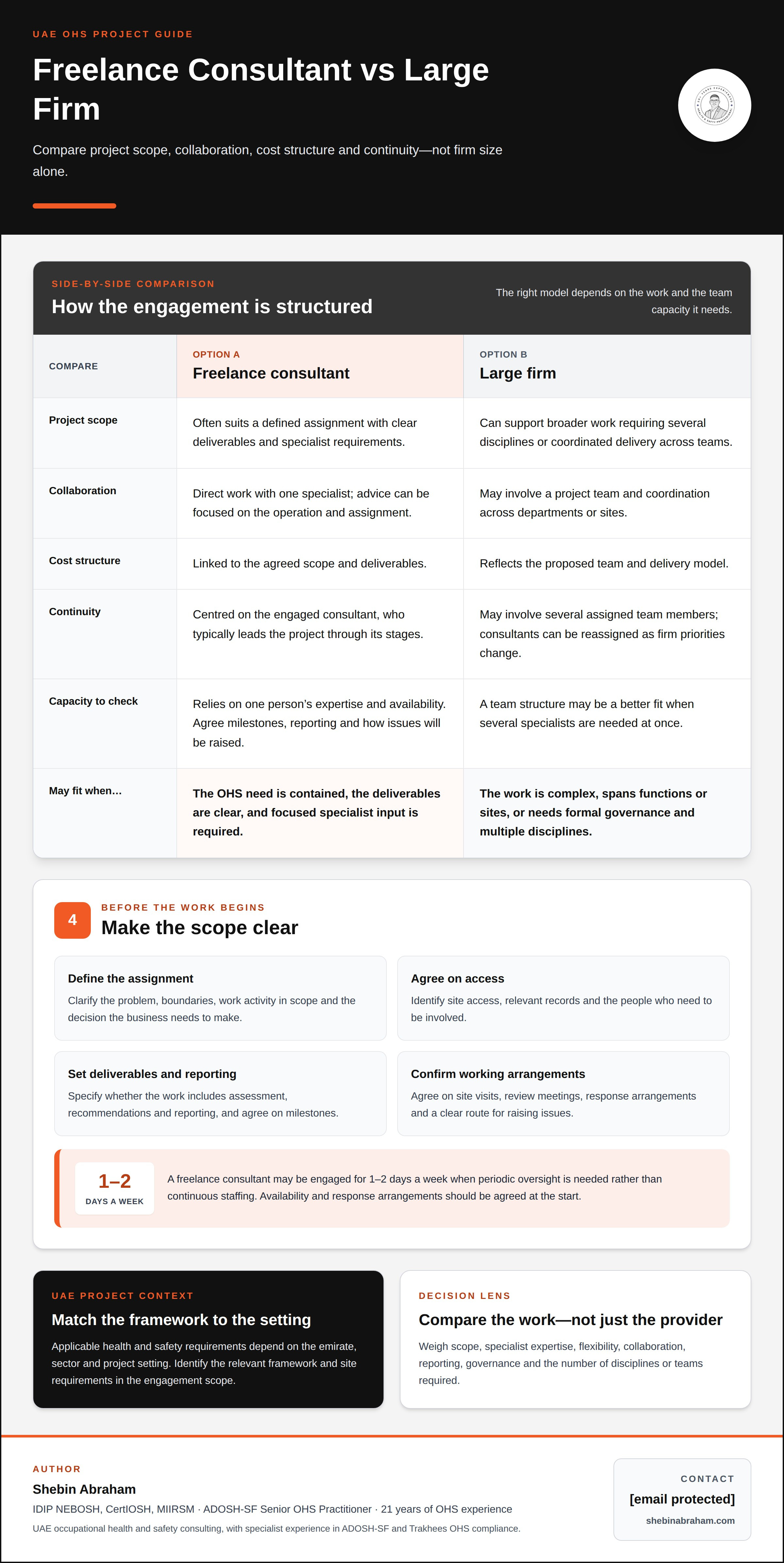
| Option | Project scope | Collaboration | Cost structure | Continuity |
|---|---|---|---|---|
| Freelance consultant | Often suits a defined assignment | Direct work with one specialist | Linked to agreed scope and deliverables | Centred on the engaged consultant |
| Large firm | Can support broader, multidisciplinary work | May involve a project team | Reflects the proposed team and delivery model | May involve several assigned team members |
Continuity and Project Loyalty
Continuity means keeping the same professional involved from scoping through close-out. Freelance consultants typically lead their projects and rarely switch assignments mid-project; employed consultants may be reassigned when new work or firm priorities arise. This difference matters when site access and follow-up discussions shape OHS advice.
A freelance engagement also relies on one person’s capacity. Agree on milestones, reporting arrangements and how issues will be raised. If the work requires several specialists at once, a large firm’s team structure may be a better fit.
Engagement Scope and Risks
A freelance safety consultant can help define an engagement by clarifying the problem, boundaries, site access, deliverables and reporting line. This gives both parties a shared basis for managing the work. For example, a review can specify which work activity is in scope and what recommendations the report should address.
In the UAE, applicable health and safety requirements depend on the emirate, sector and project setting. Identify the relevant framework and site requirements in the engagement scope. Potential challenges with freelance support include a mismatch between expertise and assignment, unclear deliverables or limited continuity if the consultant becomes unavailable.
Address these challenges through a precise scope, agreed milestones, documented findings and a clear escalation route. A large consultancy may be more suitable when a project requires multiple disciplines, extensive security arrangements or governance across functions. To decide when to choose a freelance safety consultant over a large firm, weigh the scope against the expertise and team capacity required.
Flexibility and speed in freelance work
A freelance arrangement can suit OHS work that needs focused input without a permanent project team. Its practical flexibility lets you shape the engagement around site access, operational demands and the support required. For example, review sessions can be arranged around production activity rather than asking the operation to follow a consultant’s timetable.
Availability still depends on the consultant’s existing commitments and the work involved. Freelancers may provide support to multiple clients, so flexibility doesn’t mean unlimited access or immediate attendance. Agree on working days, site visits, review meetings and response arrangements at the start. A freelance consultant may be engaged for 1-2 days a week, which can suit a business needing periodic oversight rather than continuous staffing.
Scheduling can help bring in the right expertise at critical project stages. A business might need an OHS specialist during a planned site review and again when its team considers the recommendations. A corporate consultancy may have established processes for allocating staff, while an independent consultant can coordinate directly with the people responsible for the work. Either arrangement needs clear scheduling and agreed responsibilities.
Speed is not simply a matter of choosing one provider type. It depends on the scope, access to relevant information, decision-making and the consultant’s capacity. One reported freelance engagement began about 10 days after the initial conversation, but that example isn’t a standard start time. For an OHS assignment, early agreement on the target, site arrangements and deliverables helps avoid delays caused by unclear expectations.
Use a straightforward planning sequence before work begins:
- Set the target outcome, such as reviewing a defined workplace concern.
- Identify when the consultant needs access to the site, records or relevant staff.
- Agree on meetings, progress updates and delivery dates.
- Allow time for operational decisions and feedback on recommendations.
A clear sequence gives both sides a workable schedule without confusing flexibility with guaranteed speed. If site conditions change or decision-makers are unavailable, the timeline may need adjustment. A large firm’s broader team may be more suitable when work must happen across departments at once. Freelance support is strongest when one specialist can coordinate directly with people who understand the operation.
For focused OHS support, freelance HSE consulting can provide a direct working arrangement shaped around project needs and agreed availability.
Specialised expertise and direct collaboration
A specialist’s value comes from applying relevant OHS knowledge to your operation, not from firm size alone. Direct collaboration can keep advice close to the people managing the work.
Specialised Expertise
A freelance consultant may focus on a defined area, such as workplace risk management or a particular compliance framework. That focus can suit a project where one specialist’s judgement is central. Large consulting firms may bring several disciplines together, which can be more useful when an assignment spans functions or locations.
Match the expertise to the actual work. For an OHS review, relevant experience means more than broad advisory language: the consultant should explain how they assess the workplace, interpret findings and turn recommendations into practical action. Ask for an example of a similar problem and how their approach addressed it.
Direct access also shapes the working relationship. You can discuss the operational context with the professional conducting the assessment, rather than relying only on handovers between team members. This can help the consultant understand why a procedure is difficult to apply at a particular site. Clear documentation still matters: record agreed findings and recommendations for those responsible for action.
Experience at consulting firms can help practitioners learn frameworks, tools and methods for solving client problems. A freelance specialist may bring that experience into a focused engagement without needing a full project team. Online platforms and professional networks can also connect businesses with specialists, but the match should rest on relevant work and communication, not profile wording alone.
Experience, Insurance, and References
Assess experience by matching previous assignments to your project’s hazards, operating environment and advisory needs. Request a concise account of comparable projects, the consultant’s role and the outputs delivered. References can add context: with permission, speak to a former client about communication, practical recommendations and follow-through.
Insurance is a separate consideration from technical competence. Ask what cover the consultant holds and request current evidence, then compare its scope with the work and contractual responsibilities. The appropriate cover depends on the engagement; don’t assume one policy type or limit fits every OHS assignment.
Use a simple review before appointing a consultant:
- Match demonstrated experience to the project’s specific OHS needs.
- Discuss a comparable assignment and the consultant’s personal contribution.
- Review reference feedback on delivery, clarity and follow-up.
- Check insurance evidence against the agreed scope and responsibilities.
These checks let you compare an independent specialist with a firm based on evidence, not presentation. A large consultancy may offer a broader team, while a freelancer provides direct access to one expert. Choose the arrangement that gives your project the right expertise and clear accountability.
Freelance consulting compared with employment at a large firm
The key difference is how expertise and responsibility are organised. A freelance consultant provides focused individual input; a large firm can assemble a broader team.
Freelance Safety Consultant
A freelance safety consultant is an independent professional engaged for specialist advice or project delivery. The main advantages are direct access to the person doing the work and the ability to shape a focused engagement. The limitation is capacity: one consultant may not cover every discipline or provide a team for simultaneous work across departments.
For example, a business seeking an OHS review for one operation may value a specialist’s direct involvement. The consultant can work with the people closest to that operation and tailor recommendations to its conditions. This arrangement suits projects where individual expertise matters more than team size.
The advantages of freelance support include focus, direct communication and a close fit between skills and scope. Its limitations can include narrower capacity and dependence on one professional’s availability. A large safety consultancy with a multidisciplinary team may be more suitable when a project spans technical disciplines, functions or locations, or requires formal third-party assurance.
Large Consultancy Firm
A large consultancy can bring professionals with different skills together under one project structure. That model can support complex assignments requiring coordinated input, executive reporting or governance across business units. A firm may also have documented results from similar projects and teams whose members have worked together before.
That breadth can be useful, but it isn’t automatically necessary for a contained assignment. If one specialist can address the defined need, a larger team may add coordination layers without changing the expertise required. Compare the proposed team and work plan with the decisions your project needs to support.
Freelancers can choose clients and work with multiple clients, while employees at consulting firms work within their employer’s structure and priorities. That distinction affects who you collaborate with and how the engagement is organised. A freelancer’s professional network, including connections made through LinkedIn, may also help them draw on relevant relationships, but it doesn’t replace the skills needed for the assignment.
Use these criteria to compare the two options:
- Scope: Is the work contained, or does it cross disciplines and functions?
- Expertise: Does one specialist have the required ability, or is a broader team needed?
- Governance: Does the assignment require coordinated reporting or formal assurance?
- Working relationship: Is direct access to one adviser valuable, or is team coordination essential?
Choose the model that meets the project’s actual requirements. A freelance consultant can suit focused specialist work; a large firm may be better suited when multidisciplinary capacity and coordinated oversight are central.
What does a freelance safety consultant do compared with a large consultancy firm?
A freelance safety consultant typically provides focused expertise and practical support for an agreed assignment. A large consultancy can combine specialist knowledge, broader strategy and coordinated work across a team. The distinction matters when deciding who will assess a concern, develop recommendations and support implementation at your UAE workplace.
For example, a site team might need an OHS review of a specific work activity. A freelancer can work directly with the people performing and supervising that activity, then present findings in a practical format. The work may include observation, discussion with relevant staff, analysis of identified gaps and recommendations for responsible managers. The agreed scope defines the precise tasks.
A large consultancy may address the same concern as part of a wider organisational programme. It can bring different disciplines together when an issue connects with operations, governance or multiple locations. That breadth can help coordinate analysis and reporting, particularly when executives need a consolidated view. The work may involve several consultants and additional coordination with the business.
The distinction is not simply advice versus action. Freelancers can be engaged for their skills and implementation support, while consultants may be hired for knowledge and strategy. In an OHS engagement, a specialist might assess a defined risk and translate findings into recommended controls. A wider team may consider how related procedures, reporting lines and business priorities fit together. Either approach can include analysis and recommendations.
Clarify the professional’s role at each stage of the engagement:
- Assess: Establish the operational issue and review relevant workplace information.
- Advise: Explain findings and recommend measures suited to the work setting.
- Support: Help managers interpret recommendations and plan follow-up.
- Report: Record the agreed findings, responsibilities and next actions.
These stages make the work easier to evaluate, whether one specialist or a team leads it. A freelance consultant can maintain a direct link between assessment and advice. A large firm can assign separate people to technical review, coordination and reporting. The business should understand who is responsible for each output and how decisions move from findings to action.
Choose based on the work’s required depth and reach. A contained OHS issue may need one practitioner with relevant expertise and a clear remit. A programme involving several functions or regions may need coordinated disciplines and executive-level reporting. For focused occupational health and safety support, discuss your OHS project and the practical guidance it requires.
Shebin Abraham: OHS Freelancer Trakhees Consulting
Shebin Abraham provides Freelance Trakhees OHS Consulting for businesses seeking focused advice on Trakhees OHS requirements. It suits projects where direct collaboration with an OHS specialist is useful, rather than a larger multidisciplinary team. The work can focus on your operational concerns, define the support required and provide relevant OHS consulting.
Share your project scope, work setting and main OHS concerns to start a focused discussion. For needs involving ADOSH-SF standards, Shebin Abraham provides Freelance ADOSH-SF Consulting. The right engagement depends on the expertise and scope your project requires.
Contact Shebin Abraham to discuss your OHS consulting needs.
Set Your OHS Project in Motion
The right support should fit the work ahead and help your team make practical OHS decisions. When deciding when to choose a freelance safety consultant over a large firm, focus on the expertise, scope and collaboration your project needs. Share a clear project brief with Shebin Abraham to start a discussion about the next steps.
Shebin Abraham provides OHS Services, Freelance HSE Services and Freelance ADOSH-SF Consulting. These services support businesses seeking occupational health and safety guidance, including advice related to ADOSH-SF standards. Share the project setting, main concern and intended outcome to focus the discussion on relevant support.
Good safety work is grounded in the realities of the workplace and the people carrying it out. Take the next step with a considered conversation about your project. Contact Shebin Abraham to discuss your project, and move forward with clarity and care.
Frequently Asked Questions
Decision Framework: What’s Best for Your Project?
Choose the arrangement that matches the decision your project needs to support. For one operational concern, define the expected assessment, recommendations and reporting before selecting an individual specialist. If the assignment combines technical disciplines or requires coordinated reporting across business units, consider whether a larger firm’s structure is a better fit. For example, reviewing one work activity differs from coordinating an OHS programme across several functions.
When is a freelance safety consultant the better choice for a business?
A freelance safety consultant can suit a business that needs focused expertise and direct input for a contained OHS assignment. This could include reviewing a specific workplace concern or getting specialist advice without creating an ongoing internal role. The business should identify a clear contact for decisions and provide access to relevant operational information. This helps the consultant tailor findings to the actual work instead of offering generic recommendations.
How do freelance safety consultant fees compare with large firm rates?
There’s no reliable, universal rate comparison based on provider type alone. Freelance fees depend on scope, complexity and delivery requirements; a large firm’s proposal may reflect its team and project structure. Compare what each proposal includes, such as site work, analysis, reporting and follow-up. A lower headline fee may not cover the same deliverables, so assess the complete scope rather than a single rate.
What factors affect the cost of freelance health and safety consultancy?
Cost depends on the assignment’s scope, complexity and delivery requirements. Reviewing one defined work activity differs from a broader assessment requiring more site access, information analysis or detailed reporting. The specialist input and agreed outputs also affect the engagement. Set out the issue, working arrangements and deliverables clearly so the proposal reflects the actual work rather than an assumed package.
What qualifications and certifications should a freelance safety consultant have?
Look for qualifications and professional credentials relevant to the OHS work, alongside experience in a comparable operational setting. NEBOSH International Diploma, IOSH and IIRSM membership, and ISO 45001 Lead Auditor credentials are examples of qualifications and affiliations associated with OHS practice. Their relevance depends on the assignment. For framework-specific advisory, such as ADOSH-SF or Trakhees, assess the consultant’s experience with that framework and the project’s needs.