

HSE documentation is only useful when approved procedures guide the work people actually do. HSE documentation support services help organizations develop and maintain practical policies, responsibilities, risk assessments, procedures and records, then connect those documents to workplace implementation.
It’s understandable to focus first on which documents are needed. But having policies on file is only part of the picture: documents also need clear ownership, appropriate review and approval, and a practical link to daily operations. This article explains what HSE documentation support services can cover and how development, compliance, review and implementation fit together in the UAE.
You’ll also learn what professional support can involve, what information helps shape the work, and how document control keeps approved versions clear and usable. The guidance reflects the experience of Shebin Abraham, IDIP NEBOSH, CertIOSH, MIIRSM, an ADOSH-SF Senior OHS Practitioner with 21 years of OHS experience, whose HSE documentation support services focus on practical workplace compliance.
Key Takeaways
- Effective HSE documentation connects workplace policies and objectives with clear responsibilities, so people understand their roles.
- Emergency plans, drill records and training documentation help show how preparedness is communicated and put into practice.
- Risk assessments, incident records and inspection findings can guide practical controls and follow-up actions.
- Review, approval and version control help keep documents applicable, current and ready for use in daily operations.
- Professional OHS support can help organizations develop and implement documentation suited to their workplace and compliance needs.
HSE policies, objectives and responsibility matrices
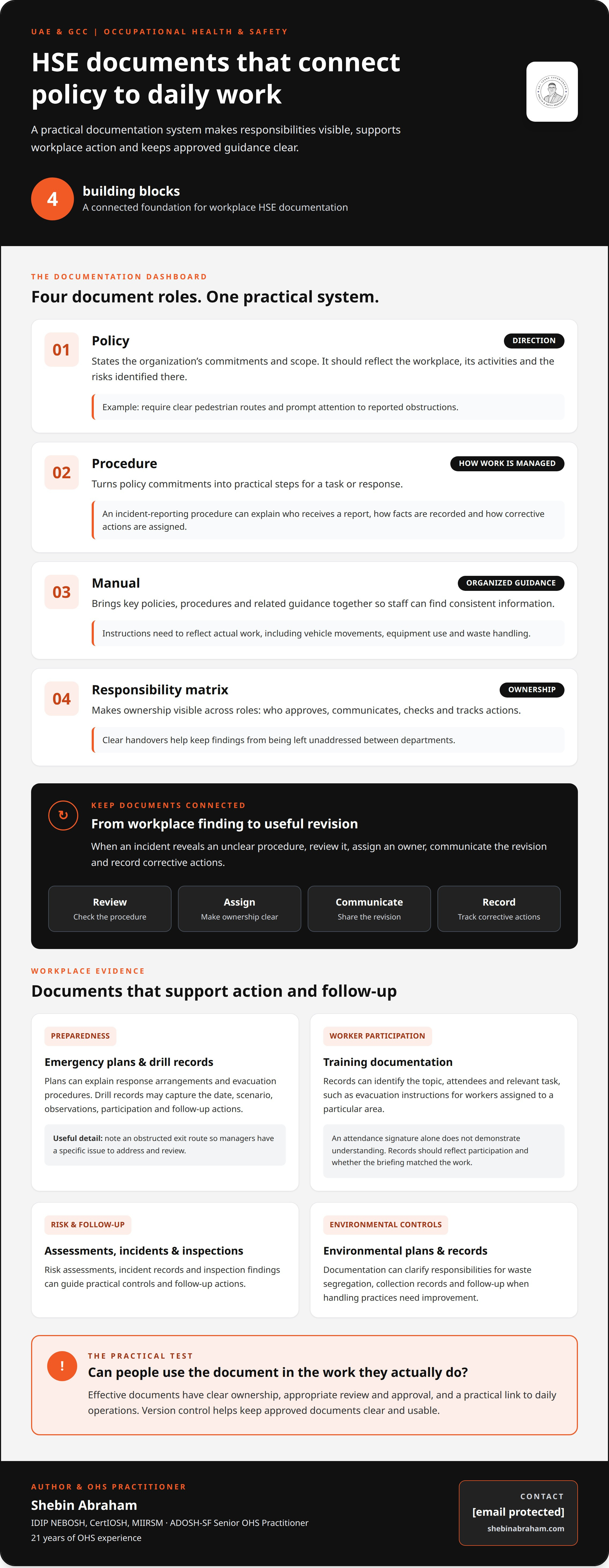
An HSE policy sets the organization’s direction for protecting people and managing environmental responsibilities. It gives managers, supervisors and workers a shared reference for decisions. For example, a warehouse policy can require clear pedestrian routes and prompt attention to reported obstructions. The policy should reflect the workplace, its activities and the risks identified there.
Procedures turn policy commitments into practical steps. An incident-reporting procedure can explain who receives a report, how facts are recorded and how corrective actions are assigned. A safety manual can bring key policies and procedures together so staff can find consistent guidance. It is useful only when its instructions reflect actual work, such as vehicle movements, equipment use and waste handling.
Objectives translate broad commitments into areas for action and review. An organization might focus on improving inspection follow-up, strengthening emergency readiness or reducing recurring housekeeping findings. Each objective needs an owner, a way to assess progress and a route for reporting results to management. These details distinguish an active improvement objective from a sentence that exists only in a manual.
A responsibility matrix makes ownership visible across roles. It can identify who approves a procedure, communicates it, carries out a workplace check and tracks corrective actions. For example, a supervisor may record a blocked walkway while a designated manager assigns follow-up and confirms completion. Clear handovers reduce the risk of findings being left unaddressed between departments.
- Policy: states the organization’s commitments and scope.
- Procedure: explains how a task or response is managed.
- Manual: organizes policies, procedures and related guidance.
- Responsibility matrix: assigns ownership for decisions and actions.
Environmental objectives should connect with the organization’s environmental controls and records. HSE documentation can support organizations implementing the ISO 14001 environmental management system, according to the International Organization for Standardization. For a workplace managing waste, related documents could clarify responsibilities for segregation, collection records and follow-up when handling practices need improvement.
Keep documents connected. If an incident reveals that a procedure is unclear, the organization can review it, assign an owner, communicate the revision and record corrective actions. This links policy intent with workplace safety and practical improvement. A responsibility matrix shows who manages each step, while management review can assess whether objectives and controls remain suitable.
Corrective actions should lead to a procedure update when needed. HSE procedures should address hazards and risks identified through the organization’s risk assessment process. HSE officers should follow their organisation’s reporting and investigation procedures, including confidentiality requirements.
What‘s meant by Health and safety documentation?
Health and safety documentation is the organized record of how a workplace identifies hazards, manages risks and prepares people to work safely. It includes plans, assessments, procedures and evidence of actions taken. For example, a warehouse may keep an emergency plan alongside drill and staff training records.
When selecting HSE documentation support in the UAE, consider relevant OHS experience, understanding of your workplace and the ability to produce practical documents. Look at professional qualifications, familiarity with applicable requirements and whether the consultant can explain how records support day-to-day work.
Support can include preparing or reviewing risk assessments, emergency response plans, safe work procedures, incident records, inspection records and training documentation. The right scope depends on the workplace’s activities, hazards and existing HSE arrangements.
An HSE consultant can prepare or review health, safety and environmental documents, including risk assessments, emergency procedures, incident reports and waste management records. Documents should be based on workplace activities and information about existing controls.
Emergency plans should explain how the organization prepares for foreseeable events and communicates appropriate responses. Related documentation may cover fire prevention, emergency response and employee evacuation procedures. In a warehouse, a plan can describe how staff receive an alert, follow evacuation routes and reach the designated assembly point. Clear instructions help workers understand what action applies to their role.
Plans need supporting records. Drill documentation can record the date, scenario, observations, staff participation and follow-up actions. A record that only says a drill took place gives little detail about what happened. For example, noting an obstructed exit route gives managers a specific issue to address and review during the next exercise.
Training records show which health and safety topics were covered and who took part. A useful entry identifies the subject, attendees and relevant task, such as evacuation instructions for workers assigned to a particular area. An attendance signature alone does not demonstrate understanding. Records should reflect worker participation and whether the briefing matched the work.
Environmental plans and records address environmental aspects alongside emergency readiness. Documentation can describe how hazardous and non-hazardous waste is managed and disposed of. If spill response is part of site arrangements, related instructions and records should connect the response with the materials and controls at that workplace.
These records become more useful when they support review and action, rather than simply filing activity. Professional HSE documentation support can help shape plans and records around workplace conditions and operational needs.
Safety standards and regulatory compliance
HSE documents should reflect workplace hazards, applicable requirements and the controls people use. The International Organization for Standardization identifies ISO 45001 as an occupational health and safety management system standard relevant to HSE documentation.
Job Safety Analysis and Method Statements
A job safety analysis breaks a task into steps, identifies hazards at each stage and records suitable controls. For example, a maintenance task may require documentation of access arrangements, equipment isolation and safe work practices. A method statement explains how the work will be done. Review both documents for consistency with the actual task, workplace conditions and assigned responsibilities.
Workplace Health and Safety Documents
Workplace health and safety documentation can include risk assessments, inspection reports, incident and near-miss records, and investigation reports. Each record should describe relevant facts, identify hazards and connect findings to corrective actions. For instance, a report about a damaged machine guard should identify the equipment and location, then record the action and its completion status. Clear records support safety management and review.
HSE File Management
Health and safety file management keeps documents identifiable, accessible and controlled. A controlled file can show a document number, revision, approval details and issue date. An index helps users find the current procedure instead of relying on an old copy saved locally. Retain incident, inspection and training records in an organized structure, with access suited to their purpose and confidentiality needs.
Document Completeness and Currency
Incomplete, outdated or non-compliant HSE documents can leave workers following unclear instructions or controls that no longer match workplace hazards. They can also weaken an incident investigation if records omit key facts, responsibilities or corrective actions. Review documents when processes, equipment, hazards or organizational requirements change. Identify affected documents, assign revisions and communicate approved updates to relevant personnel.
Compliance depends on more than naming a standard in a manual. A management system needs evidence that procedures address identified risks and actions are followed through. An internal review can compare risk assessments with method statements, inspection findings and incident records. If a finding recurs across records, examine whether existing controls address its underlying cause.
File quality also affects how reliably people use safety documentation. A supervisor looking for an approved task procedure needs to distinguish it from a superseded version. Consistent document identification, approval records and controlled distribution make that distinction clearer. These practices support workplace safety and give managers a useful basis for investigations, corrective actions and continual improvement.
HSE documentation development and implementation process
Preparation time for an HSE plan, risk assessment or method statement depends on scope, task complexity and available workplace information. A single, clearly defined activity needs less analysis than a document covering several work areas, contractors and hazards. Review time also depends on how quickly responsible personnel provide feedback and approve practical controls.
Effective development connects written procedures with actual operations. A documentation process typically moves through these steps:
- Define the scope. Identify the work, location, people involved and documents required.
- Gather information. Review existing procedures, equipment details, task sequences and workplace hazards.
- Assess and draft. Record risks, controls, responsibilities and clear instructions for the work.
- Review and prepare for use. Gather relevant comments, resolve gaps and issue the approved version.
Permit-to-work procedures should explain how higher-risk work is authorized, coordinated and closed. The document can identify the task, work location, hazards, precautions and responsible personnel. Isolation procedures should describe how hazardous energy sources are identified and controlled for the activity. For example, a maintenance method should align with the equipment and isolation arrangements used at the workplace.
Safe work procedures and standard operating procedures translate risk controls into task instructions. An equipment operating procedure can describe required checks, normal steps and what to do if an unsafe condition arises. The wording should match the equipment and workers’ responsibilities. Generic instructions may miss workplace hazards, so document development should use task-specific information and operational input.
PPE records connect identified hazards with the protective equipment assigned to workers. Records may show what was issued and document compliance with PPE requirements. The related procedure should explain when equipment is needed and how it fits the task. For example, a work instruction can identify required PPE at the relevant step, rather than leaving workers to infer it.
Implementation begins when approved documents reach the people who use them. Relevant supervisors can brief workers on changed procedures, clarify responsibilities and gather feedback during work. If a control proves impractical, review the concern and revise the document through its approval process. This keeps procedures aligned with operations instead of allowing an unused manual to serve as the only evidence of implementation.
HSE documentation support can include developing policies, standard operating procedures, safety manuals and other materials for certification preparation. The work should focus on documents relevant to the organization’s operations, linking written instructions with tasks, hazards and responsibilities. Reviewing policies, operating procedures and safety manuals together helps present a coherent account of how work is managed and controls are communicated.
Organizations can include HSE consultants in preparing and reviewing certification documentation alongside their other HSE documents. The focus is on materials that reflect the work, explain controls and responsibilities, and are ready for the people who use them. This keeps certification documentation connected to workplace procedures and implementation, rather than separate from the instructions workers and supervisors rely on.
Document review, approval and implementation
Document control turns a draft into guidance people can identify, trust and use. A risk assessment may describe a hazard accurately, yet fail operationally if its controls are impractical or approval is unclear. Review, approval and implementation therefore need connected responsibilities, traceable revisions and feedback from the workplace.
Relevant supervisors, managers, auditors and other personnel can review HSE records. Their review should test whether instructions reflect actual activities, identified risks and available controls. A supervisor familiar with a maintenance task, for example, can flag a sequence that does not match equipment access. Consolidated comments help the document owner resolve conflicting feedback before approval.
Controlled documents should make their status clear. Include document numbers, revision numbers, approval details, dates and controlled distribution. These identifiers help workers distinguish the current procedure from an outdated copy. A document index can record the title, owner, revision and location, giving managers a practical view of the HSE management system’s controlled information.
Approval is not a substitute for operational review. Appointed competent personnel should review and approve operational controls before use, establishing accountability for the controls themselves. Documentation support does not certify a site or management system. Internal audits can assess readiness before an official certification audit, helping identify gaps in records, document control or implementation.
Implementation starts by issuing the approved version to the people and locations that need it. Relevant personnel should understand how a revised procedure affects their work. For example, if a risk assessment changes a control for vehicle movements, supervisors need the current instruction before applying it. Controlled distribution and removal of superseded copies reduce conflicting directions.
Review should continue after issue. HSE documents need periodic review and review when processes, equipment, regulations, hazards or organizational requirements change. Incident findings and inspection observations can also signal that controls need reconsideration. If an issue recurs, corrective actions should address its underlying cause, not simply repeat an earlier instruction.
A useful handover can include editable working files, PDF issue copies, a document index, revision information and consolidated review comments. These materials help the organization maintain records, trace decisions and manage future changes. The handover should make clear which copy is controlled and which files remain working drafts.
Strong document governance connects review comments to approval, controlled issue and follow-up. Discuss HSE document review and implementation support to bring that process into clearer focus for your workplace.
Shebin Abraham: OHS Services
Shebin Abraham provides OHS Services to organizations seeking practical support with workplace requirements, HSE documentation and implementation. His Freelance HSE Service can help teams develop or review their occupational health and safety arrangements.
For organizations working with specific requirements, Freelance ADOSH-SF OHS consulting and ADNOC HSE Prequalification Support address distinct needs. This support can help align procedures, risk assessments and document controls with operational activities and applicable compliance requirements.
Choose support according to the gap you need to address, whether document development, review or implementation. Contact Shebin Abraham to discuss your HSE documentation needs.
Make Your HSE Documents Work for What Comes Next
Strong HSE governance is ongoing work, not a finished file. As activities change, HSE documentation support services can help keep workplace controls aligned with operational needs. Choose a clear priority for the next review, such as an instruction that no longer reflects current work.
Effective HSE documentation support services connect identified gaps with a practical review and implementation plan. The right starting point depends on what is changing, who uses the documents and which decisions need clearer support. A focused conversation can help define the scope and keep people’s safety at the centre.
For support with workplace documentation, contact Shebin Abraham about HSE documentation. HSE documentation support services can help you take a considered next step toward clearer, more usable workplace practices.
Frequently Asked Questions
What is HSE Documentation?
HSE documentation is the organized information an organization uses to manage health, safety and environmental matters. It can include policies, risk assessments, safe work method statements, inspection findings, incident records and training evidence. For example, a contractor’s task pack might combine a task risk assessment with a method statement and relevant worker briefing records. Together, these materials connect planned controls with work activities and provide a record for review.
What UAE laws and regulatory standards apply to HSE documentation?
Applicable requirements depend on the organization, work activities, contract and governing framework. Relevant references can include ISO 45001, the occupational health and safety management system standard identified by the International Organization for Standardization, as well as ADOSH-SF and Trakhees requirements where applicable. UAE Federal Labour Law and MOHRE requirements may also be relevant. Documentation should reflect the standards and obligations that apply to the specific operation, rather than rely on a generic list.
What HSE documents are required for UAE construction projects and contractor approvals?
There is no single document pack that suits every project or contractor approval. A construction submission may include risk assessments, job safety analyses, method statements, emergency arrangements, training records and relevant inspection or incident records. The scope depends on the work, identified hazards and approval requirements. For contractors preparing for ADNOC HSE prequalification, tailored support can organize documentation around applicable prequalification requirements.
What steps does an HSE consultant follow to prepare and obtain approval for HSE documentation?
An HSE consultant gathers project and workplace information, identifies applicable requirements, then drafts or reviews relevant documents. The process typically includes collecting operational input, addressing review comments, recording revisions and preparing the agreed submission package. Competent personnel should review and approve operational controls before use. Documentation support can assist with preparation and submission, but does not itself certify a site or management system.
Do UAE HSE documentation requirements vary by emirate, industry, or free zone?
Yes. Requirements can differ according to the applicable regulatory framework, industry risks, project conditions and free-zone or client approval process. For example, ADOSH-SF and Trakhees have distinct compliance contexts. A construction contractor’s documentation needs may also differ from those of a warehouse or manufacturing operation. Identify the governing requirements first, then align the documents and review process with the work being performed.