

A freelance HSE consultant can bring a focused, independent perspective, while corporate OHS provides continuing in-house support. For a freelance HSE consultant versus corporate OHS, the right choice depends on the work your organisation needs and whether it needs ongoing internal oversight or targeted expertise. Freelance consultants typically need to earn more than twice their previous employee salary, while accounting for benefits, business expenses and time spent finding work.
It’s understandable to weigh flexibility against the stability of employment, especially when safety responsibilities affect both people and operations. This article explains the benefits and trade-offs of freelance HSE work, how income compares with employment, what consultants can provide, and when hiring one makes sense in the UAE.
Shebin Abraham, IDIP NEBOSH, CertIOSH, MIIRSM, is an ADOSH-SF Senior OHS Practitioner with 21 years of experience in occupational health and safety. His practical perspective informs this guide to making a considered choice for your workplace.
Key Takeaways
- Freelance HSE support can bring an independent perspective and targeted expertise, while in-house OHS teams provide ongoing internal oversight.
- Compare freelance earnings with your former salary, employment benefits, business expenses and the time needed to find and secure work.
- Consultants can support in-house teams with risk assessments, audits, HSE system development and practical workplace solutions.
- When hiring, consider relevant UAE experience, professional credentials and how well the consultant’s approach fits your operations.
- Understand which local requirements apply to your workplace, including OSHAD where relevant, before deciding what support your team needs.
1. Benefits of freelance HSE work
A freelance HSE consultant can offer an independent view of workplace risks. An external adviser may be less influenced by internal structures or politics than an employee. For example, they can flag recurring near misses even when production targets make that conversation uncomfortable. This perspective helps managers examine hazards, procedures and practical controls with fresh eyes.
Flexibility is another advantage. A UAE business may need focused support for a defined project, such as reviewing a risk assessment or strengthening its HSE management system. Freelance support can be tailored to that task, rather than requiring a permanent role for every specialist need. A consultant can also work alongside an existing OHS team to address a workload spike or technical gap.
External expertise can add structure to complex work. A consultant may identify hazards, review procedures and turn findings into clear actions for supervisors. After a site inspection, for example, the consultant can explain which task needs a revised control and who should follow up. Practical recommendations matter: a procedure that reflects the work is more useful than a document employees cannot apply.
Freelance support can also strengthen internal capability. When a consultant explains the reasoning behind each recommendation, managers and workers have a clearer basis for future decisions. A workplace review might include discussing why a control is needed, who uses it and how to monitor its effectiveness. The benefit extends beyond the report when the team understands how to sustain the improvement.
Outsourcing also has risks. Unclear contract scope can leave gaps between a consultant’s advice and the organisation’s implementation, while incomplete records can make follow-up difficult. Responsibility depends on the agreed work and circumstances; outsourcing advice does not, by itself, establish who was responsible for a particular decision or action. Before work begins, define deliverables, reporting lines, escalation steps and who owns the records.
Independent work brings its own demands. Freelancers handle billing, invoices, bookkeeping, marketing and selling their services alongside technical assignments. Finding clients may involve contacting prospective organisations by phone or email, or working through recruiters. Illness, stress and gaps between contracts also need planning. These demands can reduce the time available for paid consulting, even when the technical work is strong.
For professional development, the NEBOSH International General Certificate provides a foundation, and a NEBOSH Diploma is also recommended for HSE consultants. A sound freelance arrangement combines relevant competence with a clear scope and dependable communication. In a UAE workplace, match the consultant’s experience to the hazards, workforce and operational realities that need attention.
2. Comparing freelance income with employment
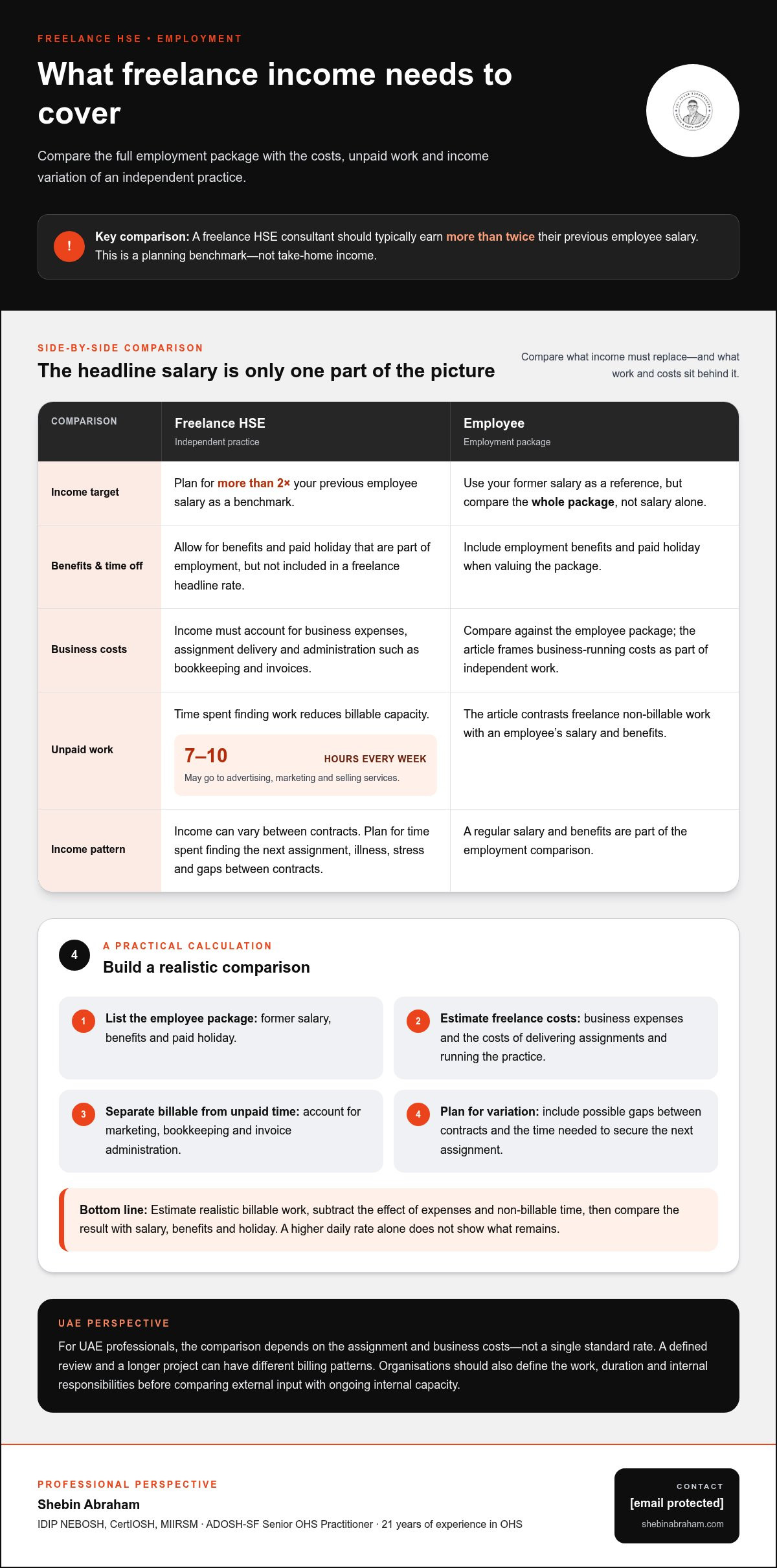
A freelance HSE consultant should typically earn more than twice their previous employee salary. Treat this as a planning benchmark, not take-home income. Independent consultants must cover business expenses and unpaid work, while an employee’s salary forms only part of the employment package. A meaningful comparison starts with the value of the whole package, not one headline figure.
List your former salary, employment benefits and paid holiday, then estimate the expenses of running an independent practice. These may include assignment delivery and business administration costs. This exercise shows what freelance income needs to replace and helps you decide whether the change fits your financial needs.
Separate billable assignments from the time needed to secure them. Freelance HSE consultants may spend seven to ten hours every week advertising, marketing and selling their services. That time cannot be billed directly to a client. If you overlook it, a full calendar may seem more profitable than it is.
For a practical comparison, estimate the work you can bill, then account for marketing, bookkeeping and invoice administration. Compare the resulting income with your previous salary, benefits and holiday time. The freelance HSE consultant vs Corporate OHS comparison is not simply about a higher daily rate. It is about what remains after costs and non-billable work, as well as the different support each arrangement provides.
Income may also vary between contracts. A busy project period can be followed by time spent finding the next assignment. Include possible illness, stress and gaps between contracts in your financial planning. An employee may weigh a regular salary and benefits, while an independent consultant also needs to plan for periods without client work.
For UAE professionals, the comparison depends on the assignment and business costs, not a single standard rate. A consultant completing a defined review has a different billing pattern from one supporting a longer project. Estimate realistic billable capacity for each arrangement, then account for the non-billable time needed to run the practice.
Employers should compare expected deliverables with the internal time needed to coordinate and implement them. A targeted review and continuing support are different commitments. In a freelance HSE consultant vs Corporate OHS assessment, define the work, duration and internal responsibilities before comparing the options. A clear scope helps show whether external input meets a specific need or ongoing internal capacity is more suitable.
For organisations weighing a defined assignment, freelance HSE support may be considered alongside the internal resources required to deliver the work. The useful comparison includes the assignment’s scope, coordination needs and follow-through, not just its fee.
Assess freelance earnings against the full employment package. Include benefits, holiday time, expenses, unpaid business tasks and potential gaps between contracts. This gives HSE professionals and UAE employers a grounded basis for comparing independent work with employment and choosing an arrangement that fits their responsibilities.
3. Consultant services and in-house support
A freelance HSE consultant can add specialist capacity without replacing an organisation’s in-house OHS team. The consultant may assess a defined problem, recommend controls and help employees apply them. For example, an internal team handling routine site inspections could bring in external support for a complex hazard review. The in-house team retains operational knowledge and follows through on agreed actions after the assignment.
Common consultancy assignments include health and safety risk assessments, fire risk assessments, hazard identification, HSE system development, legal compliance reviews, audits and accident investigations. A consultant can connect findings to practical steps. If an audit identifies gaps in contractor controls, recommendations might clarify responsibilities, documentation and follow-up. The value lies in translating observations into improvements that fit the organisation’s activities.
HSE support can also address management systems. Work involving ISO 9001, ISO 14001 and ISO 45001 may be organised into four phases: gap analysis, documentation, implementation and support with third-party certification. This does not mean the consultant issues accredited certification. The organisation’s own managers and workers still need to use the system in daily operations and maintain its records.
Some assignments go beyond routine workplace controls. Consultancy may cover business continuity and crisis management when an organisation needs to examine how disruption could affect safe operations. A consultant can help map processes and develop workplace solutions, while in-house leaders contribute knowledge of staff, equipment and operating conditions. This collaboration makes the advice more relevant than a generic procedure copied across sites.
Good project delivery should leave the internal team more capable. Include knowledge transfer in the scope: the consultant explains findings, discusses why controls matter and gives responsible employees a clear role in follow-up. An audit close-out meeting, for example, can clarify each action owner and the evidence needed to show completion. Straightforward language helps supervisors apply recommendations consistently.
Consultants working in a group can draw on colleagues with different skills and experience, while developing their own expertise. That can help a client when a project crosses technical areas. Still, the advice needs to fit the site. Assess whether recommendations are workable, clear to use and aligned with actual operations, rather than relying on polished documents alone.
Strong support also depends on communication. HSE advisers need tact and diplomacy when discussing sensitive organisational issues with managers. In-house staff provide operational context, while a consultant brings an external viewpoint. Together, they can frame findings around specific risks and workable changes. This partnership works best when expectations, reporting lines and action ownership are clear from the outset.
4. Hiring freelance occupational health and safety specialists
For UAE businesses, a practical licensing check is the consultancy’s trade licence. Hiring guidance recommends checking whether it includes the words “Professional Health and Safety Consultants.” Also establish whether the assignment requires separate authority or site-specific approval, rather than assuming one credential covers every workplace and scope.
Verify the consultant’s professional credentials directly. Relevant professional body membership can include CIMOSH or FIIRSM, and qualifications can demonstrate formal HSE training. Match the evidence to the assignment: someone reviewing a workplace risk assessment needs relevant occupational safety competence, while a project involving a specialist management system may require experience with that system.
Review the consultant’s CV for time spent working as a health and safety consultant, not just their overall career summary. Someone with broad operational experience should also demonstrate relevant consulting work, such as conducting reviews, advising managers or supporting corrective actions. This helps distinguish practical advisory experience from a title alone.
Compare the consultant’s previous work with your organisation’s actual challenges. If your site needs help improving contractor controls, look for experience with similar issues. Case studies can show the problem addressed, the consultant’s role and how recommendations were delivered. They also help you assess whether the consultant has worked in a comparable industry or operational setting.
Assess how the consultant explains the proposed approach. Useful HSE advice addresses your specific problem in straightforward language. A recommendation for a warehouse, for example, should reflect how people, vehicles and work processes interact. A generic procedure may miss those operational details, even if the document appears complete.
Test the practical fit of each proposed solution. Ask how supervisors will use it during routine work, who will own follow-up and what evidence will show completion. A workable control should align with the organisation’s activities. If employees cannot apply a procedure during a real task, the document alone will not resolve the underlying issue.
Include knowledge transfer in the assignment. The consultant should explain findings to the people responsible for maintaining improvements, such as managers, supervisors and internal OHS staff. A close-out discussion can clarify why a control matters and how to monitor it. This helps the organisation continue the work after the consultant’s engagement ends.
Finally, ask how the consultant manages technical quality and sensitive discussions. A technical governance or quality policy can explain the review process; request a copy if available. HSE issues may involve difficult conversations with managers, so tact and diplomacy matter. Agree on the reporting route, deliverables and action ownership before work begins.
5. What UAE laws and regulations apply to HSE consultants and corporate occupational health and safety teams?
Do not assume that one UAE framework applies identically to every workplace. Requirements depend on the organisation’s location, activities and relevant authority. Locally compliant HSE systems in the UAE can include OSHAD. Start by identifying the authority and requirements that apply to the site, then compare them with existing procedures.
For a corporate OHS team, this means connecting requirements with daily operations. A construction site, warehouse and office may face different hazards and require different controls. Record the applicable requirements, assign internal responsibility for each action and retain evidence of implementation. A consultant can help assess gaps, but the organisation still needs clear ownership of decisions and workplace controls.
Before engaging an external specialist, define the regulatory question the assignment must address. Specify, for example, whether the work concerns a compliance review, an HSE system assessment or preparation for a particular site requirement. This prevents a general review from being mistaken for a complete assessment against every authority or approval relevant to the business.
Use a document review to establish the starting point. Gather current HSE procedures, risk assessments, inspection records and previous audit findings, then compare them with the requirements identified for the workplace. If a procedure covers a hazard but there is no record of implementation, the gap may be in practice, evidence or both. The review should distinguish these issues clearly.
OSHAD is relevant to some locally compliant HSE systems, but its mention alone does not establish that it applies to every UAE workplace. Identify whether OSHAD or another framework governs the site and its activities. Document the decision, including the information used internally and who is responsible for maintaining the assessment as operations change.
Consultants and in-house teams should agree on how findings will be handled. A useful report identifies the requirement or system element considered, the evidence reviewed and the proposed corrective action. For a finding about incomplete inspection records, for instance, it should identify who maintains those records and how follow-up will be tracked. This makes the advice actionable.
Keep regulatory advice within a defined scope. A review of one facility does not automatically cover another with different activities or authority requirements. A consultant’s report is not, by itself, proof that every control has been implemented. Internal managers need to communicate actions to supervisors, monitor completion and retain records showing how the workplace responds.
For UAE businesses, the practical sequence is clear: identify the applicable authority, determine the relevant requirements, compare them with workplace evidence and assign corrective actions. Use external HSE expertise to clarify technical gaps, while corporate OHS staff manage operational follow-through. This connects regulatory review with the everyday protection of people and stable operations.
Shebin Abraham: OHS Services
Shebin Abraham provides OHS Services for UAE organisations weighing targeted freelance support against internal OHS capacity. Turn to his Freelance HSE Service when a defined safety assignment or specialist guidance would help your team address operational needs. For organisations working with relevant local requirements, his Freelance ADOSH-SF OHS consulting and Trakhees OHS consulting provide focused support in those areas.
The right engagement starts with a clear understanding of your workplace, applicable requirements and the support your internal team needs. This keeps the work practical, relevant and connected to your operations. It also helps your team decide whether external expertise complements its existing OHS arrangements.
Contact Shebin Abraham to discuss the OHS support that best fits your workplace.
Choose the support that fits your next step
Choosing between a freelance HSE consultant and corporate OHS comes down to the support your organisation needs. Start with a practical priority: clarify the workplace issue, the outcome you need and how your internal team will carry the work forward. A focused conversation can help turn that priority into a suitable scope.
Shebin Abraham offers OHS Services, a Freelance HSE Service and Freelance ADOSH-SF OHS consulting. These services can support organisations seeking focused HSE guidance or assistance related to ADOSH-SF. Start by describing your operational needs and the support you want to strengthen.
Take the next step by outlining your workplace priorities and discussing the appropriate support. Contact Shebin Abraham to discuss HSE support. A considered decision can help your organisation build practical safety arrangements around the people doing the work.
Frequently Asked Questions
What are the benefits?
Freelance HSE support gives a business focused access to an outside perspective without changing its reporting structure. A manager preparing for a new work process, for example, can engage an adviser to review the safety implications before launch. The internal team remains involved, while the consultant contributes specialist analysis. This can help an organisation address a defined need while keeping decisions connected to its operations.
What are the disadvantages?
A freelance consultant may not be present as workplace conditions and priorities change, so recommendations can become outdated without follow-up. A revised process or new equipment, for example, may alter the hazards considered in an earlier review. Assign an internal owner to inform the consultant of material changes and keep controls current. A poorly defined scope can also leave expectations unclear, especially around reporting and implementation.
Why would business organisations prefer ‘outsiders’ instead of hiring an in-house HSE officer?
Organisations may choose an outside specialist when they need targeted expertise for a defined assignment rather than a continuing internal role. A company introducing a new operation, for example, may need an independent review before managers set procedures. An external adviser can bring a fresh perspective to that decision. The organisation still needs people internally who understand the work and can put agreed controls into practice.
Work as an independent or as a group?
Working independently suits a consultant who wants direct responsibility for client relationships, delivery and business administration. It also means managing the workload and pipeline alone. A group can offer colleagues with different skills and experience, which may help when a project spans technical areas. The choice depends on the consultant’s preferred working model, the assignment’s demands and how much collaboration it requires.
What are the advantages and disadvantages of hiring a freelance HSE consultant versus an in-house OHS professional?
A freelancer can provide external expertise for a specific requirement, while an in-house professional brings ongoing familiarity with staff, routines and organisational changes. A one-off review may suit outside support, while daily coordination across departments may call for an internal role. The trade-off is continuity: external input needs a clear handover and internal ownership, while an employee fills an ongoing position even when specialist demand varies.