

Workplace safety compliance in the UAE depends on the rules that apply to your emirate and sector. In Abu Dhabi, businesses follow the ADOSH-SF framework, alongside federal workplace safety requirements that apply across the country. OHSAD compliance support helps turn these requirements into practical controls, documented risk assessments, and relevant staff training.
It can be challenging to understand how general UAE obligations fit with emirate-specific frameworks and daily operations. A policy alone cannot protect people if workplace hazards, responsibilities, and training needs are not addressed in practice.
Learn about common workplace safety requirements, how Abu Dhabi’s framework differs from arrangements in other emirates, and how expert support can help identify compliance gaps and business risks. This article also explains how an experienced OHS consultant can make regulatory expectations clearer and more workable for your organisation.
Key Takeaways
- Understand how UAE-wide workplace safety obligations work alongside emirate-specific frameworks.
- See why documented risk assessments, suitable training and clear emergency procedures matter in day-to-day compliance.
- Learn how requirements can differ across Abu Dhabi, Dubai and Sharjah, and why your location shapes your approach.
- Explore how an OHS consultant can help identify compliance gaps and put practical safety controls in place.
- Meet Shebin Abraham, IDIP NEBOSH, CertIOSH, MIIRSM, an ADOSH-SF Senior OHS Practitioner with 21 years of OHS experience.
UAE occupational health and safety regulatory framework
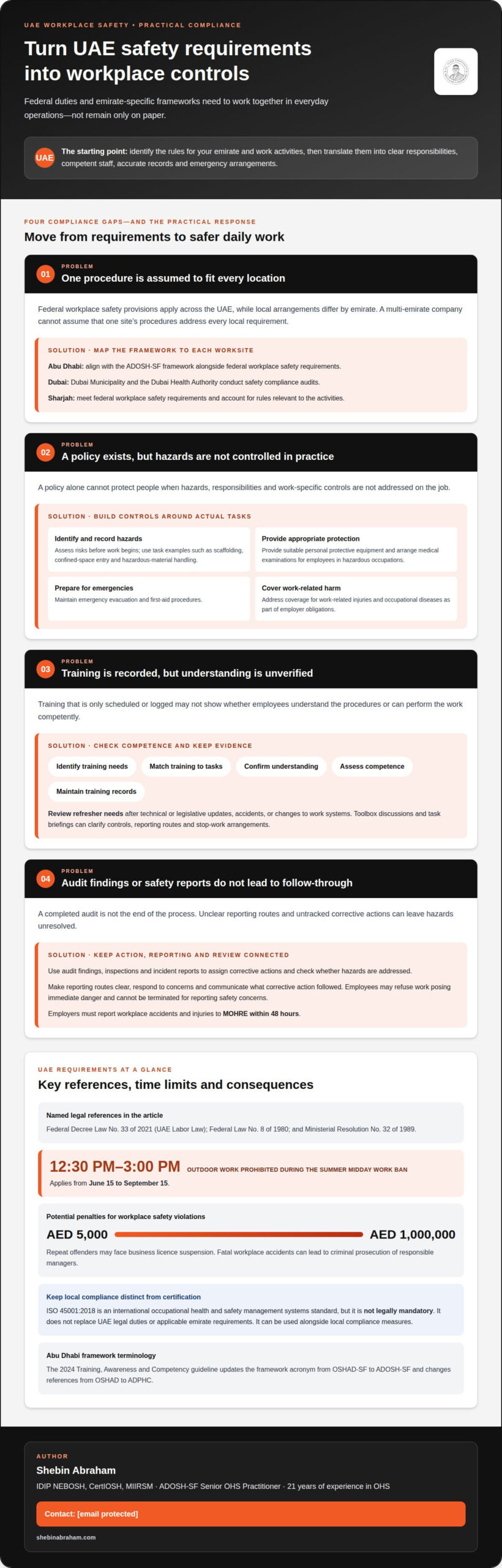
UAE workplace safety combines federal employment rules with emirate-specific occupational frameworks. Businesses need to turn these requirements into effective controls, clear responsibilities, competent staff, accurate records, and emergency arrangements.
OHSAD Meaning and Applicability
OHSAD is shorthand for occupational health and safety compliance in Abu Dhabi, where the formal framework is ADOSH-SF. Employers in Abu Dhabi must address the applicable framework requirements, while federal workplace safety provisions also shape employer responsibilities across the UAE.
This distinction matters when a company operates in multiple emirates or manages different work activities. The relevant framework guides how it identifies hazards, assigns responsibilities, and demonstrates that workers understand safety procedures. ADOSH-SF also requires entities to identify training needs, confirm understanding and competence, and maintain training and competency records.
UAE Occupational Health and Safety Requirements
Common requirements turn legal duties into practical workplace arrangements. Federal Decree Law No. 33 of 2021, identified as the UAE Labor Law, includes workplace health and safety provisions. Federal Law No. 8 of 1980 and Ministerial Resolution No. 32 of 1989 are also identified in the UAE occupational health and safety framework.
In practice, employers need to identify hazards before work begins and record their findings. They must maintain emergency evacuation and first-aid procedures, provide appropriate personal protective equipment, and arrange medical examinations for employees in hazardous occupations. Coverage for work-related injuries and occupational diseases is also part of employer obligations.
Training must match workers’ tasks, not simply appear on a calendar. ADOSH-SF expects entities to identify necessary training, confirm that employees understand it, assess competence, and retain records. Refresher training may be needed after technical or legislative updates, accidents, or changes to work systems.
Workforce health programs can extend beyond basic protective measures. For example, employers can connect exposure controls, suitable medical examinations, and clear reporting routes to the hazards employees actually face. During the UAE summer midday work ban, outdoor work is prohibited from 12:30 PM to 3:00 PM between June 15 and September 15.
OHSAD and ISO 45001
OHSAD compliance support concerns local workplace duties; ADOSH-SF is Abu Dhabi’s formal occupational safety and health framework. The 2024 Training, Awareness and Competency guideline updates the framework acronym from OSHAD-SF to ADOSH-SF and changes references from OSHAD to ADPHC. These terms describe a local regulatory context, not an international management-system certification.
ISO 45001:2018 is an international occupational health and safety management systems standard, but it is not legally mandatory. It can help an organization develop consistent processes for managing risks, responsibilities, and continual improvement. It does not replace UAE legal duties or applicable emirate requirements. A business can use ISO 45001 alongside local compliance measures, aligning its management system with the rules governing its location and activities.
Dubai, Abu Dhabi and Sharjah safety frameworks
UAE employers need to account for federal workplace safety requirements and the framework relevant to each emirate. Local arrangements differ, so companies operating across emirates need consistent controls alongside oversight tailored to each worksite.
In Dubai, Dubai Municipality and the Dubai Health Authority conduct safety compliance audits. These audits assess workplace conditions, identify hazards, and reveal gaps between documented procedures and site practices. For example, a warehouse may need to review how workers move materials, report unsafe conditions, and respond to emergencies. Managers can use the findings to assign corrective actions and track whether they address the hazards.
Abu Dhabi uses ADOSH-SF, with references updated from OSHAD to ADPHC in the 2024 Training, Awareness and Competency guideline. Organizations should align risk assessments, training arrangements, and competency records with this framework. Sharjah employers also need to meet federal workplace safety requirements and account for the rules relevant to their activities. A company with sites in multiple emirates should avoid assuming that one site’s procedures automatically address every local requirement.
Penalties for workplace safety violations in the UAE may include fines ranging from AED 5,000 to AED 1,000,000. Repeat offenders may face business licence suspension, and fatal workplace accidents can lead to criminal prosecution of responsible managers.
Regular, documented risk assessments give safety communication a practical foundation. They help teams explain hazards in the context of real tasks, such as scaffolding work, confined-space entry, or hazardous-material handling. Supervisors can use toolbox discussions and task briefings to clarify controls, reporting routes, and stop-work arrangements. Training records also help demonstrate whether employees received the relevant information and showed the required understanding and competence.
Employees have the right to refuse work that poses an immediate danger to their health or safety. They cannot be terminated for reporting safety concerns. Employers should make reporting routes clear, respond to reports, and communicate what corrective action followed. UAE employers must report workplace accidents and injuries to MOHRE within 48 hours.
Monitoring should continue after an audit closes. Managers can review incident reports, inspection findings, and recurring hazards to identify where controls need adjustment. If a near miss exposes a gap in a lifting procedure, for example, the response should address the procedure, communication, and employee understanding. For a focused workplace safety assessment, a documented review can help connect site conditions with practical corrective actions.
Expert business support to reduce workplace risk
Effective risk control starts with understanding how work is actually performed. An assessment should identify hazards linked to the task, work area, and equipment. For example, a maintenance activity may involve electrical exposure, access equipment, and nearby operating machinery. Assessing each hazard in isolation can miss how one condition increases another’s risk.
A useful assessment links each hazard to existing controls and any remaining exposure. It records who may be affected, how harm could occur, and what action would reduce the risk. Changes to equipment, materials, staffing, or work methods can alter the risk. Reviewing the assessment after such changes helps keep controls relevant to current operations.
Personal protective equipment supports risk controls but does not replace them. UAE employers must provide appropriate PPE to employees at no cost. Select equipment to suit the task and identified exposure. For example, workers handling hazardous materials need protection suited to that work, alongside safe-handling procedures and clear communication. Supervisors should explain correct use and address unsafe practices.
What are the OHSAD compliance deadlines and reporting obligations? UAE employers must report workplace accidents and injuries to the Ministry of Human Resources and Emiratisation (MOHRE) within 48 hours. ADOSH-SF entities also need to maintain training and competency records, while the applicable framework and event determine other reporting duties.
An incident investigation should establish what happened, not simply assign blame. A structured review can gather workers’ accounts, examine the work area, and compare actual practice with documented procedures. If a lifting incident follows an unclear handover, the investigation should examine communication and task coordination. Assign an owner to each corrective action and ensure it addresses the underlying gap.
Clear reporting channels help workers raise hazards, near misses, and injuries promptly. Managers can record each event, assess immediate exposure, and communicate protective measures to affected teams. Incident trends may reveal recurring equipment or process weaknesses. Reviewing reports alongside inspection findings helps safety teams spot patterns and adjust controls to prevent similar events.
Expert review can connect regulatory requirements with site conditions, risk assessments, and workable safety programmes. It can also reveal where documented controls do not match daily operations. For contractors preparing for ADNOC requirements, ADNOC HSE Prequalification Support addresses a related business need. The priority is to identify hazards, act on evidence, and protect workers with controls suited to the work.
Documenting and periodically reviewing risk assessments can help employers share relevant safety information with stakeholders. Occupational health and safety consultants identify physical, chemical, and ergonomic hazards affecting employees. UAE employers must regularly assess workplace risks and document their findings. Safety compliance audits can identify hazards before accidents or injuries occur.
UAE employers must provide health insurance for work-related injuries and occupational diseases, and cover medical treatment costs and workplace injury compensation regardless of coverage. A management system can complement locally compliant workplace safety arrangements.
Consultant support and compliance services
An occupational health and safety consultant helps turn regulatory duties into workable site procedures. In construction, this may mean reviewing task assessments, emergency arrangements, contractor communication, and worker training. The value lies in connecting written requirements with actual conduct on site. A consultant can also help management assign responsibilities, set corrective actions, and maintain records that reflect operations.
Support can begin with a gap review against the applicable framework. A consultant examines existing procedures, training records, risk assessments, and incident findings. For example, a construction site may have a lifting procedure that no longer reflects the equipment or work sequence in use. The review identifies the mismatch and helps define corrective steps. Management remains responsible for implementing controls and maintaining safe working conditions.
Consultants can also help design and deliver employee training on safety procedures, emergency protocols, and correct PPE use. Under ADOSH-SF, entities identify required training, confirm understanding and competence, and maintain related records. Refresher training may be needed after technical or legislative updates, accidents, or changes to work systems. This keeps safety communication relevant to each role rather than a general briefing disconnected from daily tasks.
How much do OHSAD compliance consulting, audits, and training cost in the UAE? The cost depends on the scope and requirements of the work. Site conditions, required assessments, and training needs all affect the level of support involved.
How can a company obtain or renew OHSAD compliance certification? ADOSH-SF compliance is addressed through applicable workplace controls, competent staff, training records, and documented procedures; ISO 45001:2018 is a separate international management-system standard and isn’t legally mandatory. Businesses should distinguish their ongoing regulatory duties from any management-system certification process.
Which OHSAD-approved consultants and training providers operate in Abu Dhabi? Consultants offer ADOSH-SF advisory and training support, but an employer’s compliance depends on implementation and records, not a provider’s label. The framework makes entities responsible for identifying training needs, confirming competence, and retaining evidence. Consultant input can help management connect occupational health assessments, procedures, and workforce needs.
Authorities and site conditions may affect the required scope, especially for construction and other high-risk activities. A consultant can help organize evidence, identify gaps, and clarify the actions needed to address them. A stronger safety culture develops when supervisors communicate procedures clearly, employees understand reporting routes, and managers follow through on assessments. This practical cycle keeps compliance connected to worker wellbeing and stable operations.
What does OHSAD stand for in the UAE, and which organizations must comply?
In UAE workplace safety, the formal Abu Dhabi framework is ADOSH-SF, not OHSAD. ADOSH-SF refers to the Abu Dhabi Occupational Safety and Health System Framework. The earlier acronym was OSHAD-SF. The 2024 Training, Awareness and Competency guideline updates that acronym and changes references from OSHAD to ADPHC. Using the formal name helps businesses identify the applicable requirements.
Workplace safety requirements can vary across emirates, so employers should check the framework applicable to each site. Abu Dhabi organisations should align their occupational safety and health arrangements with ADOSH-SF. Businesses with sites in different emirates need to consider each site’s location, activities, and applicable framework. A company-wide policy can set a consistent approach, but local requirements still matter.
Applicability depends on the employer and its work, not just its industry label. An Abu Dhabi construction company, for example, needs to consider site hazards, worker roles, and the controls in use. Contractors and operational teams also need clear responsibilities for communicating hazards and following procedures. Under the framework, the entity identifies training needs, confirms understanding and competence, and maintains records.
That makes OHSAD a term readers may encounter, but it should not replace the formal framework name in compliance documents. Use ADOSH-SF when referring to Abu Dhabi’s system, and distinguish it from OSHAD-SF in older materials. The 2024 guideline’s updated terminology is especially relevant when reviewing training documents, competency records, and internal references. Consistent naming helps prevent confusion across teams and records.
Federal workplace safety duties remain relevant alongside emirate arrangements. Federal Decree Law No. 33 of 2021, identified as the UAE Labor Law, includes workplace health and safety provisions. In practice, an Abu Dhabi employer must consider both federal obligations and the applicable ADOSH-SF requirements. An international management standard, such as ISO 45001:2018, does not replace those local duties.
For businesses operating across the UAE, start by mapping each worksite to its emirate and activities. Then connect that map to the relevant procedures, training records, risk assessments, and reporting arrangements. Sites in different emirates may share company policies, but their compliance contexts can differ. Clear ownership helps managers apply the right requirements at each location.
If your organization needs help interpreting Abu Dhabi’s framework and its application, discuss your ADOSH-SF compliance needs. Focus the conversation on your operating locations, work activities, and existing safety arrangements. That context helps identify where procedures or records need alignment, without confusing the informal OHSAD wording with the formal ADOSH-SF framework.
Shebin Abraham: ADNOC HSE Prequalification Support
Shebin Abraham provides ADNOC HSE Prequalification Support for businesses preparing for ADNOC HSE prequalification. This support helps organize your health and safety approach around prequalification requirements. For Abu Dhabi workplace obligations, Freelance ADOSH-SF OHS consulting can help address framework-related needs.
About the author: Shebin Abraham is an ADOSH-SF Senior OHS Practitioner with 21 years of OHS experience. His qualifications include IDIP NEBOSH, CertIOSH, and MIIRSM. He also provides OHS Services and Freelance HSE Service, connecting technical requirements with the realities of business operations.
Discuss your prequalification or workplace safety needs with Shebin Abraham. Contact him to talk through the support relevant to your business.
Make your next safety decision count
Compliance is more effective when it guides everyday decisions, not just audit preparation. Choose a practical next step: clarify responsibilities, address a recurring gap, or align safety procedures with the work your teams perform. A focused review can turn that priority into clear actions and stronger ownership.
OHSAD compliance support can connect workplace requirements with your operational needs. Shebin Abraham offers OHS Services, Freelance HSE Service, and Freelance ADOSH-SF OHS consulting to help businesses manage workplace safety and compliance.
For tailored guidance on your organization’s requirements, contact Shebin Abraham for compliance support. A clear conversation can help you identify a useful starting point and move forward with confidence.
Frequently Asked Questions
What are some common compliance requirements?
Common UAE requirements include controlling workplace hazards, providing appropriate personal protective equipment, and maintaining emergency arrangements. Employers also need task-relevant safety training and records showing employees’ understanding and competence. For example, a maintenance team working with hazardous materials needs procedures suited to its tasks, supported by training for safe handling. The specific controls depend on work activities, employee exposure, and the applicable emirate framework.
What are the current OHSAD occupational health and safety requirements in Abu Dhabi?
Abu Dhabi uses the formal ADOSH-SF framework; “OHSAD” is not the formal framework name. Relevant requirements include identifying workplace hazards, arranging suitable training, confirming competence, and keeping related records. The 2024 Training, Awareness and Competency guideline updated the framework acronym from OSHAD-SF to ADOSH-SF and changed references from OSHAD to ADPHC. Employers should use the current terminology in applicable procedures and documentation.
What documents and records are required for OHSAD compliance?
Useful compliance records include documented workplace risk assessments, safety procedures, emergency evacuation and first-aid arrangements, and training and competency records. Organize records by activity or worksite so managers can connect each document to the people and hazards it covers. A training record is more useful when it identifies the relevant task and shows how understanding or competence was confirmed.
What are the steps for conducting an OHSAD risk assessment and safety audit?
Start by defining the work activity and assessment scope. Observe the task, consult the people performing it, and identify hazards, affected workers, and existing controls. Evaluate whether the controls address the exposure, then document gaps and corrective actions. During an audit, compare site conditions and work practices with applicable procedures and records. Assign action owners, set follow-up arrangements, and review whether completed actions resolve the identified gaps.
What are the most common OHSAD audit findings and how can employers address them?
Potential findings include assessments that miss actual work hazards, procedures that do not match current site practices, and training records that fail to demonstrate competence. Auditors may also find unclear emergency arrangements or corrective actions without clear ownership. Employers can address these gaps by updating documents to reflect current operations, assigning responsibilities, and checking that revised controls work in practice. Use incident and inspection findings to guide these reviews.