
What if your ADOSH-SF documents look complete but don’t reflect what workers face on site? For employers searching for a freelance ADOSH consultant, useful support connects framework expectations with the realities of daily work, not just paperwork.
Before engaging a consultant, clarify what support you need, what the work will cover, and how recommendations can be put into practice. This guide explains how specialist ADOSH-SF consulting can support documentation, compliance assessments, and implementation, helping you define a practical scope and make informed decisions.
We’ll explore how to assess a consultant’s fit, agree on useful outputs, and keep worker wellbeing central as your safety management develops. The guidance is relevant to employers across the United Arab Emirates. Shebin Abraham, the author, is an ADOSH-SF Senior OHS Practitioner with IDIP NEBOSH, CertIOSH, and MIIRSM credentials and 21 years of OHS experience. His approach combines senior-level guidance with collaborative, practical support.
Key Takeaways
- Freelance ADOSH-SF consulting can provide focused guidance while accountability for workplace safety remains with the organisation.
- Assess whether a consultant can connect relevant ADOSH-SF experience and professional credentials with a practical understanding of your workplace.
- Define the scope around your concern, affected activities, and desired outcome, whether you need documentation guidance, a compliance assessment, or implementation support.
- A freelance ADOSH consultant Abu Dhabi can help connect framework expectations with practical steps suited to your organisation’s needs.
- Agree on a clear sequence of work and next actions, while keeping worker wellbeing central.
When does freelance ADOSH-SF consulting make sense for a UAE organisation?
Aligning formal safety expectations with the way work happens can be demanding. A procedure may look complete on paper yet leave questions about how it applies to a particular activity, team, or working condition. Freelance ADOSH-SF consulting gives employers focused professional guidance to examine those gaps and identify practical next steps.
The support can focus on documentation, a compliance assessment, or implementation. These are related but distinct needs. Documentation guidance helps an organisation develop or review written safety arrangements. An assessment examines how current arrangements compare with relevant ADOSH-SF expectations and workplace practice. Implementation support helps teams consider how recommendations can be applied and followed through. The advice should reflect the organisation’s actual activities and conditions, not rely on generic templates.
Advisory support can inform workplace safety decisions, but the employer remains accountable for managing safety in its organisation. A consultant can review, guide, and work alongside internal teams, but doesn’t take over the employer’s role or guarantee a particular outcome. This distinction matters whenever safety arrangements need to work consistently in real operations. For a general introduction to the wider field, see Occupational Safety and Health.
What can ADOSH-SF advisory support address?
Start with the concern that prompted the search for support. Is the written system difficult to apply? Does the organisation need a clearer view of how its current arrangements align with the framework? Or do teams need help translating recommendations into workable actions? Defining the question keeps the scope focused and makes the expected contribution easier to agree.
Shebin Abraham provides freelance ADOSH-SF consulting in these areas, including guidance with documentation, compliance assessments, and implementation. As an ADOSH-SF Senior OHS Practitioner with IDIP NEBOSH, CertIOSH, and MIIRSM credentials, and 21 years of OHS experience, he brings practical perspective to the relationship between written arrangements, assessment, and workplace action.
When is a freelance engagement a practical fit?
A freelance engagement can suit an organisation with a defined or specialist need, such as reviewing a particular part of its safety documentation, assessing a concern, or planning how agreed improvements can be put into practice. It can also provide focused input for an internal team while that team retains its ongoing responsibilities. Shape the engagement around the issue, the people involved, and the outcome sought.
An adviser can work with managers and safety personnel to understand existing arrangements, clarify questions, and discuss recommendations with those who know the work. This collaboration helps keep advice connected to operational realities and worker wellbeing. For employers working across the UAE and GCC, consider the framework and context relevant to each organisation’s activities rather than assuming requirements apply identically across jurisdictions. If you’re considering a freelance ADOSH consultant Abu Dhabi, begin by identifying the specific concern and the practical change you want the support to inform.
How to assess an ADOSH-SF consultant’s experience and working approach
Choosing advisory support means more than matching a job title to a need. Look for relevant ADOSH-SF familiarity, clear communication, and the ability to connect framework knowledge with the work your teams perform. A useful discussion should help you explain the concern, understand the proposed contribution, and identify how advice could inform practical next steps.
Framework knowledge is most useful when it can guide workable action in real operating conditions. Ask how the consultant connects written arrangements, workplace conditions, and implementation. The ADOSH-SF Manual is an authoritative reference for understanding the framework. Advice should be grounded in the applicable material and your organisation’s context.
Which experience and credentials are relevant to the decision?
Consider whether the adviser’s OHS background and ADOSH-SF experience fit the support you need. Credentials indicate professional preparation, while relevant experience shows how that knowledge may be applied. Shebin Abraham holds IDIP NEBOSH, CertIOSH, and MIIRSM credentials, is an ADOSH-SF Senior OHS Practitioner, and has 21 years of OHS experience. These credentials and experience inform his advisory work, but don’t guarantee a particular compliance or approval outcome.
Use your initial discussion to assess how the consultant listens and explains. Can they distinguish what is known from what needs further assessment? Do they explain recommendations in language managers and workers can use? Can they relate proposed actions to existing procedures and day-to-day work? Clear, measured answers help you understand the scope and work together effectively.
How should a consultant make technical guidance usable?
Useful guidance identifies the issue, explains its relevance, and makes the next steps clear to the people responsible for taking them forward. Recommendations should account for operating conditions, not treat documents as the entire safety system. Discussion with workplace teams can reveal practical constraints and keep worker wellbeing in view as actions are considered.
To compare your needs with relevant capabilities, consider what you want the engagement to help you do:
| Organisation’s need | Useful consulting capability |
|---|---|
| Clarify whether written arrangements reflect work practices | Review documentation in relation to activities and working conditions |
| Understand a defined ADOSH-SF concern | Assess the concern and explain relevant findings clearly |
| Move from recommendations to action | Discuss practical implementation steps with the responsible team |
| Build shared understanding internally | Communicate advice in accessible terms and invite informed discussion |
These capabilities can also help you assess how ADOSH-SF support fits within wider freelance HSE needs. For an overview of freelance HSE consulting support, consider how broader OHS guidance relates to your defined framework requirements. Keep the discussion focused on the concern, the expected contribution, and how internal teams will use the advice.
How to define the right ADOSH-SF consulting scope before engagement
A productive scope starts with a clear concern, not a broad request to “review safety.” Identify the activities affected, the teams involved, and what you want to be able to do differently afterwards. For example, you may need to clarify whether written arrangements reflect work practices, understand a specific compliance concern, or plan how recommendations can be put into effect.
Then agree on the type of support that fits the outcome. Documentation guidance, compliance assessment, and implementation support can complement one another, but serve different purposes. A focused scope helps the adviser concentrate on the issue and helps your team understand what to expect. Tailor the scope and outputs to your organisation, working conditions, and project rather than assuming a fixed package.
Match the support type to the need
Use the concern and desired outcome to choose the main support type. Documentation guidance focuses on written arrangements; an assessment examines a defined concern; implementation support helps the organisation work through practical actions. If a capability gap affects the planned work, relevant training may also support the engagement. Include it where it serves the purpose.
| Need | Potential advisory contribution | Useful outcome to discuss |
|---|---|---|
| Written arrangements need review or development | Documentation guidance linked to the organisation’s activities | Clearer, more usable documentation |
| A defined concern needs examination | Compliance assessment focused on the agreed subject | Findings that explain relevant gaps or questions |
| Recommendations need to move into practice | Implementation guidance alongside the responsible team | Practical actions the organisation can consider and progress |
| A capability gap affects the planned work | Training discussion aligned with the specific need | Improved understanding relevant to the activity |
Set clear responsibilities and useful outputs
Before the engagement begins, discuss what information and workplace context the organisation will provide, who will participate, and how the adviser will communicate findings. Clarify which decisions and actions remain with the organisation. This keeps the working relationship transparent and helps recommendations reach the people responsible for considering them.
Useful outputs might include clearly explained findings, practical recommendations, or guidance connected to the agreed scope. Their form should suit the work rather than follow an assumed standard deliverable. A freelance ADOSH consultant Abu Dhabi can tailor the advisory contribution to the project, while the organisation decides how to act on the advice and maintain its arrangements.
Keep the scope specific enough to guide the work, but flexible enough to reflect what the review reveals. Agree how emerging questions will be discussed and whether they fit the original focus or need a separate decision. This helps prevent a narrow document review from being mistaken for implementation support, or an assessment from being treated as a promise of a particular result. For framework context, consult the ADOSH-SF overview article alongside the official material relevant to your organisation.
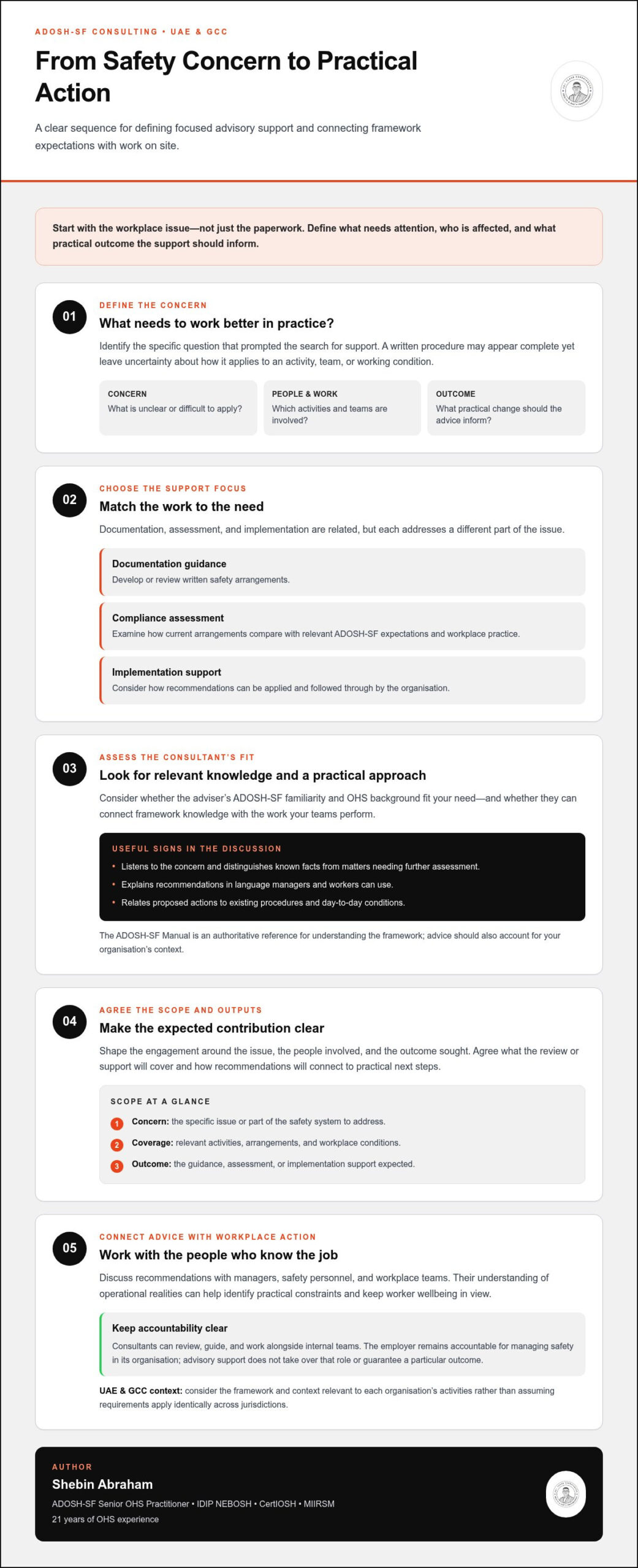
What a practical freelance ADOSH-SF consulting engagement should look like
A useful engagement makes the path from concern to considered action easier to understand. The exact approach depends on the organisation and agreed scope, but this planning sequence helps everyone know what to expect. It is an illustrative aid, not a mandated regulatory process.
- Clarify the need. Describe the concern, the activities it affects, and what you hope the advice will help you address.
- Review the context. Share relevant information about current arrangements, working conditions, and the people involved.
- Agree the scope. Confirm the focus, expected advisory contribution, responsibilities, and communication approach.
- Provide tailored advice. Consider the agreed subject and offer findings or guidance relevant to the organisation’s context.
- Discuss next actions. Review recommendations with relevant personnel and consider how the organisation will take them forward.
This sequence keeps expectations grounded. It doesn’t imply a fixed review procedure, set timeline, or guaranteed result. The work should follow the agreed need and the context available for the engagement.
From initial discussion to tailored advice
The first discussion turns a broad concern into a focused advisory question. Explain what work is affected, what information is available, and where your team needs clarity. The consultant and organisation can then agree on the scope and communication expectations before substantive work begins, including who should contribute and how emerging issues will be discussed.
That early alignment supports a more relevant review. For example, if the concern is whether a written arrangement works in practice, understanding how the activity is carried out helps connect the advice to the workplace, not just the documents. Agree on the specific approach with the organisation rather than assuming it in advance.
Turning findings into sustained workplace improvement
Findings are most useful when the people involved understand them and can discuss how recommendations relate to daily work. Managers, safety personnel, and affected workers can surface operational considerations and identify questions that need attention. Their input connects advisory guidance to the conditions people experience and keeps worker wellbeing in view.
After advice is shared, the organisation can consider ownership, practical priorities, and how to review progress through its own arrangements. The consultant guides and supports the agreed work; organisational teams remain responsible for decisions and follow-through. This helps prevent recommendations from becoming a document that is filed but not put into practice.
If you’re considering a freelance ADOSH consultant Abu Dhabi, start with a clear account of the concern and the support you need. More information about Shebin Abraham’s consulting services is available online.
Engage Shebin Abraham for tailored ADOSH-SF consulting support
Organisations seeking support with ADOSH-SF documentation, a focused compliance assessment, or implementation guidance benefit from advice shaped around their actual concern. Shebin Abraham provides freelance ADOSH-SF consulting for organisations in the UAE and GCC, connecting framework alignment with workplace conditions and practical action. His focus is clear guidance that supports responsible decision-making, not promises of approval or a particular compliance outcome.
Shebin is an ADOSH-SF Senior OHS Practitioner with IDIP NEBOSH, CertIOSH, and MIIRSM credentials, and 21 years of OHS experience. His advisory work helps organisations clarify their needs, consider relevant findings, and discuss how their teams can take recommendations forward.
A senior, collaborative approach to OHS advice
Experienced guidance is most useful when technical matters are explained clearly and considered alongside the way work is carried out. Shebin’s collaborative approach connects ADOSH-SF documentation and assessment with implementation considerations, so advice can be discussed in relation to the organisation’s activities. Listening to the people involved makes the discussion more practical and keeps worker wellbeing central.
This matters because a sound safety system needs to be understood and workable, not simply well presented. Advisory support helps teams consider how written arrangements relate to workplace conditions, where further clarity may be useful, and which practical steps deserve discussion. The organisation remains responsible for its decisions and actions; the consultant provides focused professional guidance.
Prepare for a focused first conversation
A helpful first discussion can begin with three points: the concern you want to address, the work or activities affected, and the type of support you believe may help. You don’t need to have every detail resolved. A clear outline gives the conversation direction and helps identify whether your priority is documentation guidance, assessment, implementation support, or a combination tailored to the project.
Share relevant context through an appropriate private channel rather than posting sensitive operational, worker, or incident information publicly. You can also note what your team has already reviewed and who may need to contribute. This preparation supports a focused discussion without presuming a fixed process, timeline, or deliverable.
If you’re looking for a freelance ADOSH consultant Abu Dhabi, outlining your organisation’s needs and the practical question you want advice to address is a useful starting point. Discuss your ADOSH-SF consulting needs with Shebin Abraham.
Make your next safety decision practical
Strong safety management grows through considered decisions that connect formal expectations with the conditions people work in. Your next step doesn’t need to solve every concern at once. Choose the issue that matters most, identify who is affected, and decide what useful progress would look like for your organisation.
For employers weighing support from a freelance ADOSH consultant Abu Dhabi, a focused conversation can turn that priority into a clear advisory direction. Shebin Abraham brings 21 years of OHS experience, IDIP NEBOSH, CertIOSH, and MIIRSM credentials, and experience as an ADOSH-SF Senior OHS Practitioner. His guidance supports organisations across the UAE and GCC, with attention to practical conditions and worker wellbeing.
Discuss your ADOSH-SF consulting needs with Shebin Abraham and take a considered step toward workplace action. Clear priorities and collaborative guidance can help your team move forward with care and purpose.
Frequently Asked Questions
What does a freelance ADOSH-SF consultant do?
A freelance ADOSH-SF consultant provides specialist OHS advice related to the framework and an organisation’s needs. For example, the consultant can help a team review a safety procedure for a particular work activity, understand an assessment finding, or consider improvements to its safety management arrangements. Advice should reflect the organisation’s context. The employer and its teams remain responsible for workplace decisions and actions.
When should an organisation engage freelance ADOSH-SF consulting support?
An organisation can engage support when it has a specific question that needs focused expertise or its internal team would benefit from an additional perspective. A change to work arrangements, uncertainty about whether a procedure fits an activity, or questions following an internal review can prompt a discussion. Set out what has changed or raised concern, and identify who can explain the work and its context.
Can a freelance consultant help with ADOSH-SF documentation?
Yes. Consulting support can help an organisation develop or review ADOSH-SF-related documentation so it is clear and relevant to the work it describes. For instance, a team might examine whether a procedure accurately reflects how an activity is planned and carried out. Consider the document alongside workplace practice. Decisions about adopting or maintaining it remain with the organisation.
How do I assess whether an ADOSH-SF consultant is suitable for my organisation?
Assess whether the consultant understands your concern, communicates clearly, and can relate advice to the way your organisation operates. A freelance ADOSH consultant Abu Dhabi should be able to explain the proposed focus in plain language and distinguish advice from decisions your organisation must make. Discuss relevant experience, how findings will be shared, and what information or internal input will keep the work grounded in your context.
Does ADOSH-SF consulting apply to organisations across the UAE and GCC?
ADOSH-SF is the framework associated with Abu Dhabi, so its requirements shouldn’t be assumed to apply identically in every UAE emirate or GCC jurisdiction. Organisations operating across locations should consider the framework and context relevant to each part of their operations. Specialist OHS consulting can help clarify an organisation’s ADOSH-SF-related needs, while jurisdiction-specific interpretation should be based on the applicable authoritative sources.
Can freelance ADOSH-SF consulting include implementation support?
Yes. An engagement can include guidance as an organisation considers how to put recommendations into practice. For example, a consultant can help a team discuss responsibilities, identify operational questions, or consider how proposed changes relate to existing work arrangements. The organisation decides what actions to adopt and how to follow through. Agreeing on the intended level of implementation support at the outset helps align the advice with the team’s capacity and priorities.