
Could a freelance HSE consultant provide the right support without losing sight of how your operations work? If you’re weighing project-based help against ongoing guidance, that’s a practical concern. A freelance HSE consultant UAE organizations engage should fit the work, risk profile and regulatory context, not simply deliver a stack of documents.
Freelance support can suit a defined project, a temporary capacity gap or continuing advisory needs. The key is to set a clear scope: what needs attention, which deliverables matter and how often support is needed. This guide explains when freelance HSE support may fit, what it can cover, and how to structure an engagement across the UAE and GCC, including work involving ADOSH-SF, Trakhees OHS and ADNOC HSE prequalification.
This guidance draws on Shebin Abraham’s 21 years of experience in occupational health and safety. Shebin holds IDIP NEBOSH, CertIOSH and MIIRSM credentials and is an ADOSH-SF Senior OHS Practitioner. His approach connects regulatory advice with workable systems and the everyday responsibility to protect people.
Key Takeaways
- Match a freelance HSE consultant UAE engagement to your workload, project phase, specialist needs and existing HSE capacity.
- Define the operating context, intended outcomes, responsibilities and working arrangements before setting deliverables.
- Align the consulting scope with the relevant framework, whether general OHS, ADOSH-SF, Trakhees OHS or ADNOC prequalification support.
- Choose a project-focused or continuing advisory scope, then review progress against the agreed needs.
When does a freelance HSE consultant in the UAE fit your organization?
A freelance HSE consultant is an independent adviser engaged to provide workplace safety support within an agreed scope. The work may address a defined task or continue over a longer period. Unlike a permanent employee, a consultant’s contribution is shaped around agreed objectives and operational requirements. Neither model suits every organization: the right fit depends on the work to be done and the capacity already in place.
A freelance HSE consultant UAE organizations engage can add value when a specific need is clear, but the internal team lacks the time or specialist experience to address it alone. Consider four factors: current workload, project phase, expertise required and the strength of existing HSE arrangements. A business preparing for a new project, for example, may need focused help strengthening its safety systems. An established team may instead need an adviser to guide a defined improvement initiative.
What needs can freelance HSE support address?
Support can range from advice on a specific workplace safety concern to developing, implementing or maintaining safety systems. It can also provide additional capacity during a busy project or focused guidance to improve an existing process. Measure the value by whether the work helps teams apply practical controls and protect employee wellbeing, not by the number of documents produced.
When is external expertise a useful complement?
External advice can complement an organization’s HSE team when specialist guidance, additional capacity or focused implementation support is needed. It does not have to replace internal personnel or transfer the organization’s assigned responsibilities. An adviser can work alongside people who understand day-to-day operations, bringing structured input to a defined challenge. The right arrangement depends on the organization’s needs, internal capability and the continuity required.
Before choosing a project-based or continuing arrangement, clarify the operational need. Is the request tied to a project phase, a system improvement or a recurring advisory requirement? Then agree on what the consultant will contribute, who will coordinate the work internally and what outcomes will indicate progress. Clear boundaries help keep a short assignment focused and continuing support purposeful.
- Project-focused support may suit a defined task, a temporary capacity gap or a specific phase of work.
- Continuing advice may fit when the organization needs regular input to maintain or improve its safety arrangements.
- Complementary support can strengthen an existing team while keeping operational knowledge and assigned responsibilities within the organization.
Use these considerations to match the engagement to actual operating conditions, rather than an assumed template. In the UAE and wider GCC, the scope should reflect the organization’s activities, current HSE capacity and objectives agreed with the adviser. Flexibility is most useful when it supports consistent risk control and the people doing the work.
What should a freelance HSE consultant’s scope include?
A useful scope turns an operational concern into defined work, clear responsibilities and relevant outputs. Before engaging a freelance HSE consultant, outline the activities involved, existing safety arrangements, workforce concerns and the gap you want the adviser to address. Then agree on what success should look like. This might mean practical recommendations, support with a safety system or guidance on a regulatory or prequalification need.
The scope should also explain how the working relationship will operate. Identify who will coordinate internally, who will provide operational information, how progress will be discussed and where the consultant’s advisory role ends. Recommendations can guide decisions and support implementation, while the organization retains operational ownership and its assigned responsibilities. Make deliverables specific to the work rather than relying on a generic package or assumed outcome.
Turn operational needs into a clear consulting brief
Describe the work environment and activities in plain terms. Note relevant workforce concerns, existing procedures or systems, and any improvement work already underway. For example, a brief could ask for a review of a particular safety process and advice on practical changes, instead of requesting a broad review with no defined purpose. Agree on boundaries, expected outputs, communication arrangements and the people who will act on the advice.
Match the request to the support needed. This may involve designing a workplace safety system, helping implement or maintain existing arrangements, or advising on specific risk controls. Include training or professional mentorship when the goal is to strengthen workers’ understanding or develop internal HSE capability. Recommendations should reflect the organization’s activities and be usable by the teams responsible for applying them.
Match specialist support to the required work
When a regulatory or client framework applies, make it part of the brief. ADOSH-SF consulting can focus on relevant documentation, assessments or implementation support. Trakhees OHS advice can address applicable protocols, permit documentation or compliance inspections. Include ADNOC HSE prequalification support when the organization has a relevant prequalification need. Define the work around the applicable context rather than assuming one checklist fits every operation.
For work involving hazardous materials, regional references can also inform the discussion. The Gulf Cooperation Council (GCC) has published its Global Harmonized System (GHS) standard, GSO 2654:2021, to ensure the safe production, transport, handling, use, and disposal of hazardous materials across member countries. Whether this subject belongs in the consulting brief depends on the organization’s activities and applicable requirements.
- Context: Describe the activities, workforce considerations and current arrangements.
- Purpose: State the issue to address and the practical outputs expected.
- Boundaries: Separate advisory support from operational decisions and ownership.
- Working arrangements: Agree on communication, coordination and how recommendations will be reviewed.
A well-scoped engagement links advice to decisions and day-to-day practice. For freelance HSE consulting support, keep the brief grounded in the organization’s actual needs and the people who will put the agreed work into practice.
How should UAE and GCC regulatory needs shape HSE consulting?
The applicable framework should inform the consulting brief, but it does not replace a clear understanding of the organization’s work. Activities, existing safety arrangements and the purpose of the engagement all affect what support will be useful. A freelance HSE consultant UAE organizations engage can align advice with the relevant context while keeping recommendations practical for the teams expected to use them.
Start by separating general workplace safety needs from framework-specific support. General OHS consulting can focus on safety systems, management procedures and practical risk controls. If a particular framework or client process applies, define that work separately. A document, inspection approach or process used in one context will not necessarily fit another.
Separate general OHS needs from framework-specific support
The comparison below is a starting point for scoping, not a statement of universal requirements. It outlines broad areas of support that can be tailored to the organization and its applicable context. When the work depends on a specific requirement, base the advice on the current framework details relevant to that work.
| Support area | Possible consulting focus |
|---|---|
| General OHS | Workplace safety systems, management procedures and practical risk-control advice. |
| ADOSH-SF | Relevant documentation, assessments and implementation support. |
| Trakhees OHS | Relevant protocols, permit documentation and compliance inspection support. |
| ADNOC prequalification | HSE prequalification support where it relates to the organization’s needs. |
Use this distinction to make the expected work clear. An organization looking to improve its general workplace safety arrangements may need system-focused advice. A defined framework-related need calls for a scope tailored to that context. Agree on the tasks and deliverables for the engagement instead of inferring them from a framework name alone.
Account for UAE and GCC operating contexts
Organizations working across the UAE and GCC may encounter different operating or client contexts. Avoid assuming one process applies identically across jurisdictions or operations. Identify where the work takes place, which framework or client context is relevant, and what information should guide the advice. This groundwork helps keep consulting focused instead of treating a broad regional label as one set of requirements.
Build framework-specific review into the scope. Before describing a requirement or preparing related documents, use the current details that apply to the work. This matters particularly when an engagement concerns ADOSH-SF, Trakhees OHS or ADNOC prequalification. A useful scope reflects the relevant context rather than relying on assumptions. Clear, well-grounded advice supports workable systems and informed decisions, with people’s safety at the centre.
How can you structure a practical freelance HSE engagement?
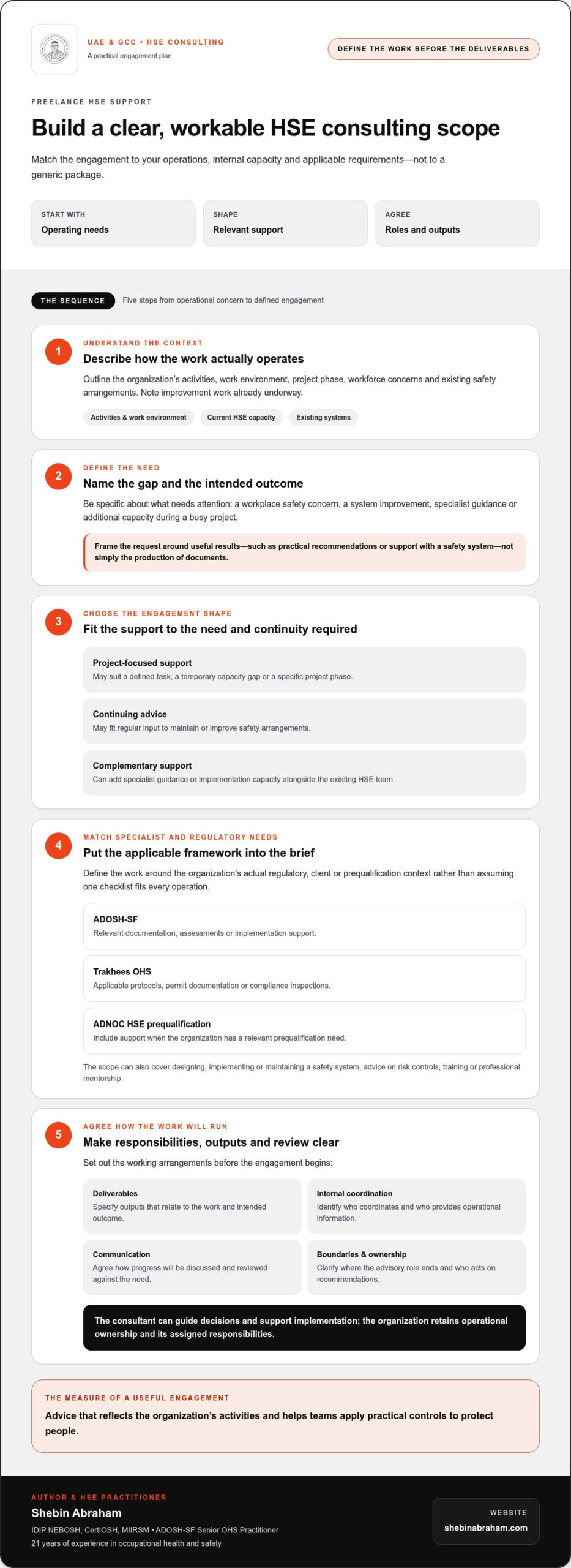
A clear engagement gives the organization and adviser a shared route from a safety need to useful action. For a freelance HSE consultant, UAE organizations can start by defining the concern, then agree on the scope, working arrangements and review points. This sequence keeps the assignment grounded in operating conditions rather than turning it into a broad request with no clear measure of progress.
Prepare the organization for useful advisory support
Before work begins, gather relevant safety procedures, existing assessments and information about the activities involved. Identify the internal stakeholders who understand the work and the operational decisions the advice should inform. This preparation helps the consultant understand the context and focus on priorities such as risk reduction, compliance support and workforce wellbeing.
Define the need in practical terms. A project-focused engagement might address a specific work phase or improvement task. Continuing advisory support may suit an organization that needs regular input on its safety arrangements. Neither format is automatically better. The scope should reflect the issue, the organization’s internal capacity and the continuity needed to make the advice useful.
Keep the engagement actionable and collaborative
Agree on the work focus, communication approach and review points. Clarify who will share information, who will make operational decisions and who will coordinate actions arising from the advice. The consultant can guide and support the work, while the organization’s internal leaders retain decision-making responsibility. Clear roles make collaboration easier and reduce the chance of recommendations being left without an owner.
Translate advice into actions that fit the way the organization operates. A recommendation should identify the issue it addresses and the team or role responsible for considering it. Review progress against the agreed objectives, discuss barriers and adjust the focus if operating conditions or priorities change. The aim is practical improvement, not paperwork that sits apart from the work.
- Define the need: State the issue, project phase or support gap that prompted the engagement.
- Set the scope: Agree on the advisory focus, expected outputs and boundaries.
- Align arrangements: Confirm communication, information sharing and decision responsibilities.
- Review progress: Revisit agreed objectives and keep recommendations connected to operational realities.
For organizations operating in the UAE and GCC, this sequence helps keep the engagement aligned with the work context. A concise brief, open communication and clear ownership can turn specialist input into safer, more workable practices. The HSE support discussion can be framed around your organization’s priorities.
What does working with Shebin Abraham as a freelance HSE consultant involve?
Working with Shebin Abraham starts with understanding the organization’s operations and the safety support it needs. Shebin is an OHS practitioner with 21 years of experience supporting organizations across the UAE and GCC. He holds IDIP NEBOSH, CertIOSH and MIIRSM credentials and is an ADOSH-SF Senior OHS Practitioner.
His experience informs a practical advisory relationship. Rather than treating HSE as a paperwork exercise, Shebin helps organizations connect workplace safety arrangements with the realities of their operations. This can mean identifying where a system needs attention, clarifying a framework-related support need or strengthening how teams understand and apply safety controls.
Bring experienced, human-centered judgment to workplace safety
Experienced advisory support can help teams interpret safety expectations and translate them into processes people can use in their daily work. Shebin’s services include workplace safety systems, relevant ADOSH-SF or Trakhees OHS consulting, ADNOC HSE prequalification support, training and professional mentorship. The focus depends on the organization’s operating context and agreed objectives.
The aim is practical stewardship: advice that supports sound decisions, workable controls and the wellbeing of people doing the work. Clearer safety arrangements can help teams understand how their work is managed and where responsibilities sit, while leadership retains operational ownership and decision-making.
For an organization considering a freelance HSE consultant UAE engagement, a useful starting point is to describe the work itself. Outline the activities involved, the support already in place and the concern or improvement priority behind the enquiry. If the need relates to a framework or client process, include that context. These details keep the discussion relevant and help avoid a broad, generic scope.
Start a conversation about the right scope
Bring the operating context, priorities and regulatory concerns into the discussion. You can also outline whether the need is for a defined project, advice on a workplace safety system, training or mentorship. The scope can then be considered against the organization’s needs and the work expected. The purpose is to define suitable advisory support, not to promise a particular compliance outcome.
Workplace safety is about people as well as systems. Thoughtful advice should respect both, helping teams apply safety arrangements in ways that make sense for their operations. The final section explains how to take the next step with Shebin Abraham.
Make your next HSE decision practical and people-focused
Turn your organization’s priorities into a focused discussion. Consider what is changing in your operations, where your team needs support and which safety decisions need clearer guidance. This gives a freelance HSE consultant UAE organizations engage a useful starting point for shaping support around real working conditions rather than assumptions.
A thoughtful advisory relationship should help your team move from concern to considered action. Bring the relevant context, including operational priorities and framework-related questions. From there, you can discuss a scope that supports your people and fits the work ahead, without treating compliance as a substitute for practical safety leadership.
Discuss your freelance HSE consulting needs with Shebin Abraham to explore a practical way forward for your organization. Clear priorities make it easier to define the support your team needs.
Frequently Asked Questions
What does a freelance HSE consultant do?
A freelance HSE consultant advises organizations on workplace health and safety and can help develop, implement or maintain safety systems. The work may also include reviewing procedures, assessing safety arrangements, recommending practical controls or supporting a defined improvement task. For example, a company introducing a new work process could seek advice on how its existing HSE procedures apply. The agreed scope defines the consultant’s contribution.
Can a freelance HSE consultant support ADOSH-SF requirements?
Yes. Freelance ADOSH-SF consulting can support organizations with relevant documentation, assessments and implementation. Start by identifying the organization’s ADOSH-SF context and the question or gap it needs to address. For instance, a team may need help organizing documentation or applying a relevant safety-system process. Specific advice should reflect the framework details that apply to the work.
Can a freelance HSE consultant help with Trakhees OHS compliance?
Yes. Trakhees OHS consulting can include guidance on applicable protocols, permit documentation and compliance inspections. The support should reflect the organization’s activities and the process involved, rather than assume every operation has the same requirements. A company preparing documentation for a relevant work activity can define the guidance it needs and identify the internal personnel responsible for operational decisions and follow-up.
When should a company use freelance HSE support instead of a permanent role?
Freelance support can suit a defined need, such as specialist input for an improvement project, additional advisory capacity during a busy phase or help with a particular HSE system. A permanent role may better fit a continuing, organization-wide need for daily internal coverage. Consider the work’s duration and regularity, the expertise required and the capacity already available within the organization.
Can a freelance HSE consultant provide ongoing support?
Yes. An engagement can provide continuing advisory support when an organization needs regular input rather than help with one defined task. Clarify the areas covered, how the adviser will work with internal personnel and how priorities will be reviewed. For example, a company may seek recurring guidance to maintain or improve its safety systems while retaining internal ownership of operational decisions.
Does a freelance HSE consultant provide safety training and mentorship?
Yes. Freelance HSE support can include targeted safety training and professional mentorship for safety practitioners. Training can address a relevant workplace topic, while mentorship can help a practitioner consider responsibilities, procedures or professional development needs. Identify the intended participants and learning purpose so the support is relevant to their roles and working conditions. Training and mentorship complement, rather than replace, practical workplace controls.
Can one freelance HSE consultant support organizations across the UAE and GCC?
Yes. Shebin Abraham provides freelance HSE and OHS consulting for organizations across the UAE and GCC. The scope should reflect the organization’s operating context and applicable framework, since a process used in one setting may not fit another. For teams working across jurisdictions, identifying where each activity takes place and what guidance applies helps keep advice relevant and supports consistent attention to workplace safety.