
Choose an ADOSH consultant based on the work your organization needs, not the name alone. When comparing GESC and Safety Labs for ADOSH consulting, distinguish between support to implement and maintain an occupational safety and health management system and an external audit that assesses compliance. ADOSH-SF sets mandatory requirements for developing, implementing and maintaining an OSH management system to control risks and improve performance.
It’s understandable to want clear guidance on which type of support fits your organization. This comparison explains the difference between implementation and audit work, what to consider when assessing the services, and how ADOSH-SF’s requirements shape your decision. It also looks at where freelance OHS consulting can support organizations working toward compliance. The perspective draws on Shebin Abraham’s experience as an ADOSH-SF Senior OHS Practitioner, with 21 years of OHS experience, and his qualifications: IDIP NEBOSH, CertIOSH and MIIRSM.
Key Takeaways
- Match the support to your immediate need: building or improving an OSH management system calls for implementation guidance, while an audit focuses on assessing compliance.
- Assess reviews and references for relevant ADOSH experience and the type of work delivered, not just general praise.
- Compare consulting packages by their actual scope, deliverables and responsibilities so you can see what support your organization needs.
- Plan compliance preparation around your organization’s current documentation, risk controls and readiness, rather than assuming a fixed timeline.
- Consider practitioner registration and sector requirements when weighing consultant suitability for Abu Dhabi operations.
What ADOSH consulting services does Safety Labs provide in Abu Dhabi?
For Safety Labs, compare its stated deliverables with the broader requirements of ADOSH-SF. The framework requires entities to develop, implement and maintain an occupational safety and health management system to control risks and continually improve performance across the UAE. Those requirements do not, on their own, define what a consultancy includes in its services.
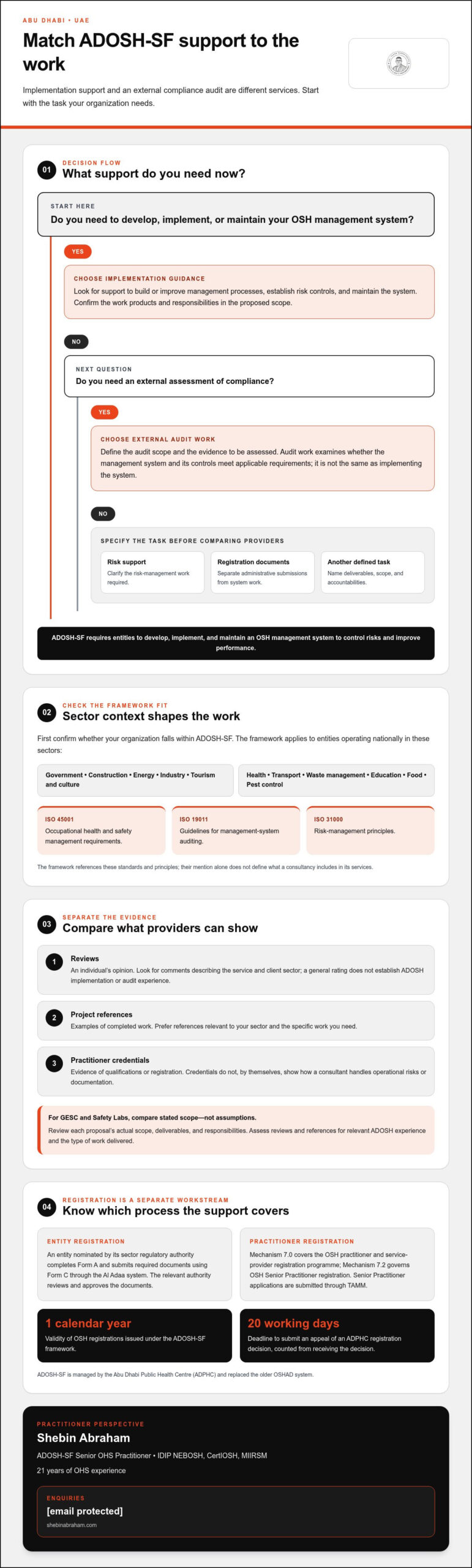
Use the framework’s components to understand what a service description covers. ADOSH-SF incorporates ISO 45001 requirements for occupational health and safety management, ISO 19011 guidelines for management-system auditing, and ISO 31000 risk-management principles. These references point to different types of work: building management processes, examining whether they are working, and addressing risk. A company’s implementation support and external compliance audit are therefore distinct service categories, not interchangeable labels.
Organizations should first confirm whether their sector falls within ADOSH-SF. The framework applies to entities in government, construction, energy, industry, tourism and culture, health, transport, waste management, education, food, and pest control operating nationally. A construction company, for example, may need to connect site controls to its OSH management system, while a health organization will have different operational risks and procedures. Sector context shapes the evidence needed for implementation and the focus of an audit.
Registration is a separate workstream. An entity nominated by its sector regulatory authority must complete Form A and submit the required documents using Form C through the Al Adaa system. The relevant sector regulatory authority reviews and approves the documents. This administrative process is distinct from developing an internal system or auditing operational compliance.
Practitioner registration has its own framework. ADOSH-SF Mechanism 7.0 covers the OSH practitioner and service-provider registration programme, while Mechanism 7.2 governs OSH Senior Practitioner registration. These mechanisms help organizations distinguish practitioner credentials from consultancy work delivered to an entity. Shebin Abraham, IDIP NEBOSH, CertIOSH and MIIRSM, is an ADOSH-SF Senior OHS Practitioner with 21 years of OHS experience.
When comparing Safety Labs and GESC for ADOSH consulting, examine each proposed task: system development, risk-management support, audit work, or registration documentation. Match the scope to your organization’s ADOSH-SF responsibilities. Comparing named work products and accountabilities is more useful than assuming every provider means the same thing by “ADOSH consulting”.
Also consider how the framework is administered. The Abu Dhabi Occupational Safety and Health System Framework (ADOSH-SF) replaced the older OSHAD system and is managed by the Abu Dhabi Public Health Centre (ADPHC). OSH Senior Practitioner registration is intended for consultancy employees providing safety services and senior OSH leads employed directly by high-risk organizations. Applications for OSH Senior Practitioner registration are submitted through the TAMM government services platform.
Registration validity and appeals are also relevant when assessing the administrative scope of support. OSH registrations issued under the ADOSH-SF framework are valid for one calendar year from issuance. Applicants appealing an ADPHC registration decision must submit the appeal within 20 working days of receiving the decision. GESC’s environmental engineer job listing required NEBOSH certification. That listing provides a hiring comparison, but it does not establish which consultancy deliverables Safety Labs includes. Confirm the stated service scope separately from practitioner registration and qualifications.
What are the client reviews and references for GESC and Safety Labs?
Reviews can provide context, but they do not establish whether GESC or Safety Labs is right for a particular ADOSH assignment. A star rating reflects an overall customer impression, not necessarily experience with system implementation or compliance audits. Look for comments that describe the service, the client’s sector, and the reported outcome. A reference for comparable work is more relevant than general praise.
Separate three kinds of evidence: a public review records an individual’s opinion, a project reference describes completed work, and a professional credential indicates a practitioner’s qualifications. These signals are not interchangeable. A positive review about responsiveness, for example, does not demonstrate experience preparing an ADOSH-SF audit. A qualification alone also cannot show how a consultant handles an organization’s operational risks or documentation.
GESC’s Abu Dhabi environmental engineer job listing sought experience implementing and auditing the Abu Dhabi OSHMS Safety Framework, Version 4.0. It also required NEBOSH certification, an ISO 45001 qualification, and at least a bachelor’s degree in environmental, safety, or a related field. Those are recruitment criteria. They don’t, by themselves, verify client satisfaction or prove that a particular project achieved a specific result.
Apply the same evidence categories when assessing Safety Labs. Keep a comparison record for review comments, project examples, and practitioner credentials. This helps prevent an isolated testimonial from carrying the same weight as a relevant reference. A comment about clear communication may inform expectations, while an ADOSH-related case example can show whether the work matches your organization’s needs.
- Relevance: Does the example concern Abu Dhabi and an ADOSH-SF assignment?
- Scope: Does it describe implementation support, audit work, or another task?
- Evidence: Does the reference explain the work performed, rather than offer broad praise?
- Recency and context: Is the example connected to a comparable sector and operating environment?
Use references to understand the work described, not to infer an outcome they do not establish. An audit reference is most useful when it explains the audit scope and resulting actions. An implementation example should identify the system elements addressed. Keep these distinctions visible when comparing GESC and Safety Labs, particularly if one public profile provides more detail than the other.
Check whether the evidence relates to the people who would carry out the work. A company review may concern a different service or project team. A named practitioner’s credentials and experience offer another perspective, but do not replace project-specific evidence. Weigh client feedback, references for comparable ADOSH work, and qualifications relevant to the assignment.
What ADOSH services are included in each company’s consulting packages?
When comparing GESC vs Safety Labs for ADOSH consulting, focus on the deliverables named in each proposal, not just the word “consulting.” A scope may cover system implementation, a compliance audit, registration documentation, or a defined combination. These are distinct workstreams, so do not assume one is included because another appears in the same service description. A useful comparison makes each task’s boundaries clear.
For implementation support, review the activities and outputs stated in the scope. They may include reviewing existing OSH documents, identifying gaps, revising procedures, and helping teams apply controls. A document review can identify missing processes; implementation guidance should explain how teams will use and maintain the revised system. Attribute a deliverable to GESC or Safety Labs only when the company’s package explicitly describes it.
Define audit work separately. Check whether the scope covers an internal readiness review, a management-system audit, or another compliance assessment. The proposal should state the assessment criteria, evidence to be reviewed, and reporting process. It should also separate evaluation from implementation, so management knows whether the consultant will develop the system, assess it, or do both.
Registration assistance is another distinct workstream. An entity nominated by its sector regulatory authority must complete Form A and submit the required documents using Form C through the Al Adaa system. The relevant sector regulatory authority reviews and approves submissions. If a package includes registration support, clarify whether it covers document preparation, submission assistance, or follow-up. Do not assume it is part of system consulting.
Use a side-by-side scope table to compare GESC and Safety Labs. Based on the proposal wording, mark each item as included, excluded, or subject to a stated limit. Consider these rows:
- Initial document and system review
- Gap findings and corrective-action planning
- Procedure development or revision
- Implementation guidance and progress reviews
- Audit scope, reporting, and follow-up actions
- Form A, Form C, and Al Adaa registration assistance
Match the listed outputs to your organization’s immediate priorities. A business with an established system may need audit findings, while a team developing processes may need implementation guidance. If both are required, compare the stages and outputs separately. Judge GESC vs Safety Labs for ADOSH consulting against a defined scope, so your team can see which deliverables address its requirements and who is responsible.
How long does ADOSH compliance support or certification preparation take with each company
There is no reliable duration to assign to GESC or Safety Labs without first defining the work. ADOSH-SF implementation, a focused gap review, and audit preparation involve different tasks. The starting point matters: an organization with current procedures and clear records has different needs from one building its system. Compare proposed phases and deliverables rather than assuming a standard turnaround.
Start with a baseline review. The team maps existing documents, operating controls, responsibilities, and evidence against the agreed ADOSH-SF scope. Next, it records gaps and plans corrective actions, followed by support to address the findings. Each phase depends on access to records, staff input, site operations, and management decisions. Delays in approving procedures or providing evidence can extend the work.
An external audit follows a different sequence: the auditor defines the criteria and required evidence, reviews records and operational practice, then reports findings. Corrective actions follow the assessment, so completing an audit and achieving readiness are separate milestones. For example, a report may identify incomplete training records, but the organization still needs to close the gap and retain evidence.
Registration has its own process and timing. An entity nominated by its sector regulatory authority completes Form A and submits the required documents using Form C through the Al Adaa system. The relevant sector regulatory authority reviews and approves submissions. Document completeness and review steps shape this process, which should be kept separate from a consultancy’s internal implementation schedule.
Registration validity creates a separate planning point. ADOSH-SF registrations are valid for one calendar year from issuance, and renewal must be completed within the 14-day period immediately before expiry. ADPHC gives at least 5 working days’ advance notice before an audit or registration review. These periods concern registration, not the duration of GESC’s or Safety Labs’ consulting projects.
Use a milestone plan to make proposals comparable. Ask each timeline to identify:
- The baseline review and information needed from your team
- Document development, review, and approval stages
- Site assessment or audit dates and reporting milestones
- Responsibility for corrective actions and evidence closure
- Dependencies involving operations, management, or regulatory review
Compare the proposed sequence with your starting system and internal capacity. A mature system needing audit preparation requires a narrower plan than a new system requiring development and implementation. In the GESC versus Safety Labs comparison, look for a transparent schedule tied to defined outputs, owners, and dependencies, not an unsupported promise of a fixed completion date.
For registered practitioners, ADPHC reviews complaints about registered practitioners within 10 working days to determine their legitimacy. This review period is a separate consideration from the phases used to prepare an organization for ADOSH-SF compliance or an external audit; it should not be treated as a promised project duration for GESC or Safety Labs.
Keep proposed scope and milestones explicit, and separate implementation work from regulatory processes. A clear plan shows which activities depend on your organization’s records, staff input, site operations, and management decisions. Keep regulatory review timing separate from the consultancy schedule.
What risks should Abu Dhabi businesses consider when choosing an ADOSH consultant
Choosing between GESC and Safety Labs requires more than comparing proposed tasks. If a consultant’s expertise does not fit your sector, important operational hazards may fall outside the scope. A construction site, a transport operation, and a healthcare facility, for example, face different activities and controls. Define your operations and the ADOSH-SF support required before comparing proposals.
Registration is also a governance consideration. An OSH consultancy office in Abu Dhabi must have at least one registered Senior Practitioner on staff to maintain its licence. Distinguish the consultancy’s status from the assigned practitioner’s credentials. Clarify who will lead the engagement and whether that person’s registration and responsibilities align with the proposed scope.
Gaps in scope can weaken the value of an engagement. A proposal focused on document review may not cover a site assessment, implementation guidance, or follow-up on corrective actions. Compare each company’s written scope with your needs. If you need an audit followed by improvement support, list both as separate deliverables and assign responsibility for each.
Do not confuse registration assistance with system compliance. An organization’s ADOSH-SF management arrangements and a practitioner’s registration are separate matters. Support with practitioner documentation, for example, does not by itself demonstrate that workplace procedures are implemented. Be clear about the required outcome: operational system support, audit preparation, practitioner registration guidance, or a defined combination.
Use a structured comparison for GESC and Safety Labs. Record evidence against practical criteria, then resolve gaps before agreeing on the work:
- Assigned practitioner: Identify the person responsible and their role in the engagement.
- Sector relevance: Match the proposed approach to your organization’s actual activities.
- Defined scope: Separate reviews, implementation tasks, audits, and follow-up actions.
- Evidence handling: Agree which records, site observations, and outputs will support the work.
- Accountability: Assign an owner for each corrective action and approval step.
Clear responsibilities matter. If a consultant identifies a gap but no internal owner is assigned, corrective work can stall. Unclear audit boundaries can also create different expectations between management and the consultant. Document roles, outputs, and decision points to keep the engagement focused on worker protection and organizational compliance.
For a practical review of your ADOSH-SF needs, discuss your consulting requirements before settling the scope. Bring your current procedures, known audit findings, and operational priorities. These details help frame the work around your organization’s actual risks, rather than a generic package.
Shebin Abraham: OHS Services
Shebin Abraham provides freelance ADOSH-SF OHS consulting for organizations needing practical support with workplace safety requirements and systems. This is a relevant next step once your comparison has clarified the work, whether that means reviewing existing arrangements, addressing compliance gaps, or planning implementation support. His OHS services focus on workable controls and clear responsibilities, not paperwork alone.
Turn to Shebin Abraham when your team needs specialist guidance on an ADOSH-SF project or freelance HSE support. He also provides OHS Freelancer Trakhees Consulting for organizations with Trakhees requirements. The scope should reflect your organization’s needs and the specific work involved.
Contact Shebin Abraham to discuss your OHS consulting requirements.
Turn Your ADOSH Decision Into a Practical Plan
A GESC-versus-Safety-Labs comparison for ADOSH consulting is most useful when it leads to a clear internal plan. Before work begins, decide who will coordinate the engagement, which teams need to contribute, and how recommendations will become part of daily operations. This preparation helps turn advice into sustained attention to workplace safety.
Shebin Abraham’s OHS Services include Freelance HSE Service and Freelance ADOSH-SF freelance OHS consulting. These services can support organizations with their occupational health and safety responsibilities. Set out the issue you need help with and the outcome your team wants to achieve. Contact Shebin Abraham to discuss a focused next step based on your operational priorities.
Contact Shebin Abraham to discuss ADOSH consulting and move forward with a considered plan for your organization.