

Can a part-time HSE consultant provide the right level of support without leaving gaps in day-to-day safety? If you’re weighing whether to hire part-time HSE consultant support or appoint someone full time, the right arrangement depends on your operation’s risks, workload and need for site presence. Flexible support can work well when responsibilities and deliverables are clear.
Choosing an arrangement shouldn’t mean compromising on worker wellbeing or practical oversight. This guide explains when part-time HSE support may fit, how to define a useful scope and communication rhythm, and how to match experience to your sector and relevant UAE or GCC requirements. It also shows how clear accountability keeps essential HSE work moving between site visits.
Shebin Abraham, IDIP NEBOSH, CertIOSH, MIIRSM, is an ADOSH-SF Senior OHS Practitioner with 21 years of OHS experience. His freelance consulting supports organisations across the UAE and GCC with practical HSE guidance, workplace safety systems, procedures, training and mentorship. Use the points below to shape an arrangement around your operational needs.
Key Takeaways
- Match HSE support to the work that needs doing, the site presence required and your organisation’s internal capability.
- Before agreeing a scope, separate recurring safety activities from project reviews, training and compliance support.
- Set out responsibilities, communication expectations and tangible outputs to prevent gaps between site visits.
- When you hire part-time HSE consultant Dubai support, assess whether the consultant’s sector experience and UAE or GCC knowledge fit your operational needs.
- For applicable organisations, include relevant ADOSH-SF or Trakhees OHS requirements when defining the advisory scope.
When does a part-time HSE consultant make sense for a UAE organisation?
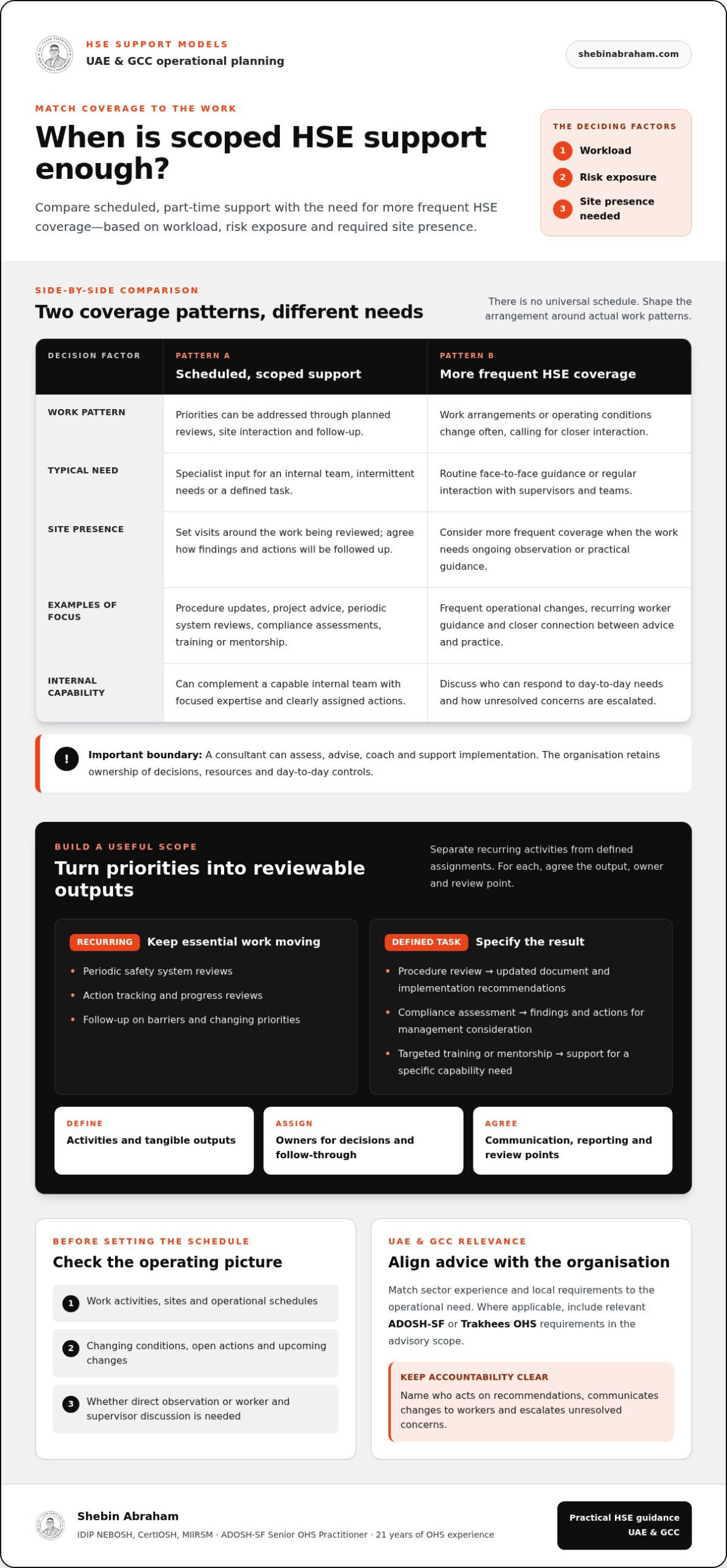
Part-time HSE consulting provides professional support under an agreed scope, schedule and set of outputs. Rather than covering every shift or managing safety continuously on site, a consultant can focus on defined priorities, such as reviewing procedures, advising on a project or strengthening workforce capability. Shape the arrangement around the work that needs attention, not an assumed number of consulting days.
This model can suit an organisation with a capable internal team that needs specialist input, or one facing a defined task such as updating safety procedures or assessing an operational concern. It can also give a business access to experienced advice when its needs are intermittent rather than continuous. Flexibility alone, however, does not make the arrangement suitable. Suitability depends on workload, risk exposure and required site presence.
Consider how quickly conditions change and what workers need from safety leadership. If activities are predictable and priorities can be addressed through scheduled reviews, planned site interaction and clear follow-up, scoped advice may be practical. If work involves frequent operational changes or routine face-to-face guidance, the organisation may need more frequent HSE coverage. Base the schedule on actual work patterns, not a universal formula.
What workplace needs can part-time HSE support address?
Start with gaps that affect daily operations. A consultant can support workplace safety systems and procedures, conduct compliance assessments within the agreed scope, and help turn findings into practical improvements. Targeted training or mentorship can also address a specific capability need, such as helping workers understand a procedure. Focus these activities on the organisation’s priorities and operating conditions rather than applying a generic checklist.
For example, a business preparing for a defined project review may need focused advice on its procedures and implementation. An established team may benefit more from periodic system reviews and coaching. Occupational safety and health covers the prevention of work-related harm and the conditions that support worker wellbeing; the wider context is outlined in Occupational Safety and Health. The practical question is which HSE work needs experienced attention now and what should improve as a result.
When might a business need more frequent HSE coverage?
Look at the full operating picture: work activities, changing conditions, sites or locations, and the support workers need to carry out tasks safely. When risks or work arrangements change often, regular interaction with supervisors and teams can help identify issues and keep guidance connected to practice. Before agreeing the scope, discuss expected site presence, reporting routes and follow-up. These factors help determine whether occasional advice is enough or a closer working schedule is needed.
Neither arrangement transfers the organisation’s management responsibilities. A consultant can assess, advise, coach and support implementation, but the organisation retains ownership of its decisions, resources and day-to-day controls. When you hire part-time HSE consultant Dubai support, make that boundary explicit: define who acts on recommendations, who communicates changes to workers and how unresolved concerns are escalated. Clear accountability keeps advice connected to the people doing the work.
How to define the scope, presence, and outputs of an HSE consultant
A productive consulting arrangement starts with a clear picture of the work, not a generic list of HSE tasks. Gather current concerns from managers, supervisors and workers. Note open actions, procedures that need review, upcoming operational changes, training needs and specific compliance support. This helps distinguish urgent priorities from routine work and keeps the engagement focused on practical results.
Next, separate ongoing activities from defined assignments. Recurring work might include periodic safety system reviews and action tracking. A project-specific assignment could focus on reviewing a procedure, assessing a work activity or delivering targeted training. If you plan to hire part-time HSE consultant Dubai support, describe the expected result for each task instead of relying on broad phrases such as “general HSE assistance.”
Turn operational priorities into clear consulting deliverables
Translate each priority into an output that can be reviewed. A procedure review, for example, could produce an updated document and recommendations for implementation. A compliance assessment could provide findings and actions for management consideration. A useful scope names activities, outputs, owners and review points. It also identifies the internal person responsible for decisions, approvals and follow-through.
Agree how progress will be discussed. Regular reviews can cover completed outputs, open actions, barriers to implementation and changes in operational priorities. This helps keep recommendations connected to day-to-day work. Shebin Abraham, IDIP NEBOSH, CertIOSH, MIIRSM, is an ADOSH-SF Senior OHS Practitioner with 21 years of OHS experience and provides consulting support shaped around organisational needs.
Match site presence and communication to the work
Set the schedule around the activity being reviewed. Consider where the work takes place, operational schedules, changing conditions and whether an effective assessment requires direct observation or discussion with workers and supervisors. Agree which matters call for a site visit and which can be handled through planned remote coordination. State how routine updates, urgent questions and action tracking will reach the right people.
Keep communication practical. Define a primary contact, how actions will be recorded and how concerns requiring management attention will be raised. Include a review point to reassess whether the agreed presence still fits if operations change. This gives everyone a shared reference for adjusting the work without leaving responsibilities or follow-up unclear.
For organisations shaping a flexible arrangement, freelance HSE consulting across the UAE can be tailored to defined priorities, deliverables and coordination needs.
How to compare part-time consulting with other HSE support models
Choose a support model by matching the work to the continuity, presence and expertise your operation needs. A defined review or improvement assignment calls for a different arrangement from ongoing coordination with teams during daily operations. Internal HSE capability matters too: an experienced team may need targeted specialist advice, while a business building internal capacity may need sustained in-house coverage.
Compare the options against your actual workload rather than assuming one model is always cheaper, safer or more compliant. If you plan to hire part-time HSE consultant Dubai support, consider what needs doing, how often workers need direct interaction and who will carry actions forward within the organisation.
| Support model | Continuity and presence | May fit when |
|---|---|---|
| Part-time consulting | Agreed input and site presence shaped around priorities | The need is ongoing but defined, or specialist advice is needed alongside internal capability |
| Full-time HSE staffing | Dedicated internal presence integrated with routine operations | Work requires sustained day-to-day HSE involvement and close coordination with teams |
| Project-based advice | Focused support for a defined assignment, with continuity tied to the project scope | A specific review, assessment or other bounded piece of work needs specialist attention |
Part-time consultant or full-time HSE officer?
Separate defined advisory tasks from routine internal coverage. Consider the expected workload, how closely HSE support needs to work with supervisors and the organisation’s availability expectations. A full-time officer can integrate into daily routines, while part-time input can focus on agreed priorities. Neither arrangement suits every operation. This freelance consultant and full-time HSE officer comparison explores the staffing decision in more detail.
Freelance consultant or consultancy firm?
A freelance consultant can provide direct engagement with a senior adviser, which may suit a focused scope and close working relationship. A larger consultancy may provide access to a broader team, depending on its structure and the assignment. Compare the expertise required, the number of disciplines involved and the communication approach that fits your team. For a fuller comparison, see this guide to freelance HSE consultants and consultancy firms.
Before deciding, map each option against the work to be completed, site interaction, internal ownership and follow-up needs. Choose the model that gives your organisation a workable level of support while keeping responsibilities clear.
How to assess experience and UAE compliance relevance before engaging
Relevant HSE experience is more than a list of sectors or credentials. Assess whether the consultant understands the activities, work environment and operational risks your organisation needs support with. Someone reviewing procedures for a particular work activity should be able to connect written controls with how the work is actually carried out. Discuss how their experience relates to the scope, what practical outputs they can provide and how they work with the teams responsible for implementation.
UAE organisations may also need advice that reflects the frameworks relevant to their operations. Where applicable, consider the consultant’s working knowledge of ADOSH-SF or Trakhees OHS requirements. Relevance depends on the entity, its activities and the assignment. Focus on requirements that apply to your organisation rather than assuming one framework covers every business.
Match the consultant’s expertise to your operational context
Compare the proposed adviser’s background with the work in scope. If the assignment involves reviewing procedures for a specific operation, look for experience that connects those procedures to site practice and workforce needs. If construction is relevant, consider the project environment and the advisory work required. This guide to the HSE consultant role for UAE construction projects provides further context.
Credentials establish a professional foundation, but they don’t replace a discussion about practical judgement. Explore how the consultant approaches assessments, identifies gaps and frames recommendations for the work at hand. For organisations with specific framework needs, connect that discussion directly to the requirements and deliverables in the agreed scope. If you plan to hire part-time HSE consultant Dubai support, assess both technical fit and the ability to work constructively with your operational teams.
Look for practical communication and follow-through
Good advice needs to be clear enough to act on. Recommendations should explain the issue, prioritise what needs attention and give operational teams a usable basis for follow-up. Agree how findings will be shared, who owns each action within the organisation, when progress will be reviewed and how unresolved matters will be escalated. Treat these as working arrangements, not assumptions to leave until an issue arises.
Notice how the consultant listens to workers and managers as well as how they present technical findings. Respectful collaboration helps keep recommendations relevant to actual tasks and supports decisions that protect people while recognising operational realities. The aim is not simply to produce documents, but to help the organisation understand and apply sound HSE practices.
Shebin Abraham provides freelance HSE and OHS consulting shaped around organisational needs, including advisory support relevant to ADOSH-SF and Trakhees requirements. Discuss tailored part-time HSE support to align experience, scope and communication with your operation.
Engaging Shebin Abraham for tailored part-time HSE support
Part-time HSE support is most useful when it reflects an organisation’s actual work, risks and capability needs. Shebin Abraham provides freelance HSE and OHS consulting to organisations across the UAE and GCC, helping turn safety priorities into practical workplace action. If you plan to hire part-time HSE consultant Dubai support, begin by identifying the outcomes you need, such as clearer procedures, a focused assessment or stronger workforce understanding.
A senior practitioner focused on practical workplace safety
Shebin Abraham holds IDIP NEBOSH, CertIOSH, MIIRSM credentials and is an ADOSH-SF Senior OHS Practitioner, with 21 years of experience in OHS. His approach starts with understanding how work is done, listening to the people carrying it out and making advice practical for managers and teams. The aim is to support sound decisions while keeping worker wellbeing central.
His consulting can be tailored to organisational needs, including support for workplace safety systems, procedures, compliance assessments, training and mentorship. Where relevant to an organisation’s operations, specialist advisory can also address ADOSH-SF or Trakhees OHS requirements. The scope should fit the need: help with a specific procedure differs from support for a broader safety system or workforce capability.
Practical collaboration matters as much as technical knowledge. Recommendations need to make sense in the context of the work and be presented so responsible teams can act on them. A clearly defined consulting arrangement identifies priorities, expected outputs and the working approach, while leaving operational decisions and action ownership with the organisation.
Start with a focused conversation about your requirements
To shape a useful scope, outline your activities, work environment and current HSE priorities. Explain what support is already in place, where teams need additional guidance and what you want the engagement to achieve. You may be addressing a system or procedure, building practical understanding through training or seeking advice relevant to a particular framework. Clear context helps tailor support to the work rather than defaulting to a standard package.
Discuss expected outputs, the level of site interaction needed, how progress should be communicated and who will coordinate actions internally. These details establish a workable arrangement and make it easier to review whether support continues to match changing operational needs. The consulting scope can then focus on implementation and the people affected by HSE decisions.
Share your priorities to begin a practical discussion about the right scope for your organisation. Discuss your HSE consulting requirements and explore tailored part-time support across the UAE and GCC.
Take the Next Step Towards the Right HSE Support
Turn your safety priorities into a clear discussion about the support your operation needs. Identify the work that needs attention, the teams involved and what practical progress would look like. This gives you a stronger starting point for a flexible arrangement that can stay aligned with changing operational needs.
If you’re considering whether to hire part-time HSE consultant Dubai support, focus on the fit between the expertise required, the work itself and the collaboration your team needs. A well-defined arrangement should support meaningful action while respecting the knowledge and responsibilities already held within your organisation.
Shebin Abraham provides freelance HSE and OHS consulting across the UAE and GCC, with practical support tailored to organisational needs. Discuss your HSE consulting requirements and take a considered step towards support that works for your operation and the people who depend on it.
Frequently Asked Questions
What does a part-time HSE consultant do?
A part-time HSE consultant can help turn a specific safety concern into usable controls, documentation or workforce guidance. If supervisors find that a procedure is applied inconsistently, for example, the consultant may review how it works in practice, recommend improvements and support focused instruction. The organisation retains responsibility for decisions and follow-through. The consultant’s contribution should reflect the agreed priorities and the people affected by the work.
Can a part-time HSE consultant support a business across the UAE?
Yes. Shebin Abraham provides freelance HSE and OHS consulting for organisations across the UAE and GCC. For an operation with more than one site, the engagement can account for differences in activities, teams and support needs rather than assuming one routine fits every location. A clear discussion of priorities helps establish where site interaction is useful, how teams will coordinate and what outcomes the organisation needs.
How do I know if my business needs part-time or full-time HSE support?
Consider how consistently HSE input is needed during normal operations. If your team needs continuing involvement in daily decisions, routine workforce interaction and ongoing follow-up, assess whether part-time availability can meet that demand. A defined review or specific improvement assignment may call for a different arrangement. If you plan to hire part-time HSE consultant Dubai support, assess actual work patterns and internal capability rather than applying a fixed staffing formula.
What should a part-time HSE consulting scope include?
Make the scope specific enough that both sides can recognise when the work is complete. For a procedure review, define which procedure is covered, whether site practice will be observed and what form the findings should take. Also state how the organisation will record decisions and track resulting actions. This detail prevents a broad request from expanding into unrelated tasks or leaving follow-up unclear.
Can a freelance HSE consultant help with ADOSH-SF or Trakhees requirements?
Yes. Shebin Abraham provides specialist consulting for organisations whose activities make ADOSH-SF or Trakhees OHS requirements relevant, including compliance assessment and documentation support. Identify the applicable framework and the specific outcome needed when defining the scope. Requirements relevant to one entity or project do not automatically apply to every UAE business.
How can a part-time HSE consultant maintain continuity?
Keep a shared record of recommendations, decisions, action owners and current status so work can progress between consulting sessions. A designated internal contact can coordinate updates and raise new operational concerns. If a planned activity changes, for example, record the change and review whether it affects open HSE actions or the agreed scope. Continuity depends on orderly handover and consistent follow-through, not simply on the number of hours scheduled.
What experience should an HSE consultant have for UAE work?
Prioritise experience that relates directly to your activities and the advice you need. If the work involves reviewing operational procedures, look for a consultant who can connect documented controls to site practice and explain recommendations clearly to managers and workers. Consider relevant UAE or GCC framework knowledge where it applies. Discuss how the consultant approaches similar types of HSE work and communicates practical findings.