

A workplace safety plan can fall short even when its procedures look complete: if employees cannot find or understand them, they cannot guide the work. To understand how to develop a workplace safety plan, start with clear policies and practical procedures, then decide how to document and share them. In the UAE, the plan also needs to reflect your organization’s operations, hazards, and applicable requirements.
A sound plan is more than a document. It gives people clear direction, supports consistent safety practices, and helps teams respond to hazards and incidents. This article explains what information a professional needs from your organization, how that information shapes the plan, and how training records and accessible documents help put it into practice.
The guidance is informed by Shebin Abraham, IDIP NEBOSH, CertIOSH, MIIRSM, an ADOSH-SF Senior OHS Practitioner with 21 years of experience in OHS. His work supports organizations across the UAE and GCC with practical, people-centred safety and compliance guidance.
Key Takeaways
- Shape safety training around employees’ actual tasks, workplace hazards, and the information they need before starting work.
- Build policies and procedures from a practical assessment of work areas, equipment, and everyday operations.
- Set up a safety and health program with clear responsibilities, achievable priorities, and a process for improving it over time.
- Make equipment inspections and maintenance part of the plan so issues can be identified and addressed systematically.
- Document training and safe-work practices, then make the current plan accessible to the people who need to use it.
How do employees benefit from workplace safety plans?
A practical safety plan helps employees understand hazards, prepare for tasks, and raise concerns before risks cause harm. Its value depends on involving workers in planning and matching instruction to the work they do.
- Involve employees in identifying hazards. Ask workers about risks they encounter during everyday tasks, shift changes, and equipment use. For example, an operator may notice a blocked access route that a periodic management review misses. Record the concern, assess the risk, and assign someone to address it. Employee feedback helps ensure planning reflects the actual work environment.
- Coordinate responsibilities across employers. When host employers, contractors, and staffing agencies share a workplace, clarify who provides site orientation, task instruction, supervision, and incident reporting. A contractor beginning maintenance work, for example, needs to understand both the task hazards and relevant site procedures. Agreeing on responsibilities before work begins helps prevent gaps between site rules and work methods.
- Provide orientation before work starts. Give new employees, and employees starting new jobs, a general safety orientation plus instruction tailored to their duties. Workers should receive task-specific guidance before they begin. Explain site hazards, safe methods, emergency actions, and how to report a hazard or near miss. Keep training connected to actual tasks rather than relying only on general information.
- Match training and certifications to each role. Employees need instruction and any certifications required for their tasks, equipment, and applicable UAE or site requirements. No single certification suits every role; a worker’s needs depend on their duties and the hazards involved. The plan should identify required instruction, who provides it, and how competence is evaluated.
- Retrain when work changes. Revisit instruction when employees take on different tasks, encounter changed hazards, or need correction after an incident or near miss. Use a practical evaluation, such as observing a worker follow a safe procedure, to identify where further coaching is needed. The article’s author, Shebin Abraham, holds IDIP NEBOSH, CertIOSH, and MIIRSM credentials and is an ADOSH-SF Senior OHS Practitioner with 21 years of OHS experience.
- Make participation accountable and sustained. Assign named roles for raising concerns, delivering training, and following up on corrective actions. The cost to develop and implement a plan depends on its scope, workforce, hazards, and training needs; it is provided after a quote request. A clear record of instruction and follow-up helps employers see whether the plan works in practice.
What are workplace safety policies and procedures?
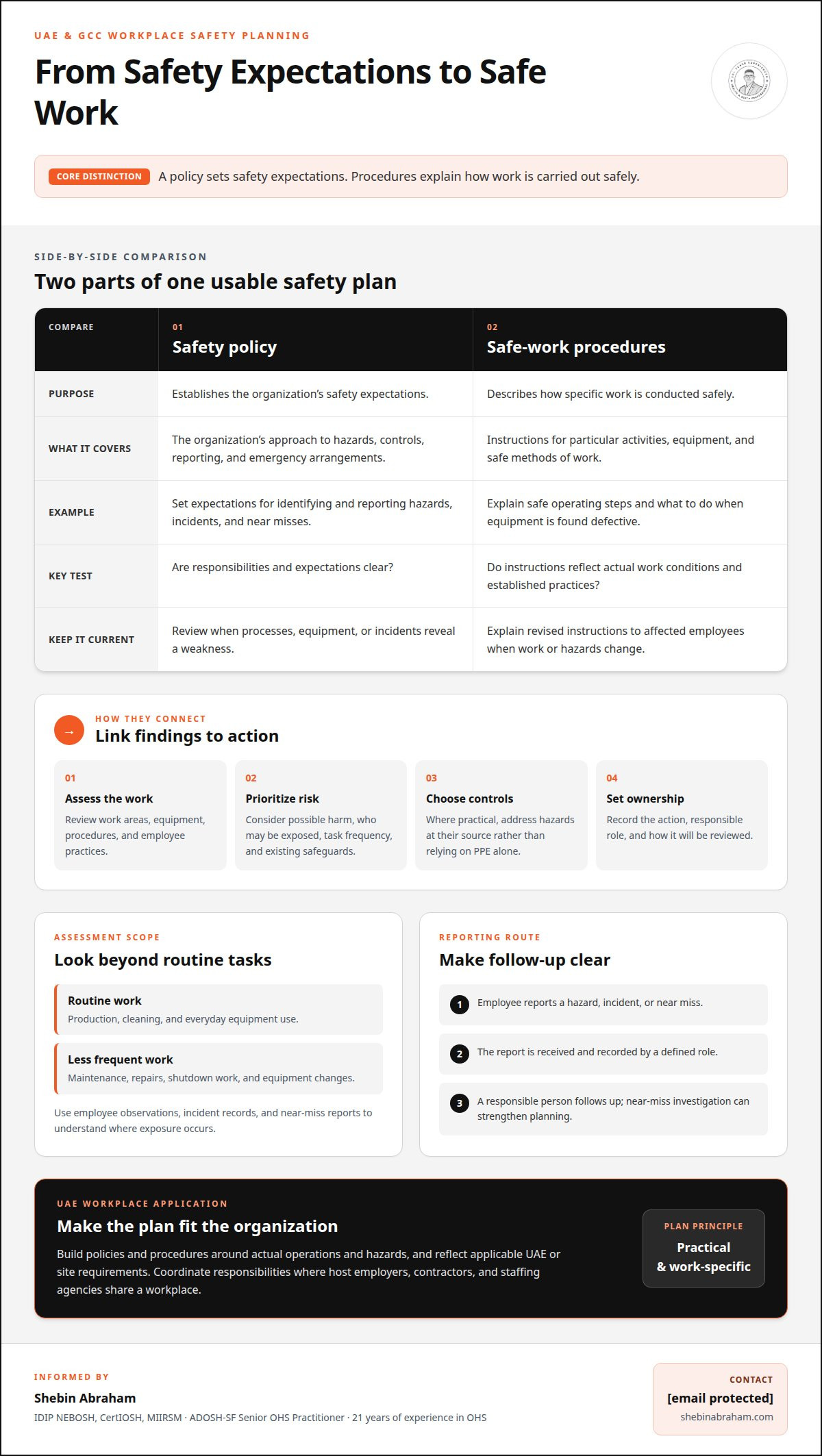
A policy establishes an organization’s safety expectations; procedures describe how work is conducted safely. A workplace safety plan includes hazard assessments, controls, reporting processes, safe-work procedures, and emergency arrangements.
How a Professional Chooses Hazard Controls
A professional assesses hazards across work areas, equipment, procedures, and employee practices. The review covers routine activities and less frequent tasks, such as maintenance or shutdown work. The professional then considers who could be exposed, how exposure might occur, and the possible consequences. Where practical, controls should address hazards at their source rather than relying on personal protective equipment alone.
How a Professional Communicates Safety Information
Establish clear routes for employees to report hazards, incidents, and near misses. Define who receives each report, how it is recorded, and who follows up. For example, a worker who spots a damaged tool should know how to report it and prevent continued use. The Workers’ Safety and Compensation Commission notes that investigating near misses can strengthen planning and help prevent future incidents.
- Assess routine and non-routine work. A professional reviews how tasks unfold in practice, including production, cleaning, repairs, and equipment changes. Maintenance, for example, can create access or isolation hazards that are absent during ordinary operations. Employee observations, incident records, and near-miss reports can show where exposure occurs. This task-by-task review keeps the assessment relevant to the organization’s actual work.
- Prioritize risks before selecting controls. Consider the possible harm, who may be exposed, how often the task occurs, and whether existing safeguards work. This helps distinguish urgent risks from issues requiring routine follow-up. Record the action selected, the responsible role, and how it will be reviewed. A professional develops a workplace safety plan by linking assessment findings to controls, responsibilities, and procedures that can be put into practice.
- Turn policy into usable procedures. State expectations in the policy, then develop instructions for specific work activities. An equipment-handling procedure, for instance, can explain safe operating steps and what employees should do if they find a defect. Check that every instruction reflects actual work conditions. Procedures that conflict with established practices can undermine implementation and disrupt productivity.
- Review changes and communicate them. Reassess hazards when processes change, new equipment arrives, or an incident reveals a weakness. Explain revised instructions to affected employees, including what changed and how it affects their work. This is a practical part of how to develop a workplace safety plan that stays aligned with operations. Professional support can help organize those findings into clear policies and procedures through structured workplace safety planning.
What is a Safety & Health Program?
A safety and health program organizes policies, responsibilities, and actions to prevent injuries and improve work practices. In the UAE, a professional aligns the program with the organization’s activities and the requirements applicable to its location and operations.
-
How a Professional Gets a Safety and Health Program Started
Begin with management’s commitment, the organization’s work activities, and its main injury risks. Set practical objectives, assign responsibility, and document the safety policy so employees understand its purpose. OSHA’s recommended approach has seven core elements, according to the Occupational Safety and Health Administration. A professional can use that framework to organize program development without treating it as a substitute for applicable UAE requirements.
-
How a Professional Manages Health and Injury Prevention
Connect occupational health and injury prevention to routine management decisions. Review incident and near-miss information, workplace observations, and employee concerns to identify where prevention needs attention. Assign a responsible role to each action, then evaluate whether the measure works in practice. Track completed safety audits, training, safety discussions, and investigated near misses to assess whether the program is being implemented.
-
How a Professional Reviews Applicable Safety Guidance
Map the requirements relevant to the organization’s UAE location, industry, work activities, and site arrangements. Applicable regulations and standards may differ with those factors, so the program should reflect the actual operating context rather than rely on a generic template. OSHA guidance can inform program design, while the professional keeps the compliance review focused on relevant UAE requirements.
- Set the policy and responsibilities. State the organization’s commitment to safety and health, explain management and employee roles, and have the top company official sign the written policy. This gives the program direction and a clear basis for communicating expectations. Connect each policy commitment to procedures, training, or oversight that can be put into practice.
- Review and improve the program. Review the written safety and health policy annually, and update the plan when processes change, new equipment is introduced, or an incident points to needed adjustments. Measure performance through completed audits, training records, hazard reports, and investigated near misses. These indicators help employers assess prevention activity and whether corrective actions are completed.
A professional develops and implements the plan by assessing hazards, setting controls and responsibilities, documenting procedures, training employees, and reviewing results. In the UAE, schedule reviews annually for the written policy and revisit the plan when work or equipment changes, or an incident calls for adjustments.
Equipment maintenance and inspections
Organize equipment care around its condition, use, and hazards. A clear inspection process helps workers identify defects early and address them before they contribute to accidents.
- List equipment and assign responsibility. Create an inventory of tools, machinery, and safety-critical equipment used across work areas. Assign a responsible role for each item, including who conducts inspections, arranges servicing, and records completed actions. For example, a supervisor might coordinate checks for shared equipment, while workers report problems they notice during use. Clear ownership helps ensure important items are not overlooked.
- Set inspection points for each item. Identify the condition indicators relevant to the equipment and its work environment. A visual check might reveal damaged guards, loose components, leaks, or worn cables. Follow applicable operating and maintenance instructions, and make the inspection process clear to the person carrying it out. Clean, service, and inspect equipment regularly.
- Record findings and corrective actions. Use an inspection report to note the equipment examined, the inspector, observed defects, and actions taken. Record whether the item was removed from use or sent for servicing. The record should show what remains unresolved and who is responsible for follow-up. Keep completed reports together so supervisors can review recurring faults.
- Respond promptly to defects. Give workers a clear way to report damaged or malfunctioning equipment. Assess the hazard, decide whether the item can remain in use, and record the reason for the decision. For instance, a faulty guard may expose an operator to moving parts. Keep defective equipment out of service until the identified risk is addressed.
- Use inspection trends to improve controls. Review reports for repeated faults, missed checks, or equipment requiring frequent repair. A pattern of damaged cables in one work area may point to storage or handling practices that need attention. Assign corrective actions and check whether they resolve the underlying issue. This makes inspection information useful beyond the individual repair.
- Connect maintenance to incident learning. After an equipment-related accident or near miss, preserve relevant inspection and service records for the investigation. Compare the equipment’s condition with previous reports, then update maintenance or inspection arrangements where findings support a change. Prompt follow-up can help reduce repeat hazards. Better records also help employers understand the circumstances behind an injury and any related compensation process.
Keep the process practical: workers need to know what to inspect, how to report a concern, and who handles the next action. Regular inspections and maintenance records help supervisors track equipment condition and address significant issues.
Documenting and distributing the safety plan
A written plan turns safety expectations into instructions employees can use. A professional documents responsibilities, emergency actions, training records, and a clear process for keeping each version current.
-
How a Professional Documents the Safety Plan
Organize the document so employees can quickly find information relevant to their work. Include policies, safe-work procedures, reporting routes, emergency contacts, and response actions. Give the plan a title, owner, approval status, and revision date. Keep supporting records, such as inspection findings and incident investigations, traceable to the procedures they inform. Avoid conflicting copies that leave teams unsure which instructions apply.
-
How a Professional Distributes the Safety Plan
Make the current plan accessible to every employee who needs it, including workers across locations or shifts. Use a controlled shared document or an available workplace copy, and explain where procedures can be found. Ask employees to confirm they have read the safe-work practices and intend to follow them. A signature records acknowledgement; it does not replace clear instruction or discussion.
- Record safety training consistently. Keep a record for each session showing its date, topics, instructor, and attending employees. Capture attendee signatures where used, then file records so supervisors can identify who received task-specific instruction. If a procedure changes, for example, the training record helps identify affected workers and document follow-up instruction. Consistent records support occupational safety oversight and future evaluation.
- Document emergency response and evacuation arrangements. Set out what employees should do during fires, medical emergencies, and natural disasters. Identify evacuation routes, emergency contacts, and response actions, then make the instructions easy to find in the plan. Explain how employees receive alerts, where they should go, and how concerns are reported. Clear, practical instructions help teams respond in a coordinated way.
- Connect records to prevention and improvement. Document incidents and near misses alongside investigations and resulting changes to procedures. For example, a recurring access issue may prompt a revised evacuation route or clearer instructions. Record the reason for each change, its approval, and when employees receive the update. This makes the document a proactive tool for reducing injury and illness risks, not simply an archived file.
- Keep distribution current. When work processes change or an incident requires an adjustment, replace outdated copies and tell affected employees what has changed. Make sure supervisors and workers can find the revised procedure before relying on it. For support developing and documenting a workplace safety plan, contact Shebin Abraham.
Shebin Abraham
Shebin Abraham helps organizations turn workplace safety requirements into practical, documented plans suited to their operations. Through OHS Services and Freelance HSE Service, he provides professional guidance on hazard controls, responsibilities, procedures, and plan reviews. He also provides OHS consulting for organizations addressing ADOSH-SF and Trakhees requirements.
Consider professional support when your team needs a structured assessment, clearer safety documentation, or help aligning procedures with its work environment. A planning discussion can focus on your operations, workforce, known hazards, and existing safety records, providing a practical starting point.
Contact Shebin Abraham to discuss developing a workplace safety plan for your team.
Put your safety plan into practice
A workplace safety plan creates value when it guides real decisions, not just when it sits in a file. Translate the organization’s priorities into assigned actions, practical procedures, and a review process that responds to changing work. That is the discipline behind developing a workplace safety plan that remains useful to the people it is meant to protect.
When your team needs help turning safety requirements into a workable approach, Shebin Abraham’s OHS Services and Freelance HSE Service can help. His Freelance ADOSH-SF OHS consulting supports organizations addressing ADOSH-SF requirements. Start with a conversation about your operations, current procedures, and the gaps you want to address.
Contact Shebin Abraham to discuss your plan and take a considered next step toward safer, more consistent work. A thoughtful plan can help your team move forward with greater clarity and shared responsibility.
Frequently Asked Questions
How can an employer get started with professional workplace safety plan development?
Start by gathering materials that show how work is organized, such as existing procedures, work schedules, site layouts, and incident records. A professional can use these to understand the plan’s scope and identify missing operational details. Include upcoming projects or changes in work methods, too. This context helps shape a plan around actual conditions rather than a generic template.
Where Does Safety Training Come In?
Training should connect written procedures to the decisions employees make during real tasks. Map each role to the instruction it needs, then use demonstrations or discussion to assess understanding. For example, a supervisor could ask an employee to explain how to stop work after spotting an unsafe condition. This shows whether the instruction is clear and usable, not simply delivered.
Why Is Safety at Work Important?
Workplace safety helps protect people from preventable harm and supports reliable operations. A hazard that interrupts a task can affect coworkers, schedules, and work quality, as well as the person directly exposed. For example, a clear process for isolating damaged equipment can prevent another worker from using it unknowingly. Protecting health is both a human responsibility and part of sound operational management.
Why are safety plans crucial for businesses?
A plan gives teams a shared reference when work changes or an unexpected event occurs. Without agreed responsibilities, employees may make conflicting decisions about stopping work, escalating concerns, or resuming an activity. For example, a shift handover can identify an unresolved safety issue and who must address it. This continuity helps preserve important information across teams, contractors, and changing work conditions.
How does a professional assess workplace hazards and risks?
A professional examines how a task unfolds, including where people move, what equipment they use, and how activities interact. For example, assessing vehicle movements alongside pedestrian routes can reveal a crossing conflict that separate task reviews might miss. The assessment considers who may be exposed, possible consequences, existing safeguards, and whether those safeguards work consistently. These findings support proportionate priorities and practical decisions.
How can a professional help employers report and investigate workplace incidents and near misses?
A professional can structure an investigation around a clear sequence of events, relevant records, and accounts from people involved. For example, a near miss involving a dropped load may require reviewing the task setup, equipment condition, and communication beforehand. The investigator can distinguish immediate causes from underlying contributing factors, document findings, and assign corrective actions. Follow-up checks whether those actions address the identified causes.