
What if the clearest sign of a strong safety culture is a worker who feels comfortable speaking up? If safety messages don’t shape everyday decisions, or people hesitate to report hazards and near misses, paperwork alone won’t close the gap. Learning how to improve safety culture in the workplace starts with making worker feedback visible in the choices leaders make each day.
Building trust takes more than a campaign or a single training session. Leaders need to listen, respond to concerns, and show teams what changed as a result. Workers also need practical ways to help identify risks and learn from how work is actually done.
This guide sets out a practical sequence for strengthening safety culture across UAE and GCC workplaces, from leadership behaviours and worker consultation to reporting, learning, and assessing progress. It explains how to look beyond slogans and paperwork for signs that everyday practice is improving. The guidance draws on the experience of Shebin Abraham (IDIP NEBOSH, CertIOSH, MIIRSM), an ADOSH-SF Senior OHS Practitioner with 21 years of OHS experience.
Key Takeaways
- Recognize safety culture through everyday decisions, reporting, and consultation, not policies and slogans alone.
- Make leadership commitments credible by responding visibly to worker feedback and involving teams in practical risk controls.
- Improve safety culture through a sequence that starts with listening and continues through action and review.
- Use regular reviews to keep improvements relevant as tasks, teams, and workplace risks change across UAE and GCC operations.
- Explore practical OHS insights informed by Shebin Abraham, an ADOSH-SF Senior OHS Practitioner with 21 years of experience and credentials including IDIP NEBOSH, CertIOSH, and MIIRSM.
What workplace safety culture means and how to recognize it
Workplace safety culture is the set of shared assumptions, behaviours, and decisions that shape how people manage health and safety at work. It shows up in routine choices: whether a worker pauses to clarify an unfamiliar task, whether a supervisor makes time to discuss a concern, and whether a team adjusts a control that isn’t working as intended. The overview of Understanding Safety Culture provides useful background, but the clearest evidence is in daily practice.
Written procedures, training records, and campaign slogans help set expectations and support consistent work. On their own, however, they don’t show whether a procedure is practical under real working conditions or whether people can follow it when pressures change. Compare documented arrangements with the way work is actually carried out. Ask workers what helps them follow the process and what gets in the way.
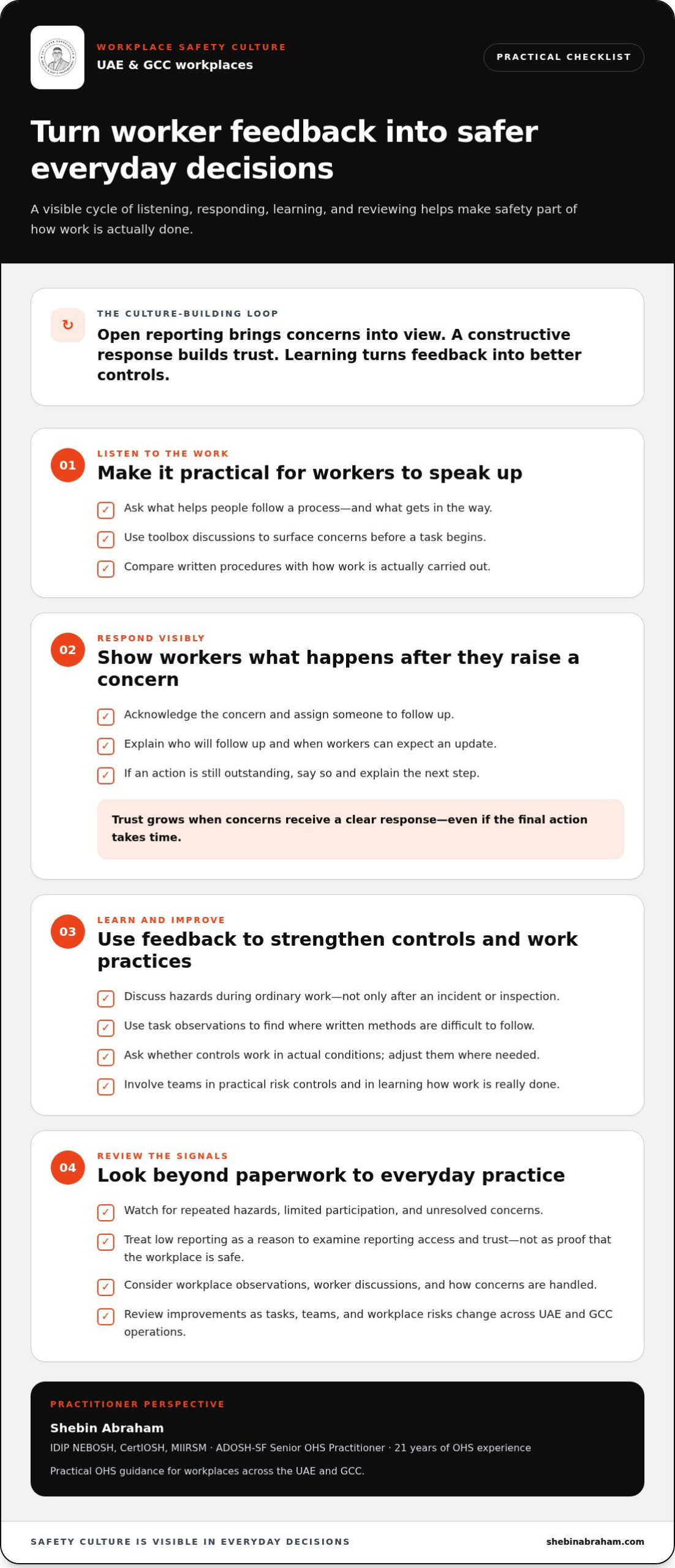
A useful diagnostic is straightforward: open reporting brings concerns into view, a constructive leadership response builds trust, and learning turns feedback into better controls.
What does a positive workplace safety culture look like?
Workers can raise concerns without expecting blame or dismissal, including when an issue involves a routine task or an inconvenient shortcut. Supervisors discuss hazards during ordinary work, not only after an incident or formal inspection. Teams consider the feedback and improve controls or work practices where needed. The key signal is follow-through: people can see that speaking up leads to a thoughtful response.
Which early signs suggest the culture needs attention?
Repeated hazards, limited participation, and unresolved concerns can point to weaknesses in how safety is managed. Look for differences between procedures and routine practice as well. A process may be clearly documented but difficult to follow during a particular shift or task. Explore the gap with the people doing the work instead of assuming the written instruction tells the whole story.
Few reports don’t automatically mean a workplace is safe. Workers may be unsure how to report, may not trust that action will follow, or may feel uncomfortable raising an issue. Treat low reporting as a reason to examine reporting access and trust. Then consider other evidence, including workplace observations, worker discussions, and how concerns are handled. This helps leaders understand how to improve safety culture in the workplace without mistaking completed paperwork for safer work.
Shebin Abraham, IDIP NEBOSH, CertIOSH, MIIRSM, is an ADOSH-SF Senior OHS Practitioner with 21 years of OHS experience. His work reflects a central principle for UAE and GCC workplaces: safety systems need to make sense in the conditions people face every day.
How leadership and worker participation shape safety culture
Leadership gives safety commitments their credibility. Workers notice whether managers make time to address concerns, provide the resources needed for safe work, and follow agreed controls when schedules or production pressures increase. A safety message carries little weight if everyday decisions send a different signal.
Make safety part of ordinary operational conversations. Discuss it alongside quality, scheduling, and other priorities when planning work or responding to change. Leaders and supervisors should model safe choices and respond consistently when someone reports a hazard or makes a mistake. A fair response seeks to understand what happened and prevent a recurrence, rather than discouraging people from speaking up.
What should leaders do to make safety commitments credible?
Show commitment through actions workers can see. When a task changes, pause to consider whether the controls still fit. If a reported concern needs further investigation, explain who will follow up and when workers can expect an update. Consistency matters: workers are more likely to trust safety expectations when leaders apply them fairly in routine operations, not just during audits or after an incident.
How can workers take part in improving safety?
Participation brings practical knowledge into decisions. Toolbox discussions can surface concerns before a task begins. Task observations can reveal where written methods are difficult to follow. Structured feedback can help teams assess whether controls work in actual conditions. Ask workers what has changed, what could go wrong, and what would make the task safer and workable. Their input can reveal hazards that procedures alone may not expose.
Consultation only matters when it influences decisions. Acknowledge concerns, assign someone to follow up, and share the outcome with the people who raised them. If an action is still outstanding, say so and explain the next step. Trust grows when reported concerns receive a clear response, even if the final action takes time.
These routines turn how to improve safety culture in the workplace from an abstract goal into shared practice. Shebin Abraham (IDIP NEBOSH, CertIOSH, MIIRSM), an ADOSH-SF Senior OHS Practitioner with 21 years of OHS experience, supports organizations across the UAE and GCC through practical OHS consulting, training, and mentorship. Explore practical OHS advisory to help translate workplace feedback into meaningful improvement.
Why procedures and training alone may not improve safety culture
Written procedures and safety training are important supports, but they don’t create a strong culture on their own. A procedure explains the expected method, and a training record shows that a session took place. Neither proves that workers can apply the guidance during real tasks or that supervisors address barriers when conditions change.
This distinction matters in UAE and GCC workplaces, where operational demands, teams, and work environments can vary. A sound safety system provides clear processes and supports compliance with applicable requirements. Safety culture is reflected in how people use those processes, whether they feel able to raise concerns, and how the organization responds and learns. Both matter: systems provide structure, while participation makes them meaningful in practice.
How are safety compliance and safety culture different?
Compliance focuses on meeting applicable requirements and following established processes. Culture is expressed through shared expectations and daily actions, including whether people trust that concerns will be taken seriously. The two are connected but not interchangeable. A documented process sets a standard, while workers’ experience can show whether it’s understood, workable, and consistently followed.
Which safety measures reveal learning rather than paperwork?
Look beyond completed activities for evidence of what changed. Training attendance shows participation in a session; worker discussions or task observations can indicate whether learning is being applied. Hazard reports, follow-up actions, worker feedback, and recurring issues all help leaders assess how well the system is working. Consider each measure in context:
- Training completed: Confirms a session was recorded, but not whether learning changed work practices.
- Hazards reported: Shows that issues are being raised, but a higher or lower total needs context about access, trust, and reporting habits.
- Actions closed: Shows recorded follow-up, but worker feedback can help establish whether the change addressed the concern.
- Repeated issues: May indicate that a control or process needs review, though teams should examine the circumstances behind each recurrence.
Don’t treat more reports as automatic proof of failure or fewer incidents as proof that risks are controlled. Reporting may increase as people gain confidence, while a low count may reflect barriers to speaking up. No single measure captures the whole picture. Combine records with conversations, observations, and follow-up to understand whether the organization is learning.
That balance is central to how to improve safety culture in the workplace: maintain formal controls, then test whether they help people work safely in practice. Shebin Abraham (IDIP NEBOSH, CertIOSH, MIIRSM), an ADOSH-SF Senior OHS Practitioner with 21 years of OHS experience, brings this practical focus to OHS consulting, training, and mentorship across the UAE and GCC.
How to improve safety culture in the workplace: a practical sequence
A useful improvement process doesn’t begin with a slogan or a new form. It starts with understanding what workers experience, then turning that insight into practical changes. Adapt the sequence to your organization’s risks, work activities, and applicable UAE or GCC requirements.
- Listen. Speak with workers and supervisors about tasks, concerns, and barriers to safe work. Include the people who perform the work, not only those who manage it.
- Identify priorities. Combine conversations with workplace observations and available incident or hazard information. Look for recurring issues and concerns with potentially serious consequences.
- Agree actions. Choose a focused priority with workers and relevant supervisors. Define the intended action, who owns it, and when its effectiveness will be reviewed.
- Implement. Put the agreed change into practice. Involve the people affected and provide task-relevant communication, instruction, or training where a need has been identified.
- Review. Check whether the action works in real conditions. Share what changed, listen for remaining concerns, and adjust the approach if the issue persists.
How should an organization identify its first improvement priorities?
Start with a grounded picture of the work. Compare documented controls with workers’ accounts and observations of how tasks are actually completed. For example, if a control is difficult to use during one stage of a task, explore why before deciding what to change. Prioritize issues based on recurrence and potential significance, informed by workers’ experience. Keep the first improvement focused, with a clear owner, action, and review point.
How can teams turn agreed actions into lasting practice?
Test proposed actions with workers and supervisors before treating them as complete. Their input can show whether a change is practical in normal working conditions and whether further instruction or training is needed. After implementation, communicate the action taken and what the review shows. If concerns remain, explain the next step instead of allowing the issue to disappear from view.
Listen, act, communicate, and learn: that’s the cycle that turns safety feedback into everyday improvement. Applying it consistently is a practical way to approach how to improve safety culture in the workplace, with decisions grounded in operational realities and relevant requirements. Shebin Abraham (IDIP NEBOSH, CertIOSH, MIIRSM), an ADOSH-SF Senior OHS Practitioner with 21 years of OHS experience, provides OHS consulting, training, and mentorship to support practical workplace improvement across the UAE and GCC. Explore practical OHS improvement support.
How to sustain safety culture improvements across UAE and GCC workplaces
Safety improvements need to keep pace with the work. Tasks change, teams shift, and new information can reveal risks that weren’t clear when an action was first agreed. A review rhythm suited to the organization’s operations and risk profile helps leaders notice these changes and keep controls practical. It also reinforces that safety is part of ongoing work, not a campaign with an end date.
How can organizations keep safety improvement active over time?
Set regular opportunities for workers and relevant leaders to review progress. Share which actions are complete, what remains open, and who is responsible for the next step. Revisit decisions when work changes, feedback raises a new concern, or incident and hazard information points to a developing issue. The purpose isn’t to add meetings for their own sake. It’s to keep decisions connected to what people experience on the job.
For organizations operating across the UAE and GCC, identify which requirements and guidance apply to the organization and its activities. ADOSH-SF and Trakhees OHS may be relevant in particular contexts, but neither should be assumed to apply universally. Assessing applicability helps teams align improvement work with the relevant framework while keeping attention on effective day-to-day practice.
When can experienced OHS guidance support culture improvement?
An experienced OHS practitioner can help an organization turn broad priorities into practical actions, connect worker feedback with system improvements, and identify where additional communication or training may help. Tailored training and mentorship can support understanding and participation, particularly when teams need to apply guidance to the tasks they perform.
Shebin Abraham (IDIP NEBOSH, CertIOSH, MIIRSM) is an ADOSH-SF Senior OHS Practitioner with 21 years of OHS experience. His OHS consulting, training, and mentorship support organizations across the UAE and GCC in strengthening workplace practice. His ADOSH-SF advisory experience informs this work, while the appropriate framework depends on each organization’s context and applicable requirements.
Knowing how to improve safety culture in the workplace means continuing to listen, review, and adapt as operations evolve. If your organization is considering its next improvement priorities, explore a tailored OHS improvement approach.
Make safer work part of every decision
A stronger safety culture grows through consistent everyday actions, not policies or training records alone. Leaders build credibility by responding to concerns, while workers contribute practical knowledge about how tasks are performed and controls work. A repeatable cycle of listening, agreeing actions, implementing them, and reviewing outcomes helps turn that input into lasting improvement.
Understanding how to improve safety culture in the workplace means looking beyond activity counts. Pay attention to whether workers feel able to speak up, whether concerns receive follow-up, and whether teams learn when conditions change. Across UAE and GCC workplaces, keep improvement aligned with operations and applicable requirements.
Shebin Abraham, IDIP NEBOSH, CertIOSH, MIIRSM, is an ADOSH-SF Senior OHS Practitioner with 21 years of OHS experience. His consulting, training, and mentorship support organizations in translating safety priorities into practical workplace action. To discuss an approach suited to your organization, contact Shebin Abraham about a practical OHS improvement approach.
Start with one meaningful conversation, then build on what you learn. Every considered response can help make safer work a shared part of the day.
Frequently Asked Questions
What is workplace safety culture?
Workplace safety culture is the shared assumptions, behaviours, and decisions that shape how people approach health and safety in their daily work. It’s visible in whether workers raise concerns, whether supervisors respond constructively, and whether teams learn from feedback. Policies and procedures help set expectations, but culture is revealed by how people use them in practice and how safety influences everyday choices.
How can managers improve safety culture in the workplace?
Managers can improve safety culture in the workplace by modelling safe choices, making time for worker input, and following through on reported concerns. Discuss safety alongside operational priorities such as quality and scheduling, so it remains part of routine decisions. When a concern is raised, acknowledge it, assign follow-up, and share the outcome. Consistent, fair responses help workers see that speaking up can lead to meaningful action.
Can safety training alone improve workplace safety culture?
No. Training can build understanding and provide guidance, but attendance records don’t show whether people can apply what they’ve learned during real tasks. Reinforce training with task-specific discussion, supervisor support, and opportunities for workers to raise practical questions. Then observe work and gather feedback to see whether the learning is useful. If barriers remain, adjust the instruction, controls, or work practices rather than relying on repeat sessions alone.
How do you measure safety culture in a workplace?
Use a mix of records and evidence from daily work. Review hazard reports, whether actions are followed up, recurring issues, worker feedback, and observations of how tasks are performed. Interpret each measure in context: a rise in reports may reflect greater willingness to speak up, while few reports don’t automatically prove that work is safe. No single indicator captures culture, so compare trends with workers’ experiences and leadership responses.
What role do workers play in improving safety culture?
Workers contribute first-hand knowledge of task conditions, hazards, and whether controls are practical. They can raise concerns in toolbox discussions, share feedback during observations, and help assess whether agreed changes work in practice. Their role isn’t limited to reporting problems. Involving workers in decisions and communicating what happened after they raised an issue helps build participation, shared responsibility, and learning across the team.
How long does it take to improve workplace safety culture?
There’s no fixed timeline. Progress depends on the organization’s starting point, operational risks, leadership consistency, and whether workers see concerns addressed over time. Some practical changes may be introduced quickly, but trust and shared habits develop through repeated experience. Set review points that fit the work, track actions and feedback, and adjust the approach when issues persist or tasks and teams change.
How can UAE and GCC organizations align safety culture initiatives with applicable OHS requirements?
Start by identifying the requirements and guidance that apply to your organization and activities, then build improvement actions into the relevant safety system. ADOSH-SF or Trakhees OHS guidance may be relevant in particular contexts, but applicability should be assessed rather than assumed. Shebin Abraham, IDIP NEBOSH, CertIOSH, MIIRSM, is an ADOSH-SF Senior OHS Practitioner with 21 years of OHS experience and provides consulting, training, and mentorship across the UAE and GCC.