

A new certificate alone won’t map out an HSE career. An HSE career mentor in the UAE can help you connect your qualifications and experience to the roles you’re targeting, then shape a practical plan for your next step. The right direction depends on the work you want to do and the capabilities those roles require.
It’s understandable to wonder whether to pursue another qualification, build experience in a particular sector, or prepare for a move into a more senior position. Mentoring and coaching can help you weigh those options against your current strengths, identify development priorities, and approach your career decisions with greater clarity.
This article explains how HSE qualifications can support your prospects, what UAE roles may expect, and how mentoring can turn those expectations into achievable career goals. You’ll also learn what a useful mentoring relationship can cover, so you can focus on steps that fit your experience and ambitions.
Key Takeaways
- Choose HSE qualifications and certifications to support the roles and sectors you’re targeting, rather than collecting credentials without a clear career goal.
- Use mentoring to identify practical development priorities, reflect on workplace experience, and turn your next career move into a focused plan.
- Mentoring costs depend on the scope of support, the mentor’s experience, and the work involved in your individual goals.
- Assess a mentor’s relevant UAE and GCC experience, professional credentials, and ability to give practical guidance for your career stage.
- Prepare for UAE job applications by tailoring your CV and interview examples to the responsibilities and requirements of each HSE role.
Mentoring and coaching
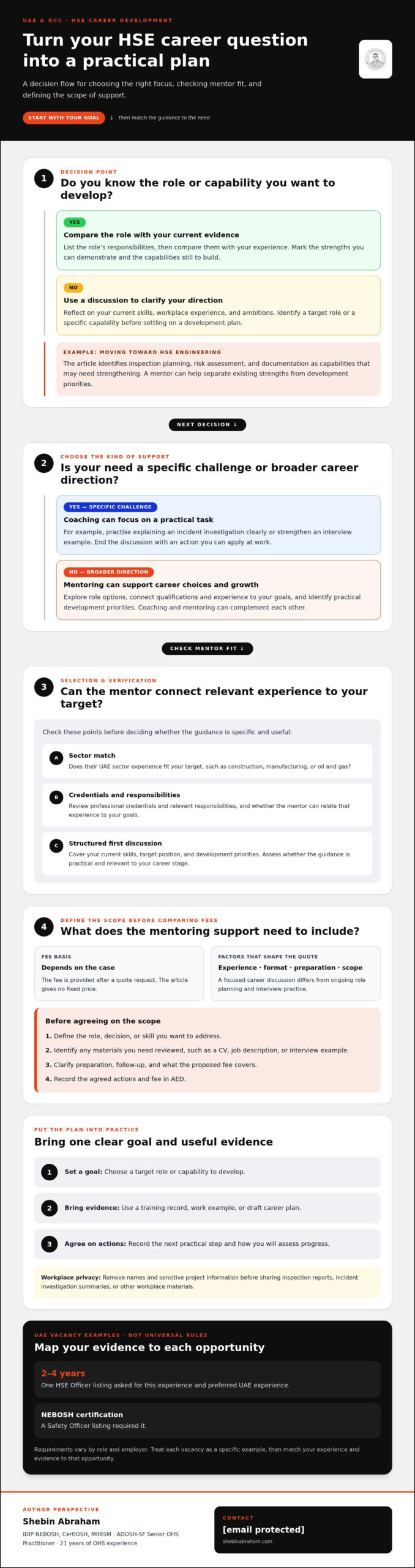
In the UAE, HSE mentoring links qualifications, workplace experience, and career decisions to practical development goals. Coaching can turn those goals into focused actions, such as preparing for supervisory responsibilities or strengthening an interview example.
Mentor Selection and Verification
Choose a mentor whose UAE sector experience matches your target role, such as construction, manufacturing, or oil and gas. Review their professional credentials, relevant responsibilities, and ability to connect experience to your goals. Ask for a structured first discussion covering your current skills, target position, and development priorities. This helps you assess whether the guidance is specific and useful.
Mentoring Costs
For UAE career mentoring, the fee depends on the case and is provided after a quote request. Cost factors include the mentor’s experience, session format, preparation, and scope of support. A focused discussion about career direction differs from ongoing help with role planning and interview practice. Define the outcome you want before reviewing the proposed scope and fee.
A practical mentoring plan starts with a clear destination. Identify a target role, then compare its responsibilities with your experience. For example, moving from an HSE Officer position toward engineering work may require stronger skills in inspection planning, risk assessment, and documentation. A mentor can help distinguish your existing strengths from capabilities to develop.
UAE job requirements vary by role and employer. One HSE Officer listing asked for 2-4 years of experience and preferred UAE experience. A Safety Officer listing required NEBOSH certification. Treat each vacancy as a specific example, not a universal rule. A mentor can help you map your evidence against the requirements of each opportunity.
Mentoring also connects daily work with professional growth. HSE leadership can involve supporting the development and performance of HSE Officers, HSE Engineers, and Road Safety Coordinators. That points to a useful career skill: explaining safe work practices clearly and supporting colleagues. Discuss examples of influencing a worksite decision, improving a process, or helping a team understand a hazard.
Keep each session focused on a concrete action. Bring a recent inspection report, incident investigation summary, or draft development plan. A mentor can help identify what your example demonstrates, where your reasoning could be clearer, and how to describe it professionally. Remove names and sensitive project information before sharing workplace materials.
- Set a goal: Choose a target role or capability to develop.
- Bring evidence: Use a training record, work example, or draft career plan.
- Agree on actions: Record the next practical step and how you’ll assess progress.
Coaching often focuses on a specific challenge, such as explaining an incident investigation clearly. Mentoring can provide a broader perspective on career choices and professional growth. The approaches can complement each other, but each discussion should end with an action you can apply at work.
This guidance reflects the experience of Shebin Abraham, an IDIP NEBOSH, CertIOSH, MIIRSM holder and ADOSH-SF Senior OHS Practitioner with 21 years of OHS experience. Apply that practical perspective to connect professional development with the responsibilities people carry on UAE worksites.
How much does HSE career mentoring cost in the UAE?
HSE career mentoring fees in the UAE depend on the support you need, not just the meeting itself. A focused discussion about your next role differs from a structured plan with CV feedback, interview practice, and follow-up. The fee depends on the case and is provided after a quote request. Scope, preparation, and the mentor’s relevant experience shape the quote. An HSE career mentor in the UAE can help define support around a specific objective.
Start by naming the outcome you want. For example, you may need help choosing between a site-based HSE Officer path and a longer-term move into management. A mentor can tailor the work to that decision. Clear goals make it easier to understand what a proposed service includes and whether it suits your needs. Write down the question you want answered before discussing the work involved.
The session format also affects the preparation required. A single discussion may focus on a specific challenge, such as explaining an incident investigation in an interview. Ongoing mentoring may involve reviewing development goals and applying feedback to new situations. Preparation time matters too, especially if you share a CV, job description, or anonymised work example beforehand.
Compare proposals by scope, not just headline fee. Check whether the discussion includes career planning, document feedback, role-specific preparation, or follow-up actions. For instance, a CV review may be separate from interview practice. A written breakdown shows what the fee covers and helps you avoid comparing different services as though they were identical.
- Clarify the goal: Define the role, decision, or skill you want to address.
- List the materials: Identify whether you need CV feedback, job-description analysis, or interview practice.
- Agree on the scope: Understand the preparation and follow-up involved.
- Keep a record: Note the agreed actions and fee in AED.
Your career stage can change the guidance you need. Someone entering the UAE market may want to present previous site experience clearly to local employers. An established practitioner may need help articulating leadership, audit, or risk-management responsibilities. These objectives call for different preparation, so outline your background and intended role when discussing the scope.
Sector focus can shape the work too. A candidate targeting construction may bring examples involving site inspections and contractor communication. Someone pursuing manufacturing roles may want to discuss operational hazards and procedures. Share the vacancy you’re considering, then identify which experience examples need attention. This keeps the mentoring discussion tied to a real career decision.
Keep the cost conversation practical. Ask for the proposed scope in writing, including preparation and follow-up. If your priority is one interview, a broad career plan may be unnecessary. If you’re weighing a sector change, a single CV edit may not address the decision. Match the support to the task, and assess its value by the clarity of the next steps.
For workplace-focused insight into how HSE responsibilities connect with professional development, explore practical HSE advisory insights. Choosing an HSE career mentor in the UAE becomes more purposeful when you bring a clear goal and defined scope to the discussion.
How can I choose and verify a qualified HSE mentor in the UAE?
Choose a mentor by matching their practical experience to your target role, then consider the evidence behind their qualifications. HSE work across the UAE varies by sector, employer, and applicable workplace framework. A structured review helps distinguish relevant career guidance from advice that stays broad or disconnected from your goals. Begin with the responsibilities you want to take on, rather than the mentor’s title alone.
Start with your own target. Write down the role, sector, or capability you want to pursue, such as moving into construction oversight or developing stronger audit skills. Then ask the mentor to explain how their experience relates to that goal. A useful answer connects real responsibilities to your development needs, rather than relying only on a job title or general claims of expertise.
Review qualifications in context. NEBOSH credentials can support HSE career development, while ADOSH-SF experience may matter for work governed by that framework. Trakhees knowledge may be relevant to roles involving its OHS requirements. These are not universal prerequisites. Their relevance depends on the role, employer, and workplace you’re targeting.
Review credentials through clear documentation. Ask to see the qualification name, awarding body, and certificate details, then use the issuing organization’s verification process. For professional memberships, check the membership designation and current status with the relevant professional body. Treat a profile description as a starting point, not the only evidence of a mentor’s professional standing.
- Check role relevance: Compare the mentor’s sector experience with your intended work.
- Review evidence: Match certificates and membership details to the mentor’s stated credentials.
- Test practical knowledge: Discuss a realistic HSE example from your target role.
- Assess the approach: Look for specific feedback and clear next actions.
Use a practical scenario to assess the mentor’s judgment. For example, ask how they would help you explain an inspection finding in an interview. A grounded response should clarify the hazard, your actions, and how you would describe the outcome. The mentor should distinguish personal experience from formal requirements, rather than present one employer’s practice as a rule across the UAE.
Discuss confidentiality before sharing workplace materials. If you plan to review an incident report or audit record, remove company names, worker details, and sensitive project information. You can then assess whether the mentor discusses professional examples without exposing private operational details. This is especially useful when your examples involve contractors or client sites.
During an introductory discussion, agree on a specific objective and a way to assess progress. For instance, you might focus on making your experience clearer for a target role. The mentor should explain how feedback supports that objective, what preparation you need, and what actions you’ll take afterward. Avoid arrangements without a defined outcome.
Finally, consider whether the mentor’s communication suits your learning needs. A technically capable practitioner may not provide useful career guidance if their feedback is unclear or generic. Bring a sample job description and an anonymised work example. Their response can show whether they understand the role and can help you present your professional experience clearly.
How can an HSE mentor help with UAE job searches, CVs, and interviews?
An HSE mentor can help you turn a vacancy into a focused application plan. Compare its requirements with your experience, qualifications, and practical examples. UAE job advertisements show that expectations vary across roles and employers. Treat each listing as a guide to that employer’s needs, not a universal career rule.
Review a vacancy before applying. Mark each requirement as a qualification, skill, responsibility, or experience. Then identify evidence from your own work for each item. For example, a role mentioning audits calls for a clear account of how you prepared, identified findings, and followed up on corrective actions.
Experience expectations vary. A listed Senior HSE Engineer role in Dubai requires 14-25 years of experience, while a listed HSE Manager role requires 5-8 years. A listed HSE Officer role in Dubai requires 3-8 years. These examples show why mentors should help you assess each vacancy individually, rather than relying on one assumed career ladder.
For CV development, make the first page easy to scan. Put relevant qualifications, sector experience, and core HSE responsibilities where recruiters can find them quickly. Match your wording to the vacancy without copying it mechanically. If the posting requests inspection experience, describe the inspections you conducted and your role in addressing findings.
Use specific evidence instead of broad claims. “Experienced in risk management” gives little detail. A stronger entry explains the work, such as contributing to a task risk assessment or monitoring control measures during a high-risk activity. Keep employer and project information confidential, and anonymise examples before sharing documents with a mentor.
An HSE mentor can help you prepare interview responses with a clear sequence: describe the situation, explain your responsibility, outline your actions, and state the outcome. For an incident investigation question, explain how you gathered information, considered root causes, and recommended corrective action. Don’t claim results you can’t support with your own experience.
Practise questions relevant to the position. A Senior HSE Engineer interview may explore HSE plan implementation, inspections, high-risk activities, training, and documentation. A manager-level discussion may focus on strategy, compliance, risk assessments, and audits. A mentor can help you prepare examples for the role’s responsibilities rather than rehearse generic answers.
- Shortlist carefully: Compare your evidence with each vacancy’s stated requirements.
- Tailor your CV: Bring relevant credentials and responsibilities forward.
- Rehearse examples: Practise concise answers grounded in real work.
- Review after interviews: Record questions that exposed skills to strengthen.
After each application or interview, note what worked and what needs attention. If recruiters repeatedly ask about a particular responsibility, prepare a stronger example before your next meeting. For practical support that connects HSE experience with UAE workplace needs, discuss your HSE career goals.
An HSE mentor can help you use sector and location details to make your search more deliberate. Arbrit Safety lists construction and manufacturing among the sectors with HSE job openings in the UAE. Use those sectors to consider where your experience may be relevant, then check the duties in each vacancy rather than assuming that similar job titles mean the same work. For an Abu Dhabi role that includes regular site inspections and audits to identify hazards and check compliance with safety regulations, prepare examples that show how you have approached inspections, recorded findings, and supported follow-up. Keep your account grounded in your own responsibilities and experience.
A listed HSE Officer role with TAQA procedures covers HSE plans, risk assessments, emergency-response training, and HSE performance monitoring. A mentor can help you map each duty to a concise example, identify where you need to explain your experience carefully, and practise answering without overstating your contribution. They can ask follow-up questions so you can clarify your decisions and the evidence behind them. Before an interview, review the vacancy and make sure your examples address its stated responsibilities. Afterward, consider which questions felt difficult and what evidence or explanation would make your next response clearer. This preparation keeps your application and interview focused on the employer’s needs while allowing you to present your work accurately.
Shebin Abraham: OHS Services
Shebin Abraham provides OHS Services for organizations seeking practical workplace health and safety support. His Freelance HSE Service can support teams with HSE responsibilities, while Freelance ADOSH-SF OHS consulting and OHS Freelancer Trakhees Consulting address relevant framework and compliance needs. Turn to these services when your career planning connects with workplace challenges, such as understanding site responsibilities or strengthening your knowledge of applicable OHS practices.
Shebin Abraham holds IDIP NEBOSH, CertIOSH, and MIIRSM credentials, is an ADOSH-SF Senior OHS Practitioner, and has 21 years of OHS experience. His perspective can help connect professional development with the practical demands of HSE work across the UAE and GCC.
To discuss OHS support relevant to your workplace, visit shebinabraham.com.
Make Your Next Career Move Deliberate
Choose one professional goal to act on next. It might be refining how you present your experience, identifying a capability to strengthen, or deciding which HSE responsibilities suit you. A written goal gives your learning and workplace decisions clear direction.
Working with an HSE career mentor in the UAE can help you examine your goals against your experience and the responsibilities you want to take on. Keep the discussion focused on practical next steps, and revisit your plan as your skills and interests develop. Career growth comes through considered decisions, applied learning, and consistent attention to the people your work helps protect.
For a conversation about your career direction and related workplace OHS needs, contact Shebin Abraham. Take the next step with care, and let your professional purpose guide the way forward.
Frequently Asked Questions
Which qualifications and certifications are most valued for HSE jobs in the UAE?
NEBOSH certification is requested in some UAE HSE job listings, while degree requirements vary by role. For example, listed roles have asked for a bachelor’s degree in engineering or a related field, or a degree in occupational health and safety. Match qualifications to the vacancy and sector you’re targeting. Practical evidence, such as conducting inspections or preparing risk assessments, can show how you apply your learning.
What should I expect from HSE mentoring sessions and career plans?
Expect sessions to focus on a defined career challenge, with practical actions to work on afterward. You might examine a job description, identify a skill to develop, or plan how to describe a workplace example clearly. A useful career plan records your goal, the steps you’ll take, and evidence of progress, such as completing relevant training or taking responsibility for a new task.
Are there HSE mentoring programs through UAE professional associations or employers?
Mentoring opportunities can depend on the employer or professional association, and may not take the form of a formal mentor-matching program. At work, development support might come from an experienced HSE colleague guiding you through a project or responsibility. Association activities may focus on professional learning and peer connections. If a formal program isn’t available to you, use a trusted senior practitioner for structured career discussions.