

Delaying an investigation until every detail is clear can mean losing useful evidence. An incident investigation consultant in the UAE should begin promptly once immediate danger is controlled, documenting the scene and gathering information while details remain fresh.
It is natural to focus first on the immediate cause, such as an unsafe act or equipment problem. A thorough investigation also examines the conditions and controls that contributed. This article explains how root cause analysis works, what a clear report should contain, and how follow-up actions can help reduce the risk of recurrence.
Written by Shebin Abraham (IDIP NEBOSH, CertIOSH, MIIRSM), an ADOSH-SF Senior OHS Practitioner with 21 years of experience in occupational health and safety.
Key Takeaways
- Begin gathering and documenting incident evidence promptly once immediate danger is controlled, while details remain clear.
- Look beyond the immediate event to underlying causes, contributing factors and failed barriers; techniques such as the 5 Whys and Fishbone diagram can support this analysis.
- Keep the investigation focused on facts and learning, not blame, so people can report concerns and help identify preventable risks.
- Make the report useful for prevention by connecting findings to corrective actions, assigning ownership and checking whether actions are effective.
- This guidance is authored by Shebin Abraham (IDIP NEBOSH, CertIOSH, MIIRSM), an ADOSH-SF Senior OHS Practitioner with 21 years of experience in OHS.
Root cause analysis
Root cause analysis examines why an incident occurred, not only what happened immediately beforehand. A missed step may be an immediate cause, while unclear instructions, inadequate training, poor equipment design or weak supervision may point to deeper causes. The investigation should distinguish immediate causes, contributing factors, underlying causes and failed barriers.
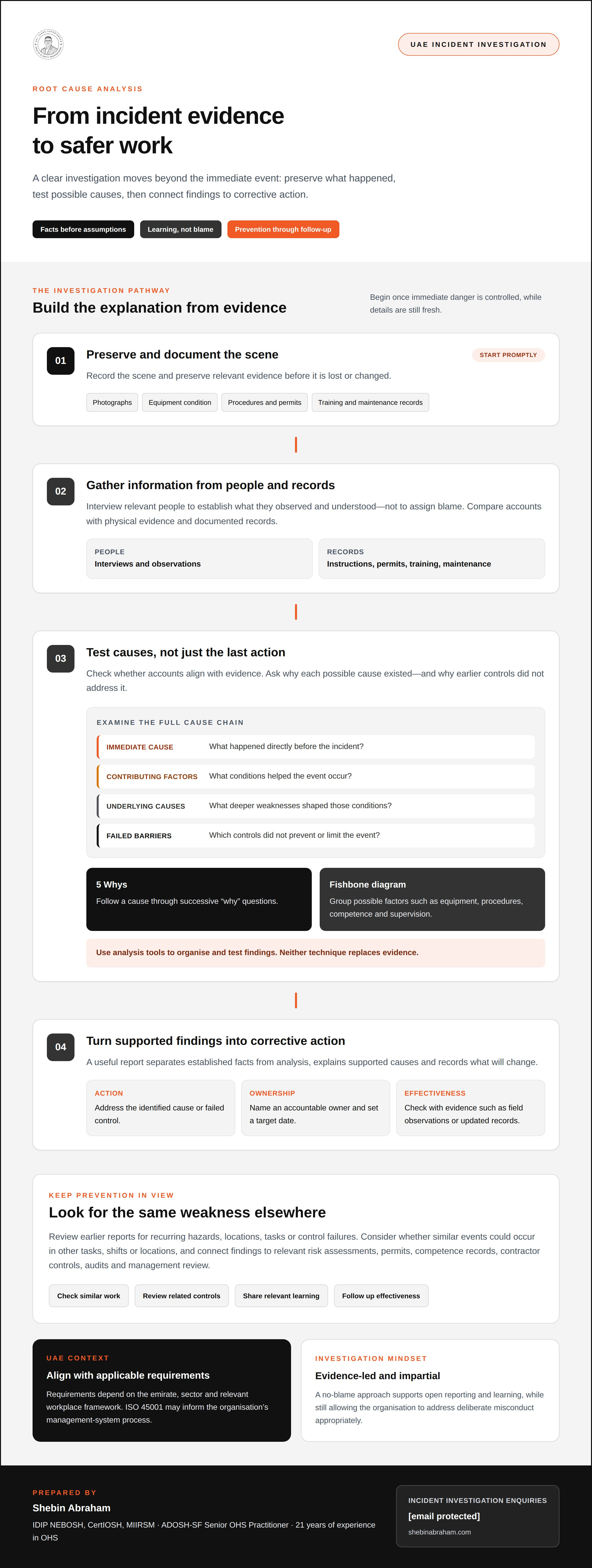
A consultant begins by preserving and documenting the scene, then gathers records and interviews relevant people. The University of Washington describes the process as covering scene preservation, information collection, root-cause determination and corrective actions. Evidence may include photographs, equipment condition, procedures, permits, training records and maintenance documents. Interviews help establish what people observed and understood, rather than assign blame.
Analysis tests whether accounts align with physical evidence and records. If a machine stopped unexpectedly, for example, investigators can compare operator interviews with maintenance history, work instructions and the equipment’s condition. They examine possible causes, asking why each existed and why earlier controls did not address it. This avoids conclusions based solely on the final action.
The 5 Whys and Fishbone diagram are two techniques used to structure analysis. The 5 Whys follows a cause through successive “why” questions; a Fishbone diagram groups possible factors, such as equipment, procedures, competence and supervision. Neither replaces evidence. Investigators use them to organise findings, test relationships and identify root causes supported by information collected.
Incident data collection also includes reviewing earlier reports for recurring hazards, locations, tasks or control failures. Trend analysis can show whether similar events involve the same procedure or contractor interface. Findings may connect to risk assessments, permits, competence records, contractor control, audits and management review, alongside ISO 45001 and ISO 14001 systems.
Choose an incident investigation consultant in the UAE by assessing practical investigation experience, evidence-handling discipline, interview skills and the ability to explain findings clearly. NEBOSH or IIRSM credentials can support a professional background, but relevant incident experience and impartial analysis matter too. In-house investigators understand site operations; an external investigator can add distance and independent scrutiny. A combined approach can retain site knowledge while challenging assumptions.
Applicable UAE requirements depend on the emirate, sector and relevant workplace framework. An investigation should be aligned with the requirements that apply to the specific operation; ISO 45001 may also inform the organisation’s management-system process. Consultants may support scene review, evidence collection, interviews, cause analysis, report preparation and corrective-action follow-up.
The fee is determined after a quote request and depends on the incident’s complexity, investigation scope, site access, evidence volume, reporting needs and follow-up work. The written report should separate established facts from analysis, explain supported causes and record actions, owners and effectiveness checks. This makes the findings usable for prevention, rather than simply a record of the event.
Preventing repeat accidents and improving safety culture
An investigation creates value when its findings change how work is controlled. Corrective actions should address identified causes and failed controls, rather than simply remind workers to be careful. If a lifting incident involved unclear signals and poor visibility, actions might address communication procedures, worksite layout and supervisory checks.
ISO 45001 requires organisations to investigate incidents, determine causes, consider whether similar events could occur and implement corrective action. That means checking whether the same weakness exists in other tasks, shifts or locations. A finding about one machine, for example, may warrant reviewing comparable equipment and maintenance controls across the organization.
Effective corrective and preventive action planning turns each recommendation into a managed commitment. Record the evidence behind the action, the control failure it addresses, an accountable owner, a target date and how effectiveness will be assessed. Revising a procedure, for example, needs a measure beyond publication: supervisors might observe whether workers follow the revised steps during the task.
- Match the action to the cause: address a design or equipment issue through an appropriate engineering or maintenance change, not training alone.
- Assign ownership: name the role responsible for delivery and provide authority to complete the work.
- Set a target date: prioritize actions according to the risk and operational circumstances.
- Check effectiveness: use evidence such as field observations, updated records or reviews of similar events.
Training can be an effective action when an investigation identifies a competence gap. It is not a complete fix if workers understood the procedure but faced conflicting instructions, unsuitable equipment or production pressure. The action plan should address those factors too, then confirm that workers can apply the training in the actual work environment.
Safety culture affects whether people report hazards and near misses before another accident occurs. A no-blame approach encourages open reporting, while still allowing the organization to address deliberate misconduct appropriately. Investigators can explain that the purpose is learning and prevention, then share relevant findings with affected teams without disclosing unnecessary personal details.
Follow-up keeps actions from ending with a closed report. Review overdue commitments, inspect completed controls and reopen an action if evidence shows the risk remains. If a revised traffic route still creates conflict between vehicles and pedestrians, the organization needs further assessment, not a paper closure.
For practical support connecting investigation findings with workplace controls, explore OHS services. Consistent follow-up helps make prevention part of daily work, not merely a response to the last incident.
How Quickly Should an Incident Investigation Start?
Begin the investigation once immediate danger is controlled and affected people have necessary support. Early action helps preserve the scene before equipment moves, records change or routine work resumes. For example, identify a damaged lifting accessory and protect it from further use while documenting its condition. Prompt evidence preservation gives later analysis a more reliable basis.
Investigators should establish the event sequence first: what happened, where, during which task and under what conditions. They can compare witness accounts with work instructions, equipment records and site observations. If accounts differ, record the discrepancies rather than forcing a single explanation. A timeline helps identify when conditions changed and which barriers were expected to prevent the event.
Classifying causes prevents an investigation from stopping at the last visible action. An immediate cause describes the direct event, such as a load shifting during a lift. Contributing factors may include restricted visibility, unclear signals or unsuitable equipment. Underlying causes can involve planning, supervision, procedures or competence. Investigators then identify which controls failed or were absent.
- Immediate causes: the direct action or condition connected to the event, such as a slipping load.
- Contributing factors: surrounding conditions, such as poor visibility or conflicting work activity.
- Underlying causes: system weaknesses, such as incomplete lift planning or unclear responsibilities.
- Failed barriers: controls that should have prevented the event or limited its consequences.
Causes vary by incident type. A vehicle collision may involve route design, visibility and traffic separation; a hand injury may involve guarding, tool condition and task instructions. The investigator tests each factor against evidence. “Human error” alone does not explain why an action seemed reasonable at the time or why the work system allowed it.
Investigation duration depends on incident severity, evidence volume, technical analysis and access to people or equipment. A contained event with clear records may need less analysis than a complex equipment failure involving several teams. Complete the report when the evidence supports clear findings, rather than simply to meet an arbitrary deadline.
Timeliness also matters for worker confidence. Explain the investigation’s purpose, protect relevant records and arrange interviews while recollections remain useful. If new evidence changes the event sequence, revisit earlier assumptions and update the cause analysis. This disciplined approach helps ensure corrective actions address the conditions behind an incident, not just its visible outcome.
Investigators should look beyond immediate causes, such as human error or failure to follow a procedure, and identify underlying causes. Consider equipment, procedures and training as possible contributing factors instead of assuming that the visible action explains the event.
When investigators identify an issue, they should ask why it existed and why it had not been addressed earlier. These questions help distinguish a direct failure from weaknesses in the work system and clarify what the investigation needs to explain.
Incident and accident investigation processes
A structured investigation gives participants a clear path from event notification to documented findings. It begins by securing relevant information and defining the event’s scope. The University of Washington describes the process as scene preservation and documentation, information collection, root cause determination and corrective actions. Each stage should leave a traceable record for reporting and follow-up.
In workplace practice, an accident usually describes an event resulting in harm or damage. An incident can also include a near miss, where harm did not occur but could have. Organizations may use these terms differently, so reports should describe the event, its consequences and potential risk rather than relying on the label alone.
Fact-finding, not fault-finding, should guide interviews and evidence review. Participants may include workers, supervisors, contractors and technical specialists with direct knowledge. Investigators compare accounts with available records and physical evidence, then note where information agrees or differs. This helps avoid premature conclusions and supports a thorough, impartial account.
A practical investigation sequence can include:
- Define the scope: establish the event, work activity, location and questions the investigation must answer.
- Preserve relevant evidence: document the scene and identify records, equipment or materials that need examination.
- Gather information: interview relevant participants and review procedures, permits, maintenance records or other applicable documents.
- Analyse findings: test possible explanations against evidence and identify contributing conditions and control failures.
- Report and follow up: record supported findings, recommendations, action owners and effectiveness checks.
Advanced investigations require methods suited to the event’s technical character. NFPA 921 is used as a reference for scientific-based investigation and analysis of fire and explosion incidents. API RP 585 is used as a case study for pressure equipment integrity incident investigation. These references address distinct technical contexts; they are not interchangeable templates for every workplace event.
Reports should distinguish verified facts, participant accounts, analysis and recommendations. For example, a fire report should separate observed damage from conclusions about how ignition occurred. This clarity helps decision-makers understand which findings rest on direct evidence and which reflect the investigators’ reasoning.
Impartiality can be especially valuable when reporting lines, contractor relationships or operational pressures may affect confidence in the findings. An external investigator can provide independent scrutiny, while in-house participants contribute essential workplace knowledge. A coordinated investigation can combine that context with disciplined evidence review, helping the organization act on findings and reduce recurrence.
Incident investigation reporting
A useful incident report turns evidence into a clear operational record. It should explain what happened, what the investigation established and what needs attention. For example, a report about a dropped load should distinguish observed damage from interview accounts and analytical conclusions. This helps readers assess the basis for each finding and act on workplace safety concerns.
An incident investigation consultant can manage reporting from initial notification through final review. Begin by recording the event’s date, location, task and known consequences. Then track evidence sources, interviews and outstanding information. If a maintenance record conflicts with an operator’s account, describe the discrepancy and how it was assessed instead of hiding uncertainty behind a simple conclusion.
Before drafting, the investigator organizes findings into a sequence readers can follow:
- Event summary: state the work activity and confirmed outcome.
- Evidence reviewed: identify relevant records, observations and participant accounts.
- Analysis: explain how evidence supports the findings and cause conclusions.
- Recommendations: connect each proposed action to a finding or control weakness.
- Follow-up: record action ownership, target dates and effectiveness checks.
Good reporting avoids presenting assumptions as facts. If one witness recalls a warning signal but another participant did not hear it, preserve both accounts. Then explain whether equipment logs, site layout or other evidence supports either interpretation. This makes the reasoning transparent and gives decision-makers a sound basis for operational improvements.
Reports should serve their audience. Senior managers may need a concise summary of risk and decisions required, while supervisors need practical detail about affected tasks and controls. Workers benefit from a clear account of relevant learning. A training record, for example, may show what instruction was provided, but should be considered alongside how the task was actually performed.
Trend analysis can add value beyond a single report. Categorizing events by task, equipment, location or control weakness can reveal patterns across workplace records. Repeated concerns involving access routes, for instance, may point to a wider operational issue. Use consistent categories so later reviews can compare events meaningfully, while protecting personal details that are not needed for prevention.
Set a defined review route before a report is finalized. The responsible manager can confirm factual details, assign actions and track overdue items. A consultant can help develop a report that is readable, evidence-based and connected to follow-up. Discuss incident investigation reporting support when your organization needs clearer findings and practical next steps.
Shebin Abraham: OHS Consultant -Dubai
Shebin Abraham can help organizations turn incident findings into practical reporting and follow-up. As a trusted incident investigation consultant UAE, he supports workplace health and safety through specialized OHS Services and Freelance HSE Service. Turn to him when an investigation needs clear cause analysis, an evidence-based report or structured advice on corrective actions.
For organizations working within Abu Dhabi’s occupational safety framework, Shebin Abraham provides Freelance ADOSH-SF OHS consulting to support relevant compliance needs across the Emirates. The focus is practical: connect investigation findings with workplace controls, responsibilities and follow-up so teams can act on lessons learned.
Contact Shebin Abraham to discuss your incident investigation and reporting needs.
Carry investigation learning into future work
An investigation can shape more than the response to one event. Use its lessons to inform future work planning, contractor coordination and operational changes, so emerging risks are considered before tasks begin. This keeps safety learning connected to real decisions rather than confined to a report.
When your organization needs support turning an incident into clear, practical guidance, an incident investigation consultant in the UAE can bring independent focus to the investigation and its follow-through. Shebin Abraham’s OHS work includes OHS Services, Freelance HSE Service and Freelance ADOSH-SF OHS consulting, supporting organizations with workplace health and safety needs.
Contact Shebin Abraham about investigations to discuss the support your situation calls for. Thoughtful learning from an incident can help teams make safer decisions as work evolves.
Frequently Asked Questions
How Can an Incident Investigation Consultant Support the Immediate Response to a Workplace Incident?
An incident investigation consultant can coordinate evidence preservation and organize a clear record after immediate safety needs are addressed. For example, the consultant can identify relevant equipment, arrange separate interviews and record which documents should be retained. This keeps the later review grounded in timely information. The consultant supports investigation and reporting; urgent medical assistance and emergency response should be handled through the appropriate emergency arrangements.
What steps should a UAE incident investigation consultant follow?
An incident investigation consultant in the UAE should agree the scope with the organization, document the event, gather relevant records, interview participants and assess evidence before preparing findings. The consultant should distinguish confirmed information from unresolved points and link recommendations to the evidence. For example, a report about damaged equipment can identify the inspection or maintenance records used to reach its conclusions, helping managers understand what the investigation supports.
Which UAE firms offer incident investigation consulting, and where do they operate?
Shebin Abraham provides occupational health and safety consulting for organizations in the UAE and GCC. His relevant services include Freelance HSE Service and Freelance ADOSH-SF consulting. He can assess an incident, develop investigation documentation or advise on follow-up. The appropriate scope depends on the operation, applicable workplace framework and support required.
What evidence and documents are needed for an incident investigation in the UAE?
Relevant evidence depends on the event and can include photographs, equipment details, work instructions, inspection or maintenance records, permits, training records and witness accounts. For a contractor-related event, task coordination and site communication records may also help explain how work was organized. Preserve original records where possible, note their source and record when they were collected so the investigation can trace how each finding was reached.
What legal and safety risks arise from mishandling an incident investigation in the UAE?
A poorly managed investigation can leave hazards unaddressed, weaken corrective actions and produce a report that does not explain the evidence behind its conclusions. Incomplete records or inconsistent accounts can also make it harder for an organization to show how it reviewed an event and responded. Compliance implications depend on the workplace and relevant framework, so investigation records should be accurate, controlled and connected to operational follow-up.