

Workers’ housing safety is part of responsible HSE oversight, not a side issue. A monthly HSE support package in the UAE can include regular attention to accommodation health and safety, alongside the compliance needs relevant to your operations.
You’re right to expect more than occasional advice. The value lies in practical, consistent support that helps keep risks visible and follow-up organised. This article explains what monthly support can include, how it can address workers’ housing and DHA and HAAD compliance needs, and what shapes the scope for each organisation.
We’ll look at the work involved, from accommodation checks and risk follow-up to HSE records and ongoing guidance, without treating every workplace as if it has the same needs. The article is informed by Shebin Abraham, an ADOSH-SF Senior OHS Practitioner with 21 years of experience in occupational health and safety.
Key Takeaways
- Assess whether your HSE workload calls for a full-time officer, outsourced support, or a combination shaped around your operations.
- Expect the scope of monthly support to reflect your workforce, industry risks, workers’ accommodation, and relevant compliance needs.
- Understand how a consultant’s qualifications and applicable approvals relate to the work they will perform.
- Compare service agreements by their defined activities, reporting, follow-up, and responsibilities, not just the monthly fee.
- For ADNOC prequalification needs, identify how dedicated support can help address the HSE requirements involved.
Do UAE businesses need a full-time HSE officer or can they outsource HSE support?
A full-time HSE officer is not the only way to organise workplace safety support. Outsourcing can suit a business with defined advisory, inspection, documentation, and follow-up needs. A dedicated employee may be more practical where operations require frequent on-site coordination and immediate internal decisions. The choice depends on the work, its risks, and the support needed between visits, not simply on headcount.
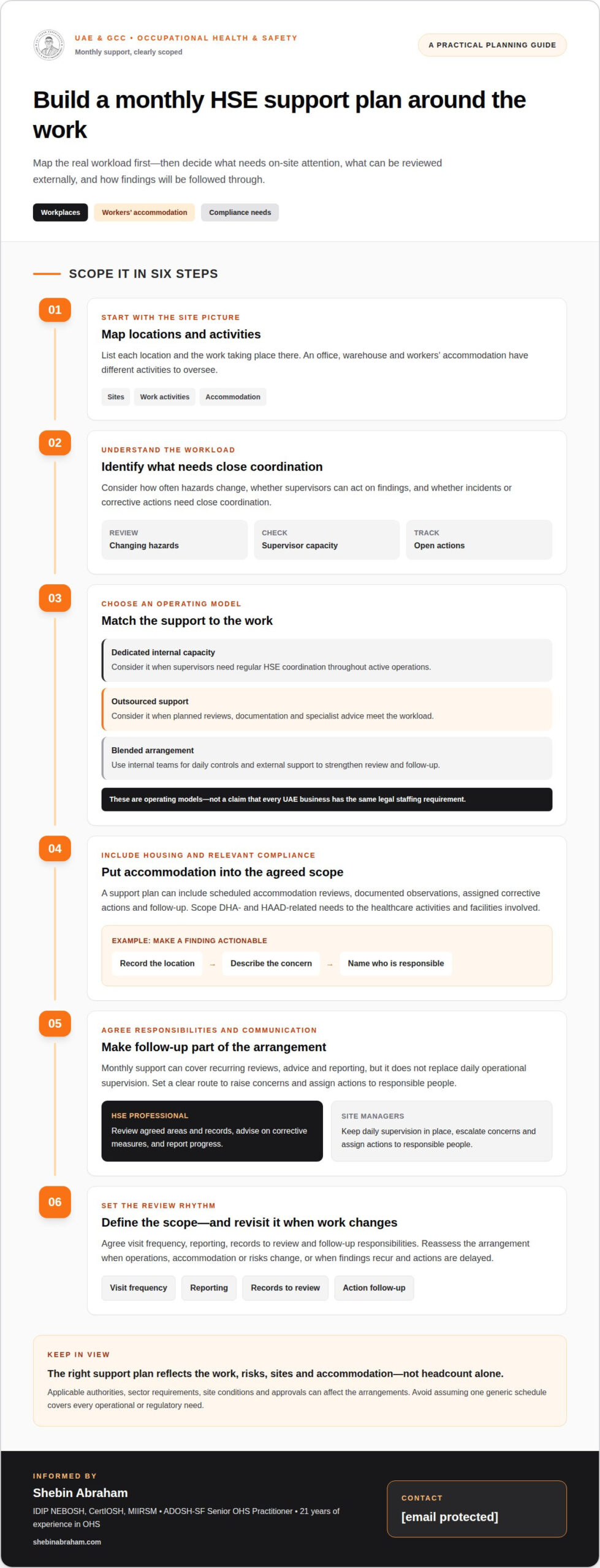
Start by mapping the work at each location. A business with an office, warehouse, and workers’ accommodation has different activities to oversee at each site. Consider whether hazards change often, whether supervisors can act on findings, and whether incidents or corrective actions need close coordination. These details help define what requires on-site attention and what scheduled external support can provide.
For employers providing workers’ housing, accommodation conditions are an important part of HSE planning. A support arrangement can include scheduled accommodation reviews, documented observations, assigned corrective actions, and follow-up. For example, if an inspection identifies a maintenance concern, the report should record its location and clarify who is responsible for addressing it. Include housing reviews alongside workplace activities in the agreed scope.
Outsourcing works best when responsibilities and communication are clear. A monthly HSE support package in the UAE can cover recurring activities, but it does not replace daily operational supervision. The professional can review records, assess agreed areas, advise on corrective measures, and report progress. Site managers still need a clear route to escalate concerns and assign actions to responsible people.
- Choose dedicated internal capacity when supervisors need regular HSE coordination throughout active operations.
- Consider outsourced support when planned reviews, documentation, and specialist advice meet the workload.
- Use a blended arrangement when internal teams manage daily controls and external support strengthens review and follow-up.
These are operating models, not a claim that every UAE business has the same legal staffing requirement. The relevant authority, sector, activities, site conditions, and applicable approvals can affect the required arrangements. DHA and HAAD-related compliance needs should be scoped to the healthcare activities and facilities involved. Do not assume one generic HSE schedule covers every regulatory or operational requirement.
Before setting the scope, provide an accurate picture of your sites, activities, accommodation, existing procedures, and open actions. The professional can then define visit frequency, reporting, records to review, and follow-up responsibilities. If a warehouse adds a new process, for instance, the support plan may need to address the changed activity rather than repeat an unchanged checklist.
Review the arrangement as operations change. New accommodation, altered work activities, recurring findings, or delayed corrective actions may indicate that the balance between internal and outsourced support needs adjustment. The aim is a workable system: people on-site know how to raise concerns, managers can assign actions, and HSE advice reaches the right decision-makers in time.
Budget planning can also take account of Dubai’s business support measures, while keeping them separate from decisions about the level of HSE coverage a site needs. Dubai’s AED 1 billion business support package was scheduled to roll out from 1 April over the next three to six months, and was intended to stimulate business for three to six months. It includes a Three-month postponement of various government fees, and Dubai businesses could defer selected government administrative, registration, and renewal fees for 90 days. Any expected cash-flow relief can inform when a business schedules advisory reviews or documentation work, but it does not replace daily supervision or the need to address hazards promptly.
Dubai’s Community Development Authority offers one-time assistance of up to AED 50,000 for medical treatment and education facilities. This is a separate form of assistance, so businesses should not assume it will cover HSE staffing or workplace safety services. For any outsourced arrangement, agree the scope, reporting route, and action owners in advance, then review whether the support remains suitable as operations and risks change. Budget measures may affect timing; they do not determine the appropriate operating model.
HSE Support Packages by Size and Industry in the UAE
Company size matters, but headcount alone cannot define an HSE support scope. A smaller business with several locations may need more coordination than a large, single-site office. A useful monthly plan reflects work activities, site access, operating shifts, contractor involvement, and existing safety processes. These factors shape the review and follow-up required.
For a small professional office, support may focus on core risk reviews, incident records, staff guidance, and corrective-action tracking. A growing company with a warehouse and accommodation must also consider operational areas, storage activities, vehicle movement, and living conditions. Identify the locations and activities covered, then set clear reporting and follow-up arrangements for each.
Construction projects need attention to changing work fronts, contractors, site coordination, and task-specific risks. Conditions can shift between inspections as work progresses. A monthly service should clarify how site reviews relate to changing activities and how findings reach project managers. For a contractor working across multiple sites, visit planning and consistent records help link observations to the right project.
Manufacturing and warehousing have different priorities. A factory may need reviews of equipment-related work, maintenance coordination, and process changes. A logistics facility may need more attention to loading areas, vehicle routes, and storage practices. In both cases, the package should reflect actual operations rather than apply an identical checklist to every business.
Healthcare organisations also need a scope suited to their facilities and activities. A clinic may require a different review emphasis from a hospital or support facility. Where DHA or HAAD requirements apply, coordinate HSE support with the relevant compliance responsibilities. Identify the facilities, records, operational interfaces, and reporting routes in the scope.
Workers’ accommodation adds a distinct workstream. A business providing housing can include accommodation reviews, recorded observations, assigned corrective actions, and follow-up in its package. For example, record a finding at a shared facility against its location and assign it for action. The scope should identify the facilities covered and how observations are documented for responsible managers.
- Map the operating footprint: list locations, shifts, activities, contractors, and accommodation requiring support.
- Set industry priorities: connect the review plan to actual hazards and operational changes.
- Define outputs: specify inspections, records, reporting, and corrective-action follow-up.
- Revisit scope after changes: add new sites, processes, or accommodation to the review plan.
This structure makes a monthly HSE support package in the UAE specific to the organisation’s work, rather than its size alone. A practical scope also shows what the professional reviews and what managers must action. For industrial businesses facing ADNOC prequalification requirements, the relevant HSE documentation and support needs form a separate consideration. Explore HSE support options when defining the work needed for your operations.
What qualifications and approvals should a UAE HSE consultant or provider have?
Match qualifications to the work rather than relying on a title alone. An office-based risk review, construction-site oversight, and accommodation assessment involve different operational needs. The professional should explain how their education, training, and experience relate to the activities in your scope. For a site with contractors, relevant experience includes coordinating observations and communicating corrective actions clearly.
Separate professional credentials from regulatory or client approvals. A qualification describes education, training, or professional standing; an approval may relate to a specific authority, site, or assignment. Requirements depend on the activity and the organisation’s applicable framework. Identify which requirements apply to the defined work, and do not treat one credential as universal approval for every UAE project.
Ask the professional to connect their experience to your operational risks. For a warehouse, that might mean explaining their approach to site observations, records, and action follow-up. For workers’ accommodation, the scope should address the facilities and health and safety matters being reviewed. For healthcare work, consider DHA and HAAD compliance needs in relation to the relevant activities and facility requirements.
Approval expectations can differ between projects and operating environments. Clarify the scope of any required approval, who it relates to, and whether it applies to the consultant, the company, or the specific assignment. For example, site access approval is not the same as evidence of technical competence. Clear distinctions help prevent misunderstandings when responsibilities are agreed.
Credentials also need practical application. A qualified professional should explain how findings become usable reports, assigned actions, and follow-up records. If a monthly review identifies a recurring maintenance issue, the report should make the location and next action clear to the responsible manager. Technical knowledge matters most when it informs decisions and supports consistent worker protection.
- Relevant education and training: show how they relate to the work in the agreed scope.
- Applicable professional standing: describe the credential accurately, without implying broader authority.
- Relevant experience: connect previous work to the industry, activities, and site conditions involved.
- Approval clarity: distinguish professional qualifications from project, site, or authority requirements.
- Practical outputs: explain how inspections, advice, records, and corrective-action follow-up are handled.
Shebin Abraham holds IDIP NEBOSH, CertIOSH, and MIIRSM credentials, and is an ADOSH-SF Senior OHS Practitioner with 21 years of OHS experience. These details describe his professional background; they should not be read as blanket approval for every project or authority. For any UAE engagement, the scope and applicable requirements determine what evidence and approvals are relevant.
Use these distinctions when defining a monthly HSE support package in the UAE. A sound agreement identifies the assigned professional, relevant qualifications, scope of work, reporting outputs, and any project-specific approval requirements. This gives management a clear basis for understanding who provides advice, what work is covered, and how findings are followed through.
Before appointing a provider, record the agreed deliverables, reporting route, and person responsible for accepting each action. Ask how the professional communicates limitations, escalates urgent findings, and tracks unresolved items. Confirm that any claimed approval applies to the specified scope, and keep its evidence with the engagement records. This makes competence and authority easier to assess throughout the work.
How can businesses compare UAE HSE support providers and service agreements
Compare the work each agreement commits to, not just its title. One proposal may include site reviews, while another focuses on advice and records. For a warehouse operating anywhere in the UAE, the scope should identify covered locations, activities, reporting outputs, and follow-up processes. This makes differences visible before responsibilities begin and helps managers assess whether each proposal addresses their actual operations.
Start with the proposed scope. Check whether it names each site, relevant operations, and the records the professional will review. A company with workers’ accommodation needs clarity about whether housing is included alongside workplace locations. Address DHA or HAAD-related requirements where they apply to the organisation’s activities and facilities. Any monthly HSE support package should make these inclusions clear in writing.
Next, compare the deliverables. Useful outputs can include inspection records, written observations, action tracking, and management updates. The agreement should explain how findings are recorded, who receives them, and how open actions are followed up. If an inspection identifies a recurring maintenance issue, the report should help managers understand its location, required action, and status. Clear outputs make findings easier to use in operational decisions.
- Scope: name the sites, activities, and records covered.
- Visits: define the planned review cadence and any site access arrangements.
- Reporting: state the expected records, recipients, and reporting method.
- Follow-up: clarify how findings and outstanding actions are tracked.
- Responsibilities: distinguish the consultant’s work from management decisions and operational controls.
Provider experience should fit your operating environment. A construction contractor may need support that understands changing project activity and contractor coordination. A clinic may have different documentation and facility considerations. Ask the provider to explain how the proposed approach addresses your actual work, rather than relying on broad claims of industry experience. Relevant examples should show how the consultant’s methods fit the activities in your scope.
Review the agreement’s boundaries, too. It should distinguish scheduled advisory work from daily supervision, emergency response, or tasks assigned to internal managers. For example, a monthly report can document an action, but the agreement should clarify who within the organisation arranges maintenance. Clear ownership prevents findings from remaining unresolved between review visits and supports accountable follow-through.
Compare communication and change-control terms. A new site, process, contractor, or accommodation facility can alter the work required. The agreement should describe how changes to scope are discussed and recorded. It should also identify the normal route for sharing reports and raising operational concerns, without implying a response time or availability the agreement does not promise. A monthly HSE support package UAE organisations use should describe how evolving needs are handled.
Finally, assess whether the proposed records support management decisions. A useful report links observations to locations, responsible roles, and follow-up status. If ADNOC prequalification is relevant, define its documentation needs as a scope item rather than assume ordinary HSE reporting addresses them automatically.
Before signing, request a written scope covering sites, activities, deliverables, communication, responsibilities, and changes. Discuss your HSE support requirements to shape a service agreement around your operations.
Shebin Abraham: ADNOC HSE Prequalification Support
Shebin Abraham provides ADNOC HSE Prequalification Support for businesses preparing or strengthening their HSE prequalification materials. Turn to this service when your organisation needs focused guidance on the HSE documentation and requirements involved in an ADNOC prequalification process.
This support helps organise relevant HSE information for a clearer submission. It can also connect with broader OHS Services or Freelance HSE Service when your business needs ongoing workplace safety support alongside prequalification preparation. The right scope depends on your operational context and the support required.
If you’re preparing for ADNOC HSE prequalification, contact Shebin Abraham to discuss your requirements.
Turn Your HSE Priorities Into a Practical Plan
Your next step is to turn operational priorities into a clearly scoped working arrangement. Identify what your team needs from a monthly HSE support package in the UAE, then align the service with the decisions and follow-up your organisation can sustain. A useful discussion starts with your sites, activities, workforce, and current HSE priorities.
Shebin Abraham provides OHS Services, Freelance HSE Service, and Freelance ADOSH-SF consulting. These services support organisations seeking professional input on workplace safety and relevant compliance needs. The focus is on understanding the work involved and defining a suitable scope, rather than applying the same arrangement to every business.
Build a working relationship around clear communication, practical advice, and responsibilities your managers can act on. This keeps health and safety connected to everyday operations and the people affected by them.
Contact Shebin Abraham to discuss your HSE needs, and take the next step toward a support arrangement that fits your organisation.
Frequently Asked Questions
What does the package include?
The package covers HSE activities agreed for your operations, rather than a fixed set for every organisation. Its scope may include risk assessments, compliance assessments, HSE documentation, or advice on workplace safety procedures. For example, a business updating a work process may need the assessment and supporting documentation to address that change. The written agreement should identify included activities and distinguish them from work outside the agreed scope.
What does a monthly HSE support package in the UAE typically include?
A monthly HSE support package in the UAE can be tailored to an organisation’s sites, operations, and applicable requirements. It may bring together scheduled reviews, practical advice, documentation support, and action follow-up. For a business with workers’ accommodation, the agreed scope can cover housing conditions alongside workplace operations. For a regulated facility, it can also identify relevant compliance documentation needs without assuming every requirement applies to every organisation.
What deliverables and site visits are included in a UAE HSE support contract?
The contract should define its site visits and written outputs, including which locations are covered and how observations are documented. Completed audit and inspection reports are delivered within 48 hours and include photographic evidence, a risk-categorised non-conformance register, root-cause analysis, and a corrective-action plan with owners and target dates. The agreement should also clarify how visit findings are communicated and how the organisation tracks assigned actions after receiving each report.
Which factors affect UAE monthly HSE support package pricing?
Scope and pricing depend on the workforce, industry risks, sites and activities, operating shifts, contractor involvement, workers’ accommodation, applicable compliance needs, and the inspections, records, reporting, and follow-up required.