

Yes. A short-term project can use dedicated HSE support alongside risk assessment and compliance guidance. OHS consulting in the GCC helps match support to project hazards, work stages and the requirements that apply in the UAE.
It’s reasonable to seek practical coverage without building a permanent team around a temporary workload. Match competent HSE support to site activities, then connect risk controls, incident learning and emergency arrangements to the way work is actually carried out.
This article explains what consulting support can cover, how risk assessments and incident investigations work, and how UAE requirements shape compliance planning. It also outlines what to consider when defining project HSE staffing and emergency plans. Shebin Abraham (IDIP NEBOSH, CertIOSH, MIIRSM), an ADOSH-SF Senior OHS Practitioner with 21 years of experience in OHS, brings UAE and GCC experience to the subject, with a focus on practical guidance that protects people and supports steady operations.
Key Takeaways
- Match project HSE staffing to the work phase, site hazards and operational demands, including when short-term support is needed.
- Build risk assessments around real tasks and exposure, then use the findings to guide practical controls and review priorities.
- Use incident investigations to identify contributing factors and strengthen prevention, rather than stopping at the immediate cause.
- Plan compliance around the rules that apply to the specific UAE emirate, sector and project, since GCC requirements differ.
- Understand how project scope, risk level, duration and support needs shape consulting costs before defining the engagement.
Occupational health and safety consultancy in the UAE and Gulf countries
Occupational health and safety consulting helps organizations turn applicable requirements into clear responsibilities and workable site practices. In the UAE and wider GCC, start by defining where work takes place, which activities are involved and who must apply the controls.
OHS Frameworks Across the UAE and GCC
Requirements differ between countries and can vary by sector, regulator and project conditions. A consultant should map them to the organization’s actual activities, then identify which procedures, records and employee briefings need attention.
For cross-border operations, separate country-specific obligations from shared corporate processes. This supports consistent management practices without assuming that procedures from one country automatically apply elsewhere. Document the rationale for each requirement and assign responsibility for keeping the relevant process current.
Consultant Qualifications and HSE Management
Review a consultant’s occupational health and safety qualifications alongside experience relevant to the assignment. Check that their skills match the work, such as developing procedures, supporting training or reviewing site controls. Credentials can show formal learning, while examples of applied work help demonstrate how that knowledge supports operations.
Effective health, safety and environmental management connects leadership responsibilities with employee participation. Consider how the consultant will help teams communicate hazards, record actions and apply lessons to work planning. Training should address employees’ actual tasks and the procedures they need to follow, rather than relying on generic awareness alone.
Expertise, Industry Coverage, and Local Presence
Compare consultants by the hazards and working conditions they understand, not just broad sector labels. For construction, they should be able to discuss contractor interfaces and changing work areas. Manufacturing assignments may require closer attention to equipment, maintenance and production routines.
Local knowledge helps consultants interpret requirements in context and communicate with the people responsible for applying them. For national or cross-border operations, clarify how site information will be gathered, how findings will reach managers and how follow-up will work. These details help determine whether the approach suits your organization.
Service Costs and Consultant Selection
To compare consulting costs fairly, define the expected work and compare proposals with equivalent deliverables. Clarify what the consultant will assess, document or support, and how additional work will be handled if project needs change.
When selecting and hiring an OHS consultant in the GCC, prepare a brief outlining the assignment’s purpose, activities and intended outcomes. Discuss who will provide site information, approve recommendations and review progress. A clear agreement keeps both parties focused on the required work and gives the organization a practical basis for evaluating the engagement.
Qualitative and quantitative risk assessments
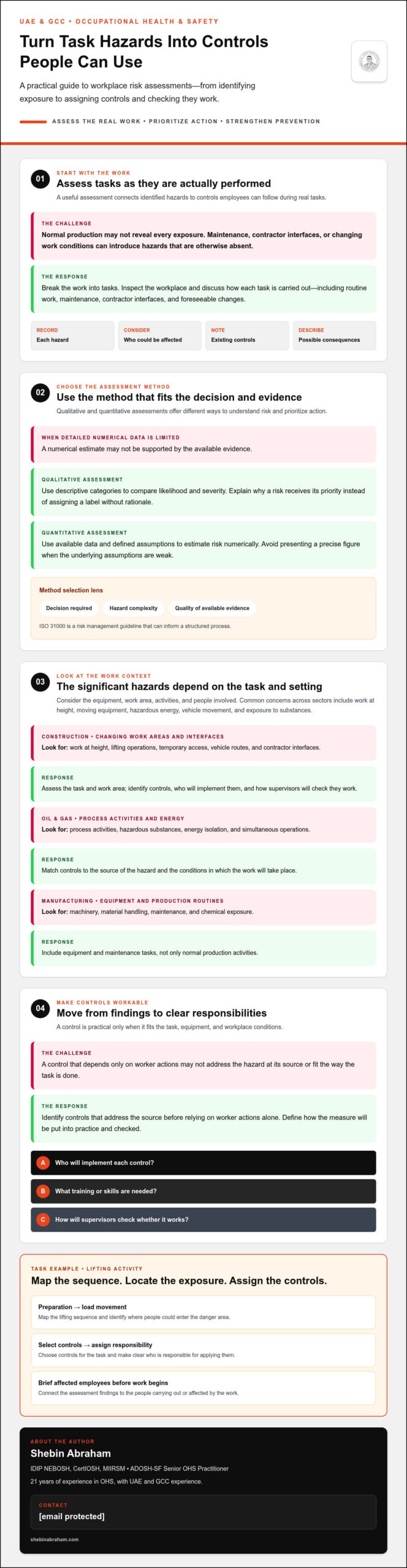
A useful workplace assessment links identified hazards to controls employees can follow during actual tasks. Qualitative and quantitative methods offer different ways to understand risk, prioritize action and support safer operations.
In construction, oil and gas, and manufacturing, common concerns include work at height, moving equipment, hazardous energy, vehicle movement and exposure to substances. The most significant hazards depend on the task, equipment, work area and people involved.
Hazard Identification and Risk Assessment
Start by breaking work into tasks, then inspect the workplace and discuss how each task is performed. Include routine activities, maintenance, contractor interfaces and foreseeable changes. For example, maintenance may introduce access or isolation hazards that are absent during normal production.
Record each hazard, who could be affected, existing controls and the possible consequences. A qualitative assessment uses descriptive categories to compare likelihood and severity. ISO 31000 is a risk management guideline that can inform a structured process. The assessment should show why a risk received its priority, not just assign a label.
Risk Controls Across GCC Industries
Construction assessments can examine work at height, lifting operations, temporary access and vehicle routes. Oil and gas reviews may consider process activities, hazardous substances, energy isolation and simultaneous operations. Manufacturing assessments can focus on machinery, material handling, maintenance and chemical exposure.
For each hazard, identify controls that address the source before relying on worker actions alone. Define who will implement each measure, what training or skills are needed and how supervisors will check whether it works. A control is practical only if it fits the task, equipment and workplace conditions.
Qualitative assessments help teams prioritize when detailed numerical data is limited. Quantitative assessments use available data and defined assumptions to estimate risk numerically. Choose the method according to the decision required, hazard complexity and quality of available evidence. Avoid presenting a precise figure when the underlying assumptions are weak.
For example, a site team reviewing a lifting task can map the sequence from preparation to load movement and identify where people could enter the danger area. It can then select controls, assign responsibilities and brief affected employees before work begins. This task-based approach makes findings easier to apply than a general workplace checklist.
Keep assessments connected to operations. Review them when equipment, materials, personnel or work methods change, and after inspections or incident findings reveal a control gap. Record the reason for each update so supervisors understand what changed and employees receive relevant information or training.
For practical support with workplace hazards and control measures, explore OHS risk assessment support as part of a planned safety program.
Accident and incident investigation
A dropped load, equipment failure or near miss can reveal gaps in work planning. A structured investigation helps teams understand what happened, protect affected people and prevent similar events. The aim is to learn, not to assign blame before the evidence is clear.
Begin with an immediate response and preserve the scene. Assist affected people under established site arrangements, secure the area and prevent further exposure. Record the location, equipment condition, materials involved and work activity. For example, after a material-handling near miss, capture the load position and route before normal operations resume.
Use a consistent sequence to gather evidence and build the analysis:
- Establish the event timeline using work records, permits, task instructions and available equipment logs.
- Speak with witnesses separately, using open questions about what they saw, heard and did.
- Inspect the equipment and work area for damage, obstructions, labels and control conditions.
- Compare actual work with the planned method, including changes, handovers and contractor interfaces.
- Record confirmed facts separately from assumptions, and identify evidence that supports each finding.
Root cause analysis looks beyond the immediate event. A worker slipping may directly cause a fall, while a wet walkway, poor drainage or an ineffective inspection process may contribute. Test each possible factor against evidence. Avoid conclusions based only on memory or a single witness account.
In UAE and GCC workplaces, investigations should reflect the activity and site context. A vehicle near miss on a construction project calls for reviewing traffic routes, visibility, pedestrian separation and communication. A machinery incident in manufacturing may require examining guarding, maintenance records, isolation practices and task instructions. Let the evidence determine which controls need attention.
Investigation findings should lead to assigned actions, not just a report. Specify the control to improve, the responsible role and how completion will be reviewed. If the investigation identifies a gap in safety training or hazard awareness, revise the briefing or work instruction and explain the change to affected teams. Check that the revised control works during the task.
International operations may use different reporting formats, but clear evidence, consistent analysis and practical corrective actions remain valuable across sites. Track recurring findings by task or location, then share relevant lessons with supervisors and employees. This turns individual incident learning into a stronger prevention process across operations.
Regulatory compliance support
GCC employers need procedures, training records and reporting practices suited to the country, sector and work. In the UAE private sector, Federal Decree-Law No. 33 of 2021 sets baseline employer obligations to maintain safe workplaces.
Build a compliance register around the location and actual work activities. For a UAE project, map applicable requirements to responsible roles, operating procedures and evidence of implementation. UAE establishments with 50 or more workers must keep records of work-related injuries. That threshold makes workforce size a practical factor in setting recordkeeping arrangements.
Requirements differ across the GCC. Qatar Labour Law No. 14 of 2004 requires risk assessments, training and equipment maintenance. In Oman, companies with more than 10 employees must obtain Ministry of Labor approval for their OHS programs. Oman also requires companies to retain records of employees exposed to hazards for at least five years after the worker leaves service.
For each project, organize compliance documents so supervisors can find current versions and see how procedures connect to work practices. A useful system may include:
- Applicable legal and project requirements, assigned to responsible roles.
- Risk assessments, procedures and records showing control measures in use.
- Training records that identify the subject, employees covered and relevant work.
- Equipment maintenance records and injury reports, retained according to applicable requirements.
- Corrective-action records showing the issue, assigned action and completion status.
Training should reflect the tasks employees actually perform. Qatar’s requirements include training, while a UAE project should align briefings with its hazards, procedures and assigned controls. Keep attendance records with the training content, and update materials when work methods or site conditions change. This helps managers connect employee awareness with how work is planned and supervised.
Reporting also needs a defined route. Set out how employees raise hazards, near misses and injuries, who receives each report, and how follow-up is recorded. For UAE establishments meeting the 50-worker threshold, maintain work-related injury records. In Oman, preserve hazard-exposure records for the required retention period. Clear ownership helps prevent reports from remaining unresolved.
Use compliance reviews to test whether documents reflect current operations. Compare a procedure with the task being performed, review training records, and follow corrective actions to closure. An ISO 45001:2018 certificate may relate to a management system, but the framework is a benchmark, not a substitute for applicable local requirements. This distinction keeps the organization’s safety culture grounded in both system discipline and country-specific obligations.
How much do OHS consulting services cost in the UAE and other GCC countries?
OHS consulting costs in the UAE and GCC depend on the work required, not on a single regional rate. A focused risk assessment differs from ongoing project support because the scope, site demands and deliverables are different.
The price depends on the assignment and is provided after a quote request. Key factors include scope, duration, risk profile, number and spread of work locations, required expertise, site access and reporting needs. A proposal should link these factors to specific outputs, so you can see what the engagement covers.
Start by defining the operational need. For example, a project seeking temporary HSE coverage should describe its work phase, site activities, expected responsibilities and reporting requirements. An organization seeking a compliance review should identify its locations, applicable frameworks and documents for assessment. Clear information helps set a proportionate scope and avoid including work the project doesn’t need.
The engagement structure also shapes the estimate. A defined assessment differs in scope from continuing support across changing operations. A short, targeted assignment might focus on a particular task or documented issue. Broader support may involve coordinating with site teams, reviewing procedures and following up on corrective actions. These are differences in scope, not fixed price categories.
Regulatory context can affect the work involved across the UAE and GCC. A project subject to local construction requirements may need a specific compliance review, while a business in another sector may need different procedures and expertise. The proposed work should reflect the applicable framework, site conditions and agreed deliverables. Don’t compare proposals by total price alone when their scopes differ.
Before requesting a quote, prepare a concise brief that includes:
- Project location, sector and current work stage.
- Activities and hazards requiring support.
- Whether the need is project staffing, assessment, compliance advice or continuing support.
- Required outputs, such as reports, procedures, action tracking or site engagement.
- Deadlines, access arrangements and internal points of contact.
Use the brief to compare scope, assumptions, exclusions and reporting arrangements. Check that the proposed deliverables address the identified need and clarify responsibilities. If a proposal includes additional site engagement or follow-up, compare those services separately rather than treating the totals as equivalent. This provides a clearer basis for selection and helps prevent gaps between agreed work and operational expectations.
For a project-specific estimate, request an OHS consulting quote with your location, work scope and required outcomes. A concise brief helps align the proposed support with your project’s actual needs.
Shebin Abraham: OHS Services
Shebin Abraham provides OHS Services for organizations seeking practical workplace safety support. His Freelance HSE Service supports project teams that need HSE assistance for defined activities or changing operational demands.
For UAE regulatory needs, Shebin Abraham’s Freelance ADOSH-SF OHS consulting and Trakhees OHS consulting help organizations address relevant framework requirements. The appropriate scope depends on the work, site conditions and compliance priorities. Share your operational needs with Shebin Abraham to discuss the support that fits your project.
Build the next step into your safety plan
Strong OHS performance comes from steady attention, not one-off paperwork. As projects change, review whether responsibilities remain clear, employees understand the controls and reporting leads to practical action. This ongoing discipline makes safety part of everyday decisions, from work planning to operational handovers.
OHS consulting in the GCC is most useful when it connects regulatory knowledge with workplace realities. Set a clear priority for the next stage, such as strengthening project oversight, addressing a compliance concern or improving how teams act on identified risks. A focused starting point helps align advice with the people and work involved.
Shebin Abraham provides OHS Services, Freelance HSE Service and Freelance ADOSH-SF Freelance OHS consulting. To discuss your requirements and take a considered next step, contact Shebin Abraham about your HSE needs. A thoughtful conversation can help clarify where practical support fits your operations and how to move forward with care for your people.
Frequently Asked Questions
Can you provide an HSE officer for a short-term project?
Yes. Freelance HSE support can suit a defined project phase, temporary workload or specific site requirement. Before work begins, clarify the role’s tasks, reporting line, site interfaces and expected outputs. For example, a project may need help coordinating site observations and sharing findings with supervisors. Shebin Abraham’s Freelance HSE Service can be scoped around the project’s activities and operational needs.
How often should an EHSMS be audited?
Plan internal audits at intervals suited to the management system and its risks, then document the schedule and findings. ISO 45001 and OSHAD-SF require EHSMS internal audits at planned intervals and management reviews at least annually. Independent third-party EHSMS audits are typically conducted annually or bi-annually. A significant operational change or recurring finding can also help identify when a focused review would be useful.
What happens after an incident, and how do you help?
After an incident, follow site arrangements to protect people and prevent further harm. An investigation can establish the sequence of events, gather relevant records and witness accounts, and distinguish evidence from assumptions. For example, a damaged tool may prompt a review of its condition, maintenance history and task instructions. Use the findings to guide corrective actions, revise controls and inform affected teams, then follow up on implementation.
What does OHS consulting include in the GCC?
OHS consulting in the GCC can include project HSE support, workplace risk assessments, incident investigation, emergency planning and regulatory compliance guidance. The scope depends on the organization’s activities and the requirements that apply where it operates. An engagement may review a work task, identify control gaps and clarify responsibilities. Recommendations are most useful when they connect management procedures to the decisions supervisors and employees make in daily operations.
Which OHS regulations and standards apply in the UAE, Saudi Arabia, Qatar, Oman, Bahrain, and Kuwait?
Applicable requirements depend on the country, sector and work activity. In the UAE private sector, Federal Decree-Law No. 33 of 2021 sets baseline employer obligations for safe workplaces. Qatar Labour Law No. 14 of 2004 addresses risk assessments, training and equipment maintenance. Oman requires Ministry of Labor approval for OHS programs at companies with more than 10 employees. Saudi Arabia, Bahrain and Kuwait have country-specific requirements that employers should map to their operations.
What licenses or accreditations must GCC occupational health and safety consultants hold?
No single credential establishes suitability for every GCC assignment. Requirements depend on the country, project and consultant’s responsibilities. Review relevant OHS qualifications, sector experience and knowledge of the applicable local framework. For example, work involving a particular management system calls for familiarity with its requirements and practical application. A certificate alone doesn’t demonstrate experience with every task, industry or regulatory process.
Which OHS consulting firms serve businesses across the GCC?
Shebin Abraham provides freelance HSE and OHS consulting for businesses in the UAE and GCC. His regulatory consulting covers ADOSH-SF standards and Trakhees OHS compliance requirements. For a business operating across borders, define each site’s activities and applicable requirements before setting the consulting scope. This helps distinguish shared management practices from procedures that must reflect a country’s rules and operating conditions.
What are the steps and timelines for an OHS audit, risk assessment, or management system implementation?
Begin by defining the scope, work activities, locations and required outputs. Then review relevant records, assess working conditions, document findings and agree on actions. Management system implementation also requires assigning responsibilities and integrating procedures into operations. Timing depends on scope, site access, operational complexity and the availability of records and personnel. A practical plan identifies dependencies, decision points and deliverables so teams can coordinate the work.