

Outsourcing HSE management is more than filling a vacancy. It gives a business access to specialist safety oversight shaped around its operations. An outsourced HSE manager in the UAE can support risk assessments, audits, HSE documentation and incident follow-up while helping teams address applicable regulatory and project requirements. Effective support connects that work with the decisions and activities taking place on site.
Choosing between in-house staffing and external support depends on the work to be done, the risks involved and the level of continuity needed. This article explains what an outsourced HSE manager may handle, how support can fit project and regulatory needs, and what to define before work begins. These considerations help you decide whether freelance or retained expertise suits your operations.
The article draws on the experience of Shebin Abraham, IDIP NEBOSH, CertIOSH, MIIRSM, an ADOSH-SF Senior OHS Practitioner with 21 years of experience in occupational health and safety. The focus is practical: protecting people while helping organizations maintain steady, responsible operations.
Key Takeaways
- Match HSE oversight to the work, risks and regulatory requirements of each UAE project, including applicable ADNOC requirements in Abu Dhabi.
- Use flexible HSE staffing to address changing project workloads across oil and gas, construction, energy and industrial operations.
- Consider retained support when your business needs ongoing HSE guidance without the same staffing arrangement for every phase of work.
- Integrate the HSE professional with site teams and management so risk controls, incident follow-up and performance information connect with daily operations.
- Assess a manager’s relevant technical education, HSE certification and experience against the demands of the role and sector.
Regulatory compliance in Abu Dhabi and the UAE
UAE HSE compliance connects applicable requirements with site procedures, risk controls and documented follow-up. On relevant projects, ADNOC requirements and UAE regulations both shape the compliance work.
Legal and HSE Compliance Support
Compliance support begins by identifying requirements relevant to the business, project and worksite. An HSE manager can help translate them into usable procedures, responsibilities and records. This supports alignment with applicable UAE labour-law and workplace safety obligations without assuming one checklist suits every operation.
Compliance also needs to work in daily operations. HSE managers may develop and monitor policies, assess risks and audit safety controls. For example, a risk assessment can identify hazards in a work activity and document relevant controls. An audit can then examine whether those controls are being followed and whether supporting records are maintained.
Incident follow-up is another practical part of compliance. An HSE manager may investigate an incident, identify contributing factors and help implement corrective and preventive measures. Findings should lead to assigned actions, such as revising a procedure or clarifying a responsibility. This links documented review to changes workers and supervisors can put into practice.
Provider Qualifications and Free Zone Requirements
When choosing an outsourced HSE provider, look for relevant technical education, HSE certification and sector experience suited to the assignment. Relevant education may include a technical degree or diploma in engineering, environmental studies, HSE or a related discipline. Certifications may include the NEBOSH International General Certificate, IOSH Managing Safety or an equivalent nationally recognized certification.
Assess how the professional will turn findings into clear actions and records. The approach should connect each requirement with a responsible role, site procedure and follow-up. For work involving ADNOC requirements, relevant familiarity helps focus support on the project’s compliance context.
Free zones may have requirements set by the relevant authority and business activity. An HSE manager should identify the requirements that apply to the site, then help align procedures with them and applicable UAE obligations. Do not assume one free-zone approach fits every authority or operation.
Across the operation, a practical sequence is to identify applicable requirements, assess risks, audit controls and follow up findings. This helps management keep compliance work connected to site decisions and the protection of people.
HSE staffing for oil and gas, construction, energy and industrial projects
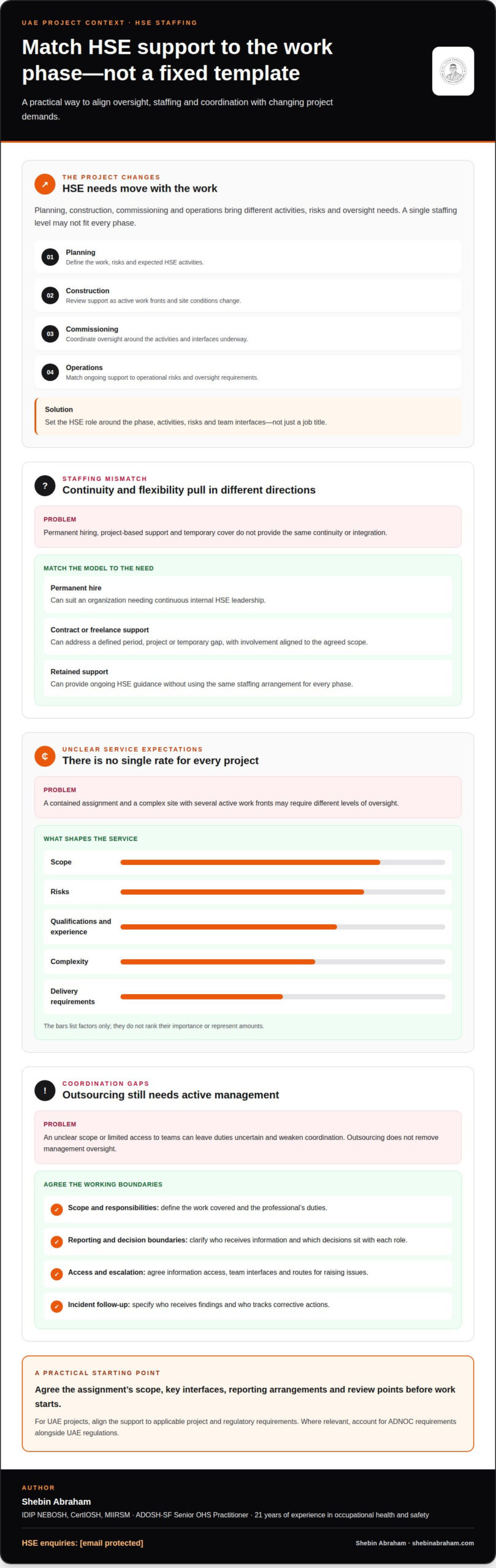
Project demands change as work moves from planning to construction, commissioning and operations. In oil and gas, construction, energy and industrial settings, HSE support should match the activities underway, the risks involved and the oversight required. A manager supporting commissioning, for example, may need to coordinate differently from one overseeing routine operations. The staffing model should reflect the work at each phase rather than assume one level of support fits all.
Permanent hiring can suit an organization that needs continuous internal HSE leadership. Contract or freelance support can address a defined period, project or temporary gap, with involvement aligned to the agreed scope. These arrangements differ in continuity and integration. Whichever model you choose, set out responsibilities, reporting lines and the work covered from the start.
Sudden projects create a different staffing challenge. An accelerated construction package or an unexpected change in project workload can increase the need for HSE oversight before internal capacity adjusts. Outsourced support can help businesses respond to seasonal changes in productivity and workload. The practical approach is to define the work phase, expected risks, team interfaces and required HSE activities, then align the professional’s role with those needs.
The cost of outsourced HSE support depends on the scope, risks, required qualifications and experience, complexity, and delivery requirements. A construction site with several active work fronts may need a different level of oversight from a contained assignment. Specialized processes may also call for relevant experience. These factors shape the service, so no single rate describes every project.
Outsourcing also requires active management. An unclear scope can leave gaps between the professional’s duties and site expectations, while limited access to teams can weaken coordination. Define reporting, decision-making boundaries, information access and escalation routes. For example, an incident-reporting process should specify who receives findings and who tracks corrective actions. Outsourcing does not remove management oversight.
For oil and gas or energy work, the professional’s sector experience should fit the project activities and operating environment. In construction, work changes as the site progresses, so review the HSE plan and support needs at phase transitions. Industrial projects also benefit from clear coordination between HSE oversight and operational teams. These needs call for relevant experience, not interchangeable job titles.
Before work starts, the professional and business should agree on the assignment’s scope, key interfaces, reporting arrangements and review points. This creates a shared basis for tracking whether support remains aligned as project activity changes. Businesses considering project-specific HSE planning can use these factors to frame the required support.
Long-term HSE staffing and retained services
Short-term assignments can address a defined project phase, while retained support provides continuity across ongoing operations. The right structure depends on how often HSE guidance is needed and how closely it must connect with staff.
Short- and Long-Term Contracts
A short-term assignment can focus on a specific need, such as supporting a construction phase or following up audit actions. A longer arrangement suits businesses that need continued guidance as operations evolve. Retained services can be tailored to the support required, giving the business planned access without assuming every month involves identical work.
Set out the scope before work begins. Define the activities covered, reporting responsibilities, site access and how the arrangement will be reviewed. For example, a retained HSE professional might review risk controls, follow up corrective actions and advise management during agreed visits. Clear boundaries help teams understand what the professional handles and which decisions remain with the business.
Reduced Recruitment Overhead
External support can reduce the need to recruit and administer a permanent HSE role directly. Recruitment, onboarding, payroll and training administration all require management time. Clarify in the agreement which responsibilities sit with the external professional and which remain with the business. Efficiency should not be confused with transferring the business’s accountability.
Compare the effort involved in hiring with the support actually required. A business needing recurring guidance may prefer a retained arrangement, while a defined project may call for temporary support. Consider how each option fits internal capacity, continuity needs and the time managers spend coordinating HSE activities. Base the decision on operational demands, not an assumption that outsourcing always costs less.
Continuity also helps preserve operational knowledge. A retained professional can document recurring hazards, open actions and agreed controls, then share them with supervisors and relevant staff. When a project moves into a new phase, for example, a concise handover can explain which controls remain applicable and which need review. Documented knowledge helps teams maintain consistent practices beyond individual meetings.
Staff development can be part of the working relationship. Site observations, audit findings and routine discussions can reveal where employees need clearer guidance. A practical training session might address a procedure workers are not applying consistently. Connect training to actual tasks and identified risks, and record attendance and follow-up through the business’s normal processes.
Review the arrangement as work changes. Shifts in project activity, staffing or operational priorities can alter the support required. Agree how scope changes will be discussed, recommendations tracked and knowledge handed over. This keeps retained support aligned with current operations while helping internal teams build familiarity with HSE processes over time.
HSE consultant collaboration and operational integration
Effective outsourced HSE management starts with an agreed scope, integration with operations and clear reporting. The professional’s work should connect site observations, management decisions and follow-up actions rather than sit apart from daily activity.
Start with an arrangement that defines responsibilities, access to relevant information and communication with internal teams. Agree site attendance in advance. Visits can be planned around activities that need direct observation, while regular reporting keeps managers informed between visits.
Integration depends on practical cooperation. Supervisors can share upcoming work changes, procedures and recurring operational concerns with the HSE professional. The professional can then relate guidance to current work, coordinate with relevant teams and record actions clearly. When a process changes, the people responsible for affected tasks need to know what changed and who will follow up.
Performance information gives collaboration a shared focus. An HSE consultant can help establish leading and lagging indicators and present the data to senior management. Teams might review whether planned inspections and corrective actions are completed alongside incident information. Use indicators to spot patterns and decide where management attention is needed.
Management and internal committee meetings also provide a route for raising HSE issues. An outsourced professional can represent the business at these meetings and liaise with third parties, including enforcing authorities and accreditation bodies. Clear records of discussions, assigned actions and follow-up responsibilities help keep decisions connected to site operations.
HSE support can also contribute to preventative maintenance. A consultant can work with maintenance teams to include health and safety considerations in planning. Before a scheduled task begins, for example, the team can discuss relevant hazards and controls. This brings HSE thinking into routine operational decisions.
After an incident, additional HSE support can help the business mitigate damage and coordinate its follow-up. The professional can help organize information, support internal communication and track agreed corrective actions. Clear escalation routes matter, so operational leaders know how an issue reaches the appropriate decision-maker.
Communication should suit the workforce. Where employees or clients use different languages, bilingual or multilingual HSE staff can work alongside existing teams. A dedicated consultant can also become familiar with the company’s processes and working relationships over time. Agree attendance, reporting, meeting participation and escalation arrangements at the outset to give collaboration a practical structure.
What qualifications and certifications must an HSE manager have in the UAE?
HSE manager qualifications should match the role, sector and operational risks. Relevant education may include a technical degree or diploma in engineering, environmental studies, HSE or a related discipline. Commonly specified certifications include the NEBOSH International General Certificate, IOSH Managing Safety or an equivalent nationally recognized certification. These credentials offer a foundation, but the right combination depends on the responsibilities and work environment involved.
Read experience requirements in context. A manager supporting construction and commissioning on power and water projects needs a background relevant to those activities. A UAE consultant role in energy, oil and gas, mining or similar industries requires more than 10 years of HSE management experience, alongside more than five years of construction and commissioning experience on power and water projects. These examples show why sector fit matters alongside formal study.
Experience expectations vary by industry and employer. A chemical-manufacturing HSE Manager vacancy in the UAE specifies at least 10 years of HSE experience in the UAE. That requirement belongs to a particular vacancy, not every HSE manager position. Other roles may place greater emphasis on familiarity with specific work processes, site conditions or operational teams.
Assess qualifications as a combination:
- Education: A technical degree or diploma can provide a foundation relevant to engineering, environmental studies or HSE work.
- Certification: NEBOSH International General Certificate, IOSH Managing Safety or an equivalent nationally recognized certification may meet stated role expectations.
- Sector experience: Compare the professional’s background with the project’s activities, such as industrial operations or commissioning.
- Practical application: Consider how the manager applies HSE knowledge to assessments, audits and operational decisions.
A qualification demonstrates formal learning, while relevant experience shows how that knowledge can apply to real work. For example, a manager supporting a power project should understand the demands of construction and commissioning, not simply hold a general qualification. Define the role’s scope and assess whether the professional’s education, qualifications and experience fit those responsibilities.
For outsourced support, clarify who will perform the work and how their background aligns with the assignment. Review role requirements, sector experience and expected responsibilities together. This helps establish whether a professional’s credentials and experience match the project’s operational needs.
Discuss your HSE manager requirements in relation to the sector, project phase and responsibilities involved.
Shebin Abraham
Shebin Abraham provides outsourced HSE and OHS consulting to help UAE businesses turn their safety requirements into practical support. Engage him when your operation needs specialist guidance aligned with its project, workforce and applicable requirements, including ADOSH-SF or Trakhees compliance.
His OHS consulting supports businesses seeking HSE oversight alongside existing teams and operational priorities. The appropriate scope depends on the work, risks and regulatory context. This service can suit a business needing focused external expertise while retaining responsibility for its workplace safety.
To discuss your HSE requirements and the support that fits your operations, contact Shebin Abraham.
Set a Clear Path for HSE Support
Start by turning operational priorities into a defined support brief. Identify the work that needs attention, the teams involved and the outcomes management expects. This gives an outsourced HSE manager in the UAE a practical basis for aligning professional support with your organization’s needs.
Shebin Abraham offers OHS Services, Freelance HSE Service and Freelance ADOSH-SF OHS consulting. These services support businesses seeking occupational health and safety guidance or focused assistance with ADOSH-SF requirements. Define the scope around your operations and the responsibilities your team needs support to manage.
Bring your priorities into a direct discussion, including the project context, applicable requirements and working arrangements that matter to your team. Contact Shebin Abraham about HSE support to discuss a suitable next step.
With a clear scope and a collaborative approach, you can move forward with greater purpose and keep people’s safety central to the work.
Frequently Asked Questions
Why outsource your Health and Safety needs?
Outsourcing gives a business access to specialist HSE input without building every capability into its permanent structure. It can suit a company facing a defined project, changing workload or need for focused compliance advice. For example, a business entering a new operational phase may need a professional to review its HSE arrangements and help address gaps while internal managers retain oversight of decisions.
What does an outsourced HSE manager do in the UAE?
An outsourced HSE manager helps a business organize and improve its occupational health and safety arrangements. Depending on the assignment, this can include developing practical procedures, reviewing documentation, advising on controls and following up improvement actions. If a work process has a recurring gap, for example, the manager can help clarify the procedure and responsibilities for addressing it.
Which UAE laws and regulations apply to outsourced HSE management?
Applicable requirements depend on the business, activity and site authority. Relevant frameworks may include UAE Federal Labour Law, MOHRE requirements, ADOSH-SF and Trakhees OHS requirements for applicable operations. ADNOC requirements may also apply to relevant projects. An HSE manager can help identify the frameworks that apply and align support with them, while the business retains its responsibilities.
How much does outsourced HSE management cost in the UAE?
There is no single fee for outsourced HSE consulting. Cost depends on scope, project risks, required qualifications and experience, complexity, and delivery requirements. Focused advisory work and continuing project support involve different levels of effort. To define the service, set out the activities, operational context and type of support required; these factors also shape the fee.
Which UAE companies offer outsourced HSE manager services?
Shebin Abraham provides freelance HSE and OHS consulting for UAE businesses, including advisory aligned with ADOSH-SF and Trakhees requirements. His support helps organizations address their operational needs and applicable compliance framework. The suitable engagement depends on the work and guidance required, since assignments differ in scope.
How do outsourced HSE services differ from hiring an in-house HSE manager?
An in-house manager is part of the organization’s employment structure and can provide continuous internal presence. Outsourced support is arranged around an agreed scope, which may suit a defined project, specialist advisory need or ongoing retained engagement. For example, a business can bring in external support for a compliance initiative while its managers continue overseeing internal responsibilities and decisions.