

The visible mistake is rarely the whole explanation. Root cause analysis for workplace accidents examines the events, conditions, decisions and controls that contributed to an incident, then identifies improvements to help reduce the risk of it happening again. A professional investigation looks beyond the immediate action to understand how the wider system shaped what happened.
After an accident, you need clear answers and practical steps to protect people and improve how work is done. This article explains how an incident investigation gathers and assesses evidence, how the five whys and fishbone diagrams help examine causes, and what information can support the analysis. It also shows how findings can guide corrective action and continuous improvement in UAE and GCC workplaces.
Written by Shebin Abraham, IDIP NEBOSH, CertIOSH, MIIRSM, ADOSH-SF Senior OHS Practitioner, this guide draws on 21 years of experience in occupational health and safety.
Key Takeaways
- A sound investigation looks beyond the immediate mistake to examine the conditions, decisions and controls that contributed to an incident.
- The five whys can help trace a chain of contributing factors, while a fishbone diagram organizes possible causes for structured review.
- Clear timelines, records, equipment details and accounts from people involved help a professional assess what happened.
- Useful corrective actions address underlying causes, assign responsibility and are reviewed to see whether they work.
- Professional OHS support can help turn incident findings into practical improvements suited to the workplace.
What is Incident Root Cause Analysis?
Root cause analysis for workplace accidents examines how an event happened, including the conditions and controls that contributed. The goal is to identify corrective actions that address underlying causes, not just the immediate event.
In UAE workplaces, establish the reporting route in line with the applicable authority and sector requirements. A sound investigation also builds a factual timeline, preserves relevant evidence and records decisions instead of relying on assumptions.
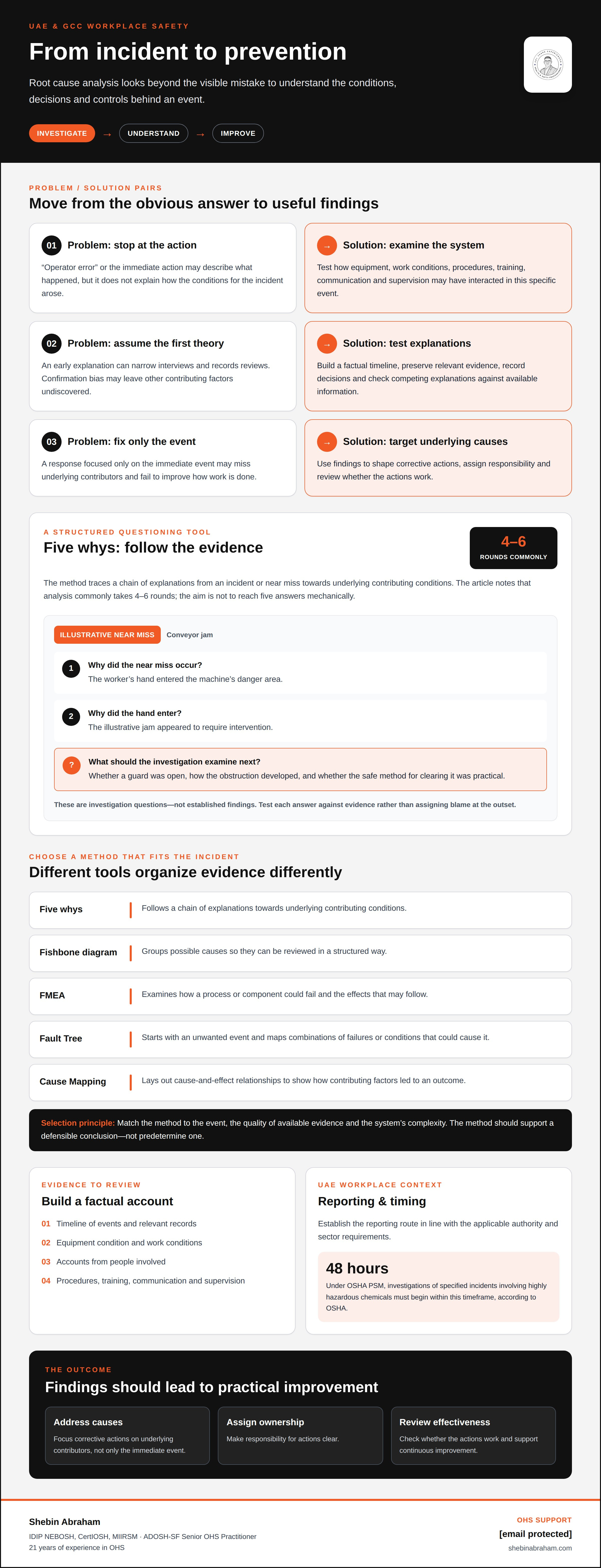
Under OSHA PSM, investigations of specified incidents involving highly hazardous chemicals must begin within 48 hours, according to the Occupational Safety and Health Administration (OSHA).
Contributing factors may include unsafe equipment or work conditions, unclear procedures, inadequate training, communication gaps and weaknesses in supervision. The investigation should test how these factors interacted in the specific event, rather than settling on one apparent cause.
Methods include the five whys, fishbone diagrams, Failure Mode and Effects Analysis (FMEA), Fault Tree Analysis and Cause Mapping. Each organizes evidence differently, from tracing a sequence of causes to examining potential failure points.
Common investigation errors include stopping at “operator error,” overlooking evidence that challenges an early theory and accepting the first explanation. Confirmation bias can narrow interviews and records reviews, leaving contributing system factors undiscovered.
UAE accident statistics and reported costs need context, such as sector, reporting scope and injury definitions. Financial impacts can include treatment, lost work, operational disruption, equipment damage and corrective actions. Which apply depends on the incident.
Root Cause Analysis Methods
Root cause analysis methods provide structured ways to connect evidence with causes and corrective actions. The five whys follows a chain of explanations, while a fishbone diagram groups possible causes for review. FMEA examines how a process or component could fail and the effects that may follow. Cause Mapping lays out cause-and-effect relationships to help teams see how several contributing factors led to one outcome.
Choose a method that fits the incident: an isolated equipment failure may call for a different analysis than an injury involving several factors. A professional considers the event, the quality of available evidence and the system’s complexity. The method should support a defensible conclusion, not predetermine one.
Fault Tree and Risk Tree Analysis
Fault Tree Analysis starts with an unwanted event, then maps combinations of failures or conditions that could cause it. For example, a machine injury may involve both access to a moving part and a failed protective barrier. A full analysis of a serious incident in a complex system may take days to weeks.
Risk tree analysis examines possible pathways to understand how hazards develop and where controls matter. Management decisions about maintenance, staffing, procedures or procurement can shape frontline conditions. Examining these links helps identify actions management can implement, rather than placing responsibility only on the person closest to the event.
Main Workplace Accident Causes
Workplace accidents can result from conditions, actions and system weaknesses combining to cause harm. A fall, for example, may involve a slippery surface, poor housekeeping, unsuitable access equipment or gaps in hazard control. The immediate event alone cannot establish which factors contributed.
An investigation considers equipment condition, work design, procedures, competence, communication and supervision. A professional compares these factors with the incident timeline and available records to separate verified contributors from assumptions. This supports actions aimed at preventing similar events across relevant work activities.
Investigation Mistakes and Biases
Investigation mistakes are gaps in reasoning or evidence that distort the account of an incident. Blaming a worker too quickly, interviewing only one witness, overlooking maintenance records or treating a procedure as proof of safe practice can all narrow the analysis.
Bias can also shape what investigators notice. Confirmation bias favours evidence that supports an early theory, while hindsight bias makes warning signs seem obvious after the event. A disciplined investigation tests competing explanations, records uncertainty accurately and checks whether management controls worked as intended. This connects corrective actions more closely to the evidence.
Five whys analysis
The five whys method traces a chain of explanations from an incident or near miss towards underlying contributing conditions. In a professional investigation, each answer is tested against evidence, then another “why” question explores how that condition arose. The aim isn’t to reach five answers mechanically. A root cause analysis using this technique commonly takes 4-6 rounds, because the evidence may reveal several connected causes.
Consider an illustrative conveyor near miss: a worker reaches toward a jammed machine. The action is clear, but it does not explain why the person could reach the hazard or why the jam occurred. A professional may examine whether a guard was open, how the obstruction developed and whether the safe method for clearing it was practical. Each answer guides the next question instead of assigning blame at the outset.
The 5 Whys technique can be set out as a linked sequence:
- Why did the near miss occur? The worker’s hand entered the machine’s danger area.
- Why did the hand enter? The illustrative jam appeared to require intervention.
- Why was intervention possible? The investigation examines the guard and access controls.
- Why did the jam-clearing method rely on access? The professional reviews the procedure, equipment and work conditions.
- Why did those conditions persist? The review considers how planning, maintenance or oversight may have failed.
This example illustrates a reasoning process, not a finding about a real workplace. A professional checks each answer against relevant evidence, including equipment condition, procedures and witness accounts. If an answer is only an assumption, investigate further. If it seems conclusive, ask why again and test whether a deeper organizational condition contributed.
Five whys analysis works best when the incident can be described clearly and the cause chain can be examined with available evidence. The time required depends on the complexity of the near miss and the evidence available. A complicated event may require other methods alongside it, especially where several independent factors or control failures need examination. A five-step list should never force a single cause where evidence supports more than one pathway.
The resulting corrective actions should address identified conditions, not simply repeat instructions to “be careful.” Depending on the findings, actions may concern machine access, work procedures, maintenance or management oversight. A professional links each action to the evidence and considers how its effectiveness will be assessed. For help connecting incident findings with practical HSE management support, the five whys can provide a clear starting point for discussion.
Defining an incident and gathering evidence
A professional defines the incident, establishes its timeline and gathers evidence before drawing conclusions. The investigation links events to contributing operational, environmental and organizational conditions.
For a root cause analysis for workplace accidents, first identify what happened, who or what was affected and which evidence could clarify the sequence. This keeps the inquiry focused while allowing its scope to change as new facts emerge.
Defining an Incident
An incident is the event being investigated, described clearly enough to distinguish the outcome from its possible causes. A professional records the task, location, people involved, equipment and observed consequences, then sets a reasonable investigation boundary.
A forklift collision, for example, is a more useful definition than a broad label such as “unsafe warehouse.” The investigation can examine the collision, approach route, nearby activity and relevant conditions without assuming a cause beforehand. A precise definition keeps interviews, records and analysis focused on the same event.
Evidence and Witness Statements
Evidence gathering combines physical observations, records and accounts from people with direct knowledge. A professional may review equipment condition, procedures, work schedules, maintenance information, photographs and relevant environmental conditions.
Witness interviews should establish what each person observed, heard and did, using open questions and a separate account for each witness. The investigator records the time and context of each statement, distinguishing direct observation from later interpretation. For a lost-time injury with multiple factors, evidence gathering for a Fishbone analysis typically takes 24-48 hours.
Time matters. In a machinery example, the jam occurred at 10:42 and the operator reached through the open guard at 10:43. Those times help establish sequence, but further evidence is needed to explain why the guard was open or the jam occurred.
Incident Scene Management and Investigation Steps
Managing the scene protects people while preserving information that could change or disappear. The professional records the scene’s condition, identifies relevant equipment and documents any changes needed to control immediate hazards. Observations should distinguish what was present when the investigator arrived from what witnesses say was there earlier.
A practical investigation proceeds through connected stages:
- Define: Record the incident, task, location and known consequences.
- Secure: Address immediate hazards and preserve relevant scene conditions.
- Document: Photograph or describe equipment, layout and visible evidence.
- Interview: Gather separate accounts and clarify each person’s timeline.
- Review: Compare statements with records, procedures and physical findings.
- Analyse: Identify supported contributing factors before recommending actions.
A forklift example shows why chronology matters: temporary pallets were stored near the loading bay at 08:42, partially obstructing visibility, before a collision at 08:48. The professional records both events, then examines how layout and work conditions relate to the collision. This preserves the distinction between evidence and conclusions.
Fishbone diagrams and the 6M categories
A Fishbone diagram organizes possible causes around one clearly stated incident outcome. The 6M categories help a professional examine contributing factors from different angles.
Fishbone Diagram Structure
A Fishbone diagram, also called an Ishikawa diagram, places the effect at the “head” and groups possible causes along branches. For a hand injury during maintenance, the head might read “hand contacted moving equipment,” with branches for evidence about equipment, work methods and conditions.
Each branch gives the investigation a way to organize possible causes without treating assumptions as findings. A professional adds specific observations beneath relevant branches, then checks which possibilities are supported by records, interviews or physical evidence. This structure can help teams see relationships a simple chronological account may not show.
The diagram supports discussion, not proof by itself. A cause listed under “Method,” for example, still needs evidence that the procedure contributed to the event. For a lost-time injury involving multiple factors, a Fishbone analysis typically takes 2-4 hours of investigation. A complex event may also need Fault Tree Analysis or another technique to examine how causes combined.
The 6M Categories
The 6M categories are a framework for sorting possible causes into six broad groups. A professional adapts each group to the workplace and event, then uses it to identify overlooked contributing factors.
- Man: People-related factors, such as task familiarity or communication during a handover.
- Machine: Equipment condition, design or protective features, such as a damaged guard.
- Method: Work procedures and task sequence, including how maintenance access is controlled.
- Material: Materials or substances involved, such as an unstable load or leaking container.
- Measurement: Inspection, monitoring or information used to judge conditions, such as an incomplete equipment check.
- Mother Nature: Environmental conditions, such as heat, dust, lighting or a wet surface.
For a forklift incident, a diagram might place a blocked sightline under environment, a load issue under material and a route-control gap under method. These are questions to investigate, not conclusions. A professional tests each against the incident timeline and available evidence, including whether the factor was present and how it influenced events.
Management and organizational conditions can shape several branches. A weakness in maintenance planning, for example, may affect both machine condition and work method. The analyst can record that relationship across categories instead of forcing it into one branch. Unlike tree analysis, which maps pathways and combinations of failures, a Fishbone diagram broadens cause exploration. Findings then support corrective actions linked to verified causes.
Root cause analysis and continuous improvement
Investigation findings matter when they lead to corrective actions and follow-up. In UAE workplaces, the aim is to control the hazard and strengthen the system, not simply close an incident file.
Corrective Actions to Prevent Recurrence
Corrective actions address verified causes and reduce the chance of similar incidents. ISO 45001 Clause 10.2 requires organizations to investigate incidents, determine their causes, consider corrective action, and review whether actions were effective.
Match actions to the findings. If an investigation identifies access to moving machinery as a cause, a control that prevents access may address the hazard more directly than repeating a warning. If unclear work instructions contributed, revising the procedure and ensuring relevant workers understand it may be appropriate. Each action should connect clearly to the evidence.
Assign each action to a responsible role and define how completion will be demonstrated. For example, check a revised procedure against the task it covers, and inspect a physical control while it is operating. This makes ownership and implementation visible.
Measuring Corrective Action Effectiveness
A professional assesses effectiveness by checking whether an action was implemented and whether it controls the cause it was designed to address. Completion alone is not proof: a closed work order does not show that a hazard is controlled during normal operations.
The review can examine workplace observations, equipment condition, relevant records and feedback from workers doing the task. If an action changes a procedure, the professional checks how it is applied. If it changes equipment, the review examines whether the intended safeguard works in the actual setting.
Compare the results with the original investigation findings. If the hazard remains, or a similar event reveals a gap, the analysis may need to be reopened. A software register can help track action owners, status, evidence and review outcomes, but its records still require professional assessment.
Continuous Improvement Through Root Cause Analysis
Continuous improvement uses incident findings to strengthen controls beyond the single event. A professional considers whether the same process, equipment or organizational weakness exists in other work areas, then identifies relevant preventive action.
For example, if a review finds that a maintenance process leaves workers exposed to a hazard, the organization can examine comparable tasks and procedures. This extends learning without assuming every location has identical risks. People responsible for implementing changes should help assess whether they are practical.
Root cause analysis becomes part of a wider improvement cycle when actions are implemented, reviewed and adjusted as evidence develops. Collecting incident trends and action outcomes can help management identify recurring weaknesses. Discuss corrective action planning to connect investigation findings with practical follow-through.
Shebin Abraham
Shebin Abraham helps UAE and GCC organizations connect incident findings with practical occupational health and safety improvements. His OHS Services can support teams in reviewing evidence, understanding contributing factors and developing corrective actions suited to their operational context.
Turn to professional support when an incident involves complex work conditions, recurring hazards or questions about whether existing controls are effective. A structured review can help clarify what happened, identify organizational issues and give management a sound basis for follow-up. Shebin Abraham is an ADOSH-SF Senior OHS Practitioner with 21 years of experience in OHS, bringing practical insight to workplace safety discussions.
If you need help understanding an incident and deciding on next steps, contact Shebin Abraham to discuss your workplace concerns.
Turn incident learning into safer work
A well-run root cause analysis for workplace accidents gives an organization a stronger basis for decisions after an incident. The next step is to connect the findings with the controls, responsibilities and work practices that shape daily operations. That keeps safety learning active after the report is complete.
Shebin Abraham’s OHS Services, Freelance HSE Service and Freelance ADOSH-SF OHS consulting support organizations addressing occupational health and safety concerns. A discussion can focus on the incident, the available evidence and the practical improvements the workplace needs to consider.
Bring your questions and discuss how the findings could inform your next steps. Contact Shebin Abraham to start the conversation and keep improvement moving forward.
Frequently Asked Questions
What is the difference between an immediate cause and a root cause?
An immediate cause is the event or condition directly linked to harm; a root cause explains why that condition existed or remained uncontrolled. For example, a worker might slip on a wet floor. A deeper inquiry could uncover recurring leaks and unclear responsibility for reporting them. Distinguishing these levels keeps corrective actions focused on the conditions that allowed the hazard to persist.
When Do You Use RCA?
Use root cause analysis when an incident, near miss or recurring hazard needs more than an immediate explanation. It is particularly useful when evidence points to several interacting factors or earlier corrective actions have not resolved the concern. Repeated equipment stoppages, for example, may warrant examining maintenance, work planning and operating conditions together. Set the investigation’s scope according to the event’s potential consequences and complexity.
What is root cause analysis for workplace accidents?
Root cause analysis for workplace accidents is a structured investigation into how an accident happened and why contributing conditions were present. It examines evidence, considers relationships between causes and supports corrective action. An injury involving a dropped load, for instance, may prompt a review of the load, lifting equipment, task planning and communication. The analysis is useful when its findings guide practical changes instead of ending with a report.
What evidence should be collected after a workplace accident?
Gather records that help reconstruct working conditions before the event, such as shift handover notes, maintenance history, training records, work permits and relevant inspection logs. Where available and appropriate, retain access-control records or camera footage before routine systems overwrite them. A professional identifies relevant materials, records their source and timing, and compares them with interview accounts. This can reveal differences between written procedures and actual work practices.
How can investigators distinguish root causes from immediate and underlying causes?
Investigators distinguish these causes by tracing how each condition contributed and testing the links against evidence. In a hypothetical trip incident, the immediate cause may be a cable across a walkway; an underlying cause could be temporary work that created the obstruction. A root cause might involve a planning process that failed to manage pedestrian routes. Support each conclusion with evidence, and do not treat a plausible explanation as established fact.
What workplace accident reporting and investigation requirements apply in the UAE?
In UAE workplaces, establish the reporting route according to the governing authority and sector requirements. Under ISO 45001 Clause 10.2, organizations must investigate incidents, determine causes, consider corrective action, and review whether the actions were effective.