

What if the biggest weakness in a construction safety plan is that it looks complete on paper? A Trakhees HSE plan for construction projects needs to do more than collect general requirements. It should reflect the actual work, site hazards and contractor interfaces, with clear controls people can follow.
Starting with a template can save time, but copied content may leave project risks and responsibilities unclear. This guide explains how to build an adaptable plan that connects construction activities to practical controls, assigned responsibilities and supporting documents.
You’ll learn how to organize the plan, coordinate project leadership, HSE personnel and contractors, and review it as site conditions or work activities change. The aim is a working document that helps people make safer decisions on site, not a file that goes untouched after submission.
This guide draws on the practical perspective of Shebin Abraham, IDIP NEBOSH, CertIOSH, MIIRSM, an ADOSH-SF Senior OHS Practitioner with 21 years of OHS experience. His experience informs a clear, project-focused approach to HSE planning for work in the UAE and wider GCC.
Key Takeaways
- Build the Trakhees HSE plan for construction projects around the work scope, site conditions and contractor interfaces, not just standard headings.
- Use a flexible contents framework to connect roles, communication, hazards, controls and monitoring arrangements.
- Turn broad safety statements into project evidence, assigned controls and clear review triggers.
- Follow a practical drafting workflow that brings project information and relevant roles together before the plan is put into practice.
- Review the plan when work or site conditions change, and use experienced project support to identify gaps and strengthen implementation.
Why a Trakhees HSE Plan for Construction Projects Must Reflect the Work
A construction HSE plan is most useful when it explains how safety will be managed on the specific project, rather than simply repeating general principles. A project-specific HSE plan connects the work to its hazards, the controls selected for those hazards, and the people responsible for putting those controls into practice.
That connection matters on a live site. Planned activities may overlap, contractors may share work areas, and conditions can change as construction progresses. A useful plan helps project leadership and site teams coordinate work, communicate potential conflicts, and respond when actual conditions no longer match the original assumptions. Align the plan with the Trakhees requirements applicable to the project, and verify their scope and relevance rather than relying on a generic template.
What the plan is intended to coordinate
The plan brings management arrangements and site-level controls together. It can explain how activities are planned, how hazards are assessed, how control measures are communicated, and how issues are raised and followed up. For example, if deliveries and lifting operations could affect the same work area, the plan should state how the teams coordinate those activities, who resolves conflicts and how the agreed arrangements reach affected workers.
Assign responsibilities to actual project roles. Project leadership may coordinate resources and interfaces, supervisors may brief teams and oversee work arrangements, and HSE personnel may support risk planning and monitoring. Contractor leads can communicate relevant controls to their teams. These are practical examples, not prescribed role titles. A plan supports safe work, but it cannot replace active supervision, worker involvement or timely decisions on site.
Why project context matters more than a standard template
A template can provide helpful headings, but the project scope, work sequence and site conditions determine what belongs under them. Excavation, lifting, work at height and vehicle movements each raise different planning questions. The answers depend on the activities involved, where and when they take place, and how they interact with other work. State the project-specific arrangements, not just the hazard name.
Reused content needs careful review. A control that suited a previous site may not fit the current layout, sequence or contractor interface. Check each relevant statement against project information, assign an accountable role, and define what would prompt a review. Forms and permits can support the plan, but a folder of disconnected documents won’t show how the controls work together.
For wider UAE context, the article Trakhees OHS Compliance: UAE Practical Guide 2026 complements this planning focus. General references can also help explain safety-management concepts. For instance, the Occupational Safety and Health Administration (OSHA) is a US agency; its background is not a substitute for applying the Trakhees requirements relevant to a project in the UAE.
What to Include in a Trakhees Construction HSE Plan
Use the framework below as planning guidance, then tailor it to the project and verify current Trakhees requirements that apply to regulatory or submission-specific fields. A well-structured Trakhees HSE plan for construction projects should help people doing the work find the arrangements they need without searching through disconnected files.
Core sections for a usable project document
Keep the main plan concise and easy to navigate. Start with the project scope, site or work boundaries, planned phases, and the document’s version and review details. Then record the project team’s responsibilities and communication arrangements. Explain how work changes, safety concerns and relevant updates will be shared with affected teams, including contractors working across shared areas.
Include a practical overview of hazard planning and controls, with enough context to show how key activities are managed. Set out how the project team will monitor implementation, record findings and follow corrective actions through to closure. Assign each arrangement to a role selected by the project team. Avoid vague wording such as “management will monitor” if it doesn’t identify who coordinates the task or follows up on a finding.
- Project scope and phases: Describe the work covered and the sequence or interfaces that affect planning.
- Document control: Identify the current version, responsible document owner and how revisions are communicated.
- Roles and communication: Name project roles, their relevant responsibilities and how information reaches workers and contractors.
- Hazard controls: Summarize the project’s approach and point to detailed activity-specific documents.
- Monitoring and follow-up: Explain how the project team records findings, assigns actions and checks whether controls remain suitable.
Supporting records and linked work documents
Don’t copy every risk assessment or method statement into the main plan. Reference the controlled documents that explain hazards and safe work arrangements in detail. A supporting-document register can list each record’s title or reference, related activity, responsible owner and current revision. This helps teams trace the plan to the working documents while keeping the main document readable.
Training records can also be referenced where they support the project’s arrangements. Keep the register current so a superseded assessment or method statement isn’t mistaken for the applicable one. Point readers to the correct record and explain how relevant changes are communicated, rather than duplicating detailed instructions that may be revised separately.
For submission-document detail, the related guide Trakhees Safety Permit Documentation: A Practical Submission Guide provides a useful companion topic. Project teams developing or reviewing their documents can also draw on Trakhees-focused HSE and OHS consulting to align the plan’s structure with project activities and supporting records.
Is a Generic HSE Plan Enough? Tailor It to Project Risks
A generic template can provide useful headings, but headings alone don’t show whether a control fits the work. “Manage work at height safely” says little about the task, the work area, who coordinates the control or what could trigger a review. A template is a starting structure, not proof that project risks are effectively controlled.
For a Trakhees HSE plan for construction projects, make each relevant statement traceable to project information and action. Consider the scope, work sequence, site constraints, contractor interfaces and changes in conditions. The examples below are illustrative planning prompts, not a complete hazard list or Trakhees-mandated wording.
Adapt the plan to work packages and interfaces
Map each work package to its relevant risk assessment or method statement, then identify the project role responsible for coordinating the arrangements. Consider where activities overlap, share access routes or depend on work by another contractor. For instance, if a delivery route crosses an active work area, specify how the interface will be coordinated, who communicates the arrangements and how changes are shared with affected teams.
Generic statement: “Control vehicle and pedestrian interaction.”
Project evidence needed: The planned delivery route, work-area layout and activities taking place nearby.
Assigned control: The project-assigned role coordinating access and communicating arrangements to affected teams.
Review trigger: A change to the route, work sequence or surrounding site activity.
Generic statement: “Use safe arrangements for lifting work.”
Project evidence needed: The planned lifting activity, its location and any nearby work or access constraints.
Assigned control: The role identified by the project team to coordinate the activity and related interfaces.
Review trigger: A change to the planned activity, location or conditions that could affect the arrangements.
Separate the plan from risk assessments and method statements
The HSE plan sets project-wide arrangements: how work is coordinated, responsibilities are assigned and changes are communicated. Risk assessments and method statements address defined tasks in greater detail. Keep those functions distinct. Reference each supporting document by its title or identifier, activity, owner and revision in a controlled register, rather than copying all its instructions into the plan.
This separation helps teams find the relevant detail and reduces the chance that duplicated instructions drift apart after a revision. If a supporting document changes, the responsible project role can assess whether the plan or related communication also needs updating. For broader requirement context, Trakhees Safety Requirements for UAE Construction is a related topic. Apply current requirements after verifying their relevance to the project.
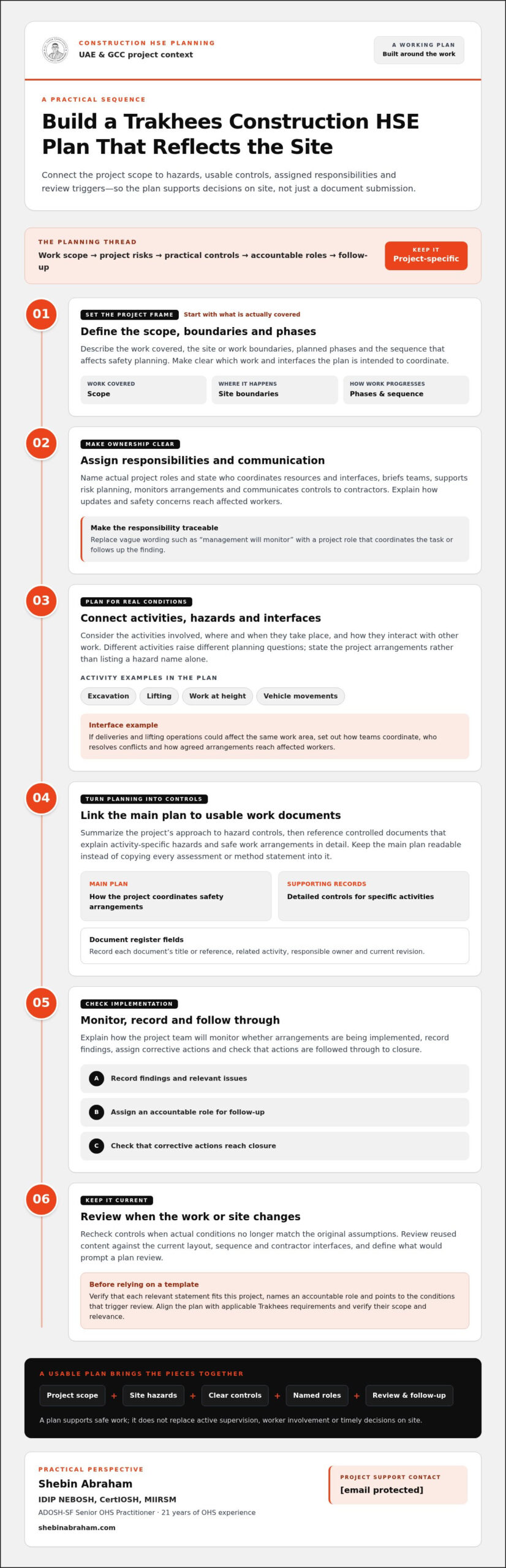
How to Draft, Review and Put the HSE Plan into Practice
A plan becomes useful through a disciplined process, not simply by completing a document. For a Trakhees HSE plan for construction projects, involve people who understand the project scope and those who will coordinate work on site. Assign each planning action to a project role, and verify applicable requirements rather than assuming a generic process applies.
A practical drafting and review sequence
Use this sequence to move from project information to a plan teams can apply. The project team should agree who owns each step based on its arrangements and responsibilities.
- Confirm the scope. Project leadership or its designated representative gathers the work boundaries, phases and current sequence. Record what the plan covers and note relevant interfaces between work packages and contractors.
- Collect supporting information. The person coordinating HSE planning gathers available risk assessments, method statements and other relevant project records. Identify missing or outdated information and assign follow-up to the responsible work team.
- Draft arrangements and responsibilities. The plan’s document owner describes how work will be coordinated, how relevant controls will be communicated and which project roles will carry out or monitor each arrangement. Use language workers and supervisors can understand.
- Review consistency and applicability. Relevant project leads and HSE personnel check that the plan and its supporting records align, responsibilities are clear, and approval arrangements are understood. Verify current requirements that apply to the project before treating a particular field or document as mandatory.
- Brief affected teams and issue the plan. The designated project roles communicate relevant arrangements to workers and contractors, then make the current controlled version available through the project’s agreed document process.
Make the plan usable during site work
Communication should reach people before the arrangements affect their work. Use induction, task briefings and supervision to explain relevant controls, interfaces and reporting routes. Keep briefings focused on the activities and work areas involved. A general presentation cannot replace checking that teams understand the arrangements for the tasks they are about to perform.
Give the project team a clear way to record changes, findings and follow-up actions. If the scope, work sequence or site conditions change, the responsible role should identify which plan arrangements and linked documents need review, then communicate relevant revisions to affected teams. Retain a controlled record of changes so project leads can distinguish the current version from superseded documents.
Inspection preparation is one practical opportunity to check whether documented arrangements match site practice. The guide How to Pass a Trakhees Safety Inspection: A Practical UAE Checklist offers a related inspection-focused perspective. For tailored support with developing or reviewing project HSE documentation, discuss your Trakhees HSE planning needs.
Keep the Trakhees HSE Plan Current With Experienced Project Support
A construction HSE plan should reflect the work as it is actually planned and carried out. Treat review as part of project control: consider relevant changes to the work and verify applicable Trakhees requirements when reviewing the document. Don’t assume a fixed review interval unless a verified project or regulatory requirement calls for one.
When a project team should revisit its plan
Changes to scope, work sequence, site conditions or contractor interfaces can affect specific arrangements. A new work phase, for example, may change how an existing activity interacts with other work. The project team should identify which sections and linked records are affected, assign someone to review them, and communicate relevant updates to the people doing the work.
That doesn’t automatically mean rewriting the whole plan. A focused review can identify whether responsibilities, controls, communication arrangements or supporting documents need adjustment. Record the decision and any revisions through the project’s document-control process. This keeps the plan responsive without creating unnecessary changes that could make it harder for teams to identify current instructions.
A practical advisory partner for HSE planning
Experienced support can help a project team organize its HSE documentation, identify gaps between written arrangements and planned work, and strengthen implementation with project leadership, HSE personnel and contractors. The adviser can help make the plan clear and usable while the project team remains engaged in decisions about its activities and arrangements. Regulatory references should be checked for current applicability and considered alongside the project’s actual work.
Shebin Abraham provides OHS consulting tailored to Trakhees requirements and construction projects. He is an ADOSH-SF Senior OHS Practitioner with IDIP NEBOSH, CertIOSH and MIIRSM credentials, and brings 21 years of OHS experience. His practical experience supports a human-centred approach to planning: connect documents to the work, make responsibilities understandable, and keep safety arrangements meaningful as project conditions evolve.
If you’d value support shaping or reviewing your project’s arrangements, discuss your construction HSE planning needs.
Make Your Next Project Decision Safer
The value of an HSE plan is tested when work shifts: a sequence changes, teams meet at an interface, or site conditions differ from what was planned. Build a habit of checking whether the arrangements still fit before those changes reach the workforce. That ongoing attention keeps safety decisions connected to the people doing the work, not just the documents on file.
Your next step can be a focused review of the Trakhees HSE plan for construction projects you’re preparing or using now. Check whether responsibilities are clear, supporting records are current, and the project team knows how updates will reach affected workers. Where specialist input would help, Shebin Abraham’s Trakhees OHS consulting can support practical planning for construction projects.
Discuss your construction HSE planning needs and take the next step with clarity and care for your team.
Frequently Asked Questions
Is a Trakhees HSE plan the same as a risk assessment?
No. A risk assessment examines hazards and controls for a defined activity or task; the HSE plan explains how safety arrangements are organized across the project. For example, an assessment may address risks associated with a particular excavation task, while the plan identifies how that assessment is managed, communicated and coordinated with nearby work. The plan should point to relevant assessments so teams can find the detailed task controls.
What is the difference between an HSE plan and a method statement?
An HSE plan sets out project-wide safety management arrangements, while a method statement describes how a specific work activity is intended to be carried out. A method statement may explain the sequence and precautions for a defined task; the plan shows how that task fits the wider project arrangements. Keep references consistent so workers can tell which documents apply to their task and where to find current instructions.
Who should prepare a construction HSE plan?
The project team should develop it collaboratively, with input from people who understand the work and its safety arrangements. Project leadership can provide scope and sequencing information, HSE personnel can help organize risk and control information, and contractor representatives can contribute details about their work and interfaces. Assign a document owner and reviewers according to the project’s arrangements, then make responsibilities clear before putting the plan into use.
How often should a construction HSE plan be reviewed?
There isn’t a single review interval that should be assumed for every project. Set review arrangements with reference to applicable project requirements, and revisit relevant content when scope, work sequence, site conditions or contractor interfaces change. A review can be targeted: if a work area changes, check the affected sections and linked records rather than automatically rewriting the entire plan. Record review decisions and communicate updates to those affected.
Can one HSE plan template be used for every construction project?
A template can provide a consistent starting structure, but one unchanged plan won’t reflect every project’s work. A fit-out and a new-build project, for example, may differ in scope, sequencing, occupied areas and contractor interfaces. Adapt the content to the actual activities, site constraints and supporting documents. Remove irrelevant material, complete project-specific fields, and verify current applicable Trakhees requirements before using template content.
Does having an HSE plan guarantee Trakhees compliance?
No. A completed document alone can’t demonstrate that every relevant requirement has been met or that planned controls are being used on site. The project team needs to verify applicable current requirements, follow relevant approval or submission arrangements, and keep records aligned with actual work. A useful plan supports consistent implementation, but it must be maintained and used alongside project oversight, current supporting documents and evidence of completed actions.
Should subcontractors be included in a construction HSE plan?
Yes. The plan should account for subcontractor activities where they affect project arrangements, shared areas or other work. Identify how each subcontractor’s relevant assessments and method statements connect with the project’s coordination process, and clarify who communicates changes or resolves work-interface issues. For example, if one team’s delivery or installation sequence affects another team’s access, make the coordination route clear and brief the affected groups before the work proceeds.