

Before you start the Trakhees OHS approval process, confirm which approval route applies to your project. Forms are only one part of the work: unclear scope, inconsistent project details or missing supporting information can make an application harder to review. Approval, permits, accreditation and inspections are related terms, but they do not mean the same thing.
This guide takes you through a practical sequence: define the work and approval sought, prepare the relevant information, submit it as directed, and respond clearly to review comments. The exact requirements depend on the project, so use current official Trakhees instructions for your application rather than relying on a checklist from another project. The steps below help you organize the work without treating one route as suitable for every case.
Written by Shebin Abraham, IDIP NEBOSH, CertIOSH, MIIRSM, ADOSH-SF Senior OHS Practitioner, this guide reflects his 21 years of experience in Occupational Health and Safety. Shebin provides freelance HSE and OHS consulting, including advisory support for Trakhees requirements, permitting documentation and compliance inspections.
Key Takeaways
- Define the project scope and approval sought first, then confirm the applicable route using current official instructions.
- Match supporting information to the specific application and check that project details, versions and responsibilities are consistent.
- Use a controlled sequence to organize the Trakhees OHS approval process, then follow the submission and review instructions for your case.
- Track review comments and respond to each one clearly. A general process guide cannot promise a fixed approval timeline.
- After a decision, record any conditions, assign related actions and keep project safety information under document control.
What the Trakhees OHS Approval Process Covers, and Where to Begin
The Trakhees OHS approval process is the project-specific sequence for identifying applicable occupational health and safety requirements, preparing relevant information and submitting it through the designated route for review. Treat it as a way to organize your work, not as a universal checklist. Current official instructions for your project take precedence over general guidance.
The applicable route may depend on the project, its activities and the approval sought. A new site activity, a change to the work scope and a different approval objective may require different information or steps. Begin by describing the work and identifying the decision you need. Then review the official instructions before assembling documents. Reusing another project’s approach without checking it can leave gaps or result in information being prepared for the wrong purpose.
What should you identify before starting?
Write down the project activity, work stage and responsible organization. Specify the approval objective and name the person coordinating the submission. Also identify who owns the technical safety information and who will check it. These responsibilities may belong to different people, so agree how information will be reviewed and kept consistent before submission.
Next, use the current official instructions for the applicable project route to map the information required. Treat this as a project-specific exercise, not a document list copied from an earlier application. Clear ownership helps the team resolve questions and keeps the safety information connected to the actual work being assessed.
How is approval different from a permit or accreditation?
These terms can appear together, but they are not interchangeable. An approval is a decision or acceptance relating to a defined request. A permit generally authorizes specified work or an activity under stated conditions. Accreditation relates to the recognition or qualification of a person or organization under a particular scheme. An inspection is an examination or verification, and should not be assumed to replace an approval.
A project may involve more than one authority process or requirement, depending on its scope. Use current official information to establish which apply. For planning, identify what each decision covers and whether any separate permit, accreditation or inspection steps remain.
Occupational health and safety is the broader discipline of protecting people at work through attention to workplace risks and controls. For foundational context, see Occupational Safety and Health. For wider UAE context around Trakhees requirements, the article “Trakhees OHS Compliance: UAE Practical Guide 2026” provides a broader companion overview. Use it alongside, not instead of, the official instructions for your project.
Prepare for Trakhees OHS Approval Before You Submit
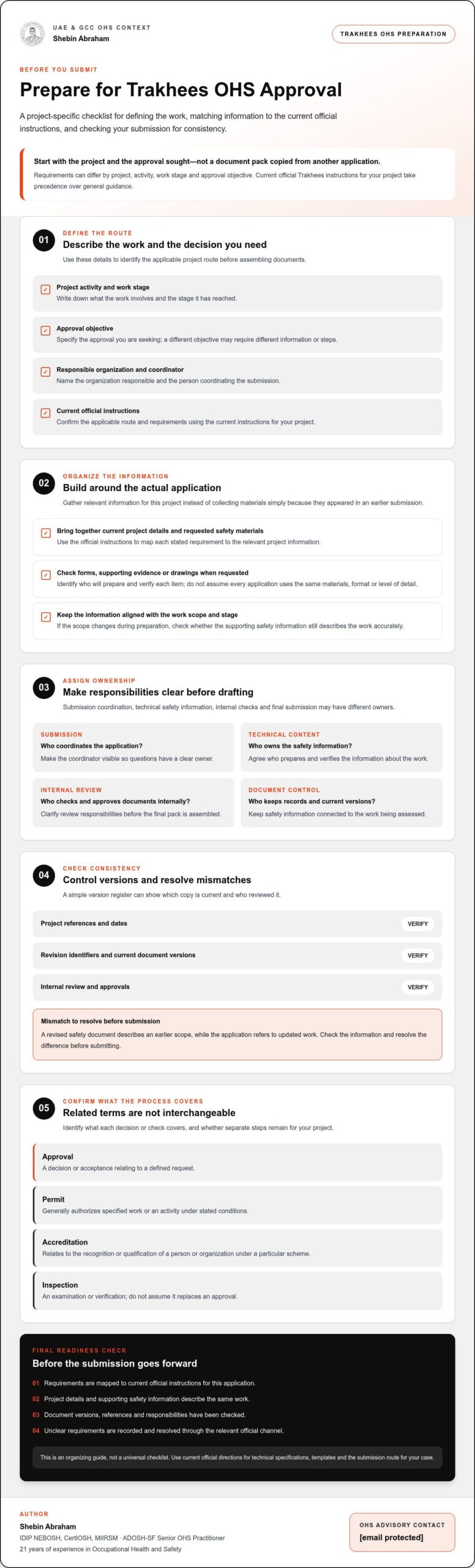
Start with the specific application rather than a generic document pack. Confirm the project scope and approval objective, then use the current official instructions to identify the information required. Requirements can differ by project and activity, so materials used for another site may not fit your application.
Submission readiness means matching current official requirements to the project and checking that the supporting information is accurate, consistent and reviewed by the right people. This keeps preparation focused on evidence relevant to the application, rather than collecting documents simply because they appeared in a previous submission.
Organize project and safety information
Bring together current project details and the safety materials requested for the application. Check that the information reflects the actual work scope and stage. If the scope changes while you are preparing the submission, review whether the supporting safety information still describes the work accurately.
Assign clear ownership before drafting begins. One person may coordinate the submission while others prepare technical information, verify details, approve documents internally or manage the final submission. Make responsibilities visible, so each question has an owner and the review does not depend on assumptions.
Keep a controlled record of document versions and revisions. Before submission, check dates, project references, revision identifiers and internal approvals. For example, if a revised safety document describes an earlier scope while the application refers to updated work, resolve the mismatch first. A simple version register can show which copy is current and who reviewed it.
Check the submission requirements without assuming a standard pack
Read the official instructions for the application and map each stated requirement to the relevant project information. Identify any forms, supporting evidence or drawings requested, and note who will prepare and verify each item. Do not assume every application uses the same materials, format or level of detail. Use current official directions for technical specifications and templates.
This approach makes gaps easier to spot. If a requirement is unclear, record the question and resolve it through the relevant official channel before finalizing the pack. Keep an internal record of the instructions used and the version of each submitted item. This gives the team a clear reference if a question comes up during review.
For document-focused guidance, the companion guide, Trakhees Safety Permit Documentation: A Practical Submission Guide, can help you plan application materials. Shebin Abraham, IDIP NEBOSH, CertIOSH, MIIRSM, ADOSH-SF Senior OHS Practitioner, provides advisory support for project-specific Trakhees requirements. Teams seeking help organizing a submission can explore Trakhees OHS submission advisory.
How to Manage the Trakhees OHS Application and Review
Once the information is ready, manage the application as a controlled project task rather than a one-time handover. The sequence below is a practical framework, not a universal Trakhees workflow. Confirm the current instructions for your case, including the submission channel and any portal requirements. The order of steps, review stages and communication method may depend on the application.
Follow a practical submission sequence
Use these steps to organize the work, then follow the official instructions that apply to your project:
- Confirm the route. Check that the approval sought matches the project activity and review the latest official submission directions.
- Prepare and check materials. Assemble the information requested for this application, then ask the responsible technical owners to check it for accuracy and consistency.
- Submit as directed. Use the channel and method specified in the applicable instructions. Do not assume every application uses the same portal or process.
- Record the submission. Retain available evidence, such as a reference or acknowledgement, and note who is coordinating follow-up and what action is next.
- Monitor and respond. Track communications through the appropriate channel and act on requests according to the directions received.
Use one controlled log to make follow-up manageable. Record the submission date, reference, communications received, action owner, response status and next follow-up action. Store correspondence and submitted versions together under a consistent project reference. This creates a clear history if responsibilities change or the team needs to trace what information was provided.
Respond clearly when reviewers request changes
Read each comment carefully and separate distinct requests. Assign an owner to each point, record the proposed response and identify any material that needs revision. Keep the log up to date so the team can see what remains open, what has been addressed and what is awaiting confirmation.
Answer each point directly. If an update affects related information, check those documents too. For example, a change to the work description may need to appear consistently wherever the scope is described in the submitted materials. Avoid changing unrelated content without a clear reason, and keep a record of revised versions and their internal checks.
Before responding, verify the required method and whether revised materials need to be resubmitted or followed by another review step. Follow the instructions or communication for your application rather than inferring the next stage from another project. A clear response trail helps the team coordinate and keep OHS information aligned with the work being assessed.
Submission and review arrangements can differ by application. A disciplined record helps your team follow the relevant route without treating a general sequence as a promise of approval, a fixed review period or a substitute for official directions.
Prevent Avoidable Delays Without Assuming a Fixed Approval Timeline
A published sequence can help you understand the stages an application may involve, but it does not guarantee a decision by a particular date. Review requirements and follow-up steps may differ between applications. Check current official instructions and application correspondence for review information and next steps that apply to your case.
Focus on the parts your team can control: provide the information requested, keep versions aligned, assign clear owners and respond to comments promptly. These practices support an orderly review, but they cannot determine how quickly an authority will respond or what decision it will make.
What can make an application harder to review?
Some administrative issues can make information harder to assess. Requested details may be missing, documents may show inconsistent revisions, or no one may be responsible for answering a query. These are practical risks to manage, not a statement of Trakhees-specific rejection criteria. The official instructions for a particular application establish its requirements.
Keep a record of unresolved questions, assign an owner to each and resolve them against current official directions before submission where possible. For example, if two project documents describe different versions of the work scope, identify the current scope and bring the relevant records into alignment. Do not guess at a requirement or use another project’s outcome as proof that the same approach applies.
How should teams track review and follow-up?
Use one dated record to follow the application from submission through updates. Capture the reference or acknowledgement available to your team, each comment received, the response sent, revised materials and the latest status. Give every open item an owner and an internal follow-up reminder. These reminders make actions visible; they do not predict when the authority will reply.
Keep communication factual and easy to trace. Link each response to the relevant comment and record which document version was provided. If the application involves construction activity, the guide Trakhees Safety Requirements for UAE Construction may provide related context, while current official directions remain the basis for project-specific requirements.
If progress appears paused, review the latest correspondence and your team’s open actions first. Check whether a response is outstanding, whether the responsible person has the information needed or whether a next step has been specified. Shebin Abraham provides project-specific Trakhees OHS advisory support to help teams organize follow-up. Explore Trakhees OHS advisory support.
After Trakhees OHS Approval: Close Out Actions and Get Expert Guidance
A decision is an important project record, but it does not end safety management. Read the decision and any associated conditions carefully. Identify which actions apply, who owns them and how they affect the work. Let the decision and current official instructions guide your next steps. Approval does not remove the need to follow applicable OHS requirements as the project proceeds.
What should the project team do after a decision?
File the decision and related correspondence in the project’s controlled records. Capture any stated conditions, limitations or follow-up requirements accurately, and make the current version accessible to relevant people. If a condition affects a work activity, schedule or safety control, communicate it to the responsible team before that activity proceeds.
Assign an owner to each applicable action and record how completion will be tracked. This may require coordination between project management, site supervision and the people responsible for OHS arrangements. Keep the decision connected to current project information so the team can see how its requirements relate to the work, rather than treating it as a document to file and forget.
Check continuing obligations and next steps against the official decision and current instructions. If the scope or work arrangements change, consider whether the decision’s conditions still address the updated situation and follow the applicable official process for guidance. Approval for a defined request should not be read as blanket clearance for work beyond its stated scope.
When can specialist OHS guidance help?
Project-specific advice can help when a team needs to interpret requirements, organize submission information or coordinate follow-up. Practical support can clarify responsibilities, keep records aligned and connect approval-related actions with ongoing safety arrangements. It supports careful compliance but does not replace official directions or promise a particular decision.
Shebin Abraham, IDIP NEBOSH, CertIOSH, MIIRSM, is an ADOSH-SF Senior OHS Practitioner with 21 years of OHS experience. His work includes advisory support for Trakhees OHS requirements, safety protocols, permit documentation and compliance inspections. His consulting helps teams approach the Trakhees OHS approval process with attention to project needs and the practical objective of protecting people at work.
For tailored support with project-specific requirements and follow-up, Discuss your Trakhees OHS requirements.
Take the Next Step With Confidence
Before your next project milestone, connect the decision, any conditions and the ongoing safety arrangements. This helps make compliance practical: the people responsible for the work understand the requirements, rather than leaving them only in the application file.
Approach the Trakhees OHS approval process with the specific project in mind. If you need help interpreting requirements or organizing OHS follow-up, Shebin Abraham provides specialized Trakhees OHS consulting. He is an ADOSH-SF Senior OHS Practitioner with 21 years of OHS experience and credentials including IDIP NEBOSH, CertIOSH and MIIRSM.
Plan your Trakhees OHS next steps with practical, project-focused guidance. A clear process supports sound compliance and the people who depend on it.
Frequently Asked Questions
Is Trakhees OHS approval the same as a safety permit?
No. An OHS approval and a safety permit should not be assumed to mean the same thing. An approval relates to a particular request, while a permit may authorize defined work or an activity. A project could have an approval decision and still need to follow separate permit instructions. Check the scope and conditions of each official document to understand what it covers and whether other steps apply.
Can I submit a Trakhees OHS application online?
The correct submission channel depends on the application and current official instructions. Check the route specified for your case before preparing the final submission. If the instructions direct you to an online system, follow its current requirements and retain any reference or acknowledgement it provides. If they specify another channel, use that instead. Do not assume the route for a different application applies to yours.
What documents are required for Trakhees OHS approval?
There is no universal document pack for every application. The materials depend on the project, activity and approval sought, so use the current official requirements for your case. The instructions may identify forms or supporting information to provide. Before submission, check that project details match across the materials, versions are current and internal reviewers have checked them. Avoid relying on a checklist from an unrelated project.
How long does the Trakhees OHS approval process take?
There is no single duration that applies to every Trakhees OHS approval process. Review stages and follow-up can depend on the application, and a general sequence does not guarantee a decision date. Check current official guidance for review information relevant to your case. Track requests and responses, but treat internal follow-up reminders as planning tools, not predictions of authority response times.
What happens if Trakhees requests changes to my submission?
Read the request carefully, identify the information or material it concerns and assign someone to prepare the response. For example, if a comment concerns a work description, check that related information remains consistent wherever it appears. Record the response and revised version, then follow the instructions for returning it. Verify whether the update requires resubmission or another review step instead of assuming what happens next.
Does every project need the same Trakhees OHS approval?
No. Requirements can vary with the project, its activities and the approval sought. A change to a site activity, for instance, may raise different requirements from the original scope. Do not treat a previous project’s approval or documents as proof that the same route applies. Use current official instructions to establish what is relevant to your application, and assess changes against the decision and conditions for your project.
Who can help prepare for a Trakhees OHS approval application?
An OHS professional familiar with Trakhees requirements can help interpret project-specific instructions, organize submission information and coordinate compliance follow-up. Shebin Abraham provides freelance HSE and OHS consulting, including advisory support for Trakhees applications. He is an ADOSH-SF Senior OHS Practitioner with 21 years of OHS experience and holds IDIP NEBOSH, CertIOSH and MIIRSM credentials. His support helps strengthen preparation without guaranteeing an approval outcome.