

A small business licence alone does not settle its Trakhees EHS obligations. Trakhees OHS compliance for a small business in a regulated UAE zone depends on its licensed activity, workplace risks, employee health and safety, and environmental responsibilities, not simply its size. Requirements can therefore vary between business activities.
It is reasonable to want a clear picture of what must be in place before an inspection or approval. This guide explains what Trakhees EHS means for your business and how accreditation, inspections, certificates, and common compliance mistakes fit together. It also explains when professional OHS consulting can help organize the requirements.
The article is authored by Shebin Abraham, IDIP NEBOSH, CertIOSH, MIIRSM, an ADOSH-SF Senior OHS Practitioner with 21 years of experience in OHS.
Key Takeaways
- Trakhees EHS obligations depend on where your business operates, its licensed activity, and its operational risks, not simply its size.
- Learn how safety advisor and supervisor accreditation relates to regulatory compliance, and which requirements apply to your role.
- Premises inspections and certificates may be part of approval, with requirements shaped by the business activity and its risks.
- A business licence or EHS status does not automatically register regulated products for sale in the UAE.
- Professional Trakhees OHS consulting can help align workplace safety arrangements and compliance documentation with your operations.
Trakhees environmental, health and safety compliance
Trakhees EHS requirements depend on a business’s activities and operational risks. A small company’s obligations may cover workplace safety, employee health, environmental controls, registration, and activity-specific approvals.
Environmental, Health and Safety Scope
Trakhees compliance considers how a business operates, not just its trade licence or headcount. Requirements may cover employee health and safety, operational risks, and environmental responsibilities. Businesses handling chemicals, waste streams, or emissions may also need environmental compliance certificates.
How does Trakhees OHS compare with other UAE workplace health and safety requirements? The applicable requirements depend on the business’s jurisdiction and activities. Businesses in Trakhees-regulated zones follow relevant Trakhees requirements, while workplaces elsewhere may fall under a different framework.
Small Business OHS Requirements
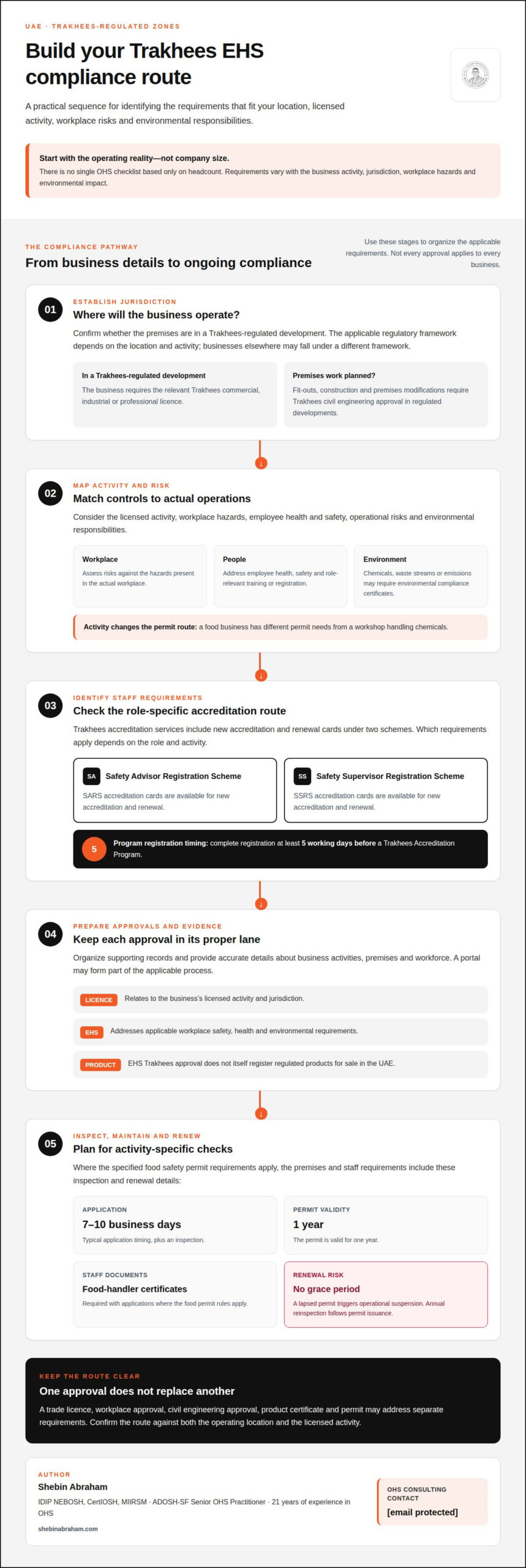
What are Trakhees OHS requirements for small businesses in the UAE? Businesses must address requirements relevant to their licensed activities, workplace risks, employee safety, and environmental impact. There is no single checklist based only on company size. For example, a food business has different permit needs from a workshop handling chemicals.
Training and registration can also be relevant. Trakhees accreditation services include new accreditation and renewal cards under the Safety Advisor Registration Scheme (SARS) and Safety Supervisor Registration Scheme (SSRS). What training, risk assessment, and safety officer requirements apply to small businesses? The relevant scheme depends on the role and activity. Assess risks against actual workplace hazards, and ensure safety registration meets applicable Trakhees requirements.
Where food safety permit requirements apply, applications require staff food-handler certificates. The premises must be inspected before the permit is issued, followed by annual reinspection.
Approval Process and Costs
What are the current Trakhees OHS fees and costs for small businesses? These are training charges, not general fees for every OHS approval.
Where the specified food safety permit requirements apply, the permit is valid for one year. Applications typically take 7-10 business days plus an inspection. A lapsed permit triggers operational suspension without a grace period, making renewal planning important to continued operations.
How can a professional help a small business register for or obtain Trakhees OHS approval? A professional can map the business’s activities and workplace risks to relevant requirements, organize supporting records, and assist with registration or approval submissions. The business should provide accurate details about its activities, premises, and workforce so the application reflects its operations. A portal may form part of the applicable process.
Trakhees accreditation purpose and regulatory compliance
Trakhees accreditation is part of a regulatory system for designated zones and communities. Understanding the authority’s role helps small businesses distinguish workplace requirements from licensing and other approvals.
Trakhees Regulatory Role
The Ports, Customs and Free Zone Corporation (PCFC) oversees economic zones and ports, including Trakhees zones. Trakhees is the Department of Planning and Development under PCFC. Its responsibilities include licensing, regulatory oversight, and civil engineering approvals in designated developments.
For businesses in Trakhees-regulated developments, this distinction matters when planning fit-outs, construction, or premises modifications. Such work requires civil engineering approval from Trakhees. Consider both the operating activity and proposed premises work when identifying applicable approvals. A trade licence and civil approval address different aspects of operating in a regulated area.
Trakhees accreditation also has a defined purpose. Its accreditation services include new accreditation and renewal of cards under the Safety Advisor Registration Scheme and Safety Supervisor Registration Scheme. Registration for a Trakhees Accreditation Program should be completed at least 5 working days before the program. This timing helps businesses plan relevant staff participation alongside operational needs.
Applicability in Regulated Areas
Small businesses are not exempt simply because they have fewer employees. Businesses operating within Trakhees-regulated development zones require a Trakhees commercial, industrial, or professional licence, rather than a standard mainland or free zone licence from another licensing authority. The appropriate route depends on the business’s location and licensed activity, so consider the zone and activity together.
That jurisdictional distinction also shapes OHS planning. A business in a Trakhees zone needs to understand the regulatory requirements relevant to its operations, while a business elsewhere may fall under another framework. A licence from one jurisdiction does not automatically establish approval under another. The correct regulatory route depends on the operating location and activity.
Trakhees approval also has limits. In the UAE, EHS Trakhees approval does not itself register a company’s regulated products for sale. A free zone licence, workplace approval, product certificate, and permit may address separate regulatory requirements. Keeping their purposes distinct helps prevent a business from relying on one approval for a different activity.
For help aligning workplace arrangements with regulated activities, professional Trakhees compliance guidance can clarify relevant requirements and support a coherent approval process.
A high-risk environmental impact assessment there can extend processing beyond fifteen business days. A standard Trakhees signage permit typically takes 3-5 business days to process and is required before installing outdoor signs, including fascia boards, banners and directional signs. Trakhees Accreditation Program office hours in Dubai are Sunday through Thursday, 7:30 AM to 3:30 PM GMT +4.
Inspection and certificate requirements
Trakhees approvals can involve document review and a physical premises inspection before a licence is issued. The process depends on the approval sought and the business activity. Treat the inspection, certificate, and operating licence as related but distinct parts of compliance. A well-prepared application connects the premises and supporting documents to the activity the business intends to conduct.
For example, some Trakhees approvals require an inspection before licence issuance. In Dubai South, a healthcare facility compliance approval typically takes 10-15 business days plus an inspection. This timeframe describes that specific approval, not every Trakhees application. The facility type and approval purpose determine which process applies, so businesses should avoid using one approval’s timeline to plan another.
Certificates also address different operational needs. A Dubai South business handling chemicals, waste streams, or emissions requires environmental compliance certificates. An environmental compliance certificate does not replace premises approval or other activity-specific permits. Map each approval to its purpose, the operation it covers, and the premises involved. This makes gaps easier to spot when a business expands or changes its operations.
Documents are essential when an inspection or premises approval is involved. For a Dubai South civil permit to modify a leased unit, the application must include architectural drawings, material specifications, contractor details, the building owner’s NOC, an active trade licence copy, and a tenancy contract or lease agreement. These documents link the proposed work to the premises and the licensed business.
Most Dubai South application documents must be in Arabic or accompanied by a certified Arabic translation. Gather the documents required for the specific application, then ensure details such as the unit, proposed work, and contractor information are consistent throughout the submission. Inconsistent records can delay an application or prompt requests for clarification. These document-control steps do not replace the approval authority’s inspection.
For a leased unit, a civil permit is required before physical modifications such as partitioning, cabling, plumbing, or shopfront installation. Trakhees grants the civil permit per project, and a fit-out in a new unit requires a fresh application. An established business therefore cannot assume an earlier permit covers later work. Keep the approved scope aligned with the project being carried out.
Plan for the inspection required by the approval being sought, rather than assuming every premises follows the same process. A healthcare facility, an industrial operation, and a business seeking civil modifications involve different approval questions. Prepare the right documents for each application, describe the proposed activity clearly, and link each certificate to the operation it covers. This can help prevent avoidable delays between submission, inspection, and approval.
Common compliance mistakes
A common mistake is treating a trade licence as complete proof of regulatory compliance. In the UAE, a trade licence authorizes the company’s stated activities, but it does not automatically register every regulated product. A business may have a valid licence and still need a separate product-registration process before placing a regulated product on the market.
This distinction matters when a business launches a new product or changes its claims. Product classification can depend on ingredients, intended use, dosage form, application method, packaging, and marketing language. A product presented in one category may follow a different registration route if its claims or use suggest another. Confirm the classification route before preparing the registration dossier, and review labels before printing packaging.
Another error is assuming EHS approval and product approval are interchangeable. Trakhees EHS approval does not itself register a company’s regulated products for sale in the UAE. Keep workplace compliance, licensing, environmental certificates, and product registration mapped to their separate purposes. For example, an environmental certificate for an operation involving emissions does not establish product registration.
Businesses can also overlook activity-specific requirements when operations change. A company that adds chemical handling, waste streams, or emissions may have different environmental compliance obligations from those associated with its original activity. Changes to premises or work processes can also affect the risks covered by its OHS arrangements. Keep submitted applications and records accurate as the business’s activities evolve.
Renewal is another point where a missed date can interrupt operations. In Dubai South, a lapsed Trakhees food safety permit triggers operational suspension without a grace period. This consequence applies to this food safety permit situation, not universally to every OHS issue. Food businesses should plan around the permit’s one-year validity and annual reinspection.
What penalties or consequences apply for Trakhees OHS non-compliance? For a lapsed food safety permit in Dubai South, the stated consequence is operational suspension without a grace period. Other consequences depend on the approval or permit involved, so this specific outcome should not be assumed to apply to every non-compliance case.
Another avoidable error is treating a previous approval as permission for a different project. Trakhees civil permits in Dubai South are granted per project, and a fit-out in a new unit requires a fresh application. An established business moving premises or starting a new fit-out should not rely on an earlier project’s approval to cover the new work.
Use a simple compliance record to reduce these mismatches: identify each business activity, link it to the relevant authority and approval, record certificate validity and renewal requirements, and keep product registration separate from workplace compliance. This gives management a clearer view of what has been obtained, what remains active, and which operational changes may require a new application.
Does Trakhees OHS apply to small businesses in free zones and developments it regulates?
Yes, small businesses operating in Trakhees-regulated zones must address requirements relevant to their activities. Company size alone does not determine whether Trakhees oversight applies. Start with the business’s location, licensed activity, and operational risks. A small office and an industrial operation may have very different compliance needs.
The distinction is jurisdictional. A business in a Trakhees-regulated development follows applicable Trakhees requirements, while a business elsewhere may fall under another authority. The term “free zone” alone does not identify the regulator. Establish the zone’s jurisdiction first, then assess the activities carried out at the premises.
Licensing follows the same location-based logic. Businesses in Trakhees-regulated development zones require a Trakhees commercial, industrial, or professional licence, rather than a standard DET mainland or free zone licence. The licence covers the company’s stated activities; it does not automatically cover every separate approval its operations may require.
For OHS planning, the next step is to connect the licensed activity to actual workplace risks. Consider work processes, employee exposure, and environmental responsibilities. For example, handling chemicals, waste streams, or emissions can bring environmental compliance requirements into consideration. A change in activity can therefore affect which requirements apply, even if the business remains small.
Premises work brings a separate consideration. A business in Dubai South planning construction, a fit-out, or modifications needs Trakhees civil engineering approval. This is distinct from workplace OHS arrangements. Keeping premises approvals separate from operational safety requirements helps prevent one document from being treated as proof of another.
A change of location matters too. A company moving into a new Trakhees-regulated development should assess the jurisdiction and activity requirements for its new premises. Existing approvals may relate to a particular operation, project, or location. Treating an earlier approval as universally transferable can leave gaps when the business moves or undertakes new work.
For a practical assessment, organize the information around three points: where the business operates, what its licence authorizes, and what risks its work creates. Then connect each point to the relevant approval or safety requirement. This helps a small business distinguish Trakhees obligations from other licensing or product-registration questions in the UAE.
If your business operates in a Trakhees-regulated zone, get support with Trakhees OHS requirements to align your workplace arrangements with your activity and location.
Shebin Abraham: OHS Freelancer Trakhees Consulting
Shebin Abraham provides OHS Freelancer Trakhees Consulting for small businesses that need practical support aligning workplace safety arrangements with their Trakhees-regulated activities. This support can help bring requirements, operational risks, documentation, and approval processes into a clear compliance approach.
This support is relevant when a business is preparing for an inspection, adjusting its operations, or clarifying which OHS requirements apply to its premises and activities. The work focuses on the business’s circumstances, connecting regulatory expectations with practical safety arrangements. It complements broader OHS Services and Freelance HSE Service when those suit the business’s needs.
For guidance on your Trakhees OHS requirements, contact Shebin Abraham to discuss your business needs.
Build a Practical Path to Ongoing Compliance
A sound approach to Trakhees OHS compliance for a small business treats safety as part of daily operations, not a task reserved for inspection day. When your activities, workforce, or premises change, review how your OHS arrangements support the work and the people doing it. Consistent oversight helps keep compliance aligned with actual operating conditions.
Where structured support would help, Shebin Abraham offers OHS Services, Freelance HSE Service, and Freelance ADOSH-SF OHS consulting. The right support depends on your operational needs and the regulatory framework relevant to your business. A focused discussion can clarify a practical next step without overcomplicating your compliance work.
Contact Shebin Abraham about compliance to discuss support for your business. With a considered plan and steady attention to workplace risks, you can strengthen both compliance and the protection of your team.
Frequently Asked Questions
What Is EHS Trakhees?
EHS Trakhees refers to Environment, Health and Safety oversight within the relevant Trakhees jurisdiction. Trakhees operates under the Ports, Customs and Free Zone Corporation and has regulatory responsibilities in designated Dubai developments. For businesses, the practical point is that EHS approval relates to regulated operations and does not replace other approvals, such as product registration or premises permissions. Identify each approval’s purpose separately.
Why Document Attestation and Compliance Matter?
Attestation can help establish that a document is authentic, while organized compliance records show how safety arrangements relate to actual work. For example, a business preparing an application can keep its licence, relevant procedures, risk assessments, and training evidence together. The required document format depends on the application and authority. Clear, consistent records also help management explain responsibilities and track corrective actions after an inspection.
What is Trakhees OHS compliance and which businesses must follow it in Dubai?
It is the occupational health and safety compliance relevant to businesses operating under Trakhees oversight. Applicability depends on the regulated location and company activities, not a minimum workforce size. For example, a small business undertaking construction-related work in a regulated development should consider both operational safety and approvals connected with that work. The licensed activity and actual scope of work help determine which requirements apply.
What documents and records are required for Trakhees OHS compliance?
The required documents depend on the approval and business activity. Useful OHS records include safety policies, procedures, risk registers, safe work method statements, competency records, and training evidence. For a food safety permit application in Dubai South, staff food-handler certificates are required. Civil permit applications require documents related to the proposed premises work, including drawings, material specifications, contractor details, and tenancy evidence.
What are the Trakhees OHS inspection and audit requirements and frequency?
Inspection requirements and timing depend on the approval, activity, and premises. Some Trakhees approvals require a physical premises inspection before a licence is issued. Food safety permits in Dubai South involve an inspection before issuance and annual reinspection. These examples are not a universal audit schedule for every business. Keep inspection evidence and corrective actions organized so management can track findings through to completion.