

A safety file can look complete while the controls people rely on at work tell a different story. Meeting Trakhees OHS compliance requirements means more than filing documents: you need to identify what applies to your operation and make sure it is reflected in day-to-day practice.
When activities vary, or older guidance is still in circulation, it can be difficult to tell which requirements are relevant. Start with current official Trakhees materials, then connect each applicable requirement to evidence and practical controls that protect people at work.
This guide explains how to identify applicable requirements, organize compliance evidence, and check that documentation reflects workplace conditions. It also covers when tailored advisory support can help align requirements, records, and risk controls. The article is written by Shebin Abraham (IDIP NEBOSH, CertIOSH, MIIRSM), an ADOSH-SF Senior OHS Practitioner with 21 years of OHS experience across the UAE and GCC.
Key Takeaways
- Identify which Trakhees OHS compliance requirements apply by considering your organization, site, activities, and current authority conditions.
- Use current official Trakhees materials to verify requirements. Treat older copies, summaries, and course information as context, not definitive evidence.
- Link each applicable requirement to the workplace control, the person responsible, and evidence that shows the control is implemented.
- Review differences between sites and worker roles, and record questions that need clarification through the appropriate authority process.
- Tailored OHS advisory can help interpret requirements, prepare project documentation, assess compliance, and organize for inspections. Paperwork does not replace effective controls that protect people.
What Trakhees OHS Compliance Requirements Mean for UAE Organizations
For an organization under Trakhees oversight, compliance involves more than keeping a general health and safety policy. First identify the authority requirements that apply to the operation and site. Then put effective controls in place and maintain evidence that reflects how work is actually managed.
Trakhees OHS compliance means meeting the requirements applicable to an organization’s site and activities through effective workplace controls, supported by accurate evidence. A general safety program can help manage risk, but it does not establish which regulatory or authority conditions apply. A well-written procedure may still overlook a relevant approval condition, while a file that appears complete may not match workplace conditions.
Occupational health and safety (OHS) concerns the protection of workers and other people who may be affected by work. For a general introduction to the discipline, see the Occupational Safety and Health Wikipedia overview. This broad context is useful, but it does not replace checking the requirements of a specific authority.
What does Trakhees OHS compliance cover?
The scope can involve several hazards and records. Depending on the operation and applicable materials, topics to investigate may include workplace hazards, safe work methods, equipment risks, worker health, emergency arrangements, and records demonstrating that controls are in place. This is a practical starting list, not a definitive list of current Trakhees requirements.
Use current official Trakhees and Ports, Customs and Free Zone Corporation (PCFC) materials to establish the applicable scope. Regulation summaries, course catalogues, third-party explanations, and uploaded copies can offer context, but do not establish that a topic or condition applies to a particular organization. Check each topic against current official material before treating it as a requirement.
Who should establish whether requirements apply?
Employers, project leads, and HSE practitioners all need to understand the conditions relevant to the work they oversee. Start by describing the organization’s activities, the site, and the work planned. Compare those details with current authority materials, then record why each requirement has been treated as applicable.
Applicability depends on context. A project’s scope may differ from routine operations at the same site, and a change in activity may raise new questions. Trakhees requirements do not automatically apply to every organization in the UAE or GCC. Identify the applicable authority and conditions for the specific operation instead of relying on assumptions or a generic safety template.
This distinction helps teams separate good general practice from verified authority requirements. It also keeps the purpose of compliance in view: controls need to work for the people exposed to risk, not simply satisfy a file review.
How to Find Current Trakhees OHS Rules and Confirm Applicability
Start with the operation, not a document someone happens to have saved. Identify Trakhees OHS compliance requirements against the organization’s actual activities and the conditions that apply to its site or project. A consistent review also makes it easier to explain why a requirement applies or why it needs clarification.
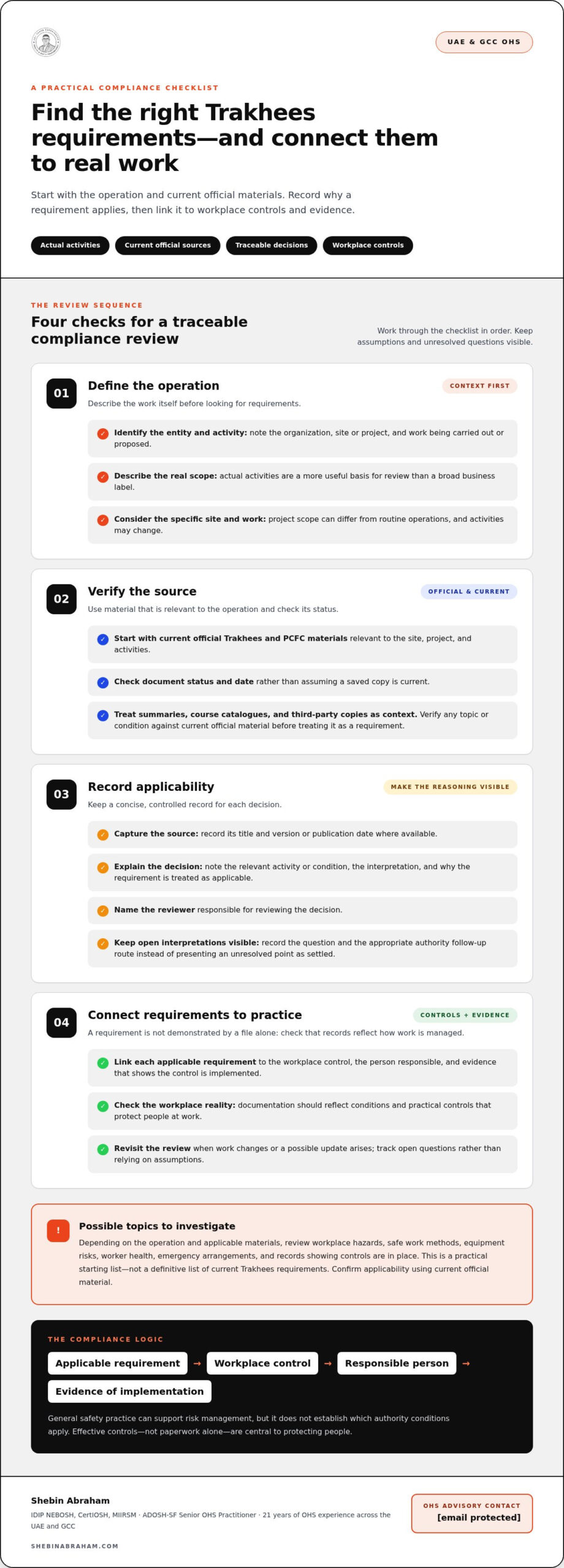
Make compliance decisions traceable to current official sources, and record the relevant activity and applicability rationale. Use this sequence to build that traceability:
- Identify the entity and activity. Describe the organization, the site or project, and the work being carried out or proposed. Actual activities provide a more useful basis for review than a broad business label.
- Consult current official material. Find Trakhees and PCFC regulations or authority guidance relevant to that context. Check the document’s status and date rather than assuming a saved copy is current.
- Record the applicability decision. Note the activity or condition addressed, how the team interpreted the material, and who reviewed the decision.
- Track updates and open questions. Revisit official sources when the work changes or a possible update arises. Keep unresolved interpretations visible and note the appropriate authority process for follow-up.
Which sources should guide a compliance review?
Give priority to current official Trakhees and PCFC materials relevant to the operation. An authority regulation or guidance document is not interchangeable with a course listing. A catalogue can show that training categories or schemes are listed, but it does not establish that every course or scheme applies to every organization, project, or worker role. Verify an item’s current status and applicability before treating it as a requirement.
Summaries and third-party document uploads can help identify topics to investigate, but they may lack context or reflect an older version. Use them as research leads and compare relevant details with current official material. Do not base a decision solely on a copied file when its version or publication status is unclear.
How can a team record applicability decisions?
Keep a concise, controlled record for each decision. Capture the official source title, version or publication date where available, relevant activity, decision and rationale, and responsible reviewer. If an interpretation is unresolved, record the question and follow-up route instead of presenting an assumption as settled.
For project submissions, connect this research record to the documents being prepared. The Trakhees safety permit documentation guide explains submission-focused documentation in more detail. Shebin Abraham provides specialized Trakhees OHS consulting to help teams interpret requirements and organize project documentation. When preparing complex submissions, Trakhees OHS advisory support can help structure the review and supporting records.
Which Trakhees OHS Considerations Change by Site, Activity, and Role?
There is no single context-free answer for every organization. The Trakhees OHS compliance requirements relevant to a workplace can depend on the organization’s operations, the site, the work being carried out, and the people involved. These factors help teams decide what to investigate, but they do not prove that a particular rule or duty applies.
Map the work as it happens. Note the activities, areas where work takes place, equipment in use, and people who could be affected, including workers and others at or near the operation. Compare those details with current official materials. A regulation summary may cover several subjects, but that does not mean every subject applies at every site.
| Factor | Question to investigate | What needs official confirmation? |
|---|---|---|
| Organization | What does the organization do, and which operations are in scope? | Whether the authority material covers those operations. |
| Site | Which work areas, facilities, or project locations are involved? | Any site-specific conditions or approval requirements. |
| Activity | What tasks, equipment, and work phases are involved? | Which requirements apply to those activities. |
| Role | Which people carry out, supervise, or support the work? | Any applicable role-related training or registration criteria. |
How do site and activity affect the review?
A construction project and an established operating workplace may raise different questions. A construction review may need to consider project phases and work areas, while an operational review may focus on recurring activities and how they are managed. This is a high-level distinction, not a statement of separate or automatic legal duties. For construction-focused context, consult the Trakhees construction safety requirements guide.
Keep the review grounded in the specific site. A subject mentioned in a regulation summary is a prompt for investigation, not proof that it applies to every operation. Check current official documents for relevant site conditions and record any questions that need authority clarification.
What should teams understand about safety roles and schemes?
Review role-related requirements separately. A course catalogue may list schemes such as SARS and SSRS, but a listing alone does not establish that either scheme is mandatory, who is eligible, or which role criteria apply. Verify the scheme’s current status and applicability through official sources before including it in a compliance decision.
A training record also does not answer every question about a worker’s role. Identify the work the person performs and why a course or registration is being considered, then check the relevant official material. This helps avoid unsupported claims and identify gaps that could affect people doing the work.
Shebin Abraham’s Trakhees OHS advisory support helps teams review site, activity, and role considerations and align documentation with applicable requirements.
How to Connect Trakhees OHS Requirements with Workplace Practice
A requirement has practical value when it shapes how people work. Once you have verified that a requirement applies, connect it to an operational control, an owner, and evidence that shows the control is being used. This creates a clear line between what the organization intends to do and what workers experience on site.
For each applicable requirement, ask four questions: What could happen if it is not addressed? What control is in place? Who is responsible for maintaining it? What evidence shows it works in practice? Base the answers on the actual operation, not just wording copied from a policy or template.
- Responsibility: Identify the person or role responsible for maintaining the control and communicating changes.
- Workplace control: Describe the practical measure used to manage risk in the task or work area.
- Evidence: Identify records or observations that show the control is understood and implemented.
- Review: Decide what could prompt reassessment, such as a change in work or a new finding.
Not every requirement needs the same document or record. Choose evidence that fits the activity and the control being demonstrated. A checklist can organize a review, but completing one does not guarantee compliance or prove that a control is effective.
What evidence helps demonstrate a working system?
Useful evidence reflects real work. Depending on the operation and verified requirements, examples may include risk-control records, relevant training records, inspection findings, or records showing that identified actions were addressed. These are possible evidence categories, not a universal set or a claim that each is required in every case.
Keep records clear and traceable. A reviewer should be able to see which activity a document relates to, who owns it, and whether it reflects current arrangements. If a procedure describes a control that workers do not use, the paperwork and practice have drifted apart. Investigate and improve the control rather than treating the issue as a filing problem alone.
How should organizations review and improve controls?
Build a repeatable review cycle around what the team learns from work. Observations, incidents, findings, and operational changes can prompt a closer look at whether controls remain suitable. Consider what has changed, whether people can follow the control, and whether further action is needed.
Assign each corrective action to a responsible person, set a follow-up point within the organization’s process, and record what was done. Close the action only when there is evidence that the response was completed and the concern addressed. If it was not, keep the action open and revise the response. This makes follow-through visible and supports steady improvement.
Effective OHS practice protects people while helping organizations maintain sound operations. Shebin Abraham’s Trakhees OHS advisory support helps connect verified requirements with workplace controls and evidence.
When Trakhees OHS Advisory Can Help UAE and GCC Teams
Some compliance questions are straightforward to research. Others depend on how a site operates, what a project involves, or how current authority conditions apply to a submission. Tailored advisory helps teams work through those details, connect relevant requirements to their operations, and identify what needs clarification before proceeding.
Support is useful when an organization needs to interpret applicable requirements, prepare project documentation, assess compliance, or organize for an inspection. The aim is practical clarity: understand the issue, identify relevant evidence or workplace controls, and establish sensible next steps. Advisory supports preparation, while approval and regulatory interpretation remain with the relevant authority.
What can specialist Trakhees OHS consulting support?
Shebin Abraham provides Trakhees OHS advisory tailored to an organization’s activities and project context. His consulting covers guidance on Trakhees protocols, permitting documentation, compliance assessments, and inspections. The work helps teams interpret applicable requirements and connect them to documentation and workplace practice instead of relying on generic templates that may not reflect the operation.
For example, a team may need to identify which project documents relate to its work, review whether evidence corresponds with site controls, or organize issues raised during a compliance assessment. Shebin’s advisory focuses on the organization’s specific question and context. It supports understanding and preparation without replacing official guidance or promising an approval or compliance outcome.
How should a team prepare for an advisory discussion?
Prepare relevant official correspondence, current documents, and a brief description of the organization’s activities and project context. Note pending decisions, differing interpretations, and practical workplace concerns that need attention.
Separate questions into two groups: those the team can resolve by reviewing available official material, and those that may need clarification through the appropriate authority process. Examples of how work is currently performed can help explain the issue. This keeps the discussion grounded in real conditions and helps identify practical next steps.
Shebin Abraham (IDIP NEBOSH, CertIOSH, MIIRSM) is an ADOSH-SF Senior OHS Practitioner with 21 years of OHS experience. His practical perspective supports UAE and GCC teams working through Trakhees OHS compliance requirements, project protocols, and related documentation.
To discuss an applicability question, project documentation, or workplace controls, Discuss Trakhees OHS consulting support with Shebin Abraham.
Make Your Next Safety Decision Count
Choose a current operational question and trace it from the applicable authority requirement to the control people rely on. This can help your team see where guidance is clear, where clarification is needed, and what workplace action should follow.
Keep the Trakhees OHS compliance requirements relevant to your operation in view as activities or project conditions change. A focused review can turn uncertainty into an organized set of questions and keep safety decisions grounded in current information and the realities of work.
If your team is working through applicability, project documentation, or a review of workplace controls, Discuss your Trakhees OHS requirements with Shebin Abraham. Share your organization’s context to identify a practical next step and keep attention on the people behind every approval and process.
Frequently Asked Questions
Who needs to check whether Trakhees OHS requirements apply to a workplace?
Employers and project or operations leads should establish which authority requirements are relevant to their entity, site, and activities. HSE practitioners can make the reasoning clear by linking a proposed work activity to the official material reviewed. Record the source and decision. If a document or course listing raises a question, treat it as a prompt for verification, not a final answer.
Are Trakhees OHS requirements identical for every organization?
No. The requirements to investigate can differ with an organization’s activities, site conditions, and project context. A team planning a temporary project activity, for example, may need to assess how it differs from routine operations at the site. General safety practices are a useful foundation, but they do not prove authority-specific applicability. Record the reasoning so it can be revisited if work or conditions change.
Can an older Trakhees regulations PDF be used as the current compliance reference?
Use an older or third-party PDF to identify questions, not as proof that its contents remain current. Check its publisher, revision details, and date, then compare relevant points with current official Trakhees or PCFC materials. If a saved file conflicts with an official source or lacks clear version information, resolve the uncertainty before relying on it for a submission or operational decision.
Does a Trakhees course catalogue show which training is mandatory?
No. A course catalogue identifies listed courses or schemes, but does not show by itself that each is mandatory for a particular organization or role. The Safety Advisor Registration Scheme and Safety Supervisor Registration Scheme may appear in course information. Before treating either as a requirement, check current official materials for its status and relevance to the person’s role. Keep course availability separate from a verified compliance obligation.
Can one compliance review cover several sites or activities?
A shared review method can help coordinate work across locations, but its conclusions should not automatically be applied to every site or activity. A team can use the same document structure while recording different work conditions, activities, and unresolved questions for each location. Compare those details with applicable materials and preserve the rationale for each site. This makes differences visible rather than obscuring them in a broad assessment.
How often should an organization review its Trakhees OHS compliance position?
Review it when relevant requirements or approval conditions change, when operations or site conditions shift, or when findings suggest controls need attention. A change in work scope, for example, can prompt a fresh applicability review. Rather than relying on an assumed fixed interval, check current official information and record what prompted the review, what changed, and which procedures or controls need follow-up.