

Could the right safety equipment for one task create a problem in another? A helmet, glove or respirator only helps when it suits the hazard, the work and the person wearing it. Effective safety equipment recommendations workplace UAE teams can rely on start with a task-specific risk assessment, not a generic PPE list.
If you’re unsure what different jobs require, or how to balance protection with comfort in demanding conditions, start by identifying the work, exposure and controls already in place. Equipment that fits poorly or interferes with a task may be difficult to use consistently. Selection should also reflect applicable UAE requirements and actual workplace conditions.
This guide explains how to connect hazards and work activities to suitable equipment, what to consider before procurement, and how instruction, care and regular review support protection over time. Shebin Abraham, IDIP NEBOSH, CertIOSH, MIIRSM, is an ADOSH-SF Senior OHS Practitioner with 21 years of OHS experience. His practical perspective keeps the focus on controls that protect people and work in real operating conditions.
Key Takeaways
- Build safety equipment recommendations workplace UAE teams can use from assessed hazards and specific tasks, rather than relying on a generic PPE list.
- Compare equipment by hazard match, fit, compatibility with other protective gear, and the conditions in which workers will use it.
- Keep PPE in its proper role: connect equipment choices with effective risk controls and practical worker instruction.
- Make recommendations usable over time by planning access, care, storage, inspection, and review as part of the protection system.
How UAE Workplace Hazards Shape Safety Equipment Recommendations
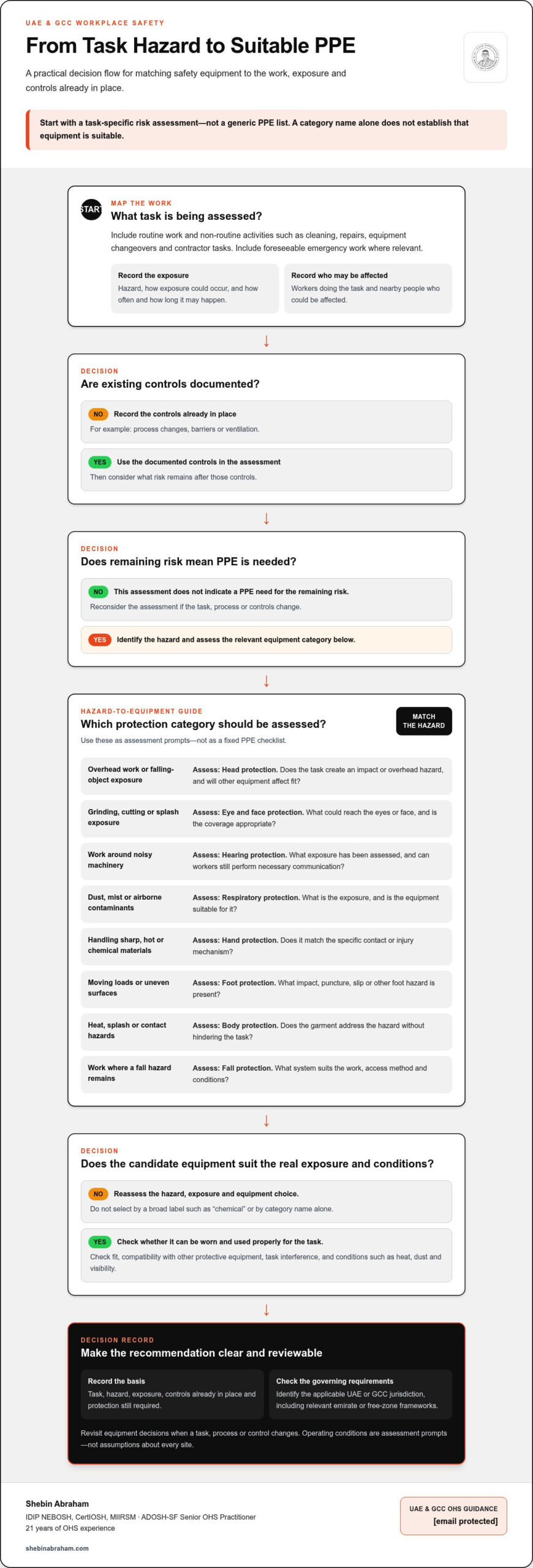
A generic PPE list names equipment categories. A risk-based recommendation explains which hazards workers face, during which tasks, and what protection is still needed after existing controls are considered. The same worker may perform routine duties, carry out maintenance and respond to an emergency, each with a different exposure profile.
Task-based equipment selection matches protective equipment to the hazards, exposure and working conditions of a specific task, while accounting for controls already in place. This approach supports practical safety equipment recommendations workplace UAE employers can explain and review, instead of choices based only on job titles or broad industry labels.
Shebin Abraham, IDIP NEBOSH, CertIOSH, MIIRSM, is an ADOSH-SF Senior OHS Practitioner with 21 years of OHS experience. His risk-focused approach starts with the work itself and the people carrying it out. The general principles of Occupational Safety and Health also place prevention and worker protection within a broader approach to managing workplace risks.
Start with the task, exposure, and existing controls
Map routine work alongside non-routine activities such as cleaning, repairs, equipment changeovers and contractor tasks. Include foreseeable emergency work where relevant. For each activity, record the hazard, how exposure could occur, how often and for how long it may happen, and which workers or nearby people could be affected.
Then document controls already in place, such as process changes, barriers or ventilation. The remaining risk helps clarify whether personal protective equipment is needed and what it must address. For a chemical transfer task, for example, consider possible contact or splash exposure, the substance involved and the controls around the transfer. Don’t select protection from the word “chemical” alone.
Build a UAE and GCC workplace risk picture
Use operating conditions as assessment prompts, not assumptions about every site. Heat, dust, noise, chemical exposure and work at height may be relevant depending on the activity and work schedule. Consider how these conditions affect exposure and whether equipment can be worn and used properly throughout the task.
Requirements can vary with the activity and applicable jurisdiction, including relevant emirate or free-zone frameworks. Identify the framework that governs the operation and account for its requirements when preparing recommendations. Keep the basis for each decision clear: the hazard, task, exposure, existing controls and protection still required.
This record gives supervisors and workers a shared, practical reason for each recommendation. It also makes reviews more useful. When a task, process or control changes, the assessment can show which equipment decisions need to be reconsidered.
Which Safety Equipment Categories Suit Common UAE and GCC Work Tasks?
Equipment categories become useful when they’re connected to a task and an assessed exposure. A construction worker handling materials, a manufacturing operator near moving machinery and an energy worker undertaking maintenance may face different hazards, even if their job titles appear similar. Use the examples below to guide an assessment, not as a fixed PPE checklist.
Match protection categories to the hazard
Start with what could reach or affect the worker. Flying particles and splash hazards may call for eye or face protection. Hand protection must match the specific mechanical, chemical, thermal or other exposure. Respiratory and hearing protection depend on the assessed exposure and on equipment suited to the hazard and conditions of use. A category name alone doesn’t establish suitability.
| Example hazard or task | Equipment category to assess | Selection question |
|---|---|---|
| Overhead work or falling-object exposure | Head protection | Does the task create an impact or overhead hazard, and will other equipment affect fit? |
| Grinding, cutting or splash exposure | Eye and face protection | What could reach the eyes or face, and is the level of coverage appropriate? |
| Work around noisy machinery | Hearing protection | What exposure has been assessed, and can workers still perform necessary communication? |
| Dust, mist or airborne contaminants | Respiratory protection | What is the exposure, and is the selected equipment suitable for it? |
| Handling sharp, hot or chemical materials | Hand protection | Does the protection match the specific contact or injury mechanism? |
| Moving loads or uneven surfaces | Foot protection | What impact, puncture, slip or other foot hazard is present? |
| Exposure to heat, splash or contact hazards | Body protection | Does the garment address the hazard without hindering the task? |
| Work where a fall hazard remains | Fall protection | What system suits the work, access method and conditions? |
Adapt the recommendation to the work setting
In construction, assess activities such as material handling, cutting and work at height individually. In manufacturing, consider machinery, noise, dust and maintenance tasks. In energy operations, evaluate the actual process and maintenance exposures rather than assuming one set of equipment applies across the site.
Heat, dust and visibility can affect comfort, use and compatibility with other equipment. Check that selected items work together and allow workers to carry out the task safely. Recommendations should reflect the requirements that apply to the activity and jurisdiction. For operations subject to ADOSH-SF or Trakhees requirements, Shebin Abraham’s OHS consulting includes guidance on the relevant framework and its application to workplace activities.
For a considered assessment, seek tailored OHS recommendations that connect equipment categories to site hazards, work activities and existing controls.
How to Compare Safety Equipment: Fit, Suitability, and the Limits of PPE
Two items in the same equipment category can serve different purposes. A category label tells you what kind of protection an item may provide, not whether it suits a particular task. Suitability comes from matching equipment evidence to the assessed hazard, the worker and the conditions of use.
Use a consistent comparison framework before making a recommendation. For safety equipment recommendations workplace UAE employers can explain and review, consider four connected factors:
- Hazard match: Does the equipment address the specific exposure or injury mechanism identified in the assessment? A general product description isn’t enough to establish suitability.
- Fit: Can the intended worker wear the equipment correctly and securely? Consider differences in fit and whether it remains practical throughout the task.
- Compatibility: If workers need several forms of protection at once, do the items work together without affecting fit, coverage or task performance?
- Use conditions: Will the equipment remain suitable in the actual work environment, including relevant heat, dust, movement and task duration?
Compare fit, compatibility, and usability
Protection depends on correct, consistent use. Poor fit, discomfort or restricted movement can make equipment difficult to wear as intended. Include the workers who will use it in the evaluation. Where practical, arrange a task trial under representative work conditions and invite feedback on fit, visibility, communication and ease of movement. Record issues and resolve them before finalising the recommendation.
Check combinations, too. Eye protection worn with respiratory or hearing protection, for example, should be assessed as a complete arrangement. One item shouldn’t displace another, interfere with its fit or prevent the worker from carrying out essential parts of the task. A trial can reveal practical conflicts that a specification sheet alone may not show.
Understand what PPE can and cannot do
PPE is not a substitute for effective risk controls. First consider whether the hazard can be eliminated or reduced through changes to the work, equipment, process or environment. Where a risk remains, PPE may form part of the control approach, alongside other safeguards and safe work arrangements. Don’t let a PPE recommendation obscure a control that could reduce exposure at its source.
Before relying on a product’s stated performance, review its supporting documentation. Check that standards or certification evidence applies to the intended use, the specific equipment and the relevant jurisdiction. Requirements can differ by activity and applicable framework, so a marking or certificate doesn’t automatically establish suitability for every workplace or task.
Keep the evidence linked to the decision: the hazard assessed, the use conditions considered and the reason the equipment was selected. Don’t claim a protection level unless it is supported by equipment evidence. This gives supervisors a clear basis for worker instruction, follow-up and future review.
How to Implement and Review Workplace Safety Equipment Recommendations
A sound recommendation only becomes useful when workers can access, understand and use the selected equipment correctly. Treat implementation as a managed process, not a procurement handover. Document the task and hazard addressed, the equipment category and selection rationale, who needs it, and the instruction and upkeep required.
For employers developing wider safety arrangements, a workplace OHS consultant guide provides broader advisory context. The steps below help turn safety equipment recommendations workplace UAE teams can apply into daily practice.
Introduce equipment with clear worker guidance
Explain which task the equipment is intended for and which hazard it addresses. Demonstrate how to put it on, adjust it, use it alongside other required equipment, and care for it. Instructions should reflect the actual work, not just general product information. Give workers a chance to practise and raise questions before relying on the equipment during the task.
Make access practical. Workers should know where the equipment is kept, how to obtain it when needed, and what to do if it is unavailable or unsuitable. Provide a clear way to report poor fit, damage, discomfort or interference with the work. Treat reports as useful feedback: they may point to an instruction gap, a fit issue, a storage problem or a recommendation that needs reassessment.
Keep recommendations current and usable
Assign responsibility for routine condition checks, records and follow-up in line with workplace procedures. Make sure workers know what to look for before use and how to report a concern. Storage and care arrangements should follow the equipment instructions and protect items from conditions that could affect their condition. Inspection and replacement criteria depend on the equipment and applicable requirements, so don’t apply one schedule or rule to every category.
Use a practical sequence to maintain the system:
- Record the decision. Keep the task, identified hazard, recommended equipment, rationale and relevant instructions together.
- Brief the users. Explain correct use, care, storage and the route for reporting problems.
- Check condition and access. Follow workplace procedures and equipment instructions, and address reported damage or barriers to use.
- Review after change. Reassess when a task, exposure, existing control or equipment condition changes, or when an incident or new risk finding raises questions about the recommendation.
After an incident, don’t assume that replacing an item alone addresses the cause. Review the task and controls as well as the equipment choice. Likewise, if workers report that equipment restricts movement or doesn’t fit properly, investigate before treating the issue as simple non-compliance.
For tailored OHS advice that connects equipment recommendations with workplace hazards, tasks and existing controls, request OHS consulting support.
Get Tailored Safety Equipment Recommendations for UAE and GCC Operations
A workplace recommendation is most useful when it reflects how people actually work, not just the equipment categories associated with an industry. Advisory support can connect documented hazards and tasks with worker needs, existing safeguards and the practical demands of the operation. This creates a reasoned basis for selection, instruction and review instead of a generic list applied across every role.
Shebin Abraham provides OHS consulting, safety training and mentorship, including professional safety equipment recommendations for UAE and GCC workplaces. He is an IDIP NEBOSH, CertIOSH, MIIRSM, ADOSH-SF Senior OHS Practitioner with 21 years of OHS experience. His advisory approach focuses on fitting recommendations to operational risks and the people doing the work.
What tailored advisory can contribute
Useful safety equipment recommendations workplace UAE organizations can apply should connect the risk assessment to day-to-day practice. This means considering which activities are performed, who may be exposed, what controls already exist and what equipment needs remain. Guidance can also account for whether selected equipment works with current procedures and other protective measures.
Recommendations need to make sense to workers, too. Safety training and mentorship can help explain why equipment is selected, how it relates to a task and how it fits within wider workplace controls. Worker input can highlight practical barriers that may not be obvious from a written assessment alone. That feedback supports clearer instruction and more useful follow-up.
Applicable frameworks depend on the operation and jurisdiction. Shebin Abraham provides advisory services aligned with ADOSH-SF and Trakhees requirements, including support with documentation, compliance assessments and implementation. Recommendations should reflect the organization’s actual work and governing requirements, while keeping framework guidance connected to a site-specific assessment.
Choose a practical next step
Bring together useful starting information before discussing your needs. A task list, relevant risk assessments and records of equipment already in use can help frame the conversation. Include details about worker roles, current procedures and reported fit or usability concerns where available. These records don’t need to be a finished recommendation; they provide context for focused advisory support.
The scope can be shaped around the organization’s operational needs. That may mean reviewing recommendations for selected tasks, connecting equipment guidance with worker instruction, or considering how the advice fits within broader OHS arrangements. For operations with more than one work setting or applicable framework, clarifying the scope helps keep the discussion relevant to each context.
Good guidance distinguishes a recommendation from a guaranteed outcome. It helps employers make informed, documented decisions and gives workers a clearer understanding of the protection intended for their tasks. If your current equipment list feels too broad, or a work activity has changed, start with the risks and the people affected. Discuss your workplace safety needs with Shebin Abraham to explore tailored OHS advisory support.
Make Your Next Equipment Decision Deliberate
Your next step doesn’t need to be a site-wide overhaul. Choose one task where exposure, equipment use or worker feedback deserves a closer look. Bring together the relevant task information and risk records, then use them to guide a focused discussion with the people who do the work. This gives your team a practical starting point and keeps safety equipment recommendations workplace UAE operations rely on connected to real working conditions.
Build improvement into the way decisions are made. Invite workers to share what helps or hinders safe use, and make it easy to revisit a recommendation when operations change. Attention to these details can strengthen trust in the safety process and help teams make considered choices without treating equipment as a one-time decision.
For advisory support shaped around your operational needs, discuss tailored workplace safety recommendations with Shebin Abraham. Every thoughtful review is a positive step toward safer, more confident work.
Frequently Asked Questions
Is PPE mandatory in every UAE workplace?
Specific PPE needs depend on assessed workplace risks and the requirements that apply to the activity and jurisdiction. Employers need to manage workplace risks, but one equipment list won’t apply to every workplace. Office duties and workshop tasks, for example, may involve different exposures and protection needs. Identify the work being done, then check the current requirements relevant to the operation before specifying equipment.
Can the same safety equipment be used across all tasks?
Not automatically. Equipment suitable for one task may not address another task’s hazards or exposure conditions. A glove used for handling materials, for instance, shouldn’t be assumed suitable for a separate chemical-handling activity. Check fit, compatibility with other equipment and the manufacturer’s instructions. For safety equipment recommendations workplace UAE employers can stand behind, assess each task separately and document how the selected equipment addresses its identified risks.
How often should workplace safety equipment be inspected?
There’s no universal inspection interval for every type of equipment. Timing depends on the manufacturer’s instructions, condition, use and applicable requirements. Follow workplace procedures for scheduled checks, and carry out checks before use where relevant. Inspect or reassess equipment after damage, unusual exposure or a change in the work. Keep records in line with workplace procedures so concerns can be followed up and recurring issues identified.
What happens if safety equipment does not fit a worker properly?
Poor fit can affect comfort, correct use and whether equipment is suitable for that worker and task. Workers should report problems promptly, such as equipment slipping, restricting movement or interfering with another item. Supervisors should reassess the selection rather than expecting someone to tolerate an unsuitable fit. Any alternative still needs to address the task’s protection needs and meet applicable requirements.
Do PPE standards apply identically across the UAE and GCC?
No single standard should be assumed to apply identically across every UAE and GCC operation. Requirements may depend on jurisdiction, sector, activity and project framework. Before equipment is specified, identify the authority or framework relevant to the operation and apply its current requirements. This is especially important for organizations working across different jurisdictions, where a familiar specification may not meet the requirements of every project.
Can workers bring their own safety equipment to work?
Personal equipment shouldn’t be relied on simply because it looks similar to workplace-issued gear. Before use, assess whether it fits the worker, is in suitable condition, matches the task, works with other required equipment and has relevant supporting documentation. Apply the workplace procedure consistently, including who reviews and records approval. Appearance alone isn’t evidence of suitability.
Is PPE enough to make a hazardous task safe?
No. PPE is one part of managing workplace risk, not a guarantee that a hazardous task is safe. Review whether the hazard can be removed or reduced through changes to the task, process or other safeguards. Then consider equipment for risks that remain, alongside clear work procedures and worker understanding. For example, protective equipment shouldn’t replace consideration of whether access to a hazardous area can be controlled.