

What if treating an occupational safety framework as a checklist leaves your organisation with the wrong picture of its responsibilities? If you’re asking what is ADOSH-SF, the key is to understand its structure and jurisdiction. ADOSH-SF is Abu Dhabi’s Occupational Safety and Health System Framework, not a universal GCC rulebook or a single document to complete.
Layered requirements and unfamiliar terminology can make the framework difficult to interpret. This guide explains its purpose, how its management system elements, mechanisms and Codes of Practice fit together, and why applicability depends on your organisation’s circumstances. It also clarifies the difference between framework-level expectations and the procedures used to manage them in practice.
You’ll learn what to establish before planning organisation-specific work, including whether the framework is relevant to your operations. The guidance draws on Shebin Abraham (IDIP NEBOSH, CertIOSH, MIIRSM), an ADOSH-SF Senior OHS Practitioner with 21 years of OHS experience. His practical perspective connects regulatory structure with the central purpose of workplace safety: protecting people through clear, sustained systems.
Key Takeaways
- Get a clear answer to what is ADOSH-SF and how it differs from a single form or checklist.
- Understand how the framework’s connected requirements relate to organisation-specific procedures.
- Assess whether the Abu Dhabi framework is relevant to your organisation instead of assuming it applies across the UAE or GCC.
- Begin with your organisation’s activity, applicable authority and operating context before planning compliance work.
- Learn how tailored advisory can support interpretation and implementation, informed by Shebin Abraham’s 21 years of OHS experience and ADOSH-SF Senior OHS Practitioner status.
What Is ADOSH-SF? Meaning, Purpose, and Core Idea
ADOSH-SF is the Abu Dhabi Occupational Safety and Health System Framework, a framework for organising occupational safety and health requirements in Abu Dhabi through a structured system rather than a single form or certificate. The name identifies a particular framework. It isn’t a generic safety qualification or a universal rulebook for every organisation in the UAE or GCC.
For readers asking what is ADOSH-SF, the practical answer is that it provides an organised way to understand and manage occupational safety and health. It sets expectations within a broader system, while organisations use appropriate procedures and controls to address their own activities and working conditions. The framework is overseen by the Abu Dhabi Public Health Centre (ADPHC).
What does ADOSH-SF stand for?
The current official expansion is Abu Dhabi Occupational Safety and Health System Framework. “Abu Dhabi” identifies its jurisdictional context. “Occupational safety and health” describes its focus on managing workplace risks and protecting people at work. “System Framework” signals an organised structure, rather than one standalone instruction or document.
That distinction matters. A form may record a particular assessment, and a procedure may explain how a task is managed, but neither alone represents the whole framework. Nor does the acronym refer to a single “ADOSH-SF certificate.” It names the framework, which is implemented and interpreted through relevant requirements and organisational arrangements.
What is the framework intended to do?
The framework’s broad purpose is to organise occupational safety and health expectations as part of an ongoing management system. In plain English, it helps connect safety intentions with the arrangements an organisation uses to recognise workplace risks, manage them and review whether those arrangements are working.
Structure makes the subject easier to manage. Without it, safety information can become a collection of disconnected documents: a policy in one place, task instructions in another, and records that don’t clearly support day-to-day practice. A framework provides an overarching reference point. Organisation-specific procedures then translate relevant expectations into practical arrangements suited to the work.
This is more than an administrative distinction. Clear, considered OHS arrangements help keep attention on people’s wellbeing while supporting consistent organisational oversight. They give teams a basis for understanding how safety is managed, rather than relying on a document that may not reflect the work being carried out.
The framework doesn’t replace thoughtful application. Requirements need to be understood in context, and the procedures used to address them should make sense for the organisation’s activities. Keeping the framework-level view separate from individual forms and processes is a sound starting point for understanding how the system works in practice.
How ADOSH-SF Organises Occupational Safety and Health
ADOSH-SF gives organisations a structure for understanding how occupational safety and health expectations relate to one another. The system includes the ADOSH-SF Manual, nine Management System Elements, mechanisms and detailed Codes of Practice. Each serves a different role, from setting the overall framework to addressing particular topics. The official ADOSH-SF Manual from the Abu Dhabi Public Health Center is the primary reference for understanding the framework and its requirements.
A framework connects OHS governance with workplace practice by setting the structure for expectations, while organisations apply relevant requirements through arrangements suited to their work. This distinction helps prevent a common misunderstanding: having a procedure or completed form doesn’t, by itself, show how the wider system is organised or whether it addresses the work being done.
Framework requirements and workplace arrangements
A system-level expectation establishes a broader point of reference. A workplace arrangement is how an organisation puts relevant expectations into practice in its operating context. The approach may differ according to the work, equipment, people involved and conditions at the site. Internal procedures should reflect applicable requirements, rather than copy a generic template without considering whether it fits.
For example, imagine a team moving materials through a busy work area. The framework provides the broader OHS structure; the organisation considers the relevant requirements and shapes its approach around the actual route, activity and conditions. This illustration isn’t a prescribed ADOSH-SF procedure. It shows why a sound system connects verified requirements to real work instead of treating paperwork as the end point.
Who contributes to an effective OHS system?
Safety management depends on communication and attention across an organisation. Leadership provides oversight and makes space for OHS in operational decisions. Workers contribute practical knowledge of the tasks and conditions they encounter. OHS practitioners can help interpret requirements and connect system expectations with workplace arrangements.
These are general roles in effective safety management, not a statement of specific ADOSH-SF duties. Their value lies in keeping information moving: workers can raise concerns, leaders can consider them, and practitioners can help clarify the OHS issues involved. That exchange keeps the focus on people and helps the organisation review whether its arrangements remain appropriate as work changes.
Understanding what is ADOSH-SF at this level means seeing a connected system, not a stack of isolated instructions. Shebin Abraham, IDIP NEBOSH, CertIOSH, MIIRSM, is an ADOSH-SF Senior OHS Practitioner with 21 years of OHS experience. He provides ADOSH-SF advisory support to help organisations interpret framework requirements in context. Learn more about ADOSH-SF advisory support.
Who Does ADOSH-SF Apply To, and Is It a GCC-Wide Standard?
ADOSH-SF is specific to the Emirate of Abu Dhabi; it is not a framework that automatically governs every organisation across the UAE or GCC. Its stated scope includes employers operating within Abu Dhabi, including free zones. The framework’s name identifies its jurisdiction, but an organisation’s obligations can depend on its activities and the relevant regulatory authority.
This distinction matters for businesses working across more than one emirate or GCC country. A framework may offer useful structure beyond its jurisdiction, but adopting good OHS practices voluntarily is different from being legally subject to that framework. Voluntary use doesn’t replace requirements set by the authority responsible for the organisation’s operations.
| Context | How to understand it |
|---|---|
| ADOSH-SF-specific | Applies within the Emirate of Abu Dhabi, including its free zones, subject to the applicable entity and authority criteria. |
| Broader UAE | Federal requirements provide a wider context, while emirates may have their own occupational safety and health arrangements. |
| GCC-wide | ADOSH-SF is not a common rulebook for all GCC countries. Requirements depend on the relevant country and authority. |
Does ADOSH-SF apply to every organisation in the UAE?
No. The framework’s jurisdiction is Abu Dhabi, not the entire UAE. Employers operating there fall within its stated scope, including those in free zones. For a particular organisation, applicable requirements and oversight can depend on its activity and the responsible Sector Regulatory Authority (SRA). The ADOSH-SF Management System Elements are part of the framework, but their presence doesn’t mean ADOSH-SF automatically applies to entities outside its jurisdiction.
Separate two questions: which requirements apply to the organisation, and which OHS practices it may choose to adopt as good practice. Applying a structured approach voluntarily can support safety management, but it doesn’t make an organisation subject to ADOSH-SF or replace rules that do apply to it. For scope decisions, use current information from the relevant authority, including the applicable SRA for Abu Dhabi operations.
How is ADOSH-SF different from broader GCC OHS requirements?
GCC-wide business activity doesn’t create one universal OHS jurisdiction. Each country and its relevant authorities may establish distinct requirements. An organisation operating in Abu Dhabi and elsewhere should distinguish ADOSH-SF requirements from those that apply to its other operations. The framework’s name or use as a reference doesn’t make it a substitute for another authority’s requirements.
Before planning compliance work, identify where the organisation operates, what activities it carries out, and which authority has oversight in each context. This helps teams avoid applying Abu Dhabi-specific requirements as though they were a GCC-wide standard, while keeping attention on the safety arrangements people need in every workplace.
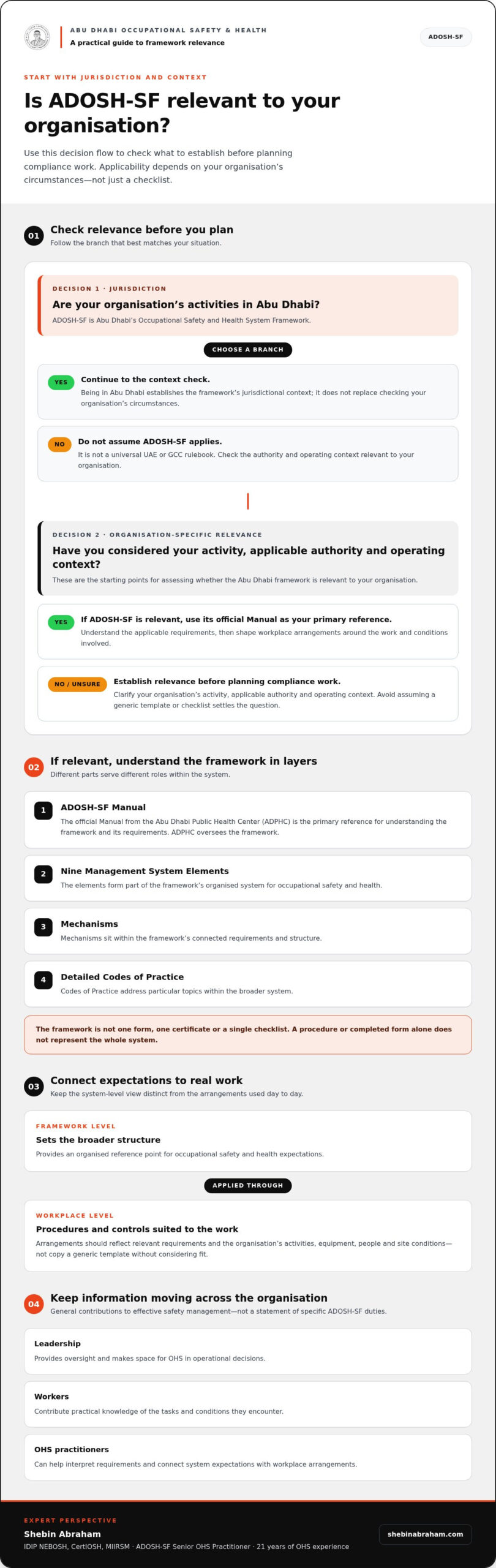
How to Understand ADOSH-SF Relevance Before Planning Compliance
Before deciding what compliance work may be needed, establish the organisation’s operating context. Start by identifying its activities and locations, then establish which authority oversees those activities and compare that context with current official framework requirements. This is a starting point for informed planning, not a substitute for interpreting the rules that apply to a specific entity.
Keep three questions distinct: where the work takes place, what the organisation does, and which authority has oversight. A company operating across Abu Dhabi and another emirate, for example, may need to consider different regulatory contexts for different operations. A shared company policy doesn’t, by itself, establish that the same framework governs each site.
Questions to clarify at the outset
Begin with the organisation’s activity and operating context, then identify the authority responsible for the relevant work. Clarify which sites, activities and worker groups need to be considered. These questions define the boundaries of the review without assuming that a framework applies simply because it is familiar or used elsewhere in the business.
Next, establish which official requirements and framework version are current for the situation being assessed. The ADOSH-SF Manual is Version 4.0, effective from 15 July 2024, according to the framework information provided for this guide. Requirements and related publications may be updated, so use current official material before drawing conclusions from older internal documents or remembered guidance.
Separate what the organisation has verified from what it has assumed. For example, a team may know that a site is in Abu Dhabi but still need to establish which authority’s requirements apply to its activity. Record the question for authoritative clarification rather than treating an assumption as a confirmed obligation. This supports careful planning and helps avoid unnecessary or misplaced compliance work.
What this overview does not replace
A general explainer can clarify the framework’s purpose and help an organisation frame the right questions. It can’t determine, on its own, whether a specific entity meets every applicable requirement. That judgement depends on the organisation’s activities, operating context and current authoritative requirements. Nor is this section a site-specific compliance assessment or implementation plan.
The next step is to use relevant official material to resolve scope and interpretation questions, then decide whether a tailored assessment or implementation guidance is appropriate. Detailed document requirements and inspection preparation call for their own focused review; they shouldn’t be inferred from a high-level overview. Practical guides on implementation, documentation, assessment, inspections and checklists can support that work when available.
When the organisation’s activities or authority context make the next steps difficult to interpret, request tailored ADOSH-SF advisory to connect applicable requirements with the organisation’s operating context.
When ADOSH-SF Advisory Can Help Your Organisation
Understanding a framework is one thing; working out how it relates to a particular organisation is another. Tailored ADOSH-SF advisory can help when an organisation needs to interpret requirements for its activities, assess how its existing OHS arrangements align, or plan practical implementation. It can also help when operations change, teams work across different regulatory contexts, or internal procedures need review against current applicable requirements.
The value lies in making the review relevant to the work, rather than treating compliance as a generic paperwork exercise. An organisation may need support clarifying which requirements apply, identifying areas that need closer assessment, or connecting system expectations with everyday workplace arrangements. The scope should reflect the organisation’s operating context and the questions it needs answered.
Who is Shebin Abraham?
Shebin Abraham holds IDIP NEBOSH, CertIOSH, and MIIRSM credentials. He is an ADOSH-SF Senior OHS Practitioner with 21 years of OHS experience, supporting organisations across the UAE and GCC. His practical perspective brings regulatory interpretation together with the realities of work, while keeping the central purpose clear: OHS arrangements should serve people as well as organisational oversight.
That experience is relevant when a team needs to move from a broad understanding of ADOSH-SF to a considered view of its own circumstances. Advice can help frame the right questions, distinguish established requirements from assumptions, and focus attention on arrangements that reflect the organisation’s activities. It supports informed decisions, while the organisation remains responsible for understanding and addressing applicable requirements.
What can tailored ADOSH-SF consulting address?
Support can include documentation guidance, compliance assessments and implementation guidance. Shebin Abraham tailors this work to the organisation’s needs, whether the priority is understanding a requirement, reviewing current arrangements, or planning how relevant expectations can be put into practice. A focused discussion can help define the issue and identify a proportionate way to address it.
Advice should reflect the organisation’s activities, operating context and current requirements from the authority with oversight. A general explanation cannot determine every organisation’s obligations, and advisory should not be treated as a guarantee of compliance or a particular outcome. The focus is accurate interpretation and practical OHS arrangements that protect people.
If tailored guidance would help your team interpret ADOSH-SF in context, discuss ADOSH-SF support with Shebin Abraham.
Turn Framework Awareness into a Practical Next Step
Knowing what is ADOSH-SF is a starting point. The next useful move is to connect that understanding to a decision your organisation needs to make, such as clarifying which requirements apply or assessing whether existing OHS arrangements reflect current expectations. A focused review can keep the work relevant to your operations and the people carrying them out.
You don’t need to resolve every question at once. Start with the issue that most affects your organisation’s ability to interpret its responsibilities. Tailored advice can bring applicable requirements and your operating context into the same conversation, so planning is based on a clearer understanding rather than assumptions.
Shebin Abraham, IDIP NEBOSH, CertIOSH, MIIRSM, is an ADOSH-SF Senior OHS Practitioner with 21 years of OHS experience. Discuss your ADOSH-SF requirements with Shebin Abraham and take a considered next step for your organisation. Clear guidance can help your team move forward with care and confidence.
Frequently Asked Questions
What is the purpose of ADOSH-SF?
Its purpose is to provide a structured basis for managing occupational safety and health in its jurisdiction. In practical terms, the framework helps organisations connect relevant expectations with how they oversee work and address workplace risks. For example, reviewing a proposed change to a work activity against applicable requirements can help teams consider OHS implications before putting the change into practice.
Is ADOSH-SF applicable to every organisation in the UAE?
No. ADOSH-SF is specific to Abu Dhabi, and its stated scope includes employers there, including those in free zones. An organisation operating elsewhere in the UAE shouldn’t assume this framework applies simply because it follows similar safety practices. For a business with operations in multiple emirates, consider each operation in its own regulatory context and identify the authority responsible for that activity.
Is ADOSH-SF a GCC-wide occupational safety and health standard?
No. ADOSH-SF is not a GCC-wide standard. It is associated with Abu Dhabi, so an organisation working in another GCC country must consider the requirements applicable there rather than treating ADOSH-SF as a substitute. A company may use consistent internal OHS principles across its operations, but that doesn’t establish that one jurisdiction’s framework satisfies another authority’s requirements.
Who is responsible for overseeing ADOSH-SF?
The Abu Dhabi Public Health Centre (ADPHC) is the competent authority overseeing the framework. Relevant Sector Regulatory Authorities (SRAs) also have a role in regulating entities within their sectors. For an organisation, the authority relevant to its activity matters when clarifying scope or requirements. Use current official guidance and the appropriate regulatory channel for questions about a specific entity.
Does ADOSH-SF require a specific occupational health and safety management system?
ADOSH-SF uses a risk-based approach, and an entity’s requirements depend on its risk classification as determined by its SRA. The framework includes management system requirements; high-risk entities have more extensive requirements for developing a full OHS management system. Establish the applicable classification and requirements before deciding what system arrangements are relevant, rather than assuming the same level applies to every entity.
How can an organisation understand whether ADOSH-SF applies to its activities?
Start by mapping the organisation’s activities and operating locations, then identify the authority responsible for oversight in each context. Compare those details with current official scope information, and distinguish confirmed requirements from questions that need clarification. If operations span different jurisdictions, assess them separately. A tailored OHS compliance assessment can help interpret relevant requirements in relation to the organisation’s work and existing arrangements.