

A larger document pack can still leave important gaps in a Trakhees permit submission. Trakhees safety permit documentation should reflect the actual work scope, not simply collect every file a project team can find. When project, contractor, and HSE records do not align, reviewers may need clarification before they can assess the submission.
A reliable checklist is useful, but requirements can vary by permit type and work activity. A one-size-fits-all list may include irrelevant records while missing evidence that matters to the specific scope. A clear, traceable pack helps reviewers follow the information and helps teams connect safety controls to the work.
This guide explains how to identify relevant documents, organise consistent project and HSE records, and check evidence before submission. It also explains how to use current Trakhees instructions and templates rather than relying on an older application or another project’s pack. With more than 20 years of QHSE and OHS experience, Shebin Abraham provides practical Trakhees OHS advisory support to help teams prepare documentation that supports permit review and worker protection.
Key Takeaways
- Use Trakhees safety permit documentation to show how planned work, safety controls, and supporting records fit together.
- Choose evidence by purpose, such as defining the work scope, controlling hazards, demonstrating competence, and coordinating activities.
- Match potential documents to the permit and work activity, then verify their applicability against current official instructions.
- Use a master index to track each document’s title, revision, date, owner, and status before submission.
- Experienced OHS support can help resolve inconsistencies and strengthen document control when scopes or contractor inputs are complex.
What Trakhees safety permit documentation is meant to demonstrate
Trakhees safety permit documentation is scope-specific evidence that helps reviewers assess proposed work and its safety controls. It should make the links between the activity, identified hazards, proposed controls, responsible people, and work methods clear. There is no single document set for every project. Applicability depends on the permit type, work activity, site conditions, and current Trakhees instructions.
The work setting can shape what a submission needs to explain. For general background on a UAE economic zone, see this overview of a UAE economic zone. Whatever the setting, documentation is most useful when it accurately describes the work that will take place, rather than relying on generic or outdated material.
A permit-to-work process connects planning, assessment, approval, and control. This video offers a brief overview of that sequence:
What does a safety permit submission help reviewers assess?
A coherent submission helps reviewers understand what work is proposed, where hazards may arise, and how the team plans to control them. A risk assessment, for example, can explain identified hazards and planned precautions. A method statement can describe how the task is intended to proceed. Whether either record applies depends on current instructions and the permit scope.
A permit submission is not the same as an organisation’s wider OHS management system. That system supports ongoing safety management across the workplace, while a permit pack focuses on evidence relevant to a particular proposed activity. Keep information current and consistent so the planned controls can guide the people doing the work.
Why does the permit scope determine the document set?
Different activities bring different hazards, work interfaces, and site conditions. Evidence that explains one task may not explain another, even within the same project. Start by defining the work and its boundaries. Then identify records that show how risks will be managed and who is responsible for each control.
Use examples in this guide as planning prompts, not as a mandatory checklist. Before preparing a submission, compare the proposed documents with current official Trakhees guidance. This scope-led approach helps teams avoid irrelevant paperwork and identify gaps that could make planned worker protections unclear.
Which safety records may support Trakhees permit documentation?
Choose records by the questions they answer, not by the number of files the team can assemble. A useful evidence pack may clarify the work scope, show how hazards will be controlled, establish who is competent and responsible, support emergency readiness, or explain coordination between parties. Applicable records depend on the activity and current submission instructions, so treat these examples as prompts rather than a universal checklist.
Risk assessments and method statements are common records to consider, but confirm their applicability to the specific permit. Training information, equipment details, emergency arrangements, and coordination documents may also be relevant if they address the work or are requested for submission.
How should risk assessments and method statements support the submission?
A risk assessment should relate to the actual tasks, hazards, people who could be affected, and controls planned for the work. A method statement should explain the intended sequence of activities and how the precautions will be applied as the work progresses. Keep both aligned with the permit scope and with each other. If the assessment identifies a hazard or control that the method statement does not address, clarify the approach before assembling the pack.
What supporting records might need to be considered?
Include supporting evidence when it fits the activity or the submission request. Competence records may show that assigned people can perform their roles. Equipment information may be relevant to the planned task, while emergency or coordination records may explain how the team will manage interfaces. Distinguish documents requested for the application from internal records retained to support safe execution. Confirm document applicability against current official Trakhees instructions.
Use a working table to check relevance and ownership before submission. A “Verification status” field can show whether a record’s applicability has been confirmed against current instructions.
| Document purpose | Owner | Revision | Scope relevance | Verification status |
|---|---|---|---|---|
| Hazard assessment | Assigned project or HSE lead | Current revision | Does it cover the planned tasks and affected people? | Check official instructions |
| Work sequence and precautions | Work planning lead | Current revision | Does it match the permit scope and assessment? | Check official instructions |
| Competence, equipment, emergency, or coordination evidence | Relevant contractor or project owner | Current revision | Does it support this activity or respond to a request? | Confirm applicability |
This review makes Trakhees safety permit documentation easier to trace across project, contractor, and HSE inputs. Shebin Abraham provides Trakhees OHS consulting to help teams align relevant records with their work scope.
Tailor document packs to the permit and work activity
A saved checklist can be a useful starting point, but it should not determine the contents of every submission. Trakhees safety permit documentation needs to reflect the actual activity, its hazards, work interfaces, and site conditions. A pack created for a different task may contain irrelevant records or fail to explain a control that matters to the proposed work.
Map each planned task to its potential hazards, controls, responsible owner, and supporting evidence. Where activities overlap or depend on one another, check that the documents tell a consistent story about sequence, access, shared work areas, and handovers. If the scope or conditions change, review whether the evidence still describes the work being submitted.
How do activity and project conditions change the evidence needed?
Consider a hypothetical example: if one contractor’s task could affect another team working nearby, the project may need coordinated information that clarifies responsibilities and timing. This illustrates why interfaces matter, but it is not a statement of a Trakhees requirement. The relevant evidence depends on the actual scope and the current official instructions.
A planning table can make these decisions visible. It helps the team identify who owns each record and what needs review, without presenting examples as a required document list.
| Work scope | Potential evidence category | Document owner | Verification needed |
|---|---|---|---|
| Task with identifiable hazards | Hazard assessment and planned controls | Assigned project or HSE lead | Check relevance to the task and current submission instructions |
| Work involving a defined sequence | Work method and linked precautions | Work planning lead | Confirm it matches the submitted scope and related records |
| Activities with contractor or work-area interfaces | Coordination and responsibility information | Relevant project and contractor leads | Confirm the information addresses actual interfaces and any requested evidence |
This table is a planning aid, not a substitute for current authority requirements. It helps teams organise their review, but it does not determine which documents Trakhees requires for a particular permit.
How can teams separate mandatory, conditional, and internal records?
Label each record as explicitly requested, conditionally relevant, or internal supporting evidence. For every stated submission requirement, record the official source and the date it was checked. This keeps the basis for the decision visible and makes it easier to revisit if instructions or scope change.
If applicability is unclear, resolve the question through the appropriate official Trakhees process before submission. Keep internal records organised for safe work management, but distinguish them from items identified as submission requirements. This keeps the submission focused while preserving the wider information teams need to coordinate work responsibly.
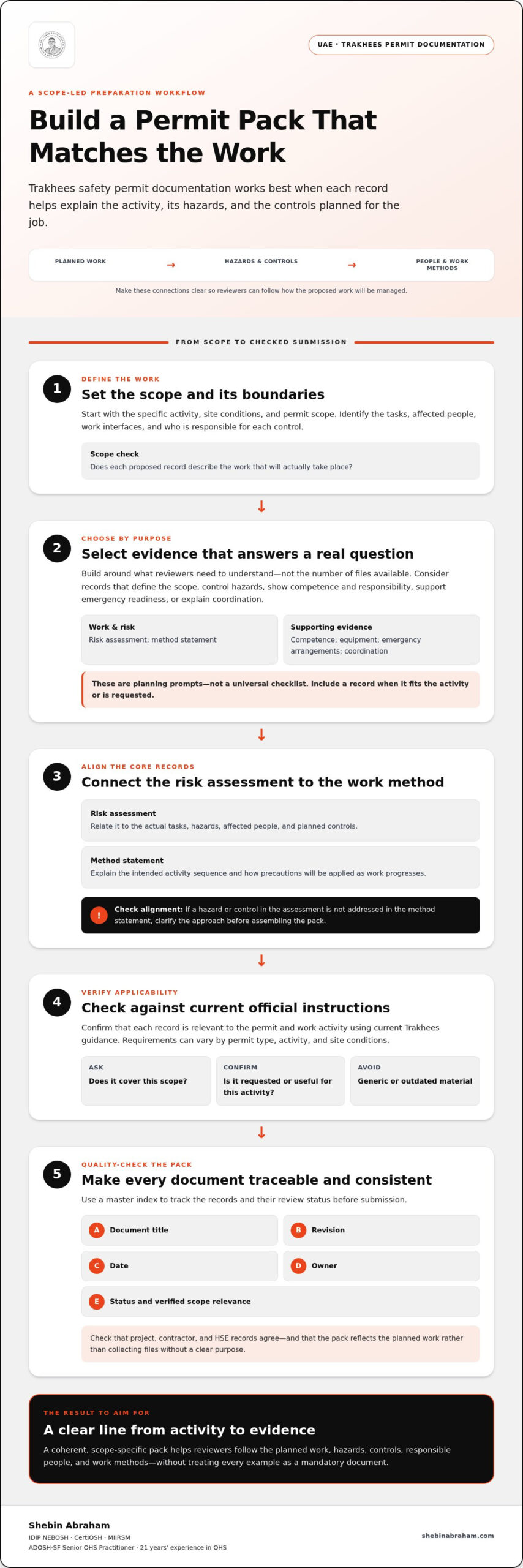
How to prepare and quality-check a Trakhees safety permit submission
A controlled workflow helps the team catch mismatched details before they lead to submission questions. Use these steps to prepare Trakhees safety permit documentation around the confirmed work scope and current official instructions:
- Confirm the scope. Align the activity description, work boundaries, site conditions, and permit type across the project team.
- Check current instructions. Review the applicable official Trakhees guidance, templates, and document requirements for the submission.
- Assign document owners. Name the person responsible for preparing, checking, and updating each record.
- Assemble the evidence. Include applicable requested documents and organise them so their relationship to the scope is clear.
- Review the complete pack. Check titles, dates, revisions, references, scope descriptions, and consistency across documents.
- Submit through the applicable process. Follow the current authority instructions for submission.
- Track status and responses. Record submissions, comments, revised files, and status updates communicated through the relevant process.
Create a master index with each document’s title, revision, date, owner, and status. Add a field for the source and date used to verify its submission applicability. Traceable document control makes gaps easier to identify before they disrupt review.
What checks should happen before documents are submitted?
Compare the assembled pack with both the current instructions and the specific permit scope. Open each attachment to confirm it is readable, correctly labelled, and current. Then cross-check key details, including activity descriptions, contractor names, dates, and document references. If an item is unresolved, record the issue, assign an owner, and settle its status before finalising the submission.
How should teams manage comments or requests for clarification?
Keep a response log that connects each comment to its owner, response, supporting evidence, and resulting document revision. Preserve previous versions and note what changed and why so the review trail remains clear. Do not assume that a response or upload means the submission has been accepted. Follow the relevant authority process and track the status it communicates.
Shebin Abraham provides Trakhees OHS advisory support to help align records, document control, and submission scope. Request Trakhees OHS advisory support.
When Trakhees documentation needs experienced OHS support
An experienced review can be useful before the team finalises its evidence pack, particularly when the work scope is complex, several contractors share responsibilities, records describe the activity differently, or clarification requests recur. These are signs that the team may need help bringing project, contractor, and HSE information together.
Specialist input can help teams assess whether records reflect the actual activities, identify inconsistencies, and strengthen document control. It can support a clearer, more coherent submission, but it cannot guarantee an approval decision. Trakhees safety permit documentation still needs to follow current instructions and the applicable authority process.
What can an experienced Trakhees OHS consultant help teams organise?
Shebin Abraham provides Trakhees OHS advisory support for permitting documentation, protocols, and compliance inspections. With more than 20 years of QHSE and OHS experience, he helps teams review the scope, structure relevant evidence, and align records with the work and applicable OHS requirements. A practical review can reveal gaps such as inconsistent activity descriptions, unclear document ownership, or controls that are not reflected across supporting records. Teams can also use the Trakhees OHS compliance requirements overview to build their understanding.
What should a team bring to an initial documentation review?
Prepare the work scope, current document index, relevant Trakhees instructions, and any comments or clarification requests already received. Include enough context to explain the activity, site conditions, contractor interfaces, and changes that have affected the planned work. This lets the review focus on the real submission rather than a generic checklist.
Keep the review practical. Trace each document back to the task it supports, clarify ownership, and identify where the evidence pack needs attention. Advice should reflect the actual activities and site conditions, while final document applicability remains subject to current official instructions.
If your team would benefit from a considered review of its permit evidence, discuss Trakhees OHS documentation support.
Prepare a Submission That Supports Safe, Clear Work
A strong permit pack is not the biggest one. It reflects the actual work, links hazards to practical controls, and follows current Trakhees instructions. Tailor the evidence to the permit scope, keep document owners and revisions clear, and check records for consistency before submission. These steps make Trakhees safety permit documentation easier to follow and help keep worker protection central to the process.
For complex scopes, multiple contractors, or recurring clarification requests, experienced OHS guidance can help bring project and HSE records into alignment. Shebin Abraham provides specialised Trakhees OHS advisory support for permit documentation and compliance requirements, informed by more than 20 years of QHSE and OHS experience.
Start with a clear picture of your work scope and the documents you already have. To discuss support tailored to your project, discuss your Trakhees OHS documentation needs. A focused review can help your team move forward with greater clarity and confidence.
Frequently Asked Questions
What documents are required for a Trakhees safety permit?
Required documents depend on the permit, work activity, site conditions, and current submission instructions. A risk assessment or method statement may be relevant, but neither should be treated as a requirement for every application. Check the current official Trakhees requirements, then map each requested item to a document owner, revision, and submission status. This helps the team identify missing or outdated evidence before submission.
How do I prepare safety permit documentation for Trakhees?
Start by defining the work scope, then review the current submission instructions and identify evidence relevant to the activity. Assign an owner to each record and create an index showing its title, revision, date, and status. Before submission, check readability and consistency, including names, dates, work descriptions, and references. A final scope-based review helps ensure the pack describes the proposed work, not an older project checklist.
Do all Trakhees safety permit applications need a risk assessment and method statement?
Not necessarily. Risk assessments and method statements are common safety-planning records, but their applicability and submission expectations can depend on the permit and activity. Verify the current official instructions for the specific application. If these documents apply, make sure the assessment addresses the actual tasks, hazards, affected people, and controls, while the method statement explains how the work will be carried out in line with those controls.
Can I use the same safety permit documents for different projects?
You can reuse controlled templates, but review and update project-specific content before using them again. Work scope, hazards, teams, interfaces, and site conditions may differ between projects. Check each record against the new activity, update its revision and owner, and verify current submission instructions. Reusing a document without checking its details can leave inaccurate descriptions or controls in a pack that should reflect the proposed work.
What happens if a Trakhees safety permit submission is incomplete?
Missing or unclear information may lead to questions, requests for clarification, or further review. The outcome depends on the submission and authority process, so do not assume a particular decision or timeline. Keep a tracker for comments, assigned response owners, supporting evidence, and revised documents. Record what changed and follow the relevant process to confirm the application status before treating the review as complete.
Who can help review Trakhees safety permit documentation?
An experienced OHS consultant can help organise evidence, check records for consistency, and align the document pack with the project scope and applicable requirements. Shebin Abraham provides specialised Trakhees OHS advisory support and brings more than 20 years of QHSE and OHS experience. This practical review can strengthen preparation and document control, but consulting support cannot guarantee approval. The relevant authority process determines the application outcome.