

A full-time HSE officer isn’t automatically the right answer for every UAE business. The choice between a freelance safety consultant vs full-time HSE officer depends on the work, how long the need will continue and how much day-to-day coordination your operations require. External guidance can add focused expertise, but it needs to connect with the people, tasks and decisions in your workplace.
If you’re weighing continuity against changing project demands, start by identifying what needs regular internal ownership and what calls for defined advisory support. This article compares how each model can support HSE responsibilities, communication and compliance, and explains when combining internal coordination with freelance advice may suit operations across the UAE and GCC.
The aim is to match the arrangement to your operational needs, not choose a model based on assumptions. Shebin Abraham, IDIP NEBOSH, CertIOSH, MIIRSM, is an ADOSH-SF Senior OHS Practitioner with 21 years of OHS experience. His practical perspective is that consulting can strengthen implementation, while your organisation’s internal teams remain closely connected to the work and its people.
Key Takeaways
- Choose HSE support based on the work, its duration and the continuity your operations need, not on assumptions about commitment to safety.
- Compare a freelance safety consultant vs full-time HSE officer by assessing internal integration, flexibility and the type of specialist support required.
- Separate ongoing coordination from defined advisory or improvement tasks to make ownership clear.
- A blended approach may suit some UAE and GCC operations, with internal teams retaining operational ownership and a consultant supporting specific needs.
- Shebin Abraham, IDIP NEBOSH, CertIOSH, MIIRSM, is an ADOSH-SF Senior OHS Practitioner with 21 years of OHS experience.
Freelance Safety Consultant vs Full-Time HSE Officer: What Is the Real Difference?
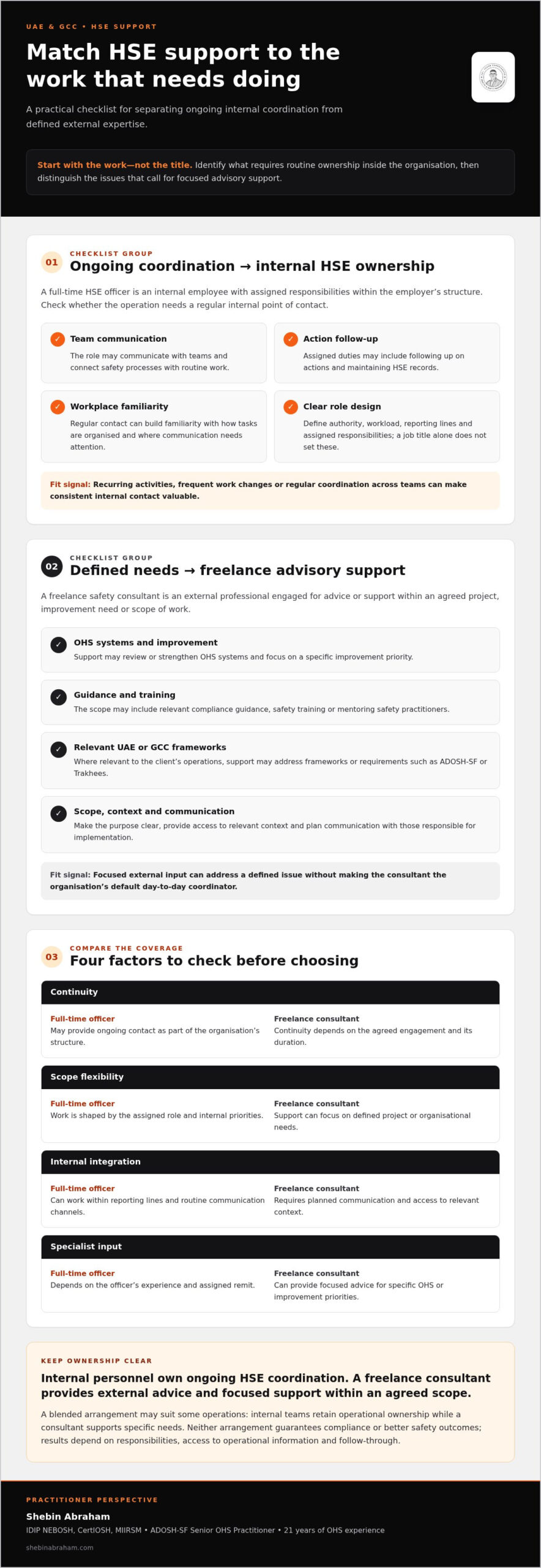
The difference between a freelance safety consultant and a full-time HSE officer is mainly how the work is arranged and connected to the organisation. A full-time officer is an internal employee with assigned HSE responsibilities within the employer’s structure. A freelance consultant is an external professional engaged to provide advice or support for a defined project, improvement need or scope of work.
Neither arrangement signals greater or lesser commitment to safety. Effective HSE practice depends on clear responsibilities, useful communication and consistent follow-through, whoever provides the support. Occupational safety and health is a broad, multidisciplinary field, as outlined in What is Occupational Safety and Health (OSH)? For a business in the UAE or GCC, the practical question is more specific: which tasks need routine ownership inside the organisation, and where would focused external expertise help?
What does a full-time HSE officer typically contribute?
An internal HSE officer can support ongoing coordination because the role is embedded in the employer’s structure. Depending on assigned responsibilities, this may include communicating with teams, following up on actions, maintaining HSE records and helping managers connect safety processes with routine work. Regular contact with the workplace can also build familiarity with how tasks are organised and where communication or follow-through needs attention.
That familiarity is useful when the role is clearly designed and supported. A job title alone doesn’t define authority, workload or reporting lines. One employer may assign an officer broad coordination duties; another may give the position a narrower scope. The organisation’s structure, operational demands and assigned responsibilities determine what the officer is expected to handle.
What does a freelance safety consultant contribute?
A freelance consultant provides external professional support shaped around an organisation’s or project’s needs. The scope might include reviewing or strengthening OHS systems, providing relevant compliance guidance, delivering safety training or mentoring safety practitioners. In the UAE and GCC, the work may also address frameworks or requirements such as ADOSH-SF or Trakhees when relevant to the client’s operations.
External support can bring focused attention to a defined issue without making the consultant the organisation’s default day-to-day coordinator. For example, a business might seek advice on improving an OHS system or arrange training for a particular workforce need, while managers and internal personnel continue their operational roles. The value depends on a clear scope, access to relevant context and communication with the people responsible for implementation.
Internal personnel own the organisation’s ongoing HSE coordination; a freelance consultant provides external advice and focused support within an agreed scope. That distinction helps clarify the freelance safety consultant vs full-time HSE officer decision. First identify the work that requires routine integration with the organisation, then separate it from specialist guidance that can be engaged for a defined purpose. The two arrangements can address different needs rather than compete on commitment to safety.
Compare HSE Coverage, Continuity, and Specialist Support
Compare the coverage your operation needs, not just the job titles. A full-time officer may provide regular internal coordination, while freelance support can focus on a defined need. Neither arrangement guarantees compliance or better safety outcomes. Results depend on assigned responsibilities, access to operational information and whether agreed actions are followed through.
| Factor | Full-time HSE officer | Freelance safety consultant |
|---|---|---|
| Continuity | May provide ongoing contact as part of the organisation’s structure. | Continuity depends on the agreed engagement and its duration. |
| Scope flexibility | Work is shaped by the assigned role and internal priorities. | Support can focus on defined project or organisational needs. |
| Internal integration | Can work within reporting lines and routine communication channels. | Requires planned communication and access to relevant context. |
| Specialist input | Depends on the officer’s experience and assigned remit. | Can provide focused advice for specific OHS or improvement priorities. |
When continuity and internal coordination matter most
Recurring activities, frequent changes in work or regular coordination across teams can make a consistent internal point of contact valuable. For that arrangement to work, the officer needs clear reporting lines and access to relevant workplace information, including current work and open actions. A full-time title alone doesn’t establish effective oversight. The role’s authority, workload and connection to operational decisions matter just as much.
For UAE and GCC operations, the appropriate arrangement depends on the organisation’s activities and structure. International guidance, including the ILO’s International Standards for Occupational Safety and Health, offers a wider reference point. Businesses still need to understand their own operating context and applicable requirements.
When flexible or specialist input may be useful
External support may suit a defined project, a review of OHS documentation or systems, training, or advice on a particular improvement priority. Set the scope around the question to resolve, the information needed and how recommendations will be communicated. That clarity helps internal teams act on the advice and retain ownership of operational decisions.
External support can become disconnected from workplace realities if communication is left vague. Agree how updates will be shared, who will provide relevant information and who will track resulting actions. The arrangement depends on suitable access and active coordination; communication alone does not create a daily site presence.
The right arrangement depends on the work, not the label. Weigh continuity, integration and specialist input before choosing between a freelance safety consultant vs full-time HSE officer. For defined external support, freelance HSE and OHS consulting can complement your internal coordination.
How to Decide Which HSE Model Fits Your UAE or GCC Operations
Choose an arrangement by examining the work that needs coverage, how often it arises and who must act on HSE information. This gives you a practical basis for the freelance safety consultant vs full-time HSE officer decision. Use the steps below to assess your organisation’s workload, project duration and need for ongoing coordination.
- Map the work. List recurring HSE activities alongside project tasks, improvement work and specialist questions.
- Establish continuity needs. Identify which activities require regular internal follow-up and which can be addressed through defined support.
- Identify specialist gaps. Note where your team could use focused OHS guidance, training, system support or mentorship.
- Set ownership. Clarify who makes operational decisions, receives advice and tracks actions within the organisation.
- Review the arrangement. Reassess the model when workload, project duration or operational priorities change.
Map workload, duration, and operational touchpoints
Build the picture from actual tasks rather than an assumed staffing threshold. A continuing operation may need regular coordination and follow-up, while a defined project may need a focused assessment, documentation support or specialist advice. Record how often each task arises, how long the work is expected to continue and which managers or teams need to contribute.
Trace the information flow as well. Who needs updates? Who can provide workplace context? Who will act on recommendations? A freelance HSE consultant hiring guide can help you frame an external engagement around its purpose, scope and practical inputs.
Project demands can shift over time. A temporary advisory need may grow into regular coordination, while intensive project work may later narrow to a specific question. Review the arrangement as the work changes instead of assuming the first decision must remain fixed.
Set responsibility, communication, and review points
Clarify internal decision ownership before assigning external advisory work. Agree how findings will be shared, who will consider recommendations and how progress on actions will be tracked. This is especially useful when several teams contribute information. Clear communication connects external advice with operational context, while decisions and implementation remain with the organisation’s designated personnel.
Keep the review practical. Revisit the support arrangement when project scope, duration, workload or specialist needs change. This helps you judge whether ongoing internal coordination remains the priority, defined external advice meets the current need, or the balance should change for the next phase of work.
Can Freelance Consulting Work Alongside an Internal HSE Officer?
Yes. A blended arrangement can work when an organisation has internal HSE coordination but also needs defined specialist input. It isn’t the right structure for every business. Its usefulness depends on whether the internal role and external scope address distinct needs without leaving gaps or creating uncertainty about who acts.
For example, an internal officer may coordinate routine communication and track workplace actions, while a consultant supports a focused review, training need or improvement project. The internal team stays connected to operations; the consultant provides advice within the agreed scope. This can suit a business that needs specialist guidance while keeping day-to-day operational ownership within the organisation.
Define complementary responsibilities clearly
Start by describing what the internal role owns and what the consultant is engaged to advise on. Name an internal contact to coordinate information, receive findings and track actions. Make sure the arrangement fits the organisation’s operations and relevant requirements, rather than relying on broad assumptions about either role. Clear boundaries also help teams know where questions and decisions should go.
A practical workflow can keep the two roles aligned:
- Agree the scope: Define the question or project the consultant will support and the intended outputs.
- Share context: Provide relevant operational information and identify the people who can explain how work is carried out.
- Deliver advice: The consultant presents findings or guidance within the agreed scope.
- Assign actions: Internal management or designated personnel decide how recommendations are handled and who follows up.
- Review progress: The internal contact tracks agreed actions and raises any need to revisit scope or priorities.
Use specialist guidance to strengthen practical implementation
External advice is most useful when it connects with real operating conditions. If ADOSH-SF or Trakhees frameworks apply to the organisation, consulting focused on those requirements can inform its work. Shebin Abraham provides OHS consulting across the UAE and GCC, including ADOSH-SF and Trakhees-related support, as well as safety training and mentorship.
Clear ownership turns external advice into an action plan; without it, even sound guidance can stall between teams. Keep the internal point of contact involved in sharing context, clarifying questions and communicating decisions. For further background on defining external support, the occupational health and safety consultant guide can help frame the engagement around your organisation’s needs.
When considering a blended arrangement, define the internal roles, operational priorities and external support scope so that advice connects with the work already underway.
Choose a Practical Next Step for Your HSE Support
The decision isn’t simply whether to hire internally or bring in outside advice. Match the continuity and internal ownership your operations need with the work that calls for specialist input. For UAE and GCC businesses, a clear brief can turn the freelance safety consultant vs full-time HSE officer comparison into a practical discussion about current work, priorities and the support required.
Prepare a clear brief for an HSE support discussion
Before discussing an arrangement, note how your work is organised and what HSE support is already in place. Include the current project phase, recurring requirements and any defined tasks or concerns needing attention. A concise brief helps distinguish ongoing coordination needs from discrete advisory or improvement work.
- Work setting and phase: Describe the operational context and whether work is ongoing, project-based or changing.
- Current priorities: Identify the HSE questions, system improvements, training or other support you want to address.
- Relevant frameworks: Note known requirements or frameworks that apply to your organisation, such as ADOSH-SF or Trakhees where relevant.
- Internal coordination: Explain who currently handles HSE communication, decisions and follow-up.
- Desired outcomes: State what useful support would help your organisation clarify, strengthen or complete.
Be specific about the work, but you don’t need every answer before starting a discussion. Even a preliminary list of priorities can show whether you need regular coordination, focused guidance or a combination that may change as the work develops.
Discuss a scope that fits the work
Shebin Abraham provides freelance HSE and OHS consulting tailored to organisational needs across the UAE and GCC. Support can address OHS systems, training, mentorship and advisory needs relating to ADOSH-SF and Trakhees when applicable. Use your brief to clarify the focus, the internal contact and how advice will connect with the organisation’s responsibilities.
Shebin Abraham, IDIP NEBOSH, CertIOSH, MIIRSM, is an ADOSH-SF Senior OHS Practitioner with 21 years of OHS experience. He provides informed advisory support to strengthen practical implementation, while your organisation retains its internal operational ownership.
Bring your work context, current priorities and preferred support scope to the conversation. Discuss your UAE or GCC OHS consulting needs with Shebin Abraham to shape an arrangement around the work and the people responsible for carrying it forward.
Shape HSE Support Around What Comes Next
Your HSE arrangement can evolve as projects, workloads and organisational priorities change. Rather than treating the freelance safety consultant vs full-time HSE officer choice as a permanent either-or decision, use it to clarify what needs consistent internal attention and where defined external advice could help. A useful discussion starts with the work ahead and the people responsible for putting decisions into practice.
Shebin Abraham, IDIP NEBOSH, CertIOSH, MIIRSM, is an ADOSH-SF Senior OHS Practitioner with 21 years of OHS experience. His UAE and GCC perspective helps businesses consider OHS consulting in relation to their operating context and priorities.
Bring your current needs and the support you’re considering to the conversation. Discuss your UAE or GCC HSE support needs with Shebin Abraham and take a practical next step for your organisation. A clear arrangement helps your teams connect advice with the people doing the work.
Frequently Asked Questions
Is a freelance safety consultant the same as a freelance HSE officer?
Not necessarily. These titles can describe overlapping safety work, but the title alone doesn’t establish a person’s authority, responsibilities or engagement scope. Clarify whether you need advice on a defined issue, support with a project or someone assigned ongoing internal duties. In the freelance safety consultant vs full-time HSE officer decision, focus on the agreed role and accountability rather than assuming titles have one fixed meaning.
Can a freelance safety consultant support a company that already has an HSE officer?
Yes. A company can engage a consultant for a focused need while its HSE officer continues their assigned internal work. For example, the consultant may advise on a specific OHS system improvement while the officer provides operational context and coordinates internal follow-up. Define the consultant’s scope and the officer’s role in receiving or applying recommendations so the advice complements existing work rather than duplicating it.
Does hiring a full-time HSE officer guarantee workplace compliance?
No. Appointing an officer doesn’t, by itself, establish that every relevant requirement has been addressed or that procedures are consistently applied. Compliance depends on the organisation’s circumstances, assigned responsibilities, operational decisions and follow-through. Managers and teams need to understand the processes that apply to their work and act on identified issues. Treat the officer as part of the organisation’s HSE arrangements, not as a guarantee or substitute for implementation.
When is freelance HSE support useful for a project?
Freelance support may be useful when a project has a defined OHS question, a temporary documentation or system improvement need, or a training requirement that calls for focused expertise. For example, a project team preparing new safety procedures could seek external guidance while internal personnel provide details about work methods and coordinate implementation. Set a clear scope, relevant inputs and intended outputs so the support fits the project phase.
Can a freelance HSE consultant help with ADOSH-SF or Trakhees requirements?
Yes. Shebin Abraham provides freelance advisory support relating to ADOSH-SF and Trakhees requirements. Start by identifying which framework applies to the organisation’s activities and what support is needed, such as guidance on OHS documentation, compliance assessment or implementation. The scope should reflect the organisation’s circumstances. Advice can inform its work, while internal personnel remain involved in decisions and practical follow-through.
What should an organisation define before engaging a freelance safety consultant?
Define the issue to address, the activities included, the information the consultant will need and the people responsible for decisions and follow-up. Agree how findings will be recorded and shared, and what completion of the assignment should look like. For example, if the scope concerns a procedure review, clarify which documents are included and who will consider proposed changes. This keeps expectations and responsibilities clear.
How can a business decide whether it needs continuous or project-based HSE support?
Consider how often HSE coordination is needed and whether the work continues between projects. If internal teams need regular coordination across routine activities, ongoing internal capacity may be important. If the need relates to a defined task, phase or specialist question, project-based support may fit. Review workload and duration together, then decide who will maintain continuity and act on advice as needs change.