

What keeps site safety controls effective when the work plan shifts, new subcontractors arrive, or activities overlap? An HSE consultant for construction projects UAE-wide helps turn safety requirements into practical controls that keep pace with the work. The role goes beyond preparing documents or pointing out hazards. It involves working with project teams to align responsibilities, risk controls, and site activity.
It’s understandable to want clear answers about what a consultant contributes. Effective support helps teams interpret applicable requirements, plan for risks, and coordinate controls as a project moves from preparation through active construction. This article explains the consultant’s role at different stages, how to coordinate controls when work and subcontractor activity change, and what tailored HSE support can look like in the UAE and GCC.
Shebin Abraham, IDIP NEBOSH, CertIOSH, MIIRSM, is an ADOSH-SF Senior OHS Practitioner with 21 years of OHS experience. His practical project perspective reflects a simple principle: safety works best when it supports the people doing the work as well as the systems guiding it.
Key Takeaways
- An HSE consultant for construction projects UAE teams work with helps translate safety requirements into practical controls that inform project decisions and support worker wellbeing.
- Early input helps teams consider safety before work begins, with guidance continuing through active construction and close-out.
- Manage risks through a clear sequence: understand the task, identify hazards, agree controls, communicate them, and review them when conditions change.
- A clear scope, access to relevant project information, and regular communication help the consultant and project team coordinate observations and follow up agreed actions.
- Consider HSE support at mobilisation, when work phases change, or when site conditions and subcontractor activity create new coordination needs.
What an HSE Consultant for a UAE Construction Project Actually Does
An HSE consultant for construction projects UAE teams work with provides project-specific safety advice, connecting worker wellbeing with day-to-day operational decisions. The consultant helps teams plan, communicate, and review safety controls so they fit the work being carried out. That means considering the project’s actual activities and arrangements, rather than relying only on general policy statements.
Support can include interpreting applicable health and safety requirements, identifying hazards in planned activities, and clarifying responsibilities and controls. As work progresses, a consultant can also share observations and recommendations that help teams decide whether existing controls still suit the site conditions and work sequence.
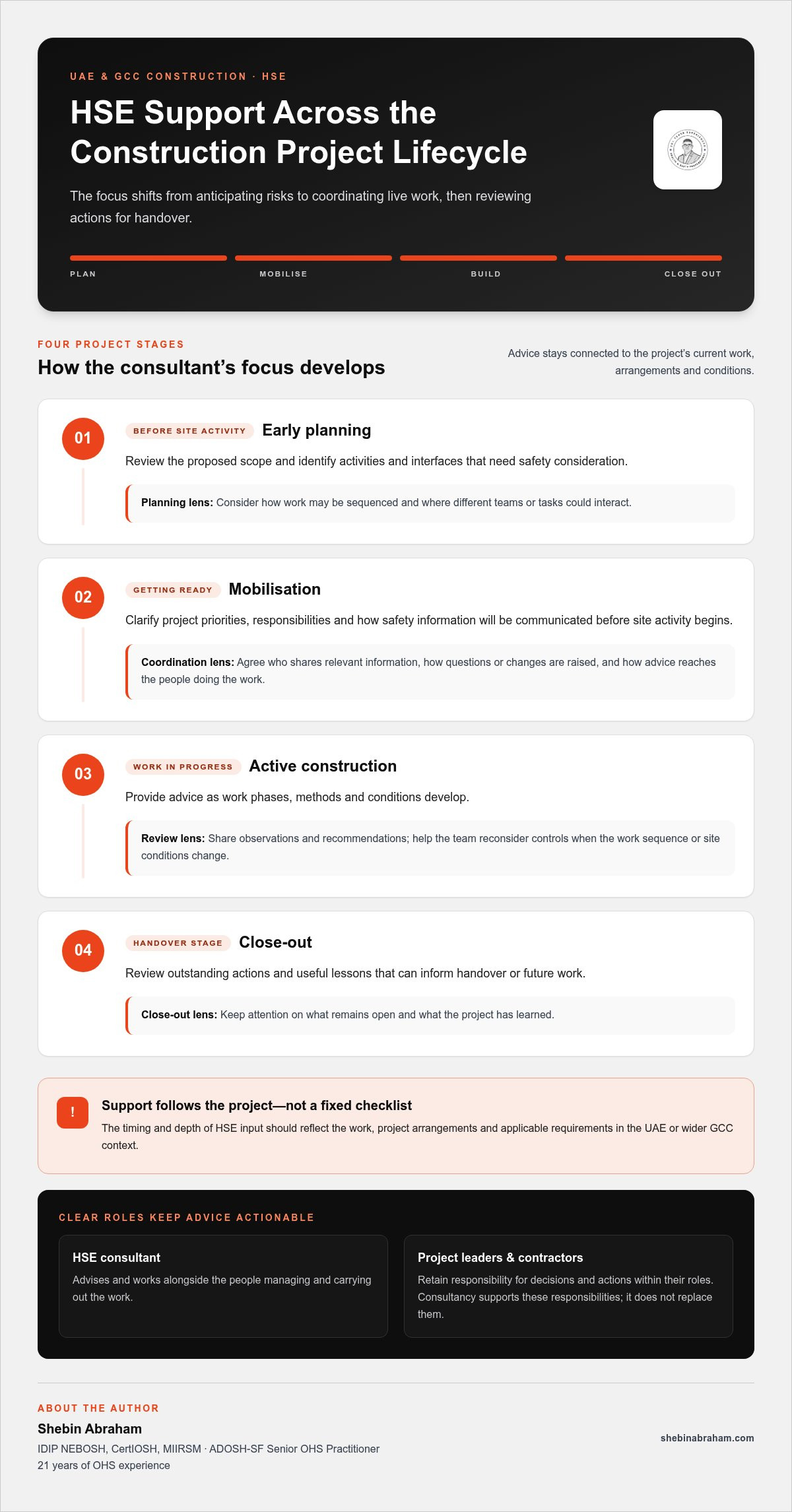
Consultancy supports the project team’s responsibilities; it doesn’t replace project leadership or contractor duties. The consultant advises and works alongside the people managing and carrying out the work. Project leaders and contractors remain responsible for decisions and actions within their roles. Clarifying this distinction helps direct advice to the people with the authority and knowledge to put controls into practice.
How project-focused HSE consultancy differs from general safety advice
Generic safety statements may set broad expectations, but project-focused advice connects those expectations to the scope, sequence, and conditions of a particular site. It considers what work is planned, which teams are involved, and how their activities may affect one another. For a broad introduction to common construction hazards and safety management, see this Construction Safety Overview.
For example, a recommendation should make sense alongside the project’s work plan and site arrangements. If the sequence changes or site conditions shift, teams may need to reconsider how a control is communicated or applied. The consultant helps identify these practical questions and provide relevant guidance, rather than simply repeating policy language.
Who benefits from HSE input on a construction project?
Clients and project managers can use coordinated advice to understand how safety controls relate to planning and project decisions. Contractors can use it to align work methods and communicate expectations to their teams. Workers benefit when instructions are clear and relevant to the task in front of them.
Shared understanding matters when several work teams operate on the same site. One team’s activity may affect another team’s access, timing, or work area. Clear communication helps people coordinate before those interfaces become a source of confusion. The goal isn’t paperwork for its own sake. It’s to support safer decisions and consistent action across the project.
In practice, useful HSE input links planning with communication and review. The consultant helps make controls understandable and relevant, while project leaders, contractors, and workers provide the information and decisions needed to apply them. This partnership brings safety guidance into operational discussions, where it can inform how work is organised and carried out.
Where an HSE Consultant Adds Value Across the Construction Project Lifecycle
HSE input can be useful before the first site activity and remain relevant through handover. Its focus changes with the project. Early discussions help teams anticipate safety considerations, while later reviews respond to actual work methods, sequencing, and site conditions. For an HSE consultant for construction projects UAE teams, the priority is keeping advice connected to the project’s current stage.
A practical lifecycle sequence may look like this:
- Early planning: Review the proposed scope and identify activities and interfaces that need safety consideration.
- Mobilisation: Clarify project priorities, responsibilities, and how safety information will be communicated before site activity begins.
- Active construction: Provide advice as work phases, methods, and conditions develop, and help teams revisit controls where needed.
- Close-out: Review outstanding actions and useful lessons that can inform handover or future work.
This isn’t a fixed checklist for every project. The timing and depth of support should reflect the work, project arrangements, and applicable requirements in the UAE or wider GCC context.
Planning and mobilisation: address safety before site activity starts
At the planning stage, a consultant can review expected activities, how work may be sequenced, and where different teams or tasks could interact. This early view helps project leaders consider safety while plans can still be shaped. It can also highlight information that needs to be shared between the client, project management, and contractors as mobilisation approaches.
Before work starts, teams can agree who will communicate relevant safety information, how questions or changes will be raised, and how advice will reach the people doing the work. The aim is shared understanding, not an assumed set of approvals or documents. Early coordination gives teams a clearer basis for planning responsibly.
Active construction and close-out: keep controls connected to the work
Once construction is under way, planned methods and site conditions can change. A new phase may introduce different interfaces, or a revised sequence may affect how teams coordinate. The consultant can help the project team assess those changes and consider whether existing guidance still fits, rather than treating an earlier plan as permanently applicable. Support can be tailored to project activities and relevant framework requirements.
As work approaches completion, reviewing open actions and recording relevant lessons can make handover more orderly and help teams carry useful learning into future work. Teams considering freelance support can explore freelance HSE consultant services across the UAE. For project-specific HSE support, discussing the project’s activities and stages can help shape a scope around practical needs.
How HSE Consultants Help Control Construction Risks on UAE Projects
Risk control starts with the work as planned, not with a generic hazard list. An HSE consultant helps the project team connect each activity to its hazards, the people and equipment involved, and the conditions around the work. This gives teams a practical basis for choosing precautions and deciding how workers will understand them.
A useful sequence is:
- Understand the work: Clarify the task, method, work area, equipment, and teams involved.
- Identify hazards: Consider what could cause harm during the task and where other activities may affect it.
- Agree controls: Work with the project team to identify precautions suited to the task and site conditions.
- Communicate: Make relevant expectations clear to the people planning and carrying out the work.
- Review: Revisit the assessment and agreed controls if the task, sequence, or conditions change.
Controls protect people most effectively when they match the work as it is actually planned and carried out. The examples below are prompts for project-specific assessment, not assumptions that every site has the same hazards or needs identical controls.
Turn work activities into practical risk controls
Consider work at height: suitable advice depends on the task, work area, access arrangements, and people involved. For a lifting activity, the discussion may need to account for the lift plan, equipment, nearby work, and how the area is managed. Excavation calls for consideration of the planned activity and surrounding site conditions. Temporary electrical work also requires attention to how the task and equipment fit the site arrangements. A consultant helps the team examine these factors and agree suitable precautions, rather than applying a one-size-fits-all rule.
Briefings make the agreed approach usable. Workers need to know the precautions relevant to their task, how the work area is organised, and whom to tell if they have a concern or notice a change. Clear, task-specific communication helps close the gap between a risk assessment and decisions made on site. The detail should reflect the work and applicable project requirements, not an assumed universal specification.
Coordinate contractors and respond to changing site conditions
Risks can emerge where activities meet. A lifting operation, a nearby access route, and another contractor’s task may affect one another, even if each activity has been considered separately. Regular communication between project participants helps surface these interfaces early. The consultant can support coordination by helping teams share relevant plans, identify potential conflicts, and discuss how activities will be arranged.
Revisit controls when the work plan changes, a new phase starts, or site conditions differ from those assumed during planning. A change may affect who is exposed, how work is accessed, or whether activities can safely proceed alongside one another. The HSE consultant can help the team identify what needs reassessment and communicate any revised approach. Decisions remain with the relevant project participants, supported by practical advice grounded in the work at hand.
How the Project Team Can Work Effectively with an HSE Consultant
Good HSE support depends on a working relationship, not simply a report delivered at the start or end of an assignment. The project team and consultant need a shared understanding of the scope, access to relevant project information, and a clear way to raise questions as work develops. This keeps advice grounded in current site activity and useful to the people making operational decisions.
Start by clarifying which project activities and stages the consultant will support, who the key project contacts are, and how relevant plans or changes will be communicated. Details about work sequencing, contractor interfaces, and changing site arrangements help the consultant provide focused advice. The project team can explain how decisions are made and who will coordinate follow-up.
Set clear expectations for communication and follow-up
Agree how the consultant will communicate with project representatives and relevant work teams. The process should make it practical to share observations, discuss concerns, and raise changes that could affect planned work. A brief discussion with the people involved can clarify context before an observation becomes an action.
Where the team agrees action is needed, record what should be addressed, who will take it forward, and how progress will be followed up. This creates a clear trail from observation to response without requiring a particular reporting template or review schedule. The value is making responsibilities visible and keeping open actions from getting lost among competing project priorities.
Ongoing project support differs from a standalone audit or compliance gap assessment. An audit or assessment reviews an agreed scope at a particular point in time. Ongoing support helps the team discuss emerging issues and changing activities as they occur. The project’s needs determine which form of input is appropriate, and the two can serve different purposes.
Keep advice aligned with project and framework requirements
Applicable requirements depend on the project’s location, activities, and governing framework. Shebin Abraham provides specialized OHS consulting aligned with ADOSH-SF standards and Trakhees OHS requirements, including guidance on documentation, compliance assessments, implementation, permitting documentation, and compliance inspections. For construction projects, establish which framework applies and keep regulatory interpretation aligned with current official guidance. Support for ADNOC HSE prequalification is also available where relevant to the project.
For a useful comparison of resourcing approaches, the guide to choosing a freelance safety consultant or full-time HSE officer can help teams think through how support fits their operational needs.
Make collaboration part of the project rhythm. Share relevant changes, involve the right representatives in discussions, and agree how recommendations will be considered and tracked. If your construction team needs practical HSE support shaped around its project activities, discuss your project support needs.
When to Bring in an HSE Consultant for a Construction Project
Bring in HSE support when the project needs focused advice to plan work, respond to a change, or coordinate safety across teams. Mobilisation is a useful time to involve a consultant, before site activities begin and project arrangements are set in motion. Support can also help later, when a new phase or work method raises questions the team needs to resolve.
For an HSE consultant for construction projects UAE teams, the right scope depends on the project’s activities and applicable requirements. Consider additional input when:
- Mobilisation is approaching and the team is aligning its safety priorities.
- A new work phase introduces different tasks or interfaces.
- Work sequencing or site conditions change in a way that affects existing plans.
- Contractor coordination becomes more complex, or teams need clearer communication.
These are prompts to consider support, not signs that a project is automatically unsafe or non-compliant. Change is part of construction. The practical question is whether the project team has the information and coordination needed to assess what that change means for the work.
Recognise when project conditions call for additional HSE input
A new activity can bring different hazards, equipment, or work-area interfaces. A revised sequence may affect how teams share access or coordinate tasks. Early advice gives project representatives an opportunity to examine those changes before work proceeds, clarify what needs reviewing, and agree how information will be shared. The scope can then reflect the issue at hand instead of defaulting to a broader intervention than the project needs.
In the UAE and GCC, project teams should also consider which requirements and framework apply to their work. The consultant’s role is to provide practical guidance aligned with the project context, not to assume every site follows the same arrangement.
Meet the experienced HSE practitioner behind the guidance
Shebin Abraham provides freelance HSE and OHS consultancy across the UAE and GCC, including support for construction projects. He holds IDIP NEBOSH, CertIOSH, and MIIRSM credentials and is an ADOSH-SF Senior OHS Practitioner. His 21 years of OHS experience informs practical advice and support tailored to project activities.
Teams considering different support models can explore this guide to freelance HSE consultancy versus a consultancy firm. The right approach depends on project needs, relevant interfaces, and the support required at each stage.
If your construction project is approaching mobilisation, entering a new phase, or facing coordination challenges, discuss project-specific HSE support. A clear conversation about activities, priorities, and applicable requirements can help shape support around the work ahead.
Make Your Next Project Decision with Safety in View
Bring HSE considerations into the project conversation before a decision becomes difficult to revisit. As your team looks ahead, identify the upcoming activity or change that would benefit from a clearer safety perspective. That gives the discussion a practical starting point and keeps advice connected to the work, rather than treating safety as a separate administrative task.
An HSE consultant for construction projects UAE teams engage can shape support around project priorities and applicable requirements. The aim is considered guidance that works alongside project planning and supports the people responsible for carrying out the work.
Shebin Abraham, IDIP NEBOSH, CertIOSH, and MIIRSM, is an ADOSH-SF Senior OHS Practitioner with 21 years of OHS experience. He provides freelance HSE and OHS consultancy across the UAE and GCC. Discuss HSE support for your construction project and align safety advice with the work ahead.
Frequently Asked Questions
Is an HSE consultant responsible for construction site safety?
An HSE consultant provides professional advice and support, but consultancy alone doesn’t transfer the project team’s responsibilities. The exact allocation depends on applicable requirements, contracts, and assigned roles. For clarity, document who advises, who makes decisions, and who follows up actions. For example, agree which project representative reviews a recommendation and how it will be considered within the site’s planning and communication processes.
When should a construction project involve an HSE consultant?
A project can involve a consultant during planning or mobilisation, or later when activities, sequencing, or contractor interfaces raise new questions. Early input gives the team an opportunity to consider safety while work arrangements are being developed, rather than after a concern has affected site activity. Suitable timing depends on the project’s scope and needs. A new work package can be a useful point to reassess whether additional guidance would help.
Can an HSE consultant support projects across the UAE?
Yes. Shebin Abraham provides freelance HSE and OHS consulting across the UAE and GCC, with guidance tailored to project activities and applicable requirements. A team can begin by outlining its project scope, stage, and main HSE questions. The applicable framework may differ between projects, so advice should reflect the circumstances and governing requirements rather than assume one interpretation fits every site.
What should a construction team share with an HSE consultant?
Share enough context for the consultant to understand the work and its setting. This may include the project scope, upcoming activities, work sequence, contractor interfaces, and known safety concerns. For example, noting that a work area will be shared can help focus the discussion on coordination. The relevant information varies by project; start with what is available and identify any gaps that affect the advice.
Does an HSE consultant replace a site HSE officer?
No, the roles shouldn’t automatically be treated as interchangeable. A consultant provides advisory support within an agreed scope, while a site HSE officer may have different duties assigned by the project organisation. Set out the working arrangement so project staff know who gives advice, who coordinates site processes, and who owns each assigned action. The division of responsibilities depends on the project setup and applicable requirements.
What qualifications and experience matter in a construction HSE consultant?
Relevant experience should relate to the project’s work environment, risk profile, and applicable framework. Shebin Abraham holds IDIP NEBOSH, CertIOSH, and MIIRSM credentials and is an ADOSH-SF Senior OHS Practitioner, with 21 years of OHS experience. These details provide professional context, not a promise of a particular result. Teams can also consider whether the consultant’s experience relates to the activities and advisory needs in scope.
Can HSE advice adapt when construction work plans change?
Yes. If a revised sequence, new activity, or changed site condition affects how work is carried out, the team and consultant can revisit the relevant advice. For instance, a change to work timing may affect coordination with another team. Discuss what has changed, who may be affected, and whether existing guidance still fits. A previous assessment shouldn’t be assumed to address every later change.